
Sotheby’s First Major Contemporary Art Auction After Brexit Brings in a Steady $120 Million, Led by Tepid Bidding on a Hockney Pool Painting
In London on Tuesday night, just two weeks after the official
withdrawal of the UK from the European Union cast a gloomy shadow
over the international art market, London’s winter
contemporary art sales got under way at Sotheby’s.
Across the three major auction rooms this week, taking into
account evening and day sales, presale estimates called for betwen
£178.6 million and £253 million ($231 million to $328 million) to
be spent on works of contemporary art. But that seemingly
impressive number belies a stark fact: the estimates are 22 percent
down on low estimates from the year prior.
Yet this evening’s Sotheby’s sale was an exception, and the
total presale estimate—£85 million to £118.8 million ($110 million
to $154 million)—almost exactly mirrored the figures from the 2019
edition of the same auction.
The result this year was a pleasing £92.5 million ($120 million)
sale (compared to last year’s £93.3 million, or $121 million),
after five lots sold for over £5 million and only three of the 46
lots were unsold. (Prices include the buyer’s premium; estimates do
not).
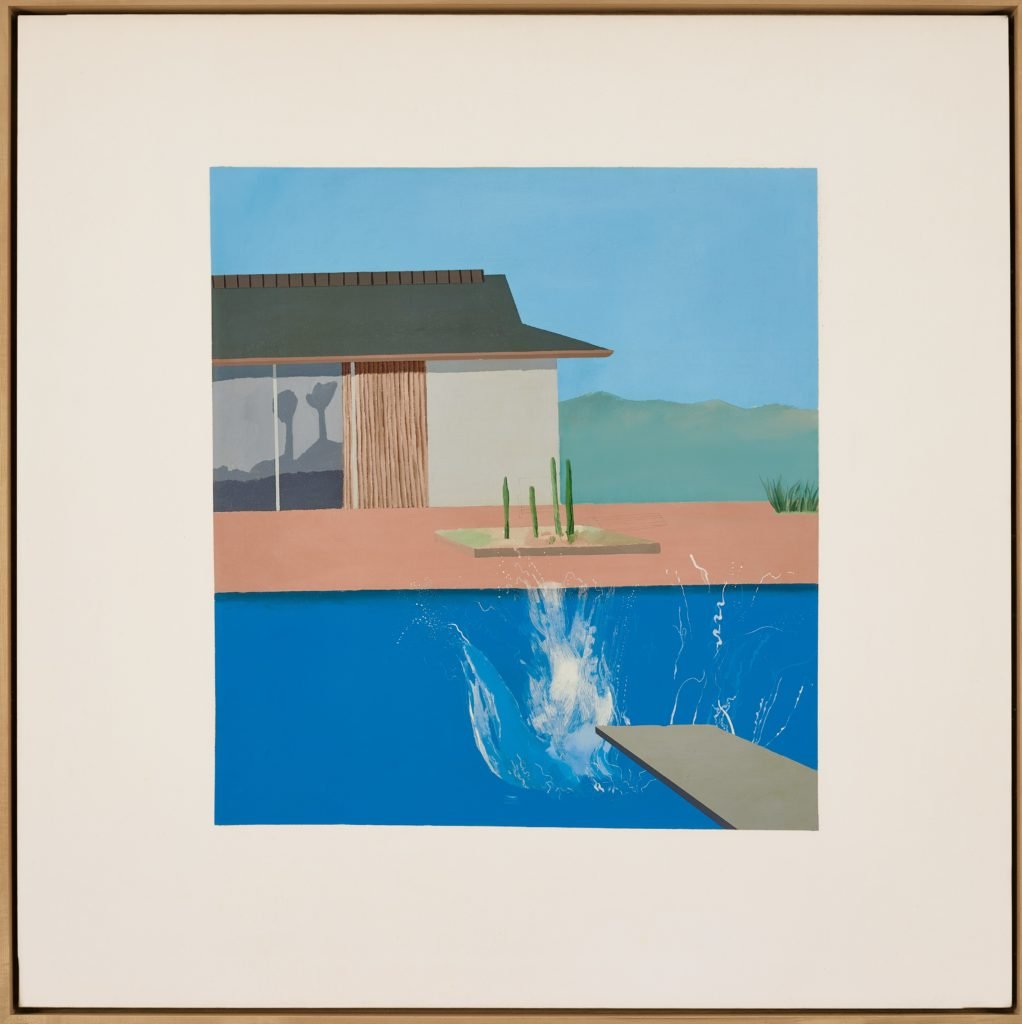
David Hockney, The Splash (1966).
Courtesy of Sotheby’s Images Ltd.
The top lot by far was David Hockney’s California pool painting,
The Splash (1966), which was guaranteed with a £20
million ($26 million) low estimate.
The painting has lively market history. It was first sold at
auction in 1973, for a hammer price of £25,000, to Hockney’s
dealer, John Kasmin, from whence it found its way into David
Geffen’s collection. It then went into another Californian
collection before appearing at Sotheby’s in 2006, when it was
bought by art advisors Christopher Eykyn and Nicholas Maclean for
£2.9 million ($3.8 million in today’s dollars), reportedly on
behalf of Joseph Lau, a Hong Kong property billionaire.
Lau was then a known force in the art world, paying $17.4
million for a large portrait of chairman Mao by Andy Warhol in
2006, and $39.2 million for Gauguin’s Tahitian Te Poipoi
at Sotheby’s in 2007. He went on to splash out millions on diamonds
for his daughters, even buying the most expensive diamond ever sold
for $48 million.
But Lau’s fortunes have since fallen, and he is currently a
fugitive from Hong Kong and Macau, where he has been convicted of
fraud and money laundering. So the precise identity of the seller
of the Hockney work—whether it is Lau, a member of his family, or a
shell company—is unknown.
Smaller in size and less well-known than A Bigger
Splash (1967), and without the figurative elements that
enlivened the artist’s record-setting $90.3 million pool painting,
Portrait of an Artist (1973), The
Splash failed to set the room alight and sold after just two
bids for £23.1 million ($30 million) to Sotheby’s Los Angeles based
specialist Jackie Wachter. So it’s probably going back to
California.
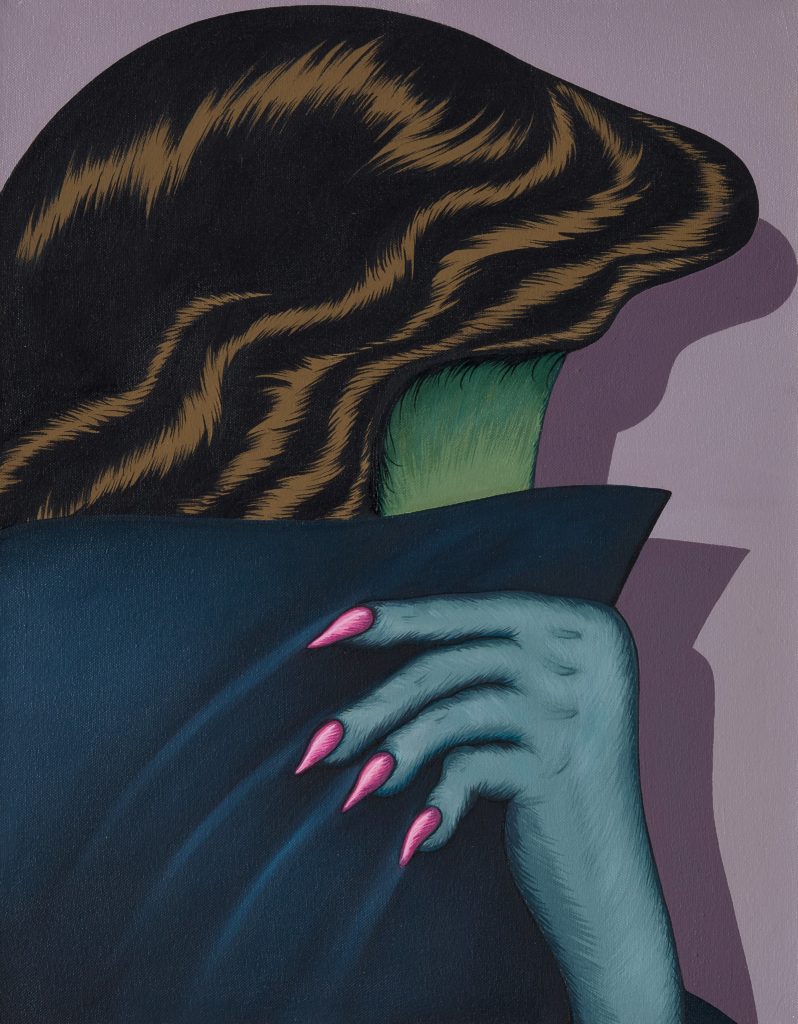
Julie Curtiss, Witch (2017).
Courtesy of Sotheby’s Images Ltd.
The sale opened with works by two artists who have both
been snapped up recently by major galleries: Julie Curtiss
and Nicole Eisenman.
In 2016, Curtiss’s precise views of women’s heads, reminiscent
of Domenico Gnoli, could be had for a few thousand dollars at most.
As of this year, though, you have to go through White Cube in
London (or Anton Kern in New York) to get one of her works. Or you
could go to an auction, of course.
Curtiss’s evening offering, Witch (2017),
came with a £50,000 to £70,000 estimate and attracted a
flurry of bids from dealer Hugh Gibson before falling to one of
several phone bidders for £162,500. Before Tuesday evening,
only five works by Curtiss had ever been up for auction, with the
top lot going for $423,000 at Christie’s New York last
November.
Eisenman is now mid-career, but has just been taken on by Hauser
& Wirth. Until 2015, her work struggled to make $10,000 at auction,
but last October, one painting sold for £690,000 ($894,000).
At Sotheby’s on Tuesday, her large 2004 painting of skiers on
nursery slopes carried her highest estimate yet, at £200,000 to
£300,000 ($259,2000 to $388,770) and sold above that to a phone
bidder for £387,000 ($501,510).

Banksy, Vote to Love (2018).
Courtesy of Sotheby’s Images Ltd.
A now customary joke painting by Banksy joined the front
runners. Vote to Love (2018), a reconfigured Brexit
poster, was submitted to the Royal Academy summer exhibition in
2018, but rejected—until the committee discovered who the artist
was and reversed their decision.
In the RA’s catalogue, it was priced at £350 million in
reference to the amount British Prime Minister Boris Johnson had
said Brexit would save the National Health Service. Dealers said
the real price of the work was nearer to £750,000
($971,925). On Tuesday, it sold for £1.2 million ($1.6
million), double its estimate.
The sale was strong on British art. Still riding a wave since
leaving Gagosian was Cecily Brown, whose typically scumbled large
painting, Twenty Million Sweethearts, doubled its previous
auction price, set only two and a half years ago, to sell for £1.15
million ($1.5 million).
Bridget Riley’s black-and-white painting,
Drift (1963), sold to an American buyer the last time
it was at auction in 2016, when it made a high-estimate £1.4
million ($1.8 million today). This time around, it almost doubled
the price, selling to Alan Hobart of the Pyms gallery for £2.7
million ($3.5 million).
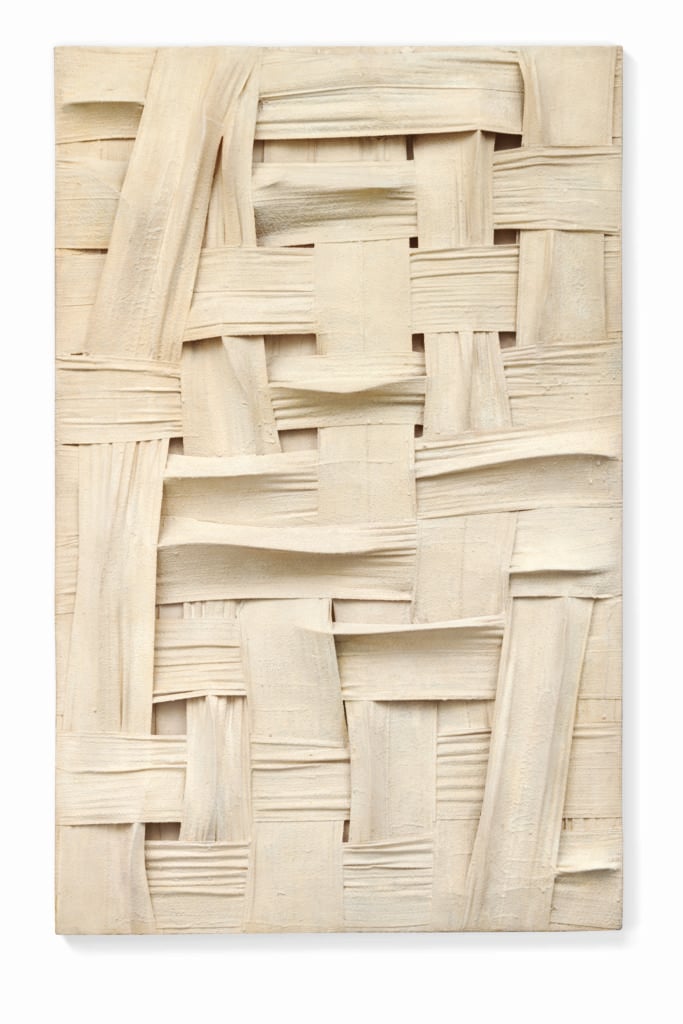
Salvatore Scarpetti, The Corn
Queen (1959). Courtesy of Sotheby’s Images Ltd.
A large Francis Bacon Turning Figure (1963) seemed
tamely estimated at £6 to £8 million ($7.8 million to $10.4
million)—until you realized it was a collage. Nonetheless, it sold
for £7 million ($9 million).
There was more demand for a small Frank Auerbach Head of
JYM (1976), which was chased by advisors from Beaumont
Nathan before selling to London Old Masters dealer Fabrizio Moretti
for £1.7 million ($2.2 million). Moretti also picked up Salvatore
Scarpetti’s 1959 torn bandage painting, The Corn Queen,
within the estimate for £1.6 million ($2 million). It last sold in
2014 for $1.4 million, so there’s a little change there to play
with.
Asian bidding, though not always easy to identify, accounted for
eight lots, Sotheby’s said. Among those seemed to be a buyer for a
work by the Portuguese-born artist Maria Helena Vieira da
Silva, whose L’Incendie II (1944) sold within
estimate for £1.6 million ($2 million). Da Silva was an auction
favorite in the 1980s, when her prices rose to £225,000 ($291,64 in
today’s dollars), a record that held for nearly 25 years. A recent
comeback has seen a record £2.05 million ($2.7 million) paid in
2018 for the slightly more abstract L’Incendie
1 (also 1944). At a traveling exhibition of her
work, currently at Waddington Custot, works are priced up to £1.4
million ($1.8 million).
Asian telephone bidding by Hong Kong representatives also
accounted for works by Dubuffet (above estimate, at £1.8 million,
or $2.3 million); Maurizio Cattelan (above estimate, at £1.5
million, or $1.9 million) and the hot new favorite out East, Eddie
Martinez (whose Empirical Mind State sold for six
times its estimate, at £615,000, or $797,140).
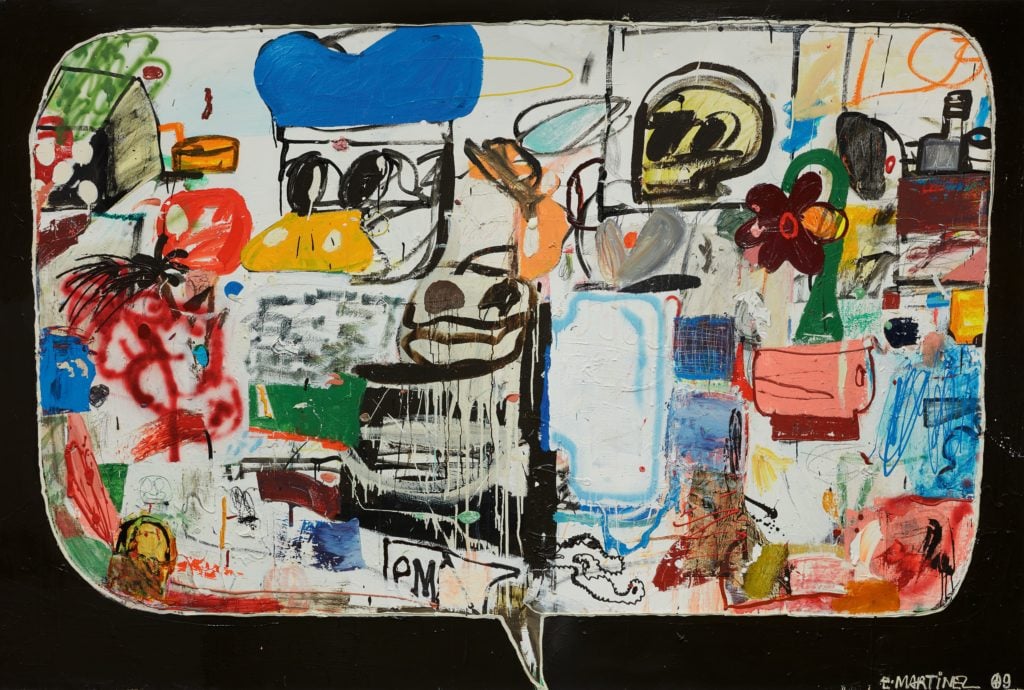
Eddie Martinez, Empirical Mind
State. Courtesy of Sotheby’s Images Ltd.
Interestingly, the underbidder on the Martinez was the Russian
art specialist and dealer James Butterwick. Butterwick seemed to
have a client prepared to bid across the board for large,
eye-catching paintings and the dealer ended up buying the
second-top lot, Jean-Michel Basquiat’s Rubber (1985),
for a mid-estimate £7.5 million ($9.7 million), and Adrian Ghenie’s
large canvas, The Arrival, on the high estimate for £4.2
million ($5.4 million).
One of the best performers on Tuesday evening was Zero group
artist Gunther Uecker, whose nails on canvas, White
Field (1982), saw competitive bidding from dealer Omer
Tiroche, as well as from the artist’s representatives, Levy Gorvy.
It ultimately sold to an American phone bidder for a double
estimate £1.5 million ($1.9 million).
The only record set in the sale was for the somewhat-forgotten
East German artist A. R. Penck. His market, though, has been coming
back, and his politically charged World of the
Eagle (1981)—a critical play on the German Imperial coat
of arms—sold for a record £531,000 ($688,260).
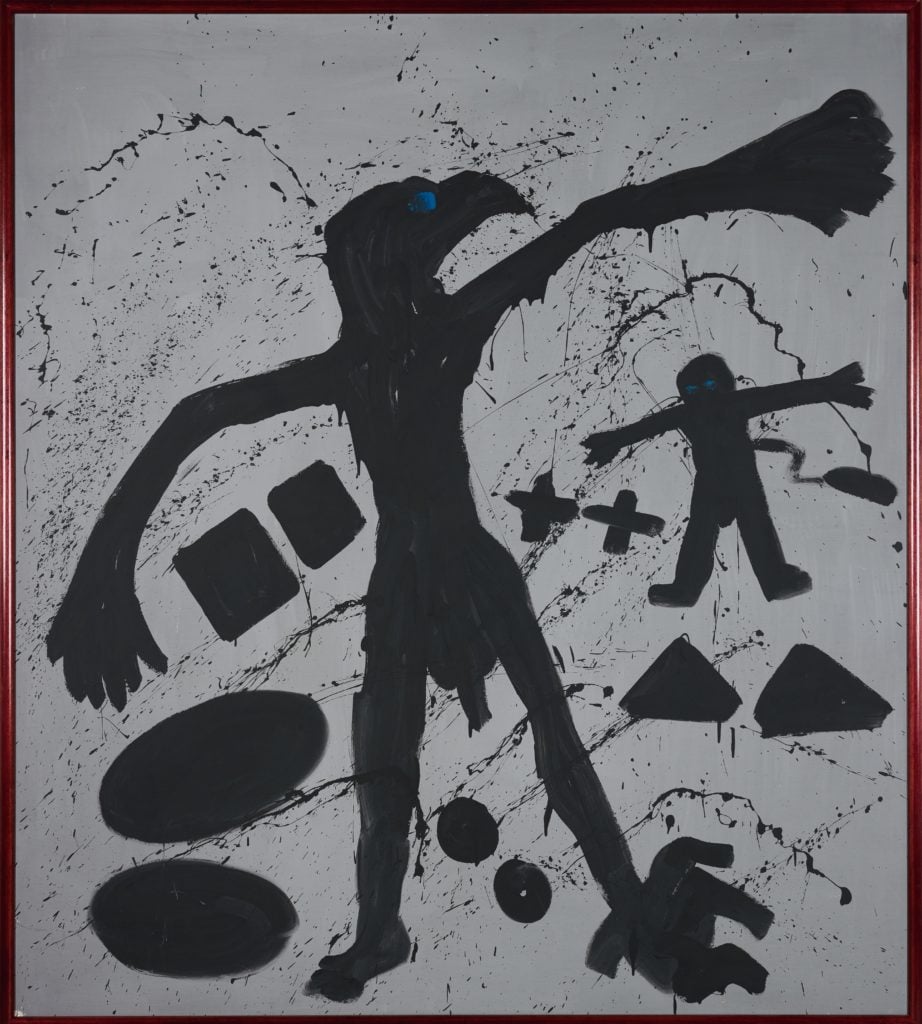
A. R. Penck, World of the Eagle
(1981). Courtesy of Sotheby’s Images Ltd.
One lot was withdrawn: a pre-squeegee Gerhard Richter abstract
picture that the US consignor had bought three years ago for $9
million. It doesn’t seem long ago that similar all-colorful
Richter abstracts were fought over, but the work’s low estimate of
£6 ($7.8 million) would have gone down as a net loss for the
seller, and the painting attracted no presale interest,
signalling that the market has moved on.
Another cautionary tale about selling too soon was told by Kerry
James Marshall’s fairly thin Draw Me (2012), which
had been bought in 2018 for $1.7 million but went unsold with an
ambitious £1.5 million ($1.9 million) low estimate.
The post Sotheby’s First Major Contemporary Art Auction
After Brexit Brings in a Steady $120 Million, Led by Tepid Bidding
on a Hockney Pool Painting appeared first on artnet
News.
Read more https://news.artnet.com/market/sothebys-contemporary-art-evening-sale-2020-1775637
Further reading


Leave a comment