
‘It Confirms the Dread I Felt on Election Day’: Artists From Countries Targeted by Trump’s Latest Immigration Ban Speak Out
President Donald Trump has
doubled down on his restrictions to immigration from
majority-Muslim nations, issuing a presidential proclamation at the
end of January that affects nationals of six countries. Set to take
effect February 21, the new restrictions will have a particular
impact on artists and institutions with ties to Africa, which is
home to four of the newly listed countries.
The addition of Nigeria,
Myanmar, Eritrea, Kyrgyzstan, Sudan, and Tanzania to the list
nearly doubles the number of countries affected since Trump’s
original executive order, issued just days after he took
office. That ban inspired nationwide protests and threw
immigrant artists’ lives into turmoil.
Cultural professionals who have
staked their careers on international exchange are
outraged. “These bans
are terrible, and they’re inherently racist,” Mark Sabb, senior
director of innovation and engagement at San Francisco’s Museum of
the African Diaspora, told Artnet News. “They’re the opposite of
what we stand for.”
However, since the new
restrictions specifically target immigration and not visitation,
artists may find that short-term travel is
unaffected. “As of now,
this new ban doesn’t impact non-immigrant visas,” says Ashley
Tucker, a human rights lawyer and director of programs at the New
York nonprofit Artistic Freedom Initiative. “This means that
artists from countries newly added to the list should still be able
to enter the United States to perform and promote their work, and
collaborations between artists in the US and the countries newly
added to the list are still possible.”
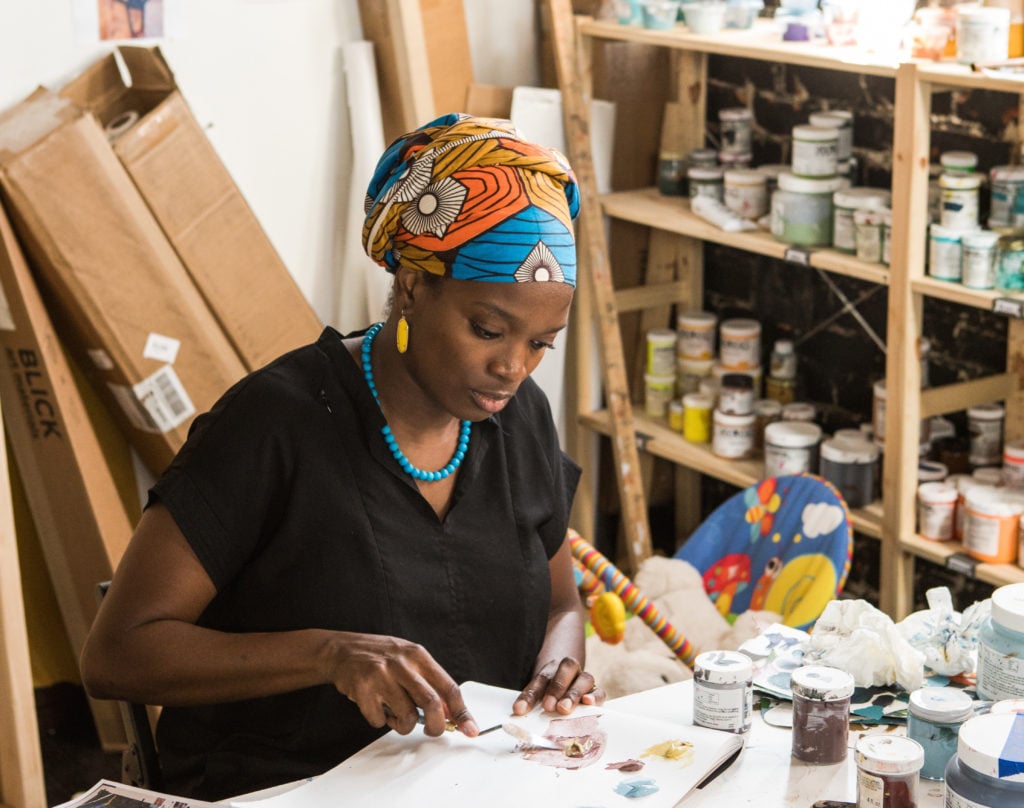
Njideka Akunyili Crosby in her studio in
Los Angeles, 2017. Photo: John D. & Catherine T. MacArthur
Foundation.
Nigeria in the Lead
Sometimes referred to as the
“Giant of Africa,” Nigeria is the most populous country on the
continent, home to some 200 million people. Data from the US
Department of State shows
that it by far outpaces the other
countries on the new list by number of immigrant visas issued in
2018, receiving about 8,000, with citizens of Myanmar, ranking
second by population, receiving only about 1,000.
It is the home, by birth or
residence, of numerous artists who are also prominent in the US.
MacArthur “genius” Njideka Akunyili
Crosby, Odili Donald
Odita, Toyin Ojih Odutola, Olu Oguibe, and Fatimah Tuggar are
native to the West African nation. El Anatsui was born in Ghana but
lives in Nigeria, and London-born Yinka Shonibare MBE grew up
there. (The country has also produced major musical talents such as
Fela Kuti, Femi Kuti, and Burna Boy, not to mention the Nollywood
film industry.)
Moreover, as outlined in
Artnet News’s 2019
report on Africa’s
emerging art markets, Nigeria is home to more black billionaires
than any other nation and has one of the world’s greatest
concentrations of young people. Lagos, the country’s largest city,
hosts commercial galleries as well as the continent’s first
contemporary art fair, Art X Lagos, and nonprofits including the
Lagos Center for Contemporary Art, praised by El Anatsui as “the
biggest thing to happen to the scene.”
“Many of the Trump administration’s decisions—ignoring Puerto
Rico in its time of need, slashing refugee numbers, deliberately
delaying the refugee process, denying green cards to people who
need government assistance, the Muslim- and now extended travel
ban, etc.—confirm the dread I felt on election day about a white
supremacist being in the seat of power,” Crosby told Artnet News.
“Their disdain for people and cultures that are not identified as
white lead to de facto white nationalist priorities and
policies.”
The effects of Trump’s policies and rhetoric are already taking
a toll, says Nigerian artist Gerald Chukwuma, who is planning to
come to New York in May for a residency with the 1-54 art fair. He
is already dreading his arrival: “You get to the airport and they
look at you like you have the plague,” he said. “Can you tell me,
after 1999″—the year Nigeria emerged from a military
dictatorship—”about any Nigerian citizen who has had anything to do
with terrorism?”
“It Doesn’t Make Any Sense”
The administration says that the
six countries have failed to meet security requirements, for
example by not having sufficiently sophisticated passport
technology or by not sharing information on criminals and those
suspected of terrorist ties.
Legal experts aren’t so
sure. “This ban doesn’t
make any sense,” Emeka Onwezi, principal at Maryland’s OAU Law
Group and a co-founder of the Nigerian American Lawyers
Association, told Artnet News. “It allows in visitors, who can apply to get a
visa within three months. But the people they ban are applying for
immigrant visas, which can take 10 years.”
Critics argue that the bans are
intended to discriminate on the basis of race and religion. During
his presidential campaign, Trump called for “a total and complete
shutdown of Muslims entering the United States”; Kyrgyzstan,
Nigeria, and Sudan are majority-Muslim, while Eritrea and Tanzania
have significant Muslim minorities. Several of the nations affected
by the original ban are also majority-Muslim.
“Some of my clients have been
waiting for more than 10 years,” said Onwezi. “You’re telling me
you cannot vet them in that time?” Noting that the ban was
announced amid Trump’s impeachment proceedings, he wondered, “Does
he want to make his base happy?”
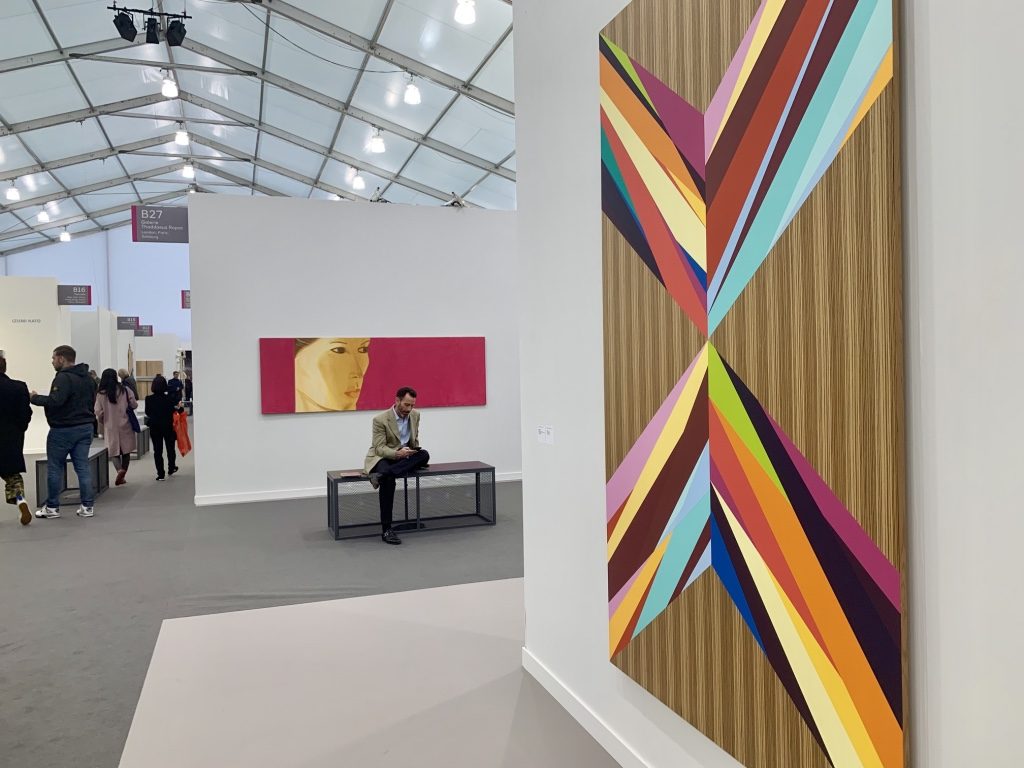
Work by Odili Donald Odita at right
during Frieze New York 2019. Photo by Sarah Cascone.
“Acquitted and Emboldened”
Artist Odili Donald Odita, who
lives in Philadelphia, was just six months old when his family fled
Nigeria for the US during the Biafran War, in the 1960s. The
artist, who has clearly been thinking about issues of nationality
and identity lately in brightly hued and abstract works with titles
such as Rocket’s Red
Glare and
The Other Side of the
Wall, says he sees
a link between the new
proclamation and Trump’s impeachment.
“He’s acquitted and he’s emboldened,” said Odita. He sees
alternate-history television shows like Netflix’s The Man in
the High Castle, where the Axis powers won, or HBO’s
Watchmen, in which white supremacists make war on US
police forces, as seeming less and less far-fetched. “This kind of
narrative is built out of the reality of the age of Trump. If you
can think it, it’s possible.”
Romanian-born Sudanese artist Khalil Albaih pointed out that
this isn’t the first time that the US has turned its back on his
country in recent years. Sudan’s people rose up in the Arab
Spring revolution, he said, braving deadly force and
institutionalized mass rape in order to depose the dictator Omar
al-Bashir and restore democracy, and yet, he said, the West ignored
its people.
“We fight for democracy and it
doesn’t matter at all,” he told Artnet News from Copenhagen, where
he is an artist in residence with the International Cities of
Refuge Network. “The region is left to burn if the Allies are not
satisfied with what you’re doing. It doesn’t matter if you die
trying to take religious extremism out of the equation, because
religious extremists rule the world—if not Muslim extremists, then
Judeo-Christian ones.”
Paving a Road To the Bottom
Whether in the West, with heads of state like Trump and Boris
Johnson, or in the Middle East, with Saudi Arabia’s Crown Prince
Mohammad bin Salman, artists see plenty of reason for a dim
outlook, with autocrats holding power and international exchange
quashed.
The US’s rejection of immigrants, Odita warns, is
self-defeating. “Young,
entrepreneurial people and science whizzes are going to places like
Canada rather than the States,” he said. “That’s the beginning of a
very big problem. You’re not going to catch up. It’s situating a
decline.”
Albaih warns of far more dire consequences from the US’s
abandonment of countries like Sudan. “If we don’t get our economic situation fixed,
another revolution is going to happen, and it will be a revolution
of the hungry,” he said. Sudan suffers from an inflation rate of 70
percent, and shortages of food and gas are common.
“This is how you turn activists
with hope into terrorists, because they have no other choice. If
they have to, people are going to take up a gun to have food for
their families.”
The post ‘It Confirms the Dread I Felt on Election Day’:
Artists From Countries Targeted by Trump’s Latest Immigration Ban
Speak Out appeared first on artnet News.
Read more https://news.artnet.com/art-world/trump-new-immigration-ban-artists-speak-out-1775277
Further reading


Leave a comment