
The Irreverent Werner Büttner, the Long-Overlooked Third Man in a Legendary German Artist Trio, Is Finally Gaining Market Traction
Standing in a small gallery in Cologne, painters Werner Büttner,
Albert Oehlen, and Martin Kippenberger broke out into song.
Sporting wool suits and mops of dark hair, they barreled out a
German miner’s hymn, taking cheeky pleasure in alienating the room
around them while making themselves the center of it. It’s 1983:
Cologne is the beating capital of the West German art world, and
this trio of artists is bent on basking in its spotlight.
Decades later, Büttner still remembers the evening well. Without
prompting, he belts out a few lines of the hymn to me, pounding his
fist in the air, while we tour his current solo exhibition at
Contemporary Fine Arts in Berlin. He holds a cigarette in one hand
and an ashtray in the other while I follow him around a
career-spanning survey that reaches back to 1979. Our conversation
inevitably ebbs and flows back towards those incubation years
alongside Oehlen and the late Kippenberger.
“It annoyed people, but it kept a lot of idiots away from us,”
recalls Büttner of the trio’s penchant for singing in public. “We
were called communists, anarchists, fascists, male chauvinists. We
got it all.” People may have been irritated, but many others were
jealous and impressed by this inner core of artists (Georg Herold
deserves honorable mention here, as does Albert’s brother, Markus
Oehlen). Büttner was one of the few former East Germans in the
group, who were dubbed the “enfants terribles”
or “bad boys,” and later enshrined among the ranks of
the Junge Wilde, a post-war art movement that stood in opposition
to Minimalist and Conceptual art, balking against authority in
general. By today’s standards, such a male-dominated movement
seems outmoded. But we shouldn’t underestimate the role that
Büttner and his cohort played in transforming the postwar art scene
and fast-forwarding the progress of contemporary painting.
By some stroke of market magic in the mid-2000s, both Oehlen’s
and Kippenberger’s prices soared, following a slow and steady climb
through the ’90s. And while Büttner’s influence on representational
painting has remained self-evident to the German art world, it’s
still less commonly celebrated on fair floors and auction blocks
worldwide. While his old friends Oehlen and Kippenberger (who died
in 1997) have enthralled the English-language market and its
museums over the last decade with their shapeshifting paintings and
sculptures, Büttner has carried on a bit more quietly—but he’s
still as irreverent as he ever was, successfully selling his work
to collectors who well-understand his relevance and staying
power.
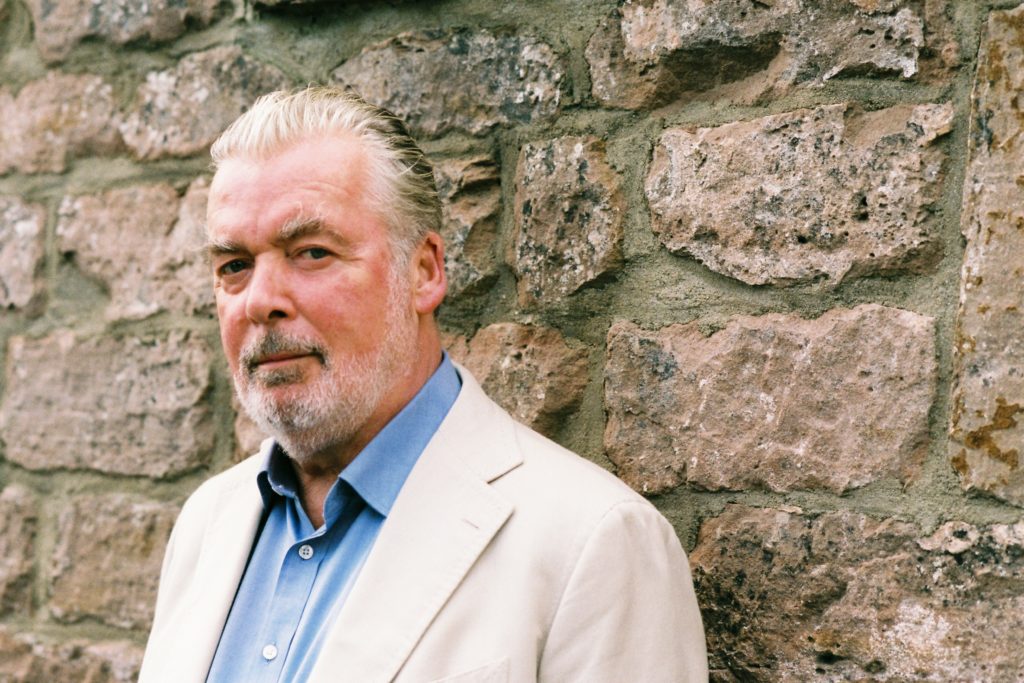
Werner Büttner.
Prude or Anarchist?
Forty years on, Büttner’s dressed in a crisp wool suit,
still faithfully following his chosen path. What has changed is
that the very subject matter and style he has long embraced—a dark
humor in the face of disillusionment, and a subversion of classical
art and the pastoral—has gained a foothold in the wider art world.
The stylized bravado of rising stars like Jana Euler, or the dark
cynicism of emerging talent like Mathieu Malouf, underscore how a
new era of in-your-face painting has returned.
While many in his 1980s scene made vivaciously colorful
works, Büttner has always stayed in the realm of natural ochres and
earth tones. He cites cavemen as his colleagues. When he uses
bright colors, which he tends to do more these days, they still
seem a bit acrid. As always, he fills up the canvases in a heavy
painting style called pastose (a skill he’s refined,
apparently, since his days as a young “smearer,” he tells me).
He laughs and cheekily suggests his career would have taken off
differently if he used colors that looked better above sofas.
Certain subject matter, too, may have scared off the occasional
collector. In one self-portrait from 1981 that is on view at
Contemporary Fine Arts, a seated Büttner stares out at the viewer,
his jaw cocked to the side. Look down, and you’ll see that he’s
masturbating through a paper bag (for the record, such public
behavior is not something he was ever in the habit of actually
doing). The painting is funny, contrarian, and a bit lonely.
Recent works from 2019 do show a more subdued version of the
typically raucous Büttner. The content and trajectory has changed
but the mood is unflinchingly the same. Artnet News columnist Kenny
Schachter, one of his many longtime fans, advises: “Don’t let
appearances mislead you—through all the cynicism and scorn, Büttner
is as much of a painting prude in love with the medium (and its
past) as an unruly anarchist trying to upend it all.”
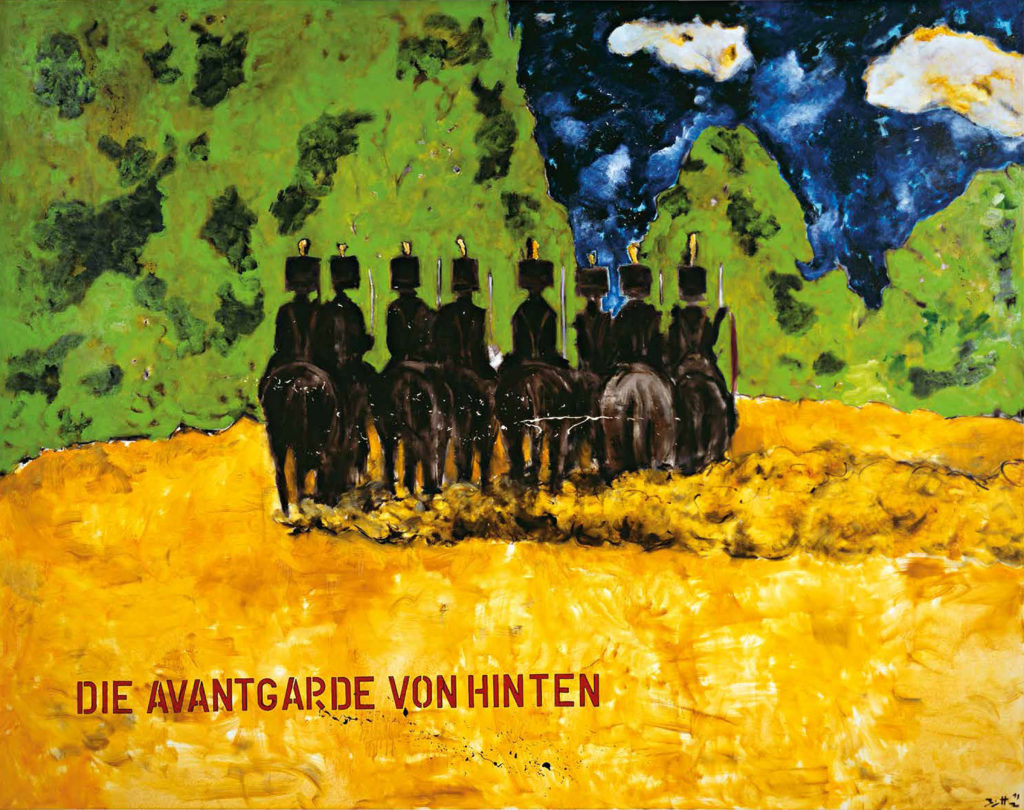
Werner Büttner, Die Avantgarde von
hinten [The avant-garde from behind], (2011). Courtesy the
artist and Marlborough, New York and London.
epoch. They manage that by borrowing liberally from the annals of
art history, from cave painting through El Greco, Magritte, Max
Beckmann, and Goya. “His pessimistic and irreverent approach to
painting really reverberates with today’s anxieties,” says Pascal
Spengemann, director at Marlborough, which represents the artist.
“But he has remained consistent and concise with his practice and
the culture has kind of moved back and forth around him.”
Marlborough began working with Büttner about five years ago, and
has shown four solo exhibitions between their London and New York
spaces; the gallery says that the demand has been
rising. Paintings from the late 1970s and 1980s,
understandably rarer to come by, tend to range from $100,000 to
$500,000 for the largest pieces, while newer paintings hover
between $75,000 and $180,000. At Contemporary Fine Arts, which
showed a diverse group of works from the early years and four new
paintings from 2019, prices were between €54,000 and €250,000
($60,000 and $276,000). That’s not quite in the realm of his more
famous peers; Oehlen’s work is projected to command prices above $10
million in the near-future. Works from Kippenberger’s estate
now command prices upwards of $10 million. But Büttner’s not
thinking about the market.
“There is a fascination for big sums and the media is on it but,
in the end, you don’t have to think about that, and that is
healthier. Or, you keep out of the game,” the artist says, noting
that he has every comfort in life. He does what he loves. He lives
in a castle outside of Hamburg, drives a Tesla, and has what he
calls “the kind of freedom you can get in this world.” He seems
content. “I let it lands the way it lands,” he adds.
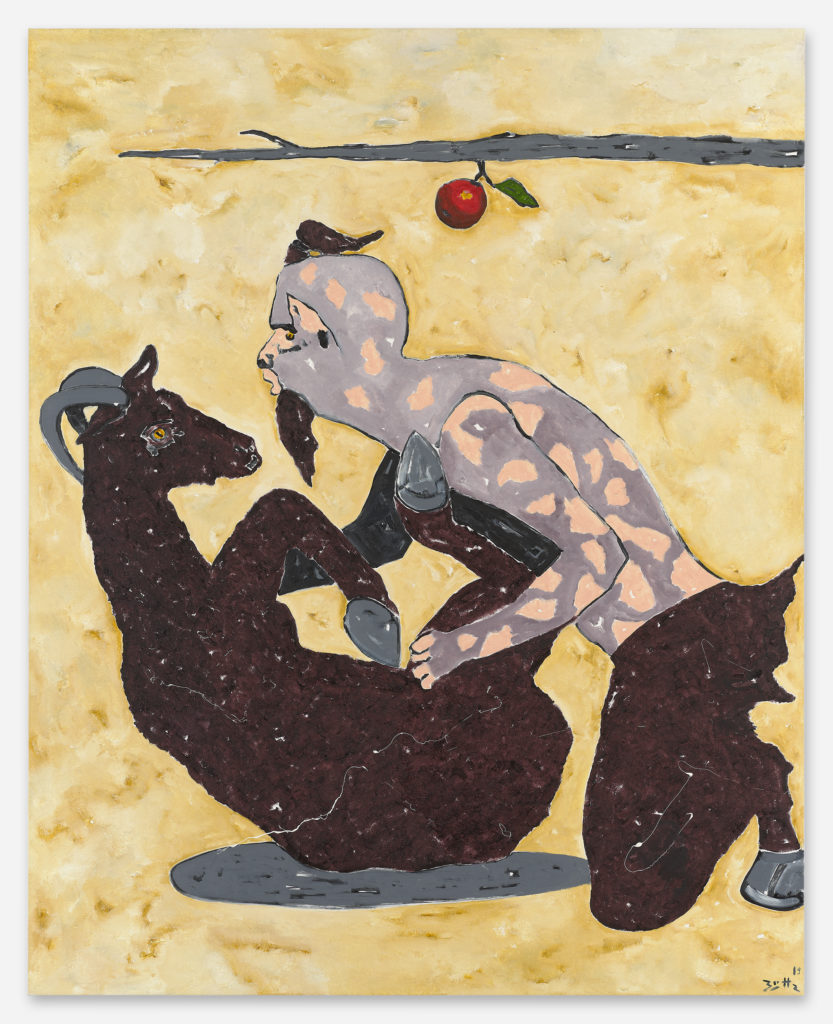
Werner Büttner, Pan, Penetrator
der Obstdiebe, und Spielkameradin (Pan, Penetratot of Fruit
Thieves, with Playmate) (2019). Courtesy Contemporary Fine Arts,
Berlin.
“Art for Art’s Sake Never Interested Me”
Marlborough is helping to shape a new trajectory for Büttner.
“There have not been the sorts of exhibitions that [would] make him
a household name, but that is changing now,” says Max Levai,
Marlborough’s president, speaking over the phone from New York. The
anglophone gallery has certainly played a key role in bringing
Büttner to foreign audiences. A show is in the works for 2021 that
will capture the larger span of his career, honing in on the early
years.
“What people are trying to achieve in representational painting
today is this aptitude and fluency that Werner has,” says Levai.
“There is a renewed interest in this late 1970s and 1980s moment in
Cologne and Werner was really an an architect of it. He’s been
dedicated to a specific attitude in painting since day one and
there is a beautiful linear progression to his work.”
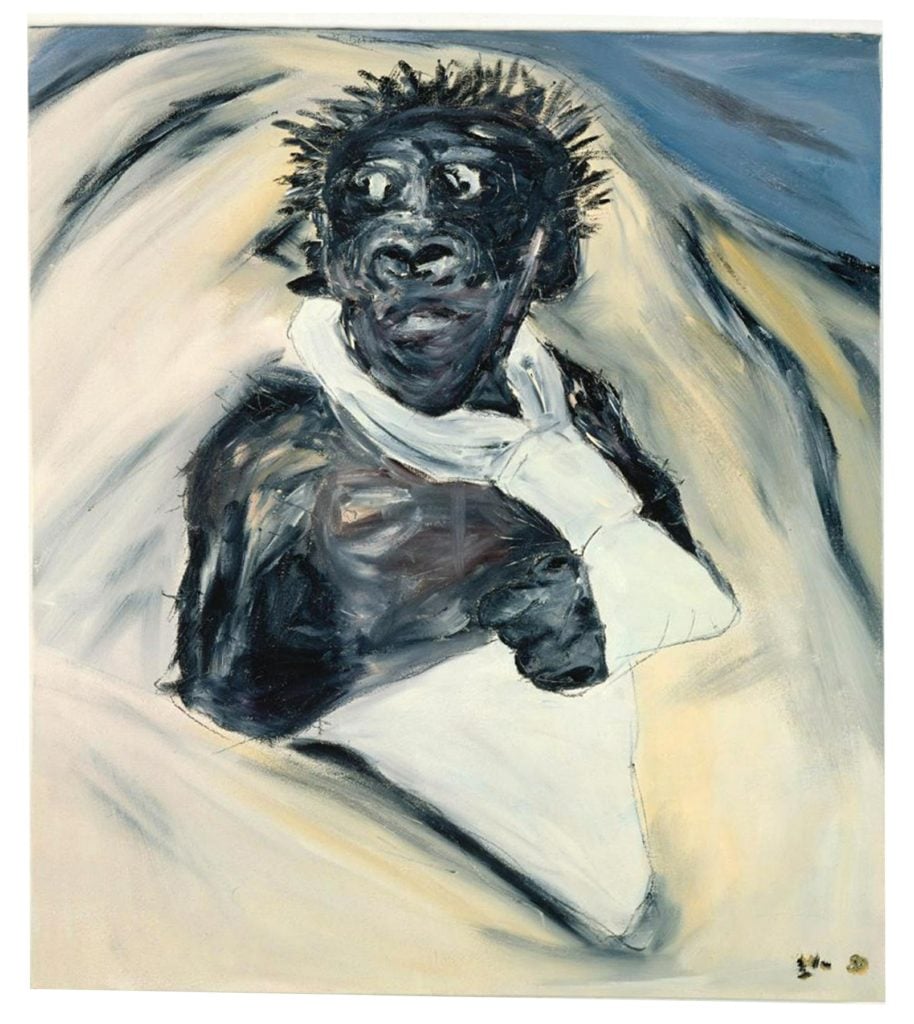
Werner Büttner
Socialstaatsimpression (1980). Courtesy Contemporary Fine
Arts, Berlin.
“Art for art’s sake never interested me. After World War II, I
had the impression that every artist who wanted to be cool said
that art is art, and everything else is everything else. I never
believed that,” says Büttner. He’s 65 years old now, and when not
teaching at Hamburg’s University of Fine Arts (where he helped
steer the practices of Jonathan Meese and Daniel Richter, two
former students), he retreats to his castle home and studio, a
refurbished, historic hotel he bought some years ago. “Art has
to have something to do with reality, with what is happening on
this fucking planet,” he adds. “If it doesn’t, for me it is
boring.”
Many of the works are as funny as they are tragic and
disturbing, and true as they are preposterous. While he certainly
paints about painting (he is a painter’s painter,
through and through), Büttner’s work also has two feet kicking
topical issues. In one work, the chair backs of an empty
cinema are depicted above the question, “Why Not Die Out?” In
another sardonic painting, a plain-looking house hangs precariously
on the edge of a cliff, while the figure of Jesus hovers nearby
(“Christ Attempts Visit,” as the title enigmatically explains).
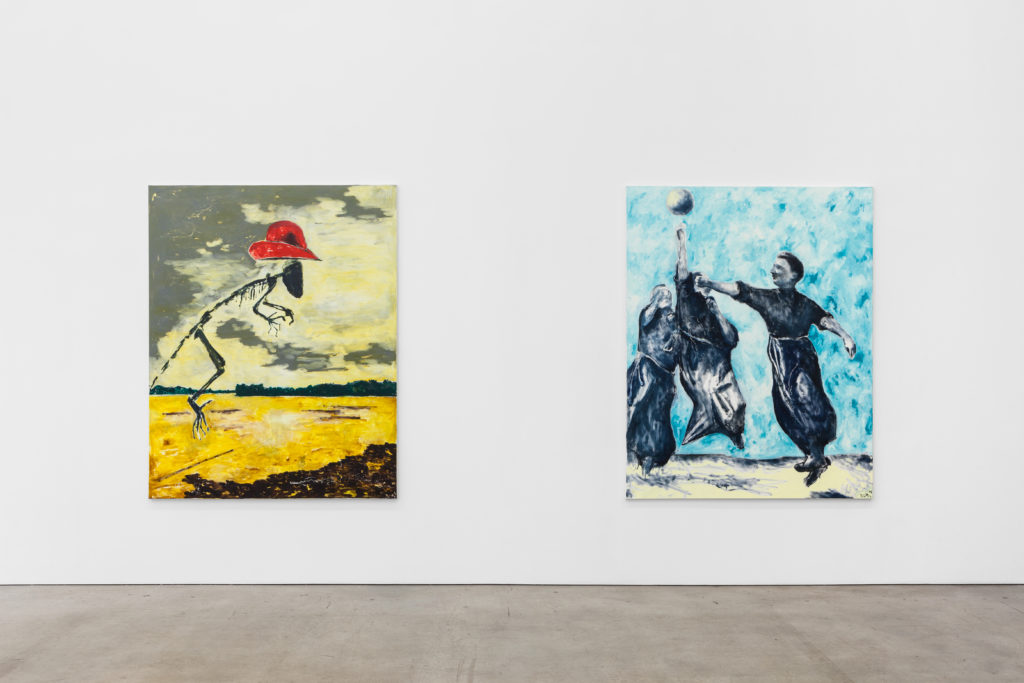
Installation view of Werner Büttner,
“Poor Souls” at Marlborough, New York in 2016.
What the Future Holds
Kippenberger, Oehlen, and Büttner met in Berlin around 1979, not
long after Büttner had dropped out of law school because he
“couldn’t stand the crowd.” First, Kippenberger invited Büttner to
be in a group show at a space he was running that was inspired by
Warhol’s Factory. In the case of Oehlen and Büttner, they met after
the former law student ended up in Oehlen’s apartment for a
one-night stand with his female roommate. Büttner tells me the two
chose painting as the best way to roll up their sleeves and do some
real work in the world. “We talked for years about what has to done
be done in art, looking at things and seeing what was missing, and
then we started,” Büttner says. Their careers progressed in fits
and starts. “We never thought that we would have international
success, because our practice was based in the German
language.”
They were determined to impress each other, at least, in what
Büttner says was a “fruitful competition.” They also had a good
time. Oehlen and Büttner founded imagined associations (like a
sperm bank for refugees from the GDR, or the Church of
Non-Differentiation) and engaged in reckless fun. Perhaps partying
was part of the process. Büttner, Kippenberger, and Oehlen imbibed,
and then imbibed each other’s ideas. They produced several
exhibitions and artists catalogs in different constellations
throughout the years, like Mahlen ist Wahlen (Painting is
Voting) and Wahreit Macht die Arbeit (Truth
Makes the Work). In Germany, the rhyming titles bring a smile, yet
something serious is being said. In Oehlen’s words, he called his
early days “the most beautiful thing in my artistic life,” adding
that a smile from either Büttner and Kippenberger was enough to
know he had done some good work.
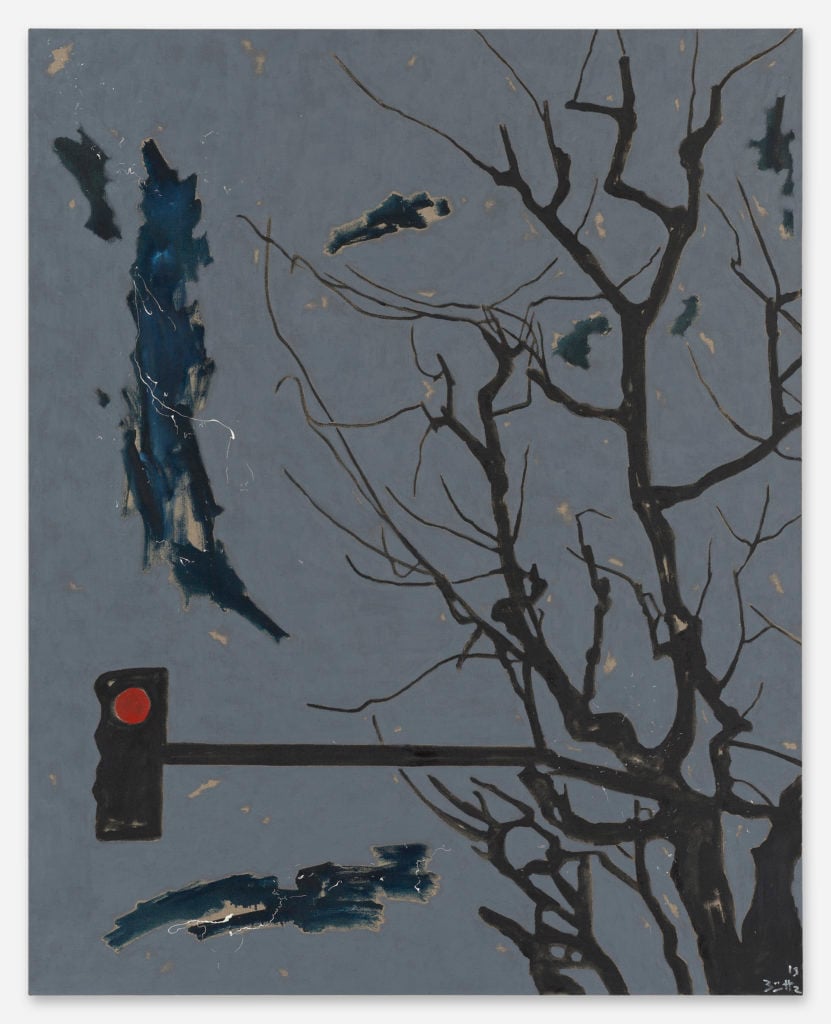
Werner Büttner, “Eines der
unzähligen Neins meiner Tage” (One of the Countless Nos of My
Day) (2019). Courtesy Contemporary Fine Arts, Berlin.
In 2020, though, Büttner undeniably lags behind the profile
of his rabble-rousing peers, at least in terms of market
recognition. Heads turned in 2014 when Kippenberger’s 1988 untitled
self-portrait sold at Christie’s New York for over $22 million to
dealer Larry Gagosian, crashing past the artist’s previous records.
That same year, Oehlen cracked the $1 million mark at
auction. Though slower off the starting line, Oehlen’s market
more officially lifted off when 1998’s Selbstportrait mit
Leeren Handen went for nearly $8 million at Sotheby’s
London last June.
Büttner admits he has been surprised by it all, but shrugs off
any comparisons. “I recently asked Albert what it feels like to
have reached this level in his career, and he said that the only
thing that gets on his nerves is people talking about it,” the
artist says. “He tries not to see it, and go on working.”
And so does Büttner. His new paintings are decidedly
brighter, and still feel compellingly current. Questions about
evil, faithlessness, hedonism, and political correctedness abound.
A red stop light forms the focal point of one work
called One of the Countless Nos of My
Day. “Art is over if we get new taboos,” Büttner tells me
“You can’t talk about this world in a correct vocabulary.”
On that note, he is currently busy in the middle of setting up
his foundation; it’s called Stiftung Störer des Stumpfsinns
ins Leben (Foundation for Disturbers of the Whole Shit). Büttner’s
always stood by disruptive causes. He’s also planning a mausoleum,
though he expresses regret that the laws have changed in Hamburg;
one can no longer leave dead bodies above ground, he laments. I
can’t tell if he’s joking, but I decide it doesn’t really matter.
As with everything he does, the meaning is as much in the gesture
and attitude as the outcome.
The post The Irreverent Werner Büttner, the Long-Overlooked Third
Man in a Legendary German Artist Trio, Is Finally Gaining Market
Traction appeared first on artnet News.
Read more https://news.artnet.com/art-world/werner-buttner-1761153
Further reading


Leave a comment