
Kidnappings, Train Crashes, and Vanishing Art: Peripatetic Land Sculptor Richard Long on the Joys of an Artistic Life on the Roa
Architecture purists might want to look away.
Mexican architect Luis Barragán’s brightly colored Modernist
masterpiece, Cuadra San Cristóbal, has an unexpected visitor: the
peripatetic Land Art pioneer Richard Long.
The
veteran British sculptor, whose extraordinary interventions into
the natural and built environment take him to all points of the
globe, has materialized in in the suburbs of Mexico City to
create four massive works at Barragán’s oft-Instagrammed stable
yard and home. Long has taken the commission in his rangy stride,
unfazed by the pressure or baggage that intervening in such a
famous spot might present. In fact, Long had never heard of the
architect—a legendary figure in architectural circles—or seen
images of the famous building before accepting the
gig.
“I’m
an opportunist,” the artist said. “They told me that he’s an
amazing architect and it’s a beautiful location.” The opportunity
in question was a solo exhibition at the space, organized by Lisson
gallery, and timed to coincide with the flood of visitors heading
to Mexico City to the week of art fairs and openings earlier this
month.
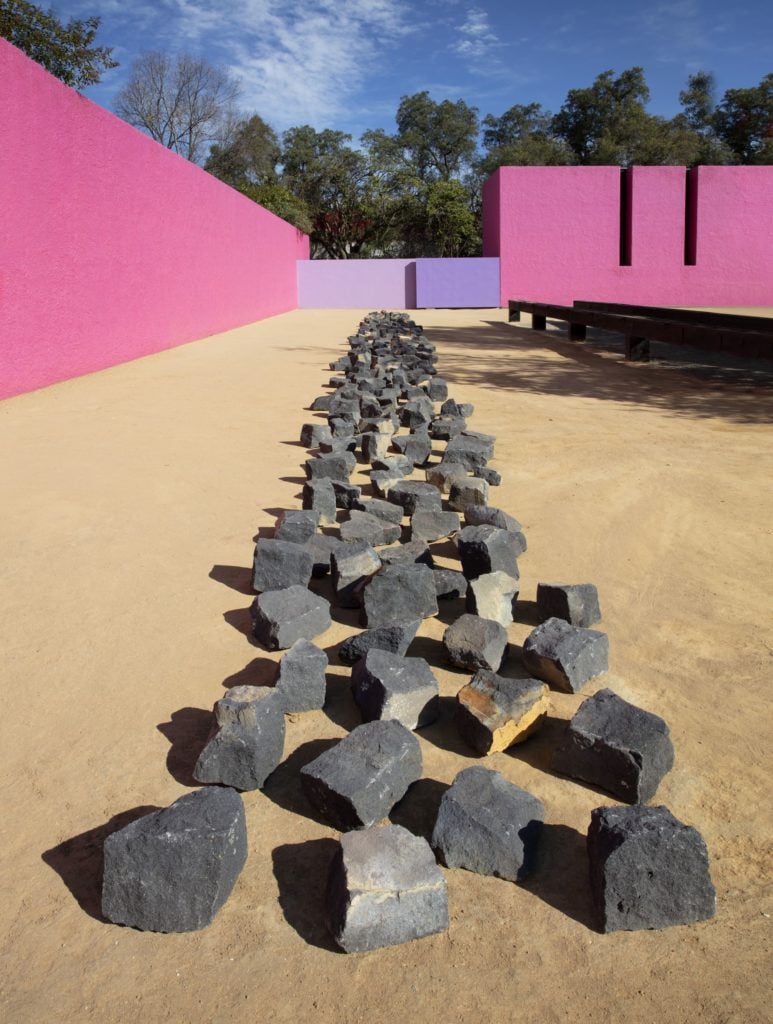
Richard Long, “Orizaba to Urique River
Deep Mountain High,” Cuadra San Cristóbal, designed by Luis
Barragán, Mexico City. Copyright Richard Long; Courtesy Lisson
Gallery. Photo by Sebastiano Pellion Di Persano.
The artist (now technically known as Sir Richard Long, following
a 2018 knighthood) is no stranger to working in unique locations
around the globe. The Turner-Prize-winning Royal Academician has
undertaken epic journeys to make sculpture in the landscape, from
Alaska to Mongolia. There have been some hairy moments along the
way. “I’ve been slightly
kidnapped,” he casually mentioned. It happened in Anatolia. He was
put in the back of a Turkish farmer’s truck and held captive in
village for two days before being released unharmed. On another
daunting walk, this time across Sicily, he was curb-crawled by a
Mafiosi, he recalled. It was just outside the village of
Corleone, of The Godfather fame, he recalled with a
chuckle.
Mexico Revisited
The
last time he was in Mexico, Long and his fellow artist and travel
partner Hamish Fulton were involved in a train crash: “No one was
hurt, but the carriages were concertinaed.” They put on their
backpacks and walked to the nearest town. “[It] had a small
airport. I used my American Express card for the first time, and
the same day we were back in Mexico City,” Long said.
There
were no such dramatic mishaps on his return to Mexico for
“Orizaba to Uríque River Deep Mountain High,” the show at the
Barragan property, and his first exhibition in the country. Road
trips to quarries near Mexico City and Puebla went without mishap.
Using the volcanic stone and slate he gathered, Long has created
four signature works: a large circle, half circle, line, and cross,
all composed of stone. They are classic forms given a new twist by
being in such an unexpected and colorful setting. The dramatic
lines of volcanic rock, hewn by hand by quarry workers and then
placed by Long with the help of only one assistant, work especially
well against Barragán’s
Minimalist backdrop, with its black, wooden horse rails juxtaposed
against hot pink walls.
“A lot
of my work comes from really nice, dynamic, visual experiences,”
Long explained. “It is not about working in the studio. It is about
engaging with all this crazy stuff in real life.”
San Cristóbal is still owned by
the Egerstrom family, which
commissioned Barragán to
create the property in 1968. Long first saw it in January when it
looked very different from the tranquil, pristine images seen in
architecture books, magazines, and social-media feeds. The stables
were being used as a backdrop to a fashion shoot that day. To the
owner’s dismay, there was a bit of a blow-up between an Italian
model and the photographer. Far from being put out by the clutter
and drama, Long was amused; the fashion shoot could be filed under
the category of “crazy stuff in real life” that keeps his practice
interesting.
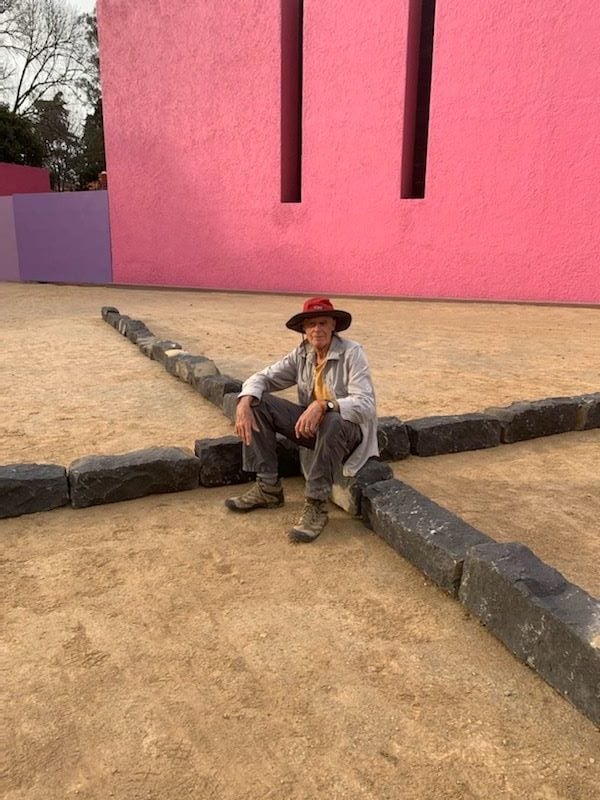
Richard Long at Cuadra San Cristobal.
Copyright the artist. Photograph by Joanna Thornberry, Courtesy
Lisson Gallery.
“My Work Is About Freedom”
Long’s
sculptures and mud murals, which he creates by hand, aren’t like
Land Art in the mode of Robert Smithson’s Spiral Jetty or Michael Heizer’s Double Negative. No bulldozers or rock-blasting is required.
“My work is deliberately not monumental,” Long
explained.
Often the sculptures are never
intended to last, be they made of stone, wood, mud, a campfire, or
simply a splash of water against a river bank. Most exist only as
photographs. As he leafed through an artist’s book documenting a
1979 trip to Mexico, I wondered if Long ever feels like revisiting
those sites to see if any trace of the work he made back then
remains. (At 74, the keen walker and cyclist certainly looks fit
enough to make the trek.) Long looked at me
askance. “That’s not
the point,” he said. “They are sculptures made as stopping places
along the journey. They will probably disappear.”
The
stone circle he made above the clouds on the volcanic Pico de
Orizaba in 1979 probably only took him an hour to make, he
revealed. Splashing water on the walls of the gorge of Uríque took
less time. “Essentially my work is about freedom,” Long
said.
The
late German art dealer Konrad Fischer was one of the first to
recognize the significance of Long’s light-touch interventions into
the landscape. Fischer gave Long a solo show in his Düsseldorf
gallery in 1968, the year the artist graduated in London. He was
only 23. “With one bound I was free of the crazy London art world
of Anthony Caro and all that welded metal stuff,” Long
recalled.
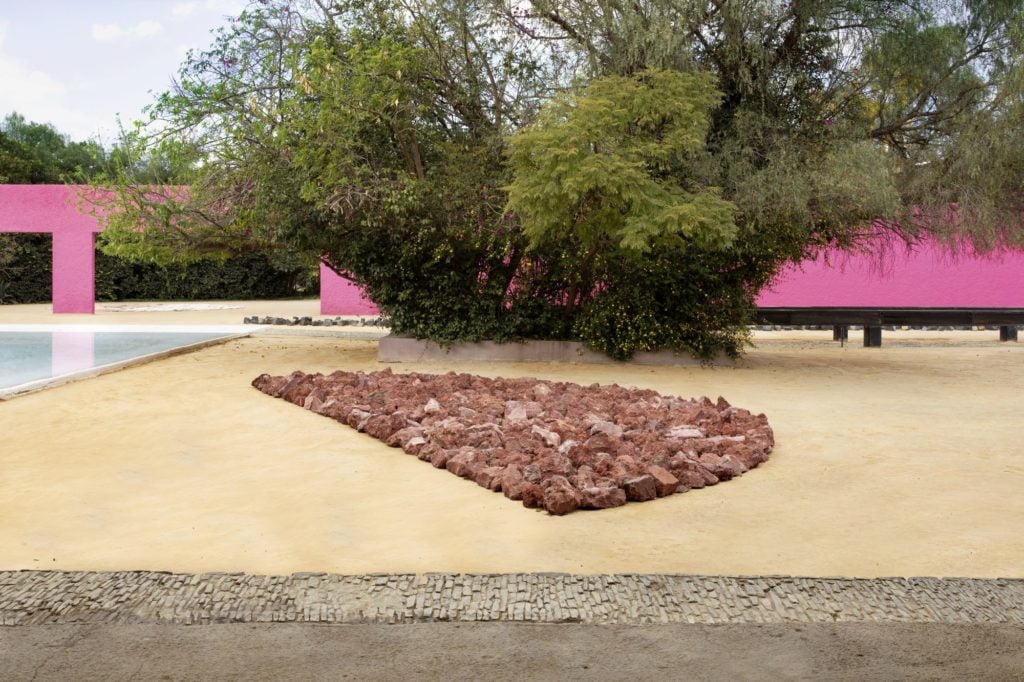
Richard Long, “Orizaba to Urique River
Deep Mountain High,” Cuadra San Cristóbal, Designed by Luis
Barragán, Mexico City. Copyright Richard Long; Courtesy Lisson
Gallery. Photo by Sebastiano Pellion Di Persano.
Recognition in the US soon followed his
European success. The artist and critic Donald Judd was one of
Long’s biggest cheerleaders. Writing in 1986, Judd declared Long to
be “Europe’s best artist.” Long downplays the high praise. “Judd
seemed to like my work,” he recalled. “Don’t ask me why. He was
always very friendly to me, although he made lots of enemies. If he
liked you as an artist then he was like a teddy bear.”
Long
and Judd exhibited together in a small gallery in Reykjavik,
Iceland in 1988; the British sculptor’s work Sea Lava Circles is now permanently on view at Chinati in Marfa,
the extraordinary art museum Judd created on the site of a former
US army base. It seems odd that Long’s work is sited on what was
the officer’s tennis court, rather than out in the natural
environment of the West Texan prairie. “I had nothing to do with
that,” Long explained. “[Judd] put it there.” It is a good example
of how an artist cannot control the display of their work by a
collector, curator, or fellow artist. “Years later it could be in a
different context. Sometimes it’s good and sometimes it’s bad,”
Long said, stoical.
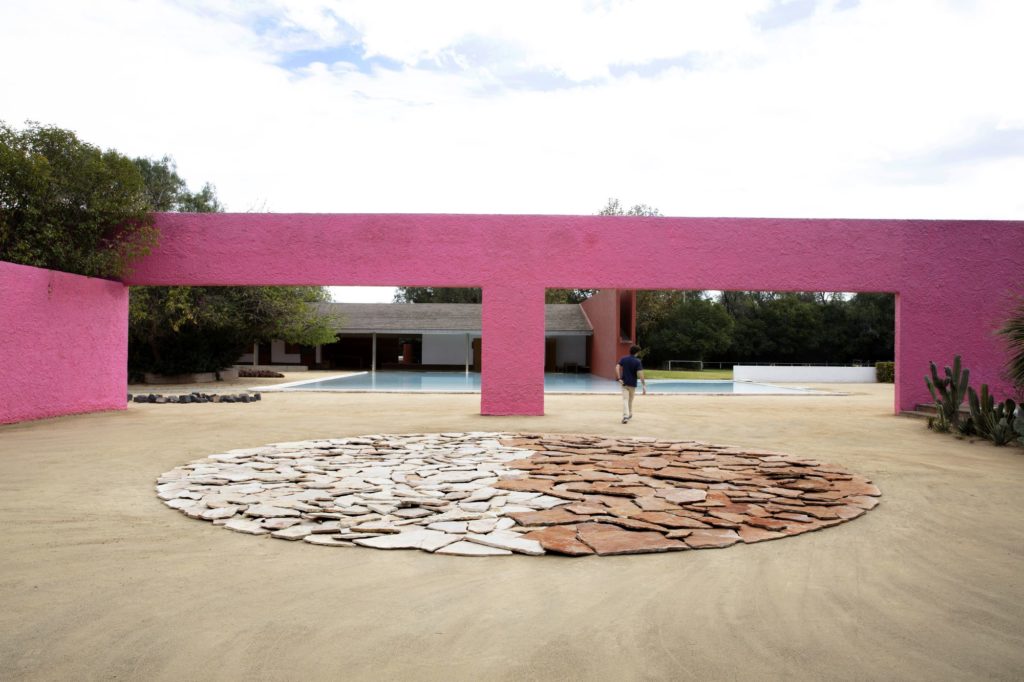
Richard Long, “Orizaba to Urique River
Deep Mountain High,” Cuadra San Cristóbal, Designed by Luis
Barragán, Mexico City. Copyright Richard Long; Courtesy Lisson
Gallery. Photo by Sebastiano Pellion Di Persano.
He sounds just as unflappable
when asked how he would feel if an unauthorized or fake Long
sculpture cropped up somewhere one day. “I often say, there are
hundreds of circles in the world. Most of them aren’t mine. In
other words, I only have to do a few circles,” he
said.
It may
be surprising to learn that the original version of Long’s 1976
Venice Biennale sculpture has long since vanished. Called
A Line of 682
Stones, it
was a square spiral that snaked
through the British pavilion. Judd’s nemesis—the Italian collector
Giuseppe Panza, who went on to sell his collection to the
Guggenheim and MOCA LA—is to blame. He borrowed Long’s work for a
show and never returned it. “[Panza] didn’t steal it, he just
lost it,” Long clarified. His attitude is the opposite of Judd’s,
who raged against the collector for making unauthorized versions of
his work on the cheap. Long seems less preoccupied with all of
that: with legacy, with ownership, with fame.
“There
are plenty of other stones in the world,” Long said. “If I really
wanted to make that work again, I could make the same work by just
getting some more stones.”
Richard Long
“Orizaba to Urique River Deep Mountain High,” February 7 through
March 7, Cuadra San Cristóbal, Mexico City.
The post Kidnappings, Train Crashes, and Vanishing Art:
Peripatetic Land Sculptor Richard Long on the Joys of an Artistic
Life on the Roa appeared first on artnet News.
Read more https://news.artnet.com/exhibitions/richard-long-barragan-mexico-1779285
Further reading


Leave a comment