
‘It Will Have a Chilling Effect’: Forensic Architecture’s Eyal Weizman on a Secretive Government Algorithm That Stopped Him Entering the US
The
director of Forensic Architecture, Eyal Weizman, has been denied
entry to the US after being classified as a “security threat” by a
Homeland Security algorithm. The unconventional artist and academic
was due to attend a survey of the multidisciplinary collective’s
work in Miami, after which he planned to travel to the opening of
“Uncanny Valley: Being Human in the Age of AI,” a group show at the
De Young Museum in San Francisco. Weizman fears that what happened
to him could have repercussions for other human-rights activists
investigating state violence.
Two
days before Weizman, a professor at London’s Goldsmiths College,
was due to fly to the US from Britain, he received an email from
the US Embassy telling him that the visa waiver on his British
passport had been revoked. When he went to the embassy in London
last week, an official would only tell him that an algorithm had
identified a related “security threat.”
“I
don’t know how the algorithm operates but from what the officer
told me it works from association, so it’s not one thing, it’s the
relation between things,” Weizman tells Artnet News.
That association could involve any
aspect of his work with Forensic Architecture, which painstakingly
pieces together evidence from a variety of sources when
investigating human-rights violations and miscarriages of justice,
often challenging the official versions of fatal
events.
“Associative algorithmic policing is a problem
particularly for human-rights groups like Bellingcat and
ourselves,” Weizman explains. “It will have a chilling
effect.”
Forensic Architecture has gained increasing
recognition in the art world, especially among politically engaged
curators. The hard-to-categorize collective was nominated for the
2018 Turner Prize, and staged an impressive show at the ICA in
London. The group also took part in documenta 14. For the 2019
Whitney Biennial they presented a video, in collaboration with
Praxis Films, that probed the links between the New York museum’s
then-chairman Warren Kanders and his company Safariland’s
manufacture and sale of so-called “less-lethal” weapons, such as
tear gas.
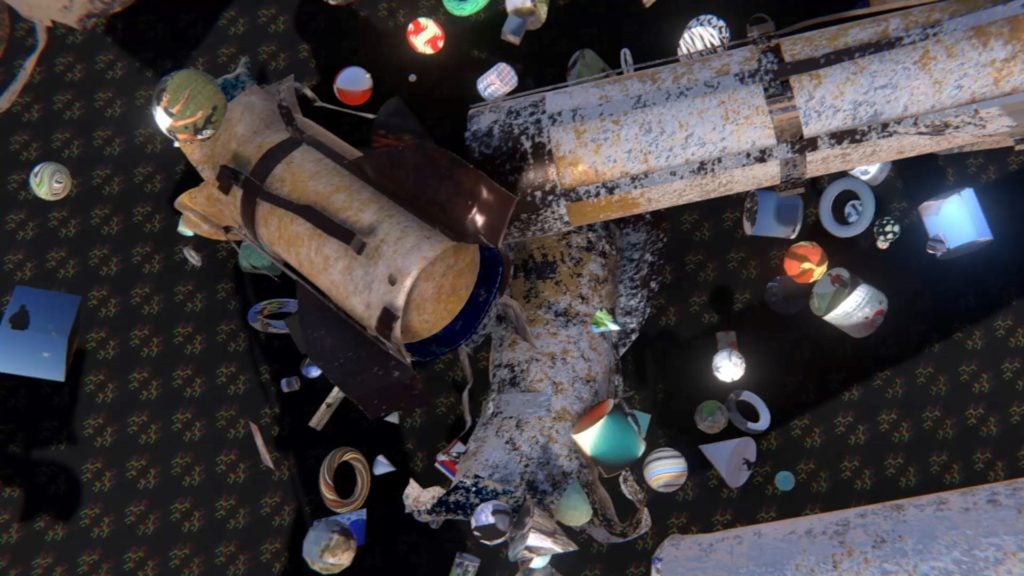
Forensic Architecture, Model
Zoo (2020). Courtesy of Forensic Architecture.
The
exhibition that Weizman was attempting to travel to in Miami is
staged in the city’s Freedom Tower and organized by the Miami-Dade
College’s Museum of Art and Design. It includes Forensic
Architecture’s new work based on the abuse of a Palestinian in
Hebron by the Israeli Defence Force. “We worked with whistleblower
soldiers,” Weizman says. “They have been under incredible pressure
from the Israel government.” The pieces takes the form of a
virtual-reality environment, an innovation for the
group.
If he
had made it to the United States, Weizman had also planned to help
launch a joint investigation into Homestead, a controversial
detention center for migrant children in Southern Florida. The aim
was to teach local groups Forensic Architecture’s research methods
into alleged abuses.
“Uncanny Valley,” the show at the De Young
Museum that features Forensic Architecture, explores contemporary
artists’ responses to the application of artificial intelligence or
AI. Much of AI technology in use today, of course, was developed in
nearby Silicon Valley. “Model Zoo [the piece on view]
is a continuation of our work at the Whitney using machine-learning
tools to identify, online, grave human-rights violations,” he says.
The irony of using algorithms to locate abuse, and then falling
victim to one himself, is not lost on Weizman.

Forensic Architecture, Model
Zoo (2020), courtesy of Forensic Architecture
Since 2018, Forensic Architecture has used
photorealistic digital renderings based around 3D models to train
algorithmic classifiers to identify tear-gas canisters and chemical
bombs deployed against protesters worldwide, including in Hong
Kong, Venezuela, and Sudan, as well as on the US-Mexico
border.
In a
joint statement, Thomas Campbell, the director of the Fine Arts
Museums of San Francisco, and Claudia Schmuckli, the
curator-in-charge of its contemporary art wing, said: “We are
deeply saddened that Eyal will not be allowed to join us this
weekend to celebrate the opening of the exhibition. We stand with
him and Forensic Architecture’s partner communities who continue to
resist violent state and corporate practices and who are
increasingly exposed to the regime of ‘security
algorithms.’”
Meanwhile, Forensic
Architecture’s many international projects and partnerships will
continue. Weizman had been hoping to accompany his partner, Inez
Weizman, who is also an academic, as well as their two children, on
the planned trip to the US.
“What is concerning is that our
two young children were kept for two and a half hours without her
[in JFK airport],” he says. His partner, who is the director
of the Bauhaus-Institute for
History and Theory of Architecture and Planning at the
Bauhaus-Universität Weimar, Germany, was eventually allowed entry
to the US to give two lectures in the US, and to launch a book. “If
they want to ask questions about me, and my passport, that’s fine,
but I was concerned as a father and because she felt uncomfortable
answering all those questions,” Weizman explains.
The post ‘It Will Have a Chilling Effect’: Forensic
Architecture’s Eyal Weizman on a Secretive Government Algorithm
That Stopped Him Entering the US appeared first on artnet
News.
Read more https://news.artnet.com/art-world/forensic-architecture-algorithm-us-ban-1782441
Further reading


Leave a comment