
The Mexican Muralists Had a Vital Influence on US Art. Can Their Revolutionary Approach Offer Lessons for the Present?
“Mexico is on everyone’s lips,” said American photographer
Edward Weston in 1932. “Mexico and her artists.” And nearly a
century later, Mexico has maintained her cult status as a source of
inspiration for artists and culture seekers internationally.
Whether cornerning the latest luxury destination,
art fair extravaganza,
or even a national border and immigration crisis, Mexico remains a
hot topic in the American imagination. Last week, the Whitney
opened “Vida Americana: Mexican
Muralists Remake American Art, 1925-1945,” a show dedicated to
outlining the influence of the Mexican Muralists—Diego Rivera, José
Clemente Orozco, and David Alfaro Siqueiros—on their American
contemporaries.
Curator Barbara Haskell uses Weston’s quote in her catalogue
essay to note the swarm of American artists traveling to Mexico in
search of alternatives to European modernism in the late ‘20s and
‘30s. And though the significant impact of the Mexican muralists
and their mentorship to American artists may not be common
knowledge, the documentation exists. In fact, MoMA’s second solo
show in its history was given to Diego Rivera in 1931. The first
was Henri Matisse.
Yet considering the current heightened political moment and
shaky relationship with Mexico, Haskell writes that it “seems more
imperative than ever to acknowledge the profound and enduring
influence Mexican muralism has had on artmaking in the United
States.” As this history comes to wider recognition, we should ask
how the concept of “influence” functions to the Whitney and the
gatekeepers of the art historical canon? How does the notion of
“influence” address the relationship of artists to the social
violence, class struggle, and fraught political realities depicted
in this exhibition, themes that remain relevant today?
“Vida Americana” makes the case for influence crystal clear.
Artworks from both countries depict heart-wrenching and murderous
strife, war, and indicting narratives of racial violence. Rivera’s
fresco on cement The Uprising (1931) depicts a Mexican
mother, infant in hand, defending her family from sword-wielding
military police. Injured or dead bodies are strewn among the feet
of a crowd of protesters. Later figurative works like American
Tragedy (1937) by the US social realist painter Philip
Evergood show police violence. Pieces by Elizabeth Catlett,
Hale Woodruff, and Rivera depict versions of lynchings and were
aimed at bringing attention to the widespread acts of terror.
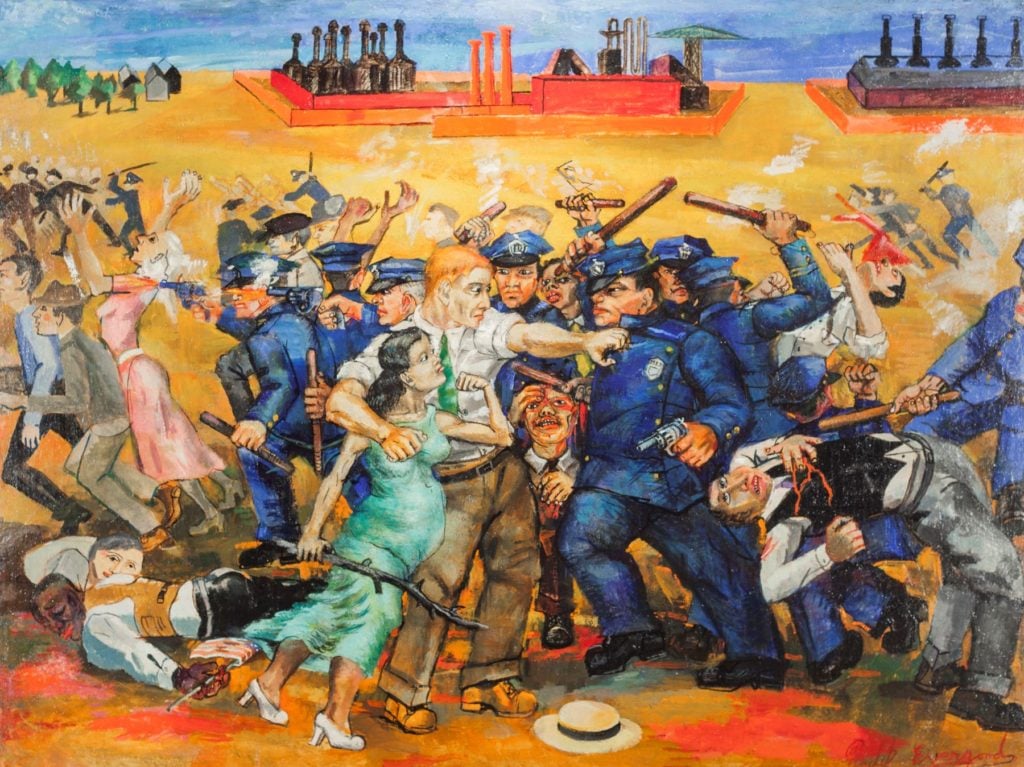
Philip Evergood, American
Tragedy (1937). Courtesy Harvey and Harvey-Ann Ross.
Sadly, many works retain their political and social relevance
today. Police violence, racial hatred, and labor protest are still
recognizable as contemporary national issues. Siqueiros’s
Proletarian Mother (1929) evokes the suffering we
currently see on the U.S. Mexico border. Considering we live in a
country that too often participates in historical amnesia—even
allowing for the omission of unpleasant history from
public school textbooks—the Whitney, an institution that
believes “that the past informs our present and that contemporary
art can help us better understand our past and realize our future”
may believe they owe us a history lesson.
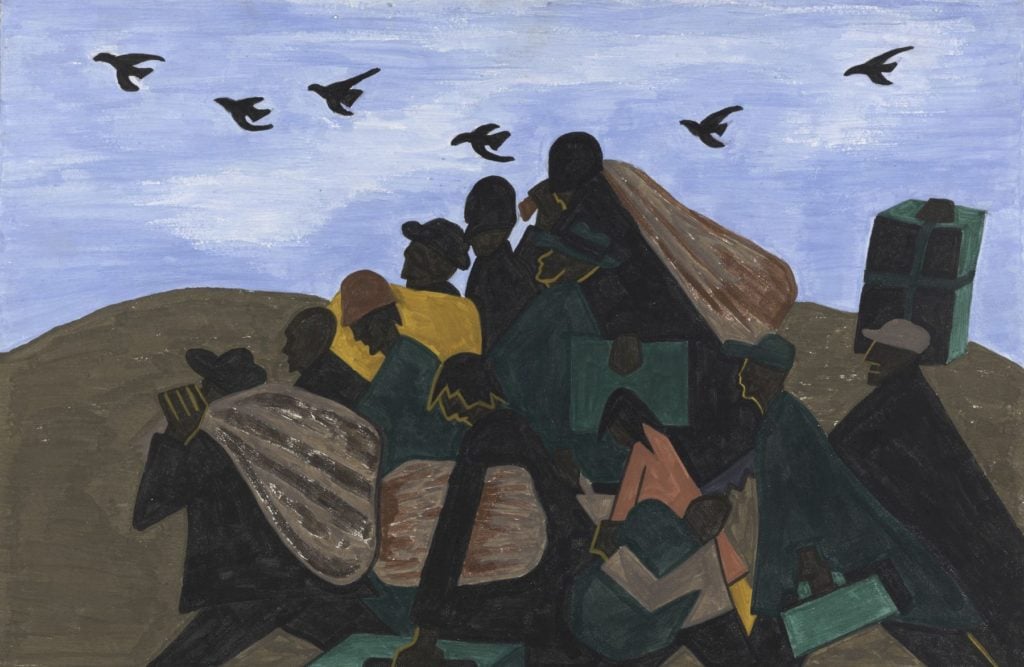
Jacob Lawrence, Panel 3 from The
Migration Series, From every Southern town migrants left by the
hundreds to travel north (1940–41). The Phillips Collection,
Washington, DC; acquired 1942. © 2019 The Jacob and Gwendolyn
Knight Lawrence Foundation, Seattle / Artists Rights Society (ARS),
New York.
And it seems that the crux of the show is centered on
remembering. Its imperatives are: remember the atrocities of the
past, remember the history of your people and your peers, and
remember your influences. Several works memorialize the
contributions of African Americans to the national labor force, war
efforts and industry. Jacob Lawrence’s Migration Series
(1940-41) reminds us of the plight of Black migrants as they
experience bombings of their homes, disease, and harsh working
conditions on their way north at the end of World War I. Eitaro
Ishigaki, one of two Japanese-Americans in the show, reminds us
with The Bonus March (1932) of the shared
disenfranchisement among Black and white war veterans post World
War II. The painting depicts a towering African American man
holding his fallen white comrade at a march demanding unpaid wages.
And Hideo Benjamin Noda, with his painting Scottsboro Boys
(1933), reminds us of the nine Black boys wrongly accused of
sexually assaulting a white woman on a Southern Railroad train in
1931.
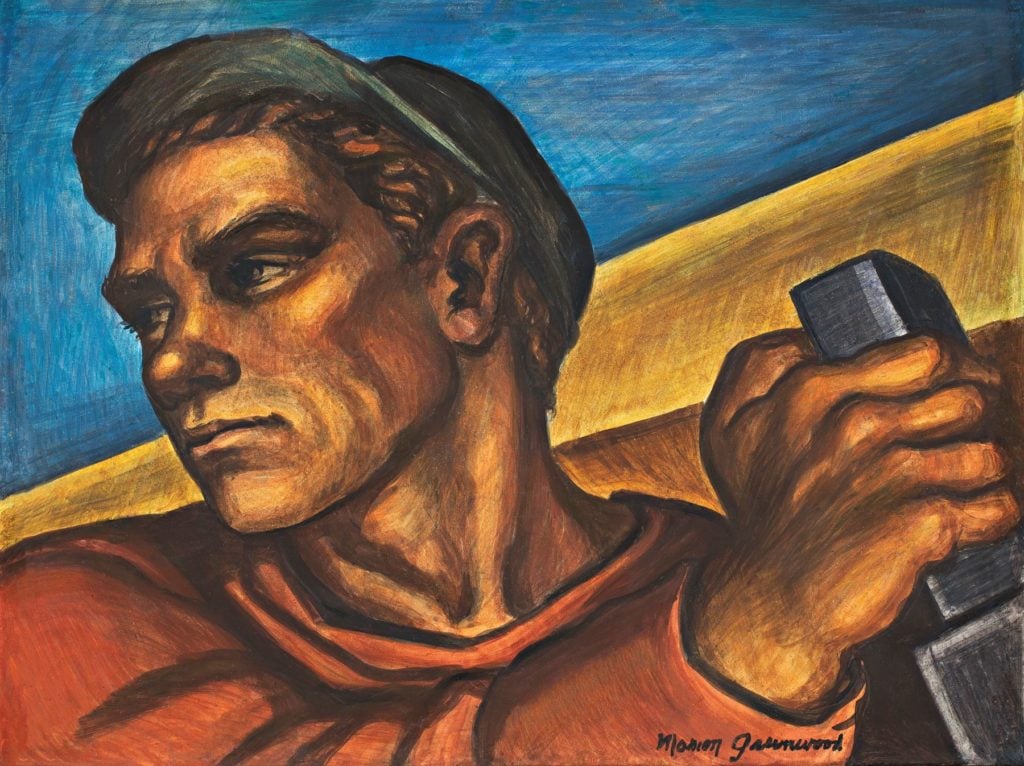
Marion Greenwood, Construction
Worker (study for Blueprint for Living, a Federal Art Project
mural, Red Hook Community Building, Brooklyn, New York)
(1940). Frances Lehman Loeb Art Center, Vassar College,
Poughkeepsie, New York; gift of Mrs. Patricia Ashley.
Five American female artists—Elizabeth Catlett, Belle
Barranceanu, Thelma Johnson Streat, Marion Greenwood, and Henrietta
Shore—each have a small work tucked in the show. Overall, women
figure more prominently as subjects—fruit and flower vendors,
teachers, comrades in the revolution, and victims of war.
Baranceanu’s Building Mission Dam (1938), a mural study of
Spanish missionaries overseeing forced labor of Native Americans,
was featured in the catalogue but unfortunately doesn’t make it
into the exhibition. Its presence would have shown another
inextricable linkage between Mexico and the U.S. through the
colonization of land and displacement of Native Americans.
Since memory and acknowledgement of influence are such a big
theme throughout the exhibition, it’s a shame to see the show
missed the chance to acknowledge some of its own forbearers.
“In the Spirit of
Resistance: African American Modernists and the Mexican Muralist
School” was seen first at the Studio Museum in Harlem in 1996
and traveled to five other museums across the country. The show is
not referenced. Its living curator Lizzetta LeFalle-Collins
confirmed to me she was not consulted by the Whitney even though
four of the six African-American artists in “Vida Americana” were
featured in her catalogue.
At any rate, “Vida Americana” is just one in a long line of
exhibitions making a similar argument. The argument for the Mexican
muralists’ influence is recounted in other books, articles, and
exhibitions going back decades. The affiliated scholars for shows
like “South of the Border: Mexico in the American Imagination”
(1993) at Yale University Art Gallery, the book Muralism Without Walls:
Rivera, Orozco, and Siqueiros in the United States,
1927-1940 (2009), and “Paint the Revolution: Mexican Modernism,
1910-1950” (2013) at the Philadelphia Museum of Art are all
acknowledged as references by the Whitney show.
If abundant art historical revisionism has been done—including
academic books and big-ticket exhibitions—where does the idea about
the exclusion of Mexican influence come from and why?
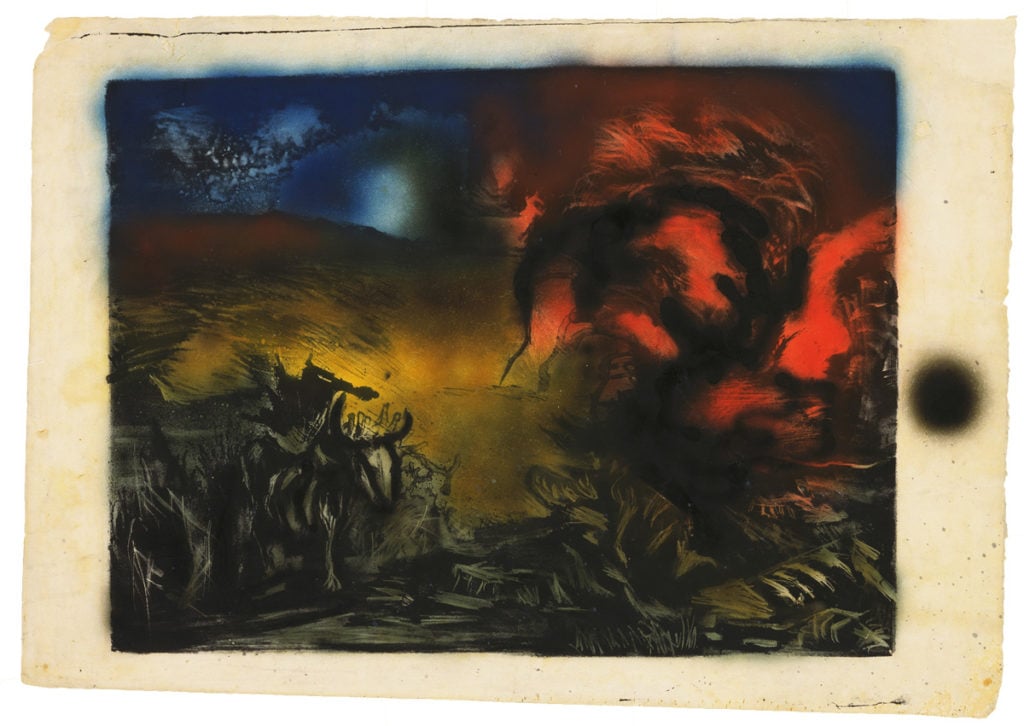
Jackson Pollock, Landscape with
Steer (ca. 1936–37). Museum of Modern Art, New York; gift of
Lee Krasner Pollock. © 2019 The Pollock-Krasner Foundation /
Artists Rights Society (ARS), New York. Image © The Museum of
Modern Art/Licensed by SCALA / Art Resource, NY.
It’s partly xenophobia, partly anti-Communist red-baiting, and
partly due to art critic Clement Greenberg’s authoritative opinion
that heralded abstraction as the one true progressive American art
form. Yet “Vida Americana” provides vivid evidence that even
Abstract Expressionism has roots in the revolutionary ideologies of
the Mexican muralists. Stylistic juxtapositions between Jackson
Pollock, Orozco, and Siqueiros make the influence viscerally clear.
It is well known that Pollock revered Orozco and was a member of
Siquieros’s experimental workshop in New York, where he was
encouraged to splatter, drip, and liberate his technique.
But Pollock had what Harold Bloom coined an “anxiety of
influence,” masking his sources of inspiration. The proof in the
show that Pollock, an innovator in American art history, was
inspired by Mexican artists to revolutionize his painting technique
will be impactful to many.
Yet using the documentation of influence to validate the
inclusion of understudied, undervalued American artists still seems
to only continue the marginalization of Latino and Native artists.
Were there absolutely no Latino and Native artists of value
influenced by the Mexican muralists? None are included in the show.
The Ojibwa painter Patrick DesJarlait and
Mexican-American artists Eduardo Arcenio Chavez and
Octavio Medellín, for
instance, were all creating during this period and show stylistic
references reminiscent of Mexican Muralism. Of the three, Medellín
was considered for “Vida Americana” but ultimately not included.
“It would have been a stretch. Every artist in the exhibition has
documentation that proves they knew the Mexican muralists or saw
their work in textbooks,” assistant curator Marcela Guerrero told
me.
Guerrero does address Mexican-Americans in her essay for the
catalogue noting their experience with exploitative labor
practices, racist hostilities, and even a government-backed deportation
effort in the late 1920s and ‘30s. Many were forced to repatriate
to Mexico even though they had birthright American citizenship, a
shamefully little-known part of American history. Guerrero notes
that Rivera first supported repatriation, then rescinded support as
he worked on his famed Detroit Industry murals in 1932.
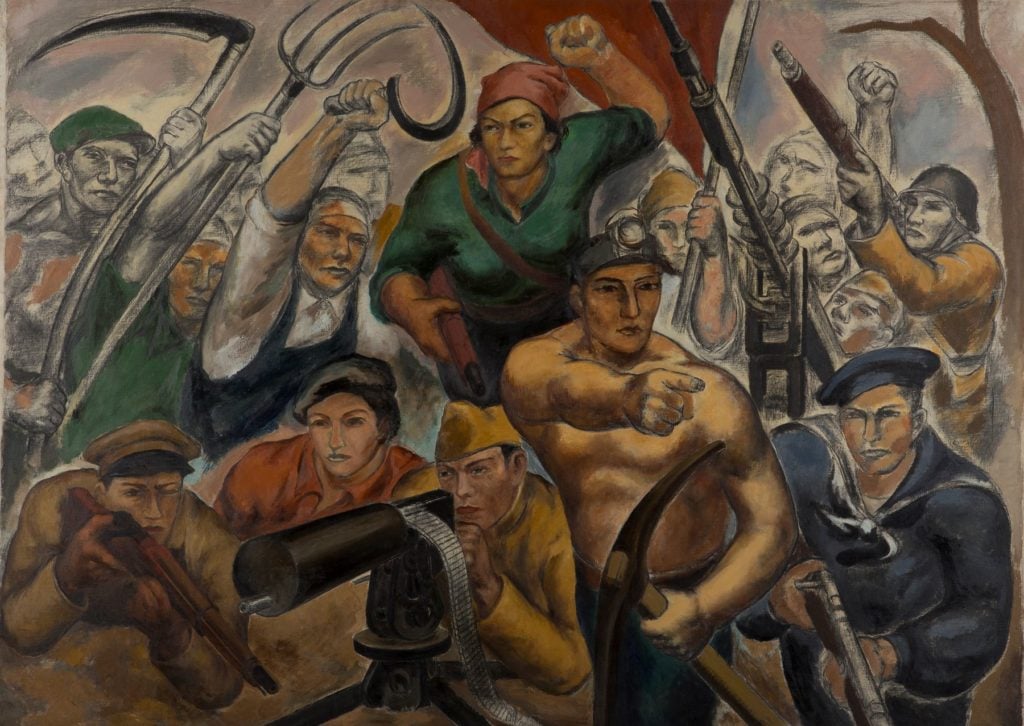
Eitarō Ishigaki, Soldiers of the
People’s Front (The Zero Hour) (ca. 1936–37). Museum of Modern
Art, Wakayama, Japan. Reproduced with permission.
So, what are the wider implications for “Vida Americana”? It is
undoubtedly true that Mexican people, the Mexican landscape, and
Mexican culture are all inextricably linked to U.S. culture. The
cultural siphoning of Mexican culture exists in tourism, fashion, exploitative photography, film, and art
internationally and has for decades. It is satisfying to see art
historical credit given where credit is due considering the
vampiric relationship the U.S. has with Mexico. But the layers of
buried histories have only begun to be unearthed.
And though recognition is necessary, I wonder when revisionist
exhibitions become cosmetic insertions as opposed to long term
investments? Data journalist Mona Chalabi believes the content of permanent
collections are better markers of a commitment to equitable and
diverse representation for museums.
“Vida Americana” was made possible through more than 65
institutional lenders. The last big demographic study of artists in
major museums clocked white artists in the Whitney’s collection
at 91.7 percent.
The museum has made efforts to diversify in the last few years
collecting important Latinx contemporary artists like Laura
Aguilar, Daniel Lind Ramos, and Teresita Fernandez. But it’s
important to remain vigilant as both the perception and reality of
cultural equity in museums can be skewed. A few
years of collecting pointedly is not enough to fill nearly a
century of blind spots in American art history. Radical investment is
needed. And one hopes that the radical images of racial justice,
worker’s rights, and democratic ideals in “Vida Americana” can
continue to influence those with the buying power.
“Vida Americana: Mexican Muralists Remake American Art,
1925-1945” is on view at the Whitney Museum of American Art,
through May 17, 2020.
The post The Mexican Muralists Had a Vital Influence on US
Art. Can Their Revolutionary Approach Offer Lessons for the
Present? appeared first on artnet News.
Read more https://news.artnet.com/exhibitions/vida-americana-mexican-muralists-whitney-1786695
Further reading


Leave a comment