
Nervous Chatter About the Coronavirus and Shaky Financial Markets Unsettled Visitors and Dealers at the Opening of Arco Madrid
Arco
Madrid, the Spanish-speaking world’s leading art fair, opened its
doors on Wednesday as bad news broke in another part of the art
world: Milan’s mega design
fair, Salon del Mobile, has been pushed back until June because of
a spike in the number of coronavirus cases in Italy.
Adding to the sense of foreboding was a sharp fall in prices on
the New York Stock Exchange.
“I
thought I might be treated like a plague carrier,” said Carolyn
Christov-Bakargiev, with a touch of gallows humor. (Wash your hands
throughly to minimize the risk of infection, experts say, and maybe
don’t shake too many hands.)
The
director of the Castello di Rivoli contemporary art museum outside
Turin is in Madrid for the fair, just days after
her museum was forced
to close because of Italy’s lockdown on regions affected by the
virus.
With
three new exhibitions shuttered before they could open, including
one of Chinese contemporary art, her 2020 program (and budget
forecast) have been thrown into doubt. It’s a situation faced by
many dealers and collectors at the fair, too.
Emmanuel Perrotin, having just arrived to
Madrid from Frieze Los Angeles via New York, says he will be
spending more time in Paris these days because of the coronavirus.
His spaces in Shanghai, Seoul, and Hong Kong are all shuttered, and
work on fitting out a new space in West Kowloon, Hong Kong, has
stopped.
Seated
aptly on a rocking Iván Argote bench, the gallerist admitted that
he was worried particularly about how all the disruptions would
impact the artists he represents.
It is
a “sad and strange” feeling, Perrotin admitted. But as a veteran of
market ups and downs, he is determined to look on the bright side.
Asian collectors are still buying, he said, and on the upside, his
carbon footprint will be reduced. “I was planning to go to Shanghai
and Hong Kong,” Perrotin said. “Now, I will not travel in
March.”
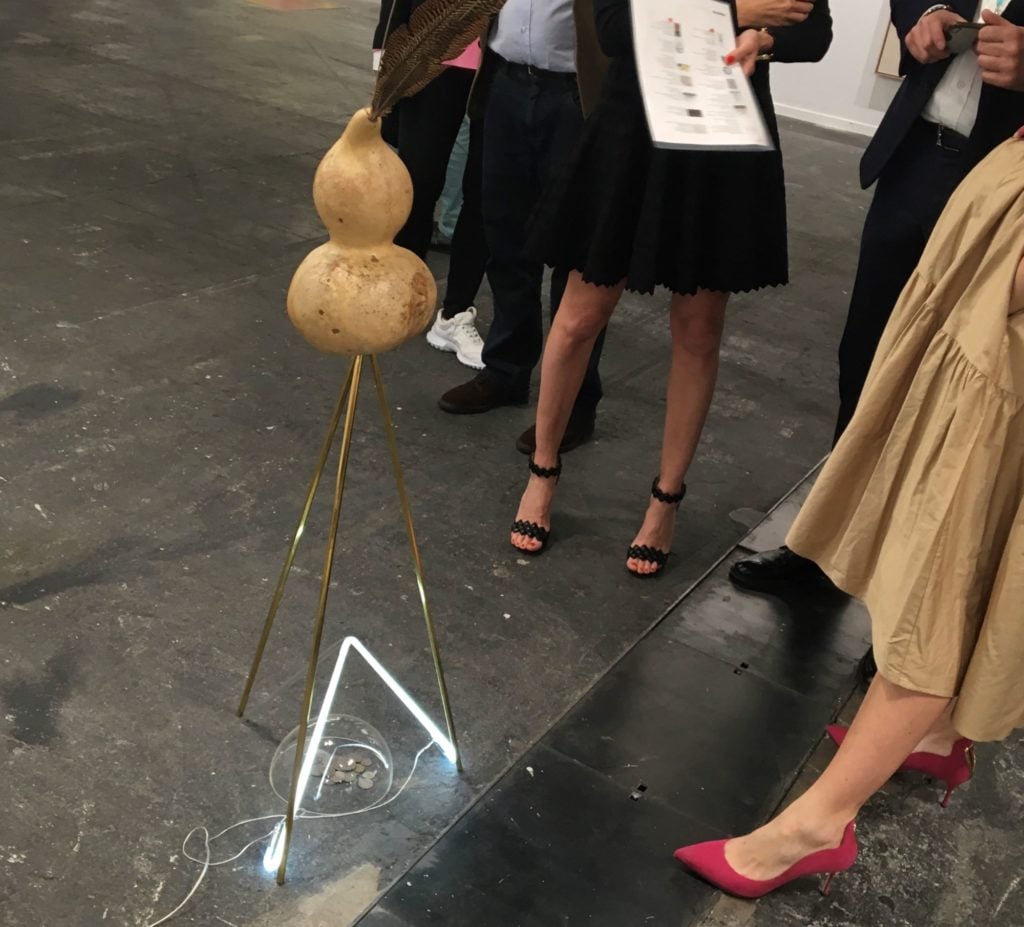
Gabriel Rico, Asintomática VII
(2019) at Emmanuel Perrotin. Photo by Javier Pes.
Wheelin’ and Dealin’
Arco
Madrid, now in its 39th edition, is where the more than 200
exhibiting gallerists expect to see their Spanish and South
American collectors out in force. Italian, French, and
globe-trotting Belgian collectors can also be guaranteed. Price
points tend to vary from tens of thousands of euros, to a few
hundred thousand.
Within
hours of the fair opening to what the organizers call “professional
visitors” (rather than VIPs), Perrotin had sold an installation by
the Mexican artist Gabriel Rico to a Spanish collector in the lower
price bracket. (So far, no rogue art critic
has taken aim at Rico’s fragile work.)
Meanwhile, the British gallerist Timothy
Taylor, who has spaces in London and New York, and who has dipped
in and out of Arco Madrid over the years, happily sold a book
sculpture by Antoni Tàpies to a Spanish collector for an
undisclosed sum on preview day.
(The
work was earmarked by a royal minion for a photo-op to take place
on Thursday, when the Spanish king and queen are due to visit the
fair. Felipe and Letizia are Arco Madrid regulars, which speaks
volumes about the event’s status.)
More
than 100,000 people are expected to attend the show before it
closes on Sunday, but sales appear to have got off to a sedate
start, with no big-ticket, early-bird purchases announced by
galleries. A 1987 Rauschenberg “glut” sculpture at Thaddaeus Ropac,
last seen at Frieze London in October, was on reserve,
however.
Elsewhere, a monumental granite sculpture by
Eduardo Chillida at Hauser & Wirth, priced at €5 million ($5.4
million), seemed to be more on show than to go (to a
collector). The solo
booth, tiny by the mega-gallery’s usual standards, seemed designed
to announce its partnership with the artist’s estate and its new
outpost in Menorca.
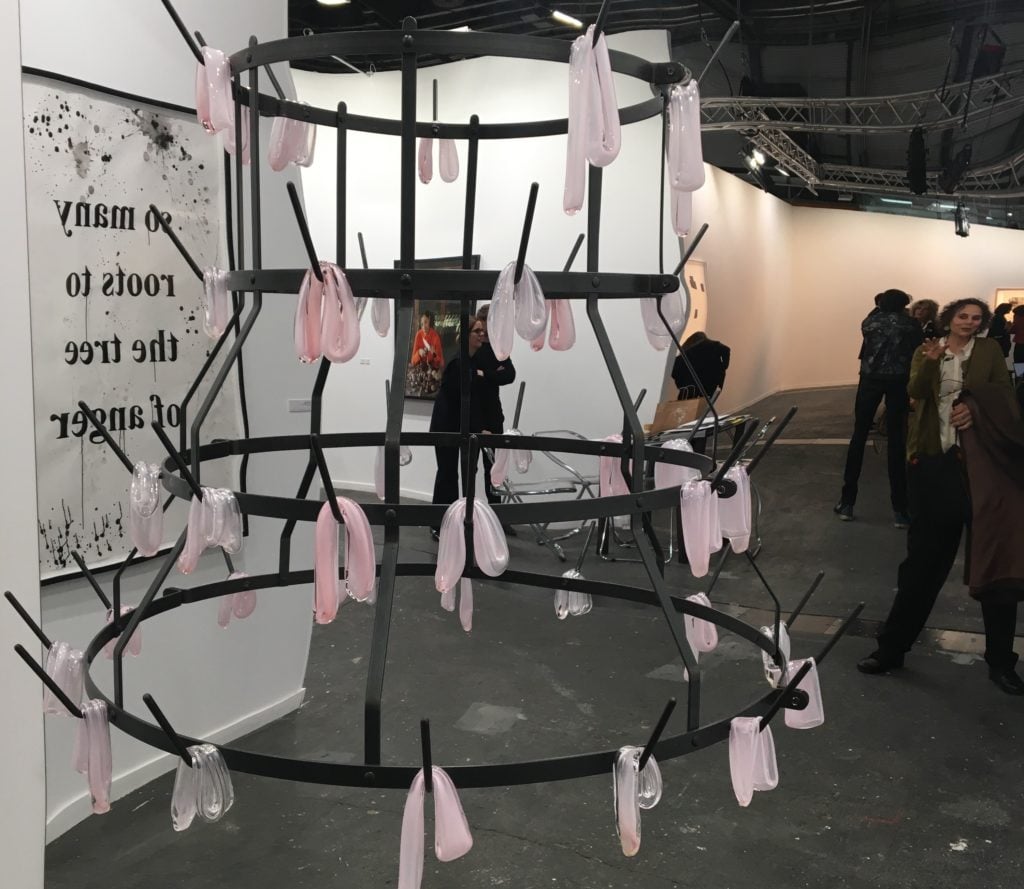
Monica Bonvicini, On the Rack
(pink) (2019) at Galerie Krinzinger. Photo by Javier
Pes.
Thomas
Krinzinger, an Arco Madrid stalwart, is presenting works ranging
from around €5,000
to €300,000 ($5,400–$33,000), and the lower price points are
aimed at newbie collectors.
“There
is a big diversity of collectors,” he said. “It’s difficult to sell
for a million here.”
A
large Duchampian bottle rack, draped with flaccid glass penises
mounted on a mirror, by Monica Bonvicini made an eye-catching
statement on the booth. The Italian artist, who is based in Berlin,
was at the fair before jetting off to Vienna, where she is
accepting this year’s Oskar Kokoschka prize—assuming the event is
not canceled because of the coronavirus
outbreak.
“Coronavirus is on my mind, of
course,” said Phillipe Vergne, the former director of MoCA LA, who
now leads the Serralves Museum in
Porto, Portugal.
The
French curator made the trip to Madrid in part because of the
strength of Spanish and South American galleries, and the chance to
learn about the artists they represent—“such as Tàpies,” he
deadpans.
Speaking seriously, he name-checks the
Miami-based, Venezuelan artist Rolando Peña as an artist worth
rediscovering. Peña has a solo presentation at the Sao
Paulo-based Galeria Baró’s booth that includes a series documenting
the artist’s 1967 collaboration with Andy Warhol, a wild happening
involving paella, a bicycle, and Factory chums at an East Hampton
bolt hole.
Peña,
who was at the fair, cut a dapper figure. His phallic-looking
diagonal column of gold painted oil barrels also makes an
impression. It is priced at €70,000
($76,000).

Ilse Fusková, El Zapallo (The pumpkin)
(1982). Image courtesy of waldengallery ©️Ilse Fusková.
As sexy—but in a feminist
way—are self-portrait photographs by another veteran artist from
South America, this time at Walden Gallery of Buenos Aires. They
feature a striking nude image of the Argentine activist-artist Ilse
Fusková with sliced-open pumpkin between her legs.
Fusková, who came out as a
lesbian in the 1980s and cofounded Buenos Aires’s Pride March,
turns 91 this year. Her 1982 work El Zapello (the pumpkin) was among those snapped up by a
Spanish Institution. (Another edition was picked up by a Portuguese
collector.)
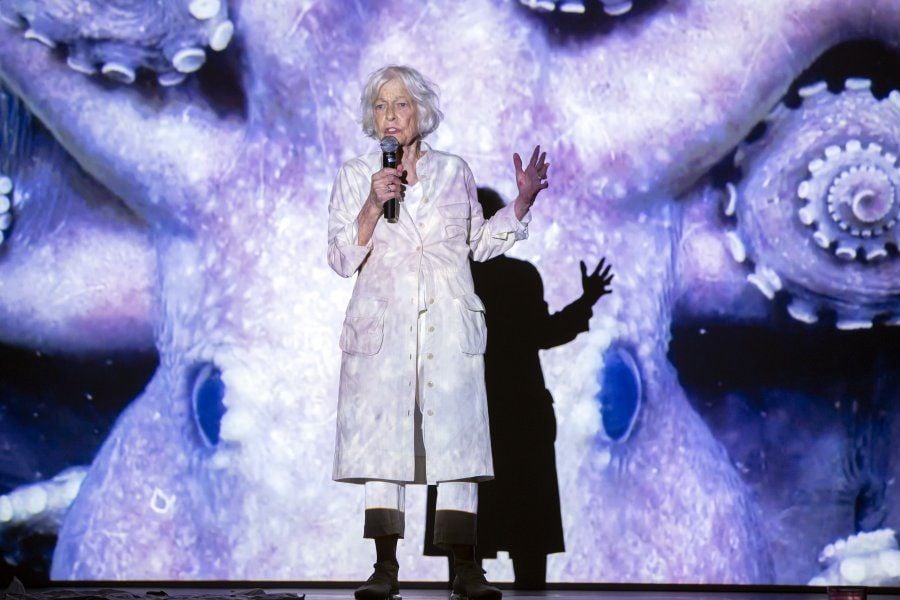
Joan Jonas, Moving Off the Land II
(2019), Ocean Space, Chiesa di San Lorenzo, Venice. Performance
with Ikue Mori and Francesco Migliaccio. Commissioned by
TBA21-Academy. Photo: Moira Ricci. © Joan Jonas.
Another veteran female artist, Joan Jonas, made the trip from
the US to restage her aquatic-themed video and performance piece
Moving OFF the Land, which had its debut in Venice in
2019.
The memorable evening event in Madrid took place at the Museo
del Prado. (Jonas’s exhibition is on view across the street, at the
Thyssen-Bornemisza Museum, and is organized by TBA21 Academy.)
The performance ended with a poignant story about the artist and
a super smart octopus who lives in an aquarium. The sea creature
plays with Jonas’s fingers on screen.
After a long day at a fair where shaking hands didn’t seem the
thing to do, considering the circumstances, the simple gesture left
a poignant impression.
The post Nervous Chatter About the Coronavirus and Shaky Financial
Markets Unsettled Visitors and Dealers at the Opening of Arco
Madrid appeared first on artnet News.
Read more https://news.artnet.com/market/arco-madrid-2020-1788345
Further reading


Leave a comment