
A Brazilian Court Has Acquitted Art Collector Bernardo Paz of Charges That He Used His Inhotim Museum to Launder Money
Bernardo Paz, a prominent art
collector and founder of Brazil’s influential Inhotim museum, has
been acquitted of money laundering, likely bringing an end to a
legal saga that has roiled Brazil’s art world for
years.
Earlier this month, a
three-judge panel in the Brazilian city of Belo Horizonte
overturned a conviction issued by a lower court in 2017,
when Paz was sentenced
to nine years in prison for funneling money raised overseas for Inhotim
to support expenses related to his mining and steel
companies.
“It was as if an atomic bomb had
dropped on my head,” Paz told a Brazilian
reporter of the
moment he heard about the original conviction. “From then on, I lay
in a bed and didn’t get out. I haven’t been to the doctor in the
last two years because, for me, it doesn’t matter whether I live or
die. I never imagined that my name would go so low.”
Neither Paz, his attorney, nor a
representative for the prosecutor’s office immediately responded to
requests for comment. “In handing down its ruling, the court in
Brasília agreed that there had in fact been no criminal
wrongdoing,” a representative for Paz said in a
statement.
The businessman’s sister, Maria
Virgínia de Melo Paz, who was sentenced to five years in prison as
part of the alleged scheme, was also acquitted this month. Because
people convicted of white-collar crimes often remain free until the
ruling is upheld by an appeals court, neither sibling spent any
time in jail.
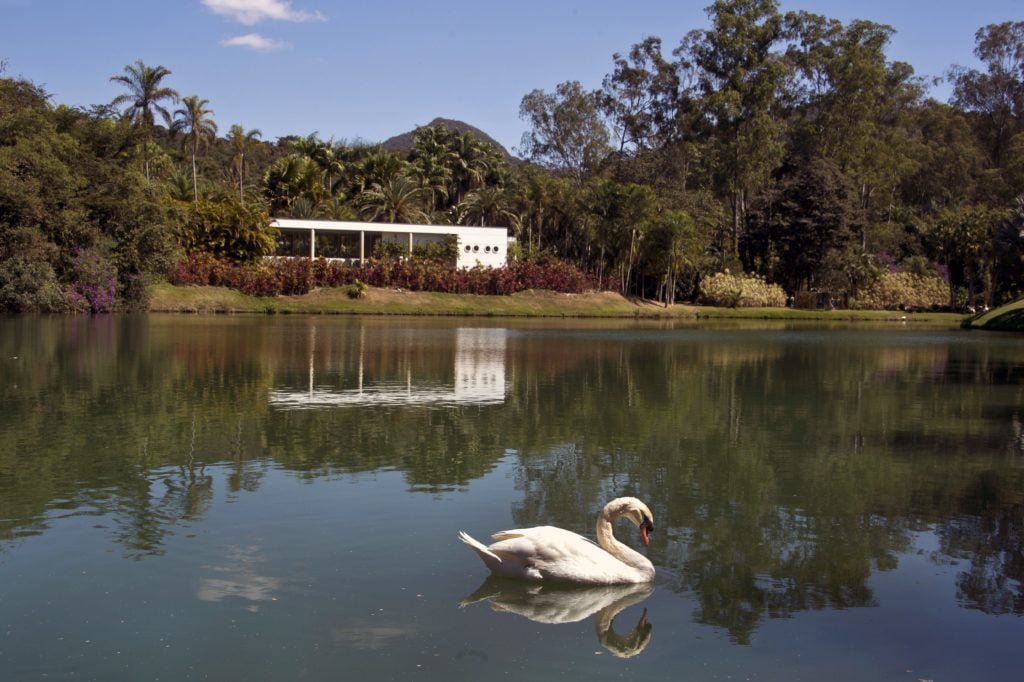
The Inhotim Centre for Contemporary Art
in Brumadinho, Brazil, some 60 km from Belo Horizonte, southeastern
Brazil. Courtesy of Nelson Almedia /AFP/Getty Images.
A 2013 complaint filed by
Brazil’s Federal Public Ministry alleged that a nonprofit company
founded by Paz to manage fundraising efforts for Inhotim was used
in 2007 and 2008 to hide tax-free transfers of some $98 million to
a conglomerate of 29 businesses he owned at the time. Paz, who sold
his conglomerate to Chinese investors in 2010, maintained his
innocence throughout the trial.
“Inhotim would like to
underscore that all its accounts are public and undergo careful
review by the Ministry of Culture in addition to being rigorously
audited by the British company Ernst & Young—both on an annual
basis,” a spokesperson for the museum said in a statement to Artnet
News in 2017.
Inhotim opened to the public in
2006 to showcase Paz’s world-class collection of art and botanical
specimens on his estate near the city of Belo
Horizonte. The institution, which houses pavilions
dedicated to work by individual artists, became a highly
influential model for private museums around the world. (It was
developed with the help of Paz’s art advisor Allan
Schwartzman, who went on to become chairman of Sotheby’s
Global Fine Art division.) Artists with work in Inhotim’s
collection include Brazilian figures Hélio Oiticica and Adriana
Varejão (Paz’s ex-wife) as well as international names like Matthew
Barney and Chris Burden.
Paz stepped down as Inhotim’s
chairman after his 2017 conviction, but continued to be dogged by allegations of
wrongdoing, including relying on child labor and evading taxes.
In 2018, he pledged 20 major site-specific
works—including Doug Aitken’s Sonic
Pavilion and four pieces by Varejão—to satisfy $100
million he owed in taxes. Brazilian officials pledged to keep the
art at the museum because of Inhotim’s importance to the local
economy and an Inhotim spokesman said that the agreement had no
relation to his money-laundering conviction.
Those weren’t the only obstacles
Inhotim has faced in recent years,
however. An outbreak of
yellow fever hit the region surrounding the museum in 2018; the
following year, the catastrophic bursting of a nearby waste dam
caused extensive damage to the area. As a result of these setbacks
and a decline in attendance, the museum’s net revenue has dropped
by over 33 percent, according to
Brazilian newspaper Folha de São Paulo.
Meanwhile, the museum has worked
to ramp up programming
efforts in an effort to
enhance its image. In a statement, a spokesperson for Paz said that
the museum has unveiled new projects by Robert Irwin, Paul
Pfeiffer, and David Lamelas within the past two years and is
preparing to open a long-awaited pavilion dedicated to Yayoi Kusama
in 2020.
The post A Brazilian Court Has Acquitted Art Collector
Bernardo Paz of Charges That He Used His Inhotim Museum to Launder
Money appeared first on artnet News.
Read more https://news.artnet.com/art-world/bernardo-paz-acquitted-inhotim-1788957
Further reading


Leave a comment