
Richard Serra’s Epic Steel Sculpture in the Qatari Desert Has Suffered ‘Significant and Deliberate’ Vandalism
A large-scale public artwork by
Richard Serra in the western Qatari desert has seen “significant
and deliberate damage” from visitors in recent
months.
Qatar Museums, an organization
that oversees a group of art institutions and public art projects
in the Arab country,
announced this week that it will launch a cleaning effort to
restore Serra’s work, East-West/West-East, which comprises four 45-foot-tall steel plates erected
in a line that spans nearly four miles.
The organization did not
disclose all the details of the damage and it did not responded to
a request for comment.
“Vandalism of any kind to our
public art, not only affects the community’s enjoyment of the piece
but also harms Qatar’s cultural heritage,” Abdullatif Al Jasmi, the
director of cultural heritage protection at Qatar Museums, said in
a statement. “It is important that people understand the social
impact of the damage to the artworks but also that they can receive
substantial fines and may be responsible for
restoration.”
Al Jasmi explained that the
organization is working with partners to institute a new Cultural
Heritage Law, “which will build on existing regulations to
strengthen the protection of arts and culture in the
country.”
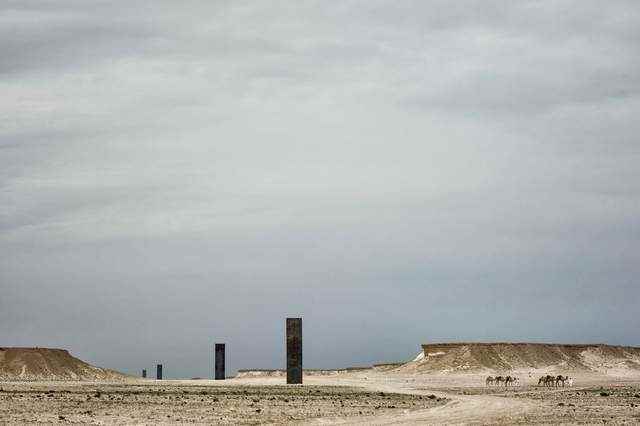
Richard Serra,
East-West/West-East (2014). Photo: Rik van Lent.
Completed in 2014,
East-West/West-East
boasts the largest footprint of any
of Serra’s works. It’s one of two public pieces by the artist in
Qatar (the other is 7, an installation of clustered steel plates
that was unveiled outside the Museum of Islamic Art in Doha in
2011). Both projects were funded by Qatar Museums, which is also
responsible for installing public artworks by Louise Bourgeois, Liam Gillick, and Damien Hirst, among others.
“Public art is a national asset
that we as citizens and residents can be proud of,” Qatar Museum’s
head of public art Abdulrahman al-Ishaq, said. “We call upon the
community to help us ensure that all public artworks are cared for
and protected, preserving them for the enjoyment of current and
future generations. Our public art is a fundamental part of Qatar’s
cultural life, benefiting the nation and its people, both socially
and economically.”
The post Richard Serra’s Epic Steel Sculpture in the Qatari
Desert Has Suffered ‘Significant and Deliberate’ Vandalism
appeared first on artnet News.
Read more https://news.artnet.com/art-world/richard-serra-epic-qatar-work-vandalized-1793622
Further reading


Leave a comment