
Art Basel’s 2020 Market Report Offsets Slumping Sales Figures With a Hopeful Fact: Millennials Are Buying More Art Than Ever
The latest of Dr. Clare
McAndrew’s annual reports sponsored by Art Basel and UBS portrays
an industry whose ingenuity and main engines for growth seem to
have stalled out.
However, the study also delves
into under-examined segments of the market that offer food for
thought about what, if anything, might finally propel sales of art
and collectibles beyond the limits of the 2010s.
If you’ve read any of the three
previous editions of The
Art Market, the headline
findings in its latest iteration will feel familiar. The report
estimates sales across all sectors of the art market to have
reached $64.1 billion in 2019, a decline of five percent versus the
prior year. That figure is roughly on par with McAndrew’s
approximation for 2017 ($63.7 billion), as well as within striking
distance of her estimate for the trade’s all-time high of $68.2
billion in 2014 (when her report was still being produced in
conjunction with TEFAF).
In other words, the market has
retrenched, but the larger takeaway is that it’s been unable to
crack the $70 billion ceiling for as long as anyone has been
checking.
Several other metrics showed
incremental upward or downward movement, but reinforced that the
macro picture of 2019 looks broadly similar to most other recent
years. The US, UK, and China (in descending order) remain the
world’s three largest art markets by value, still accounting for
more than 80 percent of the trade’s worldwide sales (82 percent, to
be exact); dealer sales increased to an estimated $36.8 billion
overall—a new peak, but only
a two-percent rise versus 2018; and online sales comprised an
estimated $5.9 billion, or nine percent of the market’s full
value.
(As a reference point, this
means e-commerce would have to nearly double in the next 12 months
to surpass the €10 billion
target for 2020 projected in McAndrew’s 2014 TEFAF Art
Market Report.)
The methodology used for the
report’s main sections remains largely unchanged from years past,
which can be read as either
a virtue or a vice, depending on your
perspective. On one hand, it
makes The Art Market
2020 a clean comparison
to past editions, reinforcing that the long-term trends on display
reflect shifts in the business rather than shifts in McAndrew’s
process. But its data still carries most of the same caveats as in
previous years, such as its melding of fine art, decorative art,
and antiques into a single stream (unless otherwise noted), as well
as the fact that its dealer-sector figures largely come from an
anonymized survey that aims to collect a representative
cross-section of the world’s private sellers via 6,500 potential
respondents—only about 1,100
of whom ultimately participated. (Although this 17 percent response
rate slightly exceeds the average for such surveys, and the report
deserves credit for gradually fleshing out its appendix over the
years, the raw data remains unavailable for review, leaving much to
a statistician’s imagination.)
Still, while attention will
almost undoubtedly gravitate toward the report’s central sales
data, arguably its most intriguing aspects arise from supplementary
analyses of Art Basel and UBS’s respective areas of expertise: art
fairs and high-net-worth individuals.
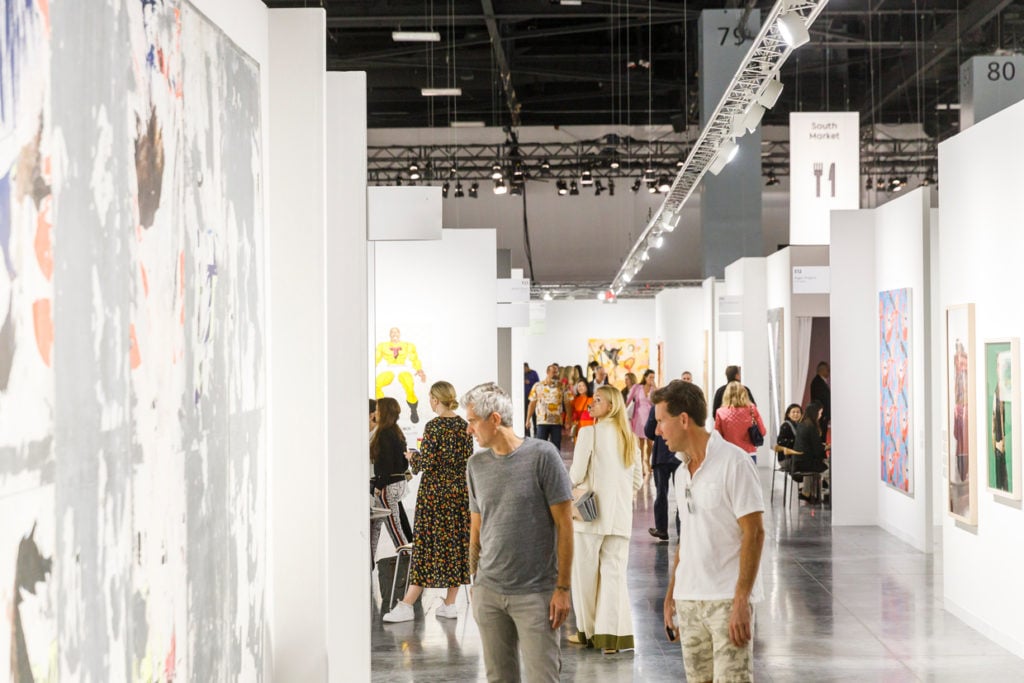
Art Basel Miami Beach 2019. Photo:
Courtesy of Art Basel.
Fair Play
Using the aforementioned dealer
survey (methodology skeptics, take note), the report concludes that
sales at art fairs totaled an estimated $16.6 billion in 2019,
essentially steady from the prior year. This figure would mean
fairs accounted for about one-quarter of the overall art market by
value—a proportion that
would have been unfathomable 20 years ago, when there were only
about 55 such events scheduled around the world.
But it isn’t just the amount of
fair sales that have changed. It’s also their timing. Although 64
percent of transactions by value ($10.6 billion worth) are still
finalized during the events themselves, about 15 percent of works
by value ($2.5 billion worth) are sold before the fairs even open,
and the remaining 21 percent of deals ($3.5 billion worth) don’t
close until after the fairs do. While this distribution may not
surprise anyone who’s participated in an art fair recently, it
would underscore that this sector of the art economy has become
more fluid—and harder to capture with traditional art-fair sales
reports—than ever.
Based on data from sources
beyond the dealer survey, the expanded timeline for deal-making
doesn’t seem to encourage risk-taking. McAndrew relays that about
two percent of “star” artists were responsible for about one-third
of the works on view in art-fair stands last year. Those star
artists also still demonstrated a huge gender disparity; only about
21 percent were female—a depressing parallel to what we’ve seen
in museum
collections.
However, the relative
conservatism of the works on view isn’t hurting attendance at many
fairs. Quite the opposite, in fact.
The report estimates that 1.2
million people visited art fairs in 2019, up four percent from
2018. Art Basel Hong Kong showed the strongest year-over-year surge
among major fairs, boosting attendance by 10 percent (and
highlighting why the cancelation of this year’s
edition due to coronavirus comes as such a blow). The Armory
Show shrunk the most among this cohort, shedding 12 percent of its
visitor figures from the prior year (perhaps owing in part to the
structural problems
discovered at its venue days before its 2019 edition was set to
debut).
Several fairs have also shown
incredible growth over a multiyear period. Among the major players,
Frieze London, Frieze Masters, and Masterpiece have each amped up
attendance by between 62 percent and 75 percent since 2013. Many
smaller fairs have done even better over that span, with Art
Beijing, the 1-54 Contemporary African Art Fair in London,
ZONAMACO, and others all at least doubling their
attendance.
And yet, consolidation (finally)
seems to have set in. The report found that the sector showed a net
loss of 14 art fairs between 2018 and 2019, suggesting the
possibility that the winners may be cannibalizing the
losers.
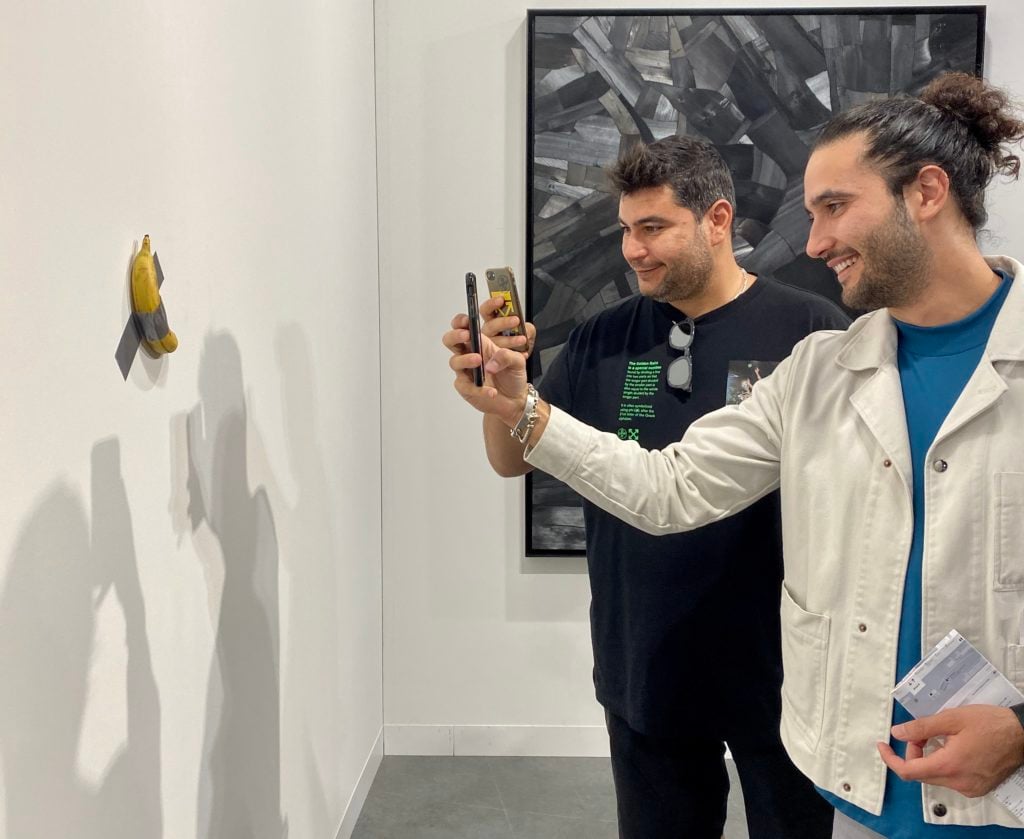
Fairgoers take pictures of Maurizio
Cattelan’s Comedian, for sale from Perrotin at Art Basel
Miami Beach 2019. Photo by Sarah Cascone.
Changes in Demand
As in past editions,
The Art Market 2020
includes data about who’s buying
art, antiques and luxury objects, not just who’s selling them.
Through UBS, McAndrew queried 1,300 high-net-worth individuals
(HNWI)—defined as
people with investable
assets greater than $1 million—about their collecting activity over a two-year
period. Each respondent hailed from one of seven markets:
the US, UK, France, Germany,
Hong Kong, Taiwan, and Singapore. And the results were
intriguing.
First, the respondents’ ages
seemed to make a much bigger difference in their habits than their
nation of origin. Millennials (here defined as people aged 23 to
38) outspent every other generation, acquiring an average of $3
million worth of art and collectible objects in the preceding two
years. In contrast, Baby Boomers in the sample (aged 55 to 73)
averaged less than $500,000 of spending each.
Although the most popular
purchases among survey respondents were jewelry, gems, and watches,
fine art ranked second among all age groups—but largely because of
the millennials’ impact on the overall results. About 79 percent of
millennial respondents acquired fine art regardless of their home
country, including 82 percent of those in the US. Millennials were
also the only generation where the majority of respondents acquired
at least one artwork, one design object, and one antique during the
two-year period in question.
Motivations for buying varied
substantially by age group, too. Roughly three-quarters of
millennials said that financial considerations impacted what, and
how much, they bought; only about one-third of Baby Boomers said
the same. Millennials were also the most enthusiastic about
churning their collections, with 71 percent saying they’d sold at
least one piece, compared to only about one-third of Boomers. And
yet, across all ages and countries of origin, 52 percent of
respondents admitted that more than half of the value of their
collection was in an off-site storage location, leaving readers to
wonder whether older HNWI simply own more artwork than their
juniors, or whether they’re more investment-minded than they’re
letting on.
Gender differences among these
wealthy buyers were pronounced, as well. Despite the fact that men
outnumbered women roughly two-to-one among respondents, women
tended to be higher-spenders on average at the upper tiers of the
market. About 34 percent of female HNWI spent more than $1 million
on art and objects, versus only about 25 percent of men. The
average female HNWI also had a larger collection than the average
male, with about one-third of women holding more than 100
works.
In total, the survey strongly
suggests that, if the art market is ever going to break out of its
box, it would do well to look to the young and to women of all ages.
And if sellers make that pivot, there’s no telling how much else
could change besides the industry’s total sales revenue.
The post Art Basel’s 2020 Market Report Offsets Slumping
Sales Figures With a Hopeful Fact: Millennials Are Buying More Art
Than Ever appeared first on artnet News.
Read more https://news.artnet.com/market/art-basel-ubs-report-2020-1794234
Further reading


Leave a comment