
Despite the Threat of Coronavirus, Buyers Turned Out in Force at the Armory Show to Make Seven-Figure Deals—Just Without the Handshakes
There was a time—just one week ago, in fact—that, because of the
impending spread of coronavirus, it was unclear if the Armory Show
would happen at all. Organizers sent out a statement insisting that
the annual New York fair at Piers 90 and 94 would go on, but
promised that “the safety of our exhibitors and guests remains a
top priority.”
Still, on Thursday, word got out that the ur-New York
collectors Barbara and Howard Morse had cancelled an
Armory-organized VIP tour of their home collection due to
“coronavirus concerns.” It appeared that the first domino had
fallen.
But instead, after that, the cancellations stopped, and the mood
seemed to shift: Now everyone was rooting for the Armory
show, hoping that it would not succumb to the outbreaks that led to
the cancellation of Art Basel Hong Kong, which was scheduled for
later this month, and the MCH-owned Baselworld watch fair at the
end of April, and the postponement of the Venice Architecture
Biennale until late August.
On Wednesday morning, the VIP preview was anything but empty. In
the opening hours the aisles were stalked by a healthy stream of
collectors from across the east coast—including Susan and Michael
Hort from New York, Barbara and Aaron Levine from Washington, DC,
and Jorge Perez from Miami—joined by curators such as future Venice
Biennale curator Cecilia Alemani and Studio Museum director Thelma
Golden. The message was clear: At least for the time being, the
threat of coronavirus will not keep the art world locked up in
quarantine.
“Everyone was ready to come,” said Nicole Berry, the fair’s
director. “Knowing that it wasn’t unsafe we decided to proceed. I
don’t think it’s deterring many people. New Yorkers are strong. I
don’t think it’s affected the city yet.”
That being said, a touchy-feely affair this was not. Instead of
the usual handshakes and double-tap cheek kisses, greetings ranged
from tasteful nods to full-on dance moves as people tried to figure
out how best to acknowledge each other’s existences. It’s strange
to watch a room full of grown men and women jabbing at each other
with their elbows. The bathroom sinks were chockablock with people
scrubbing their hands with abandon. At times the air smelled thick
of knockoff Purell.
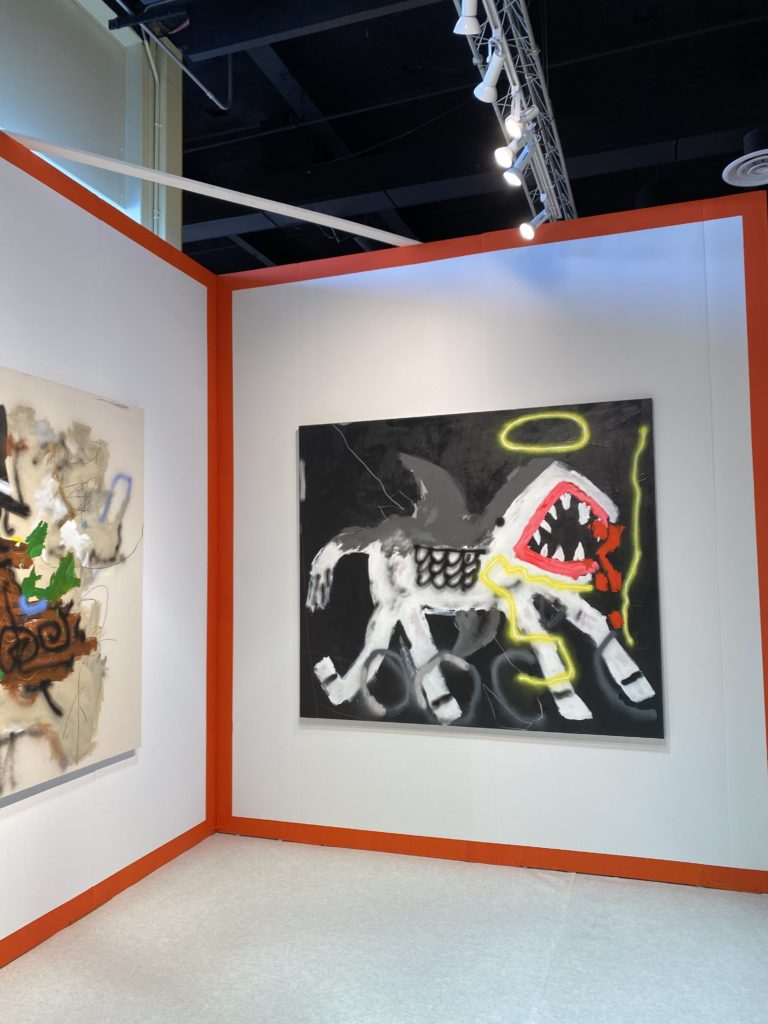
Work by Robert Nava in the booth of
Sorry We’re Closed. Photo: Nate Freeman.
A global contagion isn’t the only thing the fair has going
against it. Much has been made of the Armory Show’s relevance in
the increasingly hectic fair calendar. As of last year, it’s been
sandwiched between two fairs that have total global clout: Frieze
Los Angeles—which last month managed to upstage its already
successful first edition thanks to a mix of high-wattage booths,
celebrity attendees, and sunny weather—and, most years, Art Basel
Hong Kong. It’s hard for the Armory to compete with juggernauts,
especially when it lacks the presence of so many global
mega-galleries that have New York locations: David Zwirner, Hauser
& Wirth, Levy Gorvy, Pace, Lisson, Perrotin, etc.
But once again, the Armory Show succeeded on its own terms,
because it was a regional fair in New York City—something on the
scale of, say, Art Brussels or Expo Chicago that just happened to
be in the most important cultural city on earth. And like those
fairs, its residents prop it up, coming for not just the opening
but throughout the week, from the neighboring states and sometimes
a bit farther.
“We have a really strong US base of people that come—obviously
the tristate area is always going to come,” Berry said. “People are
traveling, and if they can make it here they can make it here.”
And such is the reason dealers keep making the trek. Even though
Roberts Projects just showed at the Felix Art Fair in its hometown
of Los Angeles, it made the trek to Gotham this week and brought
along serious works, including a large mixed media assemblage by
93-year-old artist Betye Saar, who just had a retrospective at the
Museum of Modern Art. It sold for $1.2 million—a large figure for
any fair, and one of the biggest price tags of the day.
“We’ve been doing this fair for a long time, and we support each
other, so we brought the best we could,” said gallery director
Bennett Roberts.
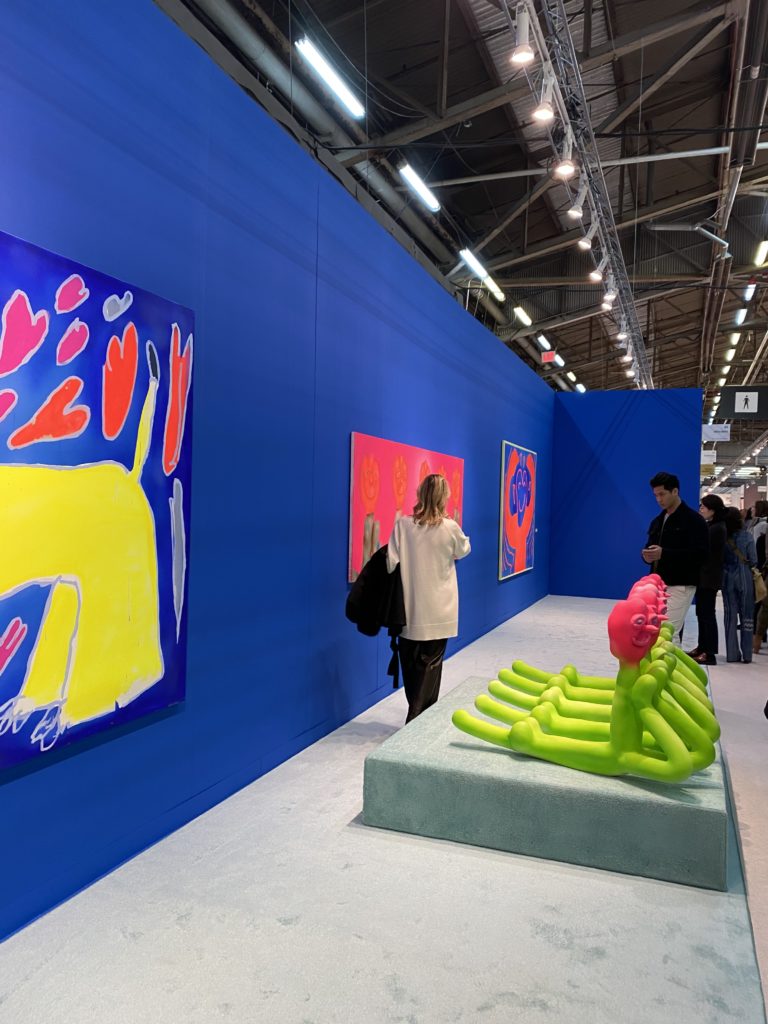
Installation view of the Jeffrey Deitch
booth featuring work by Austin Lee. Photo: Nate Freeman.
Also on the booth was a gigantic new Kehinde Wiley painting that
sold for $325,000, a new Jeffrey Gibson sculpture that sold for
$250,000, and a portrait by market darling Amoako Boafo, whose
painting The Lemon Bathing Suit (2019) sold last month for
$880,000 at Phillips on a high estimate of $65,000. The one now in
the booth, a smoldering 2019 painting titled Tassel
Earrings, sold to a Florida institution, and Roberts said a
work such as this usually sells for $200,000 on the primary
market.
“He’s hotter than hot,” Roberts said of Boafo, who is rumored to
be using this influx of cash to buy up Ferraris and tool them
around his hometown of Accra, Ghana. (Roberts did not confirm
this.)
“You know, Noah Davis is one of my discoveries too,” Roberts
went on, referring to the late painter who at the same time as the
fair had a painting sell at Phillips for $400,000 over a high
estimate of $80,000. “So people are asking me who to buy next. And
I’m not a magician, but I’m pretty good. My odds are pretty
good—I’m about a six out of ten. In baseball if you’re three out of
ten, you’re one of the all-time greats.”
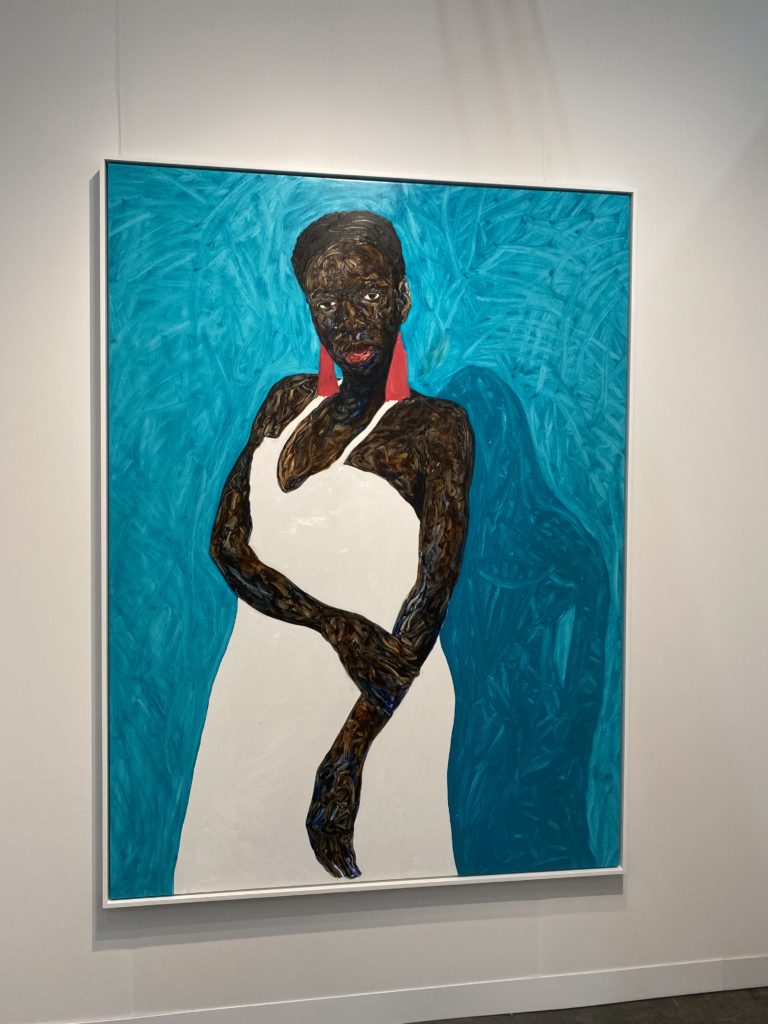
A work by Amoako Boafo in the Roberts
Projects booth.
At the booth of Brussels gallery Sorry We’re Closed in the
fair’s Focus section, located in Pier 90, director Sebastien
Janssen said he brought the big splashy new paintings by Robert
Nava because the artist is based in Brooklyn, and he’s never had a
solo booth here.
“I wanted New Yorkers to see him in the best way possible,”
Jannssen said.
He added that there’s such demand for the works that the buyers,
all but one of whom were from North America, had to endure a
waiting list until they got a work, at prices between $25,000 to
$35,000.
Jeffrey Deitch also brought a young-ish Brooklynite, the
charming maximalist artist Austin Lee, and sold all of the big,
neon-glowstick-colored, meme-influenced paintings by early
afternoon, with prices between $45,000 and $60,000.
In addition to those sales, Zeno X sold a Luc Tuymans for
$700,000 and Bortolami sold works by Mary Obering for $430,000.
Kayne Griffin Corcoran sold a Mary Corse work for $280,000. Kasmin
sold a bronze work by Lynn Chadwick (whose estate used to be repped
by the now-defunct Blain|Southern) for $130,000, while Swiss
gallery von Bartha sold Imi Knoebel’s Anima Mundi 8-4
(2019) for between $110,000 and $130,000.
Sean Kelly, a longtime Armory Show exhibitor, said that even
though his gallery is basically in the neighborhood, he brought
work by nearly every artist on his roster, and set up a special
sub-booth to display photographs taken by Dawoud Bey that make up
the series “Harlem, U.S.A., 1975-1979.” They haven’t been shown in
the city since they debuted at the Studio Museum in Harlem in 1979.
He said he chose this fair to debut works to coincide with the
traveling Bey retrospective that’s currently at the San Francisco
Museum of Modern Art—but also to acknowledge that, historically,
he’s done well at the fair.
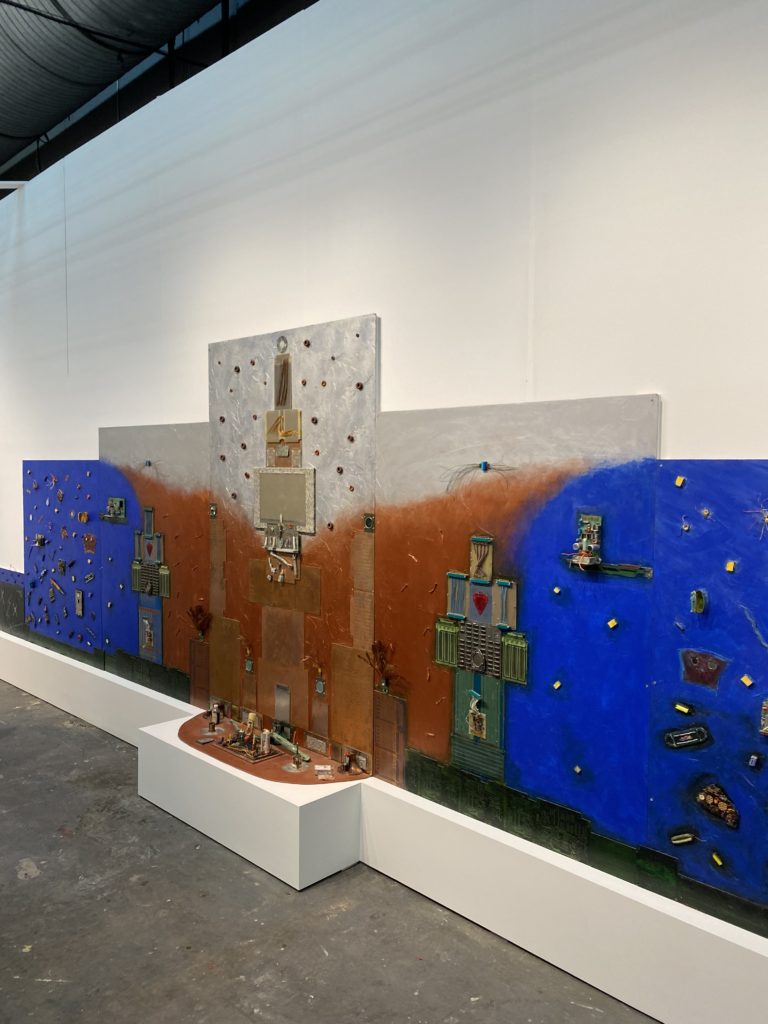
A Betye Saar work in the Roberts
Projects booth.
“Why would I do the fair if my gallery is a few blocks away?”
Kelly asked rhetorically. “Because it’s a five-day fair—people come
back every day, we do business every day. If someone wants to turn
up their nose at that, they can, but it’s ridiculous.”
He said that he had sold prints of the Dawoud Bey photos for
between $7,000 and $20,000, depending on the edition. Sculptures by
Hugo McCloud sold for between $75,000 and $95,000.
After Kelly and I were done chatting, he stuck out his arm.
Without realizing what we were doing, all of a sudden, I grabbed
his hand; we were shaking hands. I immediately recoiled, but Kelly
just laughed.
“This whole thing is ridiculous,” he said. “I’m glad you went
for the shake.”
The post Despite the Threat of Coronavirus, Buyers Turned Out in
Force at the Armory Show to Make Seven-Figure Deals—Just Without
the Handshakes appeared first on artnet News.
Read more https://news.artnet.com/market/armory-show-2020-1794207
Further reading


Leave a comment