
Forensic Architecture’s Founder on How the Group Used VR to Corroborate a Whistleblower’s Account of Human Rights Abuses in Israel
Virtual reality (VR) and augmented reality (AR) are having a
moment in the art world, from museums incorporating these
burgeoning technologies into audience engagement strategies, to the
plethora of artists using VR and AR to explore the limits of the
new medium (to varying degrees of success).
Forensic Architecture (FA) is the
latest to dip a toe in, this time exploring virtual reality’s
potential as a tool for social justice.
FA was founded in 2010 by architecture professor Eyal Weizman,
who recently was in the news for being
classified as a security threat by a Homeland Security algorithmic
policing program, and as a result denied entry into the US.
Coincidentally, he was traveling with his family to attend two
separate surveys of FA’s work: one in San Francisco and the other
in Miami, where FA’s first VR piece debuted.
Weizman was possibly targeted for undertaking exactly the kinds
of projects that his group is best known for: using open-source
technology, architectural software, artificial intelligence, and
other computer-based operations to investigate human rights
violations on behalf of organizations such as Amnesty International
and communities affected by political and state violence.
The group does not identify as an art collective, but
nevertheless exhibits its work frequently in museums and art
institutions around the world. Most recently, the Whitney Biennial
presented FA’s Triple-Chaser (2019), a video project that
looked into the use of anonymous tear gas canisters on civilians
along the US-Mexico and Israeli-Palestine borders, and the weapon’s
connection to Warren B. Kanders, a former board member of the
Whitney and CEO of Safariland Group—one of the world’s largest
manufacturers of such munitions.
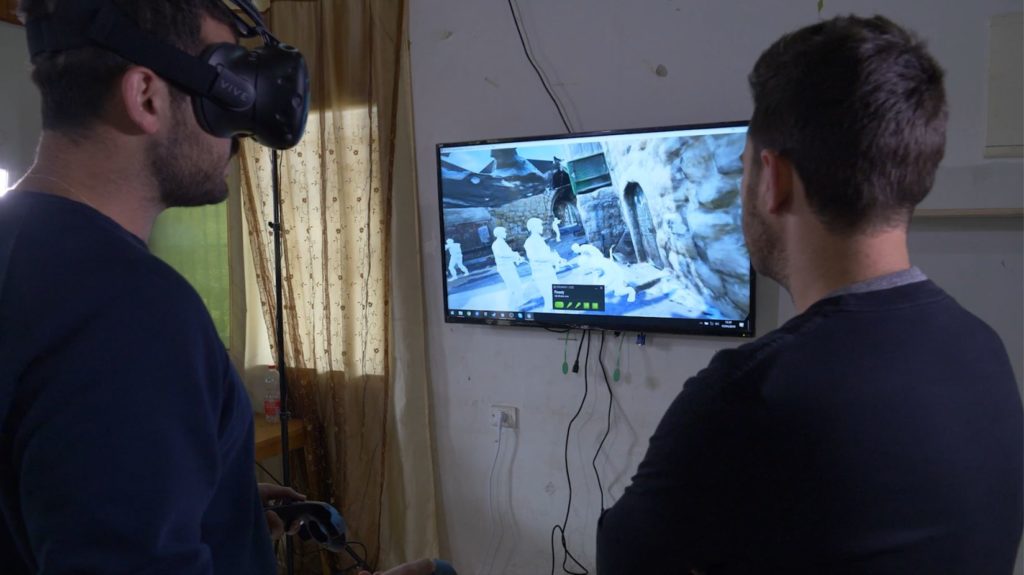
Dean Issacharoff, the soldier accused by
Israel of giving false testimony, describes the moment he illegally
beat a Palestinian civilian. Courtesy of Forensic
Architecture/Breaking the Silence.
Now, Forensic Architecure is putting VR to use on the specific
question of witness memory.
Produced with the Museum of Art and Design (MOAD) at Miami Dade
College (MDC), FA’s first project utilizing VR technology
investigates an incident that occurred in the city of Hebron,
Israel. Titled Hebron: Testimonies of Violence (2018–20),
the work will be included in the exhibition “Forensic Architecture:
True to Scale” at MOAD, the group’s first major in the US.
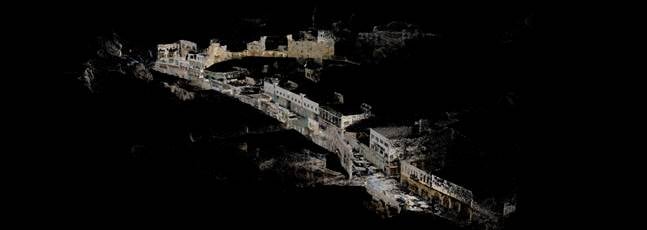
Forensic Architecture used
photogrammetry to create a point cloud scan of Shalala Street in
Hebron, Israel. Courtesy of Forensic Architecture/Breaking the
Silence (2020).
Hebron: Testimonies of Violence came together at the
behest of the Israeli activist group Breaking the Silence, an organization of
Israeli army veterans that seeks to highlight the situation in
occupied territories. In a recent phone interview, Weizman
described it as “an Israeli group of whistleblowers—basically
soldiers who testify against themselves for human rights
violations.”
The main spokesperson for Breaking the Silence, Dean
Issacharoff, confessed to brutally and unnecessarily beating a
Palestinian civilian during his IDF service in Hebron, in April
2018. An investigation by the Israeli government concluded that the
incident never took place and that Issacharoff was lying.
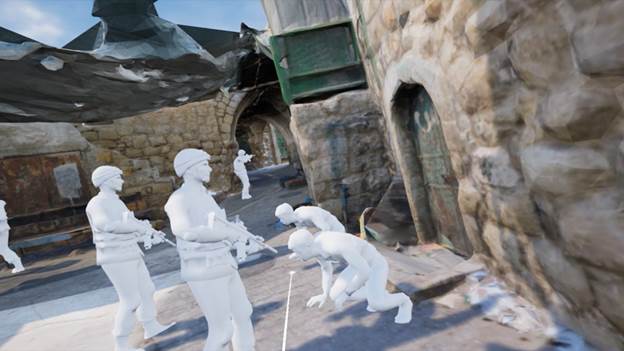
Dean Issacharoff’s point of view in the
virtual model as he describes the moment he illegally beat a
Palestinian civilian. Courtesy of Forensic Architecture/Breaking
the Silence (2020)
To corroborate Issacharoff’s confession, FA decided to meet with
two Palestinian witnesses and Issacharoff himself, and use their
testimonies to reconstruct the incident in virtual space.
Afterwards, FA would determine if their testimonies aligned, and if
they were consistent with other video and photographic
evidence.
This wasn’t an easy task. Conditions in Hebron, where the
historic city center has been under Israeli military control since
1967, have been described as
apartheid. The area is plagued by insidious violence. Israelis
and Palestinians are rarely in same space.
“We didn’t have access to that place,” Weizman told Artnet News.
“I’m Israeli. Part of our team is international and Palestinian.
There was simply no place we could meet in Hebron. Or rather, we
couldn’t have met at the site where [the incident] happened.”
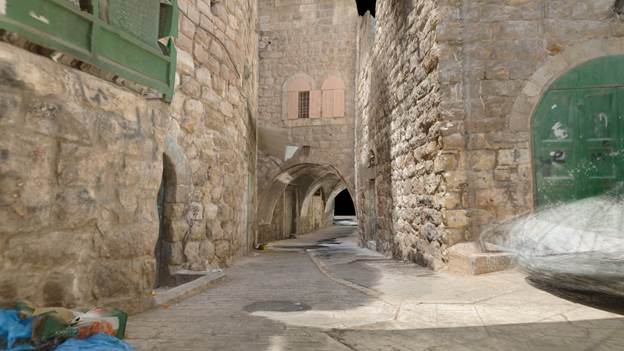
The photogrammetry scan was used to
create a high-resolution 3D model of the alleyway where the
controversial beating and arrest took place. Courtesy of Forensic
Architecture/Breaking the Silence (2020)
Instead, FA used photogrammetry to create a full-scale 3D map of
the area where the alleged beating happened. “We scanned the entire
neighborhood in huge detail. We took photographs and turned them
into a 3D model. And we allowed the testimonies to actually occur
in virtual reality,” explained Weizman. Witnesses, both Palestinian
and Israeli, were able to recreate the scene exactly as they had
seen it.
The technology allowed the witnesses to locate and move objects
and people in space—men, women, soldiers, trucks, guns, etc.—as
they recalled the event. FA was then allowed to cross-reference
these separate virtual testimonies with real photographs, to see if
the testimonies aligned or not.
In this case, FA concluded that they did, verifying
Issacharoff’s story.

Superimposition of the models from the
three witnesses we interviewed as they describe a convoy of
soldiers escorting arrested Palestinian civilians to a militarized
checkpoint in Hebron. Courtesy of Forensic Architecture/Breaking
the Silence (2020).
The exhibition at MOAD does not present the Hebron:
Testimonies of Violence as a VR experience that visitors can
use themselves. The group felt that this would have made the
project feel like amusement or an attempt to sensationalize trauma
and violence. FA instead presents still images and videos of some
witness testimonies staged within the virtual space.
Yet the potential use of VR technology as a tool for recalling
traumatic memories, is, in some ways, the real core of the
work.
Part of the genesis of the Hebron project was looking at the
success FA had from building 3D models of bomb sites to help
witnesses recall details from traumatic experiences. For example,
in Drone in Mir Ali (2018), FA worked with a German woman
to recall the details of a drone strike by creating a 3D model of
her home where the incident took place. The process triggered
memories and details of that in theory would have been lost or
never brought to light.
“The problem was, like many other witnesses, they were
traumatized and their memory of the incident [was] quite blurry or
it [was] distorted or there [were] lacunae in it,” Weizman
explained. “And the closer you get to the core of the testimony, to
the heart, to the essence, the more the memory becomes
difficult.”
Current studies have demonstrated that VR and other immersive
virtual technologies may help patients with dementia and
Alzheimer’s to recall buried memories. The implication that it may
help, in a substantial way, with memories of politically charged
events adds another tool to the toolbox of what has been termed
FA’s “evidentiary aesthetics.”
“Forensic Architecture: True to Scale” will be on view
through September 22, 2020 at the Museum of Art and Design at the
Miami Dade College.
The post Forensic Architecture’s Founder on How the Group
Used VR to Corroborate a Whistleblower’s Account of Human Rights
Abuses in Israel appeared first on artnet News.
Read more https://news.artnet.com/art-world/forensic-architecture-interview-1794126
Further reading


Leave a comment