
‘Record-Keeping Is Never Neutral’: Wolfgang Tillmans on How Photography Can Be Used as a Potent Political Tool for Change
It’s threatening to storm outside as Wolfgang Tillmans buzzes me
into his second-floor studio in Berlin. But aside from the beating
wind, there’s a calm that pervades this Sunday evening, as the
50-year-old Turner Prize winner sits down across from me in a large
space usually occupied by around 15 employees. Behind him hangs a
print of a young Chloe Sevigny holding an electric guitar, which
was likely a test for the 1995 print Chloe, currently
on view in his large exhibition at WIELS, his first
institutional show in Belgium, which opened mid-February.
To call these months busy for Tillmans would be a truism. Year
after year, the German artist takes on increasingly muscular
exhibitions, accompanying legacy publications, not to mention
political campaigns and album releases. In 2017, he had large shows
at Tate Modern and the Fondation Beyeler. Next year, he will have a
major retrospective at MoMA. Since last year, his institutional
exhibition, “Fragile,” has been touring several African nations,
including Kenya and Ethopia.
Despite his climbing prestige, Tillmans takes the same hands-on
approach to each of his projects. His photographs are stuck on door
frames and pinned above radiators, and his show in Brussels ends
without any pictures at all, but with a recording of his voice in a
room with a view overlooking the Belgian capital. Altogether, his
work feels searingly personal yet universal.
Besides his art practice, Tillmans has been actively campaigning
in defense of the European Union and the inclusiveness that it
represents. He also maintains a music, sound, and video practice
that will be featured at the MoMA’s new space called “the
Studio.”
As we begin, I fumble with my recorder and he smiles, telling me
that reporters often make this sort of remark when taking out their
audio devices. “Imagine that I would do what journalists do, but
with my camera,” he says cheekily.
This keen yet gently delivered observation is what separates
Tillmans from the rest: he and his photographs speak with a quiet
sense of authority without being assuming.
He puts his own phone out to record too, telling me that he
collects audio recordings for his archive. His studio is
meticulously populated with books, instruments, and memorabilia
that spans decades and countries. With our recording devices on the
table, Tillmans talks to me about his love of photography and
Europe, his plans for his most sweeping retrospective yet, and why
we urgently need activism as we continue to weather far-right and
populist surges in the 21st-century.
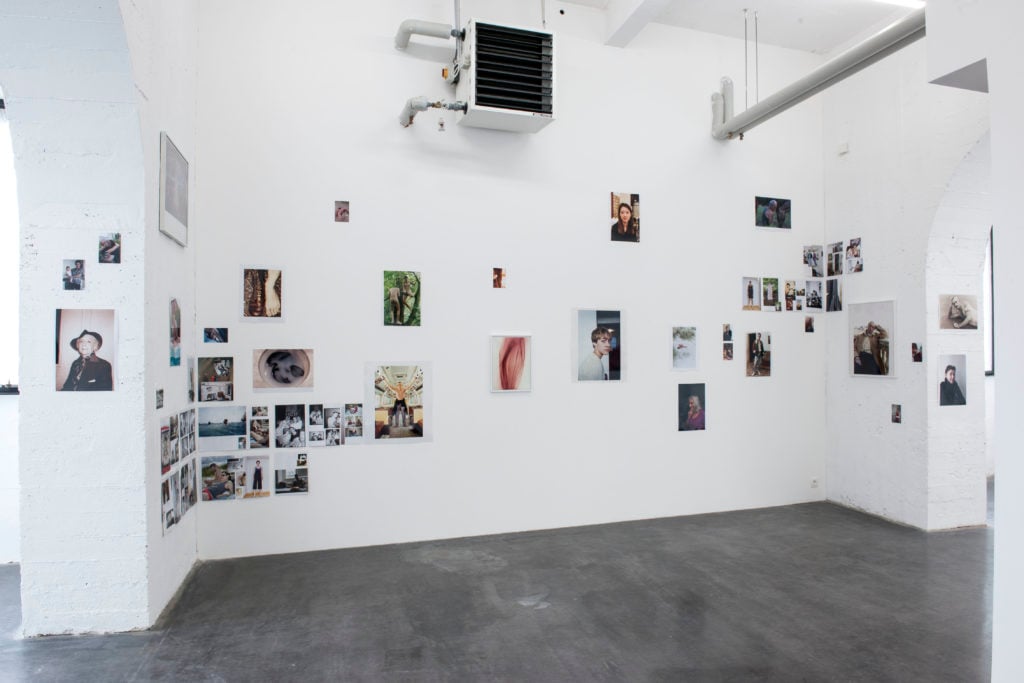
Wolfgang Tillmans “Today Is The First
Day.” WIELS 2020. Photo: Philippe De Gobert.
Can you walk me through how you were thinking about your
exhibition in Brussels?
I wanted to meet the audience where I am right now. The show is,
on the one hand an experiment, a look into where things could
develop. Maybe because of the MoMA show—which is very much a survey
with a retrospective mode—I am looking back at 30 years of work
right now. This process has made me rediscover works. Though they
might not make it into MoMA, the show at WIELS has benefited from
this fresh perspective, and new and old works sit side-by-side as
contemporaries, even though they are 25 or more years apart.
You have been coming to Brussels frequently over the
past few years to do political work in support of the European
Union, and you are vocal pro-EU advocate. But that it is incidental
to the fact that your show is titled “Today is the First Day,” and
that it opened just after Brexit officially occurred on January
31.
You couldn’t make it up. I titled the show in the autumn when
the Brexit date was still set for October 31. When it was
postponed, I did not notice that there could be this potential
conflict in interpretation. It was really only when I arrived in
Brussels two weeks before the opening and had an early interview
that one interviewer asked me about the connection. None of us had
thought about it. Sometimes when you are so close to something, you
are not seeing what is most obvious.
In the end, I had to make clear that it is not a celebration of
that new dawn. The title came from a song I wrote in 2016 and it
was purely from a personal perspective of freeing myself that I
felt at the time. Of course, there always is need for hope. It
didn’t seem strange in the end, it almost felt right. We cannot
make the done undone.
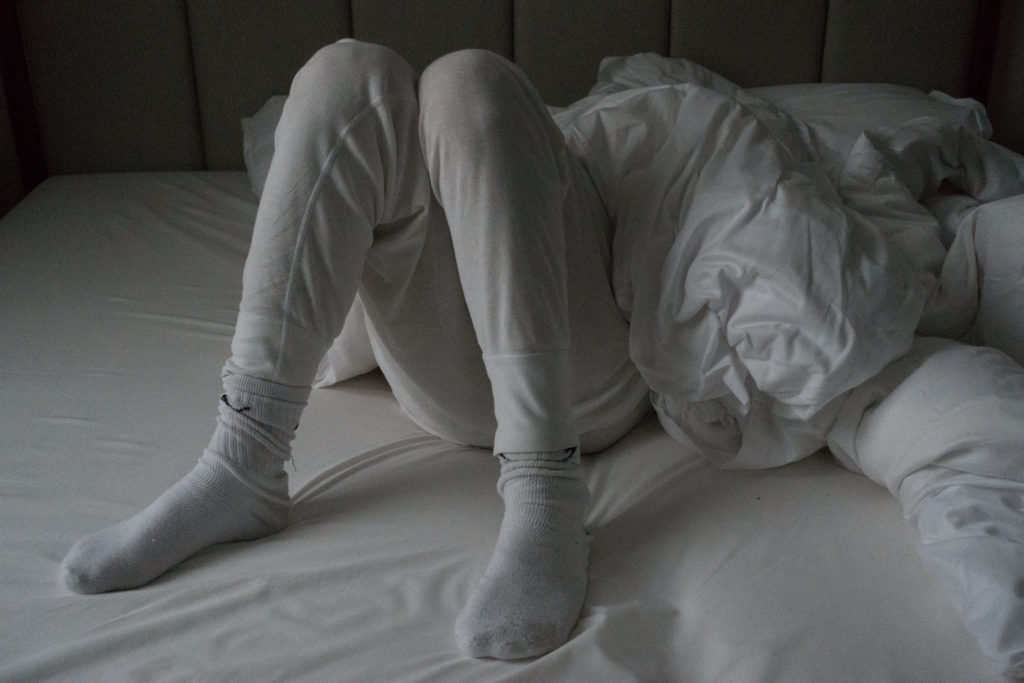
Wolfgang Tillmans, Kammerspiele
(2016). © the artist, courtesy Galerie Buchholz,
Berlin/Cologne, Maureen Paley, London, David Zwirner,
New York, Galerie Chantal Crousel, Paris.
How are you thinking about Brussels and everything it
represents to Europe in relation to this show?
At first, it seemed weird to not acknowledge it, but I decided
not to have any political campaigning, though there are political
works in different ways in the show, of course. There is just one
newspaper page from the Neue Züricher Zeitung from the
Vote Together European elections campaign in a side room
upstairs.
Not only are you based in the UK and Europe, but you are
an active pro-Remain and pro-EU campaigner. How are you feeling now
that Brexit has officially passed?
When I grew up, World War II and the idea of reconciliation were
still very much alive. We wanted to be interested in each other and
befriend each other so that the past could never happen again. The
idea is to end this process of getting closer—though this is not
how anyone in the Brexit campaign would frame it, because they say
it is not against other Europeans but against the “faceless”
machine of the EU in Brussels. But it is of course shutting a door
on 420 million other people, saying “we don’t want to share the
house with you anymore.”
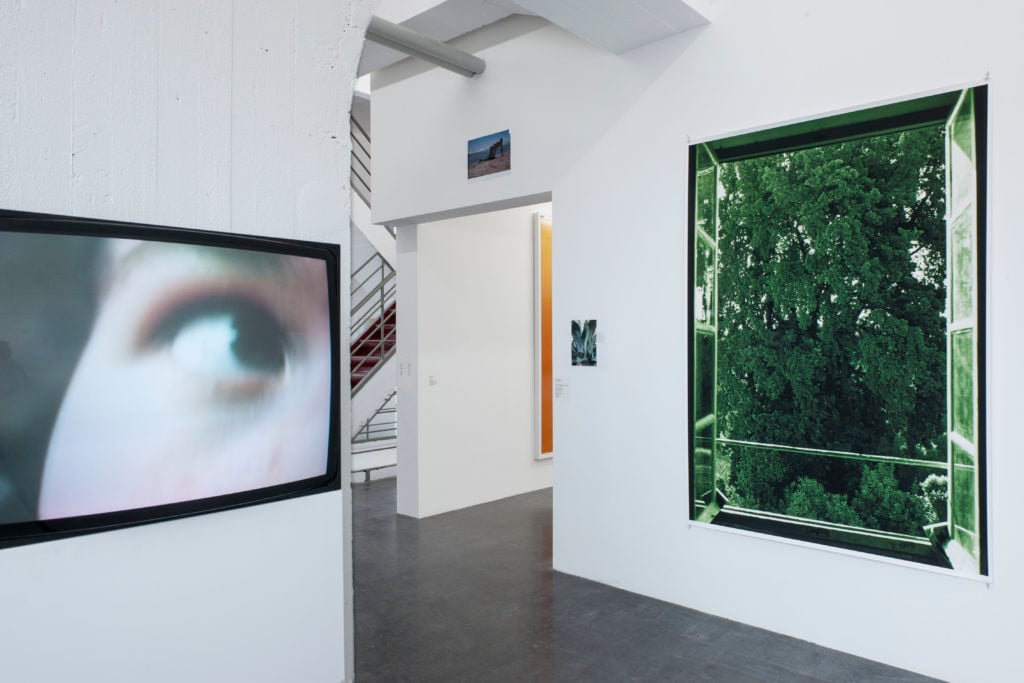
Wolfgang Tillmans “Today Is The First
Day.” WIELS 2020. Photo: Philippe De Gobert.
Do you feel that your political campaigns were
successful?
When I first conceived the anti-Brexit pro-EU campaign in March
2016, it was done in notwehr—in emergency
self-defense—because I saw that the whole mode on which my life is
based on was under direct attack.
What was really a success was the voter turnout in the European
elections. One cannot attribute any single campaign to the
successes of that election. I wanted to do what I can, even if
nobody speaks positively about the EU, even from the Remain side. I
wanted to try because, if nobody else does speak positively, it
will be lost. Of course, in 2016 no one thought that the Brexit
referendum would be lost, but I had the very strong sense that it
could go wrong. If the outcome isn’t exactly how you want it, to
think that what you did was in vain would be a terrible point of
view to take. That means then that only dictatorship of your will
would satisfy you.
The world has changed so much, even since
2016.
We had no idea what the 21st century would be like in 2007. It
is interesting, suddenly from last year to this year there was this
feeling of change. In combination with artificial intelligence,
there were changes in attitudes towards climate change, economical
shifts, and the role of China in surveillance, all of which are
suddenly gathering momentum with what came four years ago: the
populist wave, which had been building in a lesser noticed way
before. Now you have this entire complexity on the table.
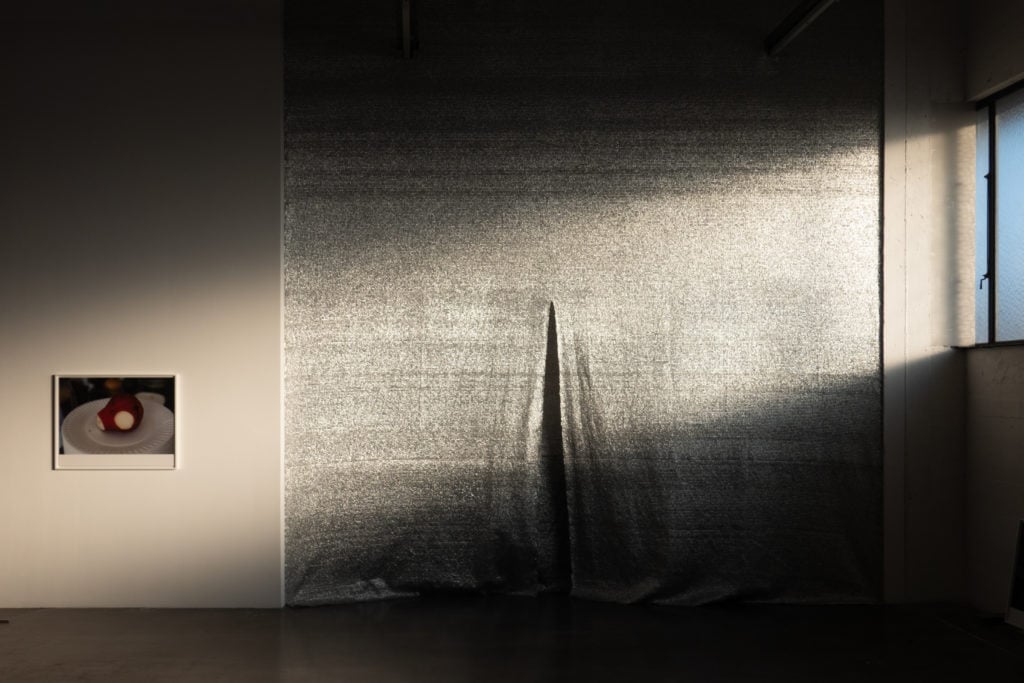
Wolfgang Tillmans “Today Is The First
Day.” WIELS 2020.
What do you make of this surge of activism in the art
world?
The last few years have been a bit of a wake up call. I don’t
feel that artists per se should have to be more activist or more
political. I think all people should be more involved—every banker
and baker. We all should be interested in what is going on and take
the whole thing seriously. Activism is really about generating
change with means that are available to you. It is not about how
good you look while doing it, or that every step is being viewed or
seen. A lot of real political change happens in un-glamorous and
not in Instagram-ready ways. More and more people are interested in
politics but fewer people are getting themselves into politics.
There has been so little activism by so many in the last 20
years that art has become quite navel-gazing in a lot of ways. So I
am not going to complain about the political voices and actions
that do happen now, since there are still so few. The urgency of
the situation will hopefully be met with a sustained response.
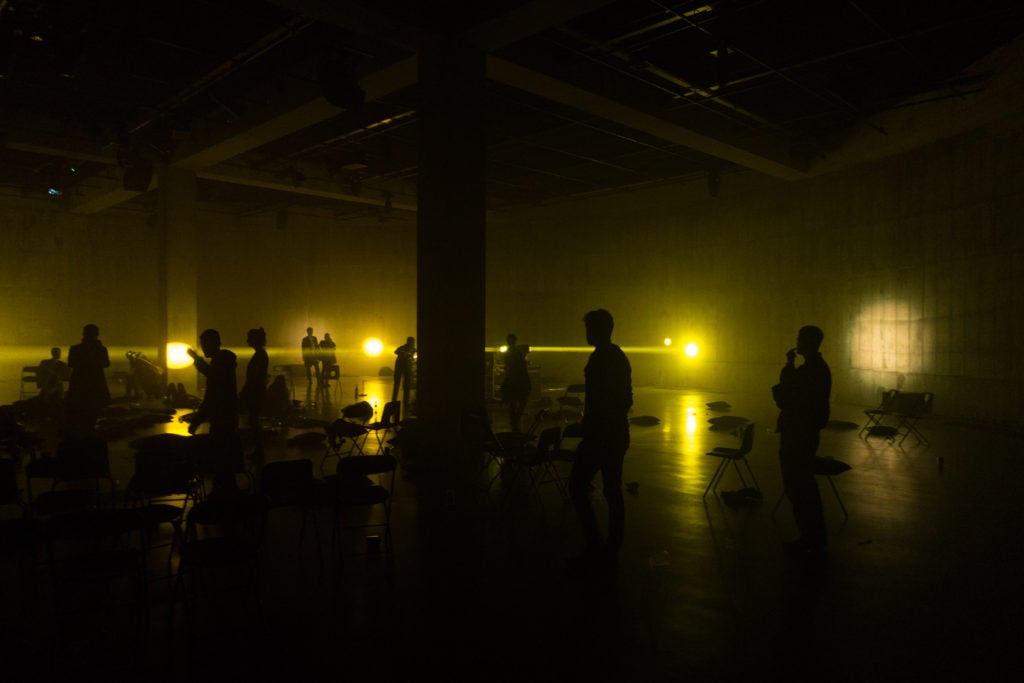
“Wolfgang Tillmans: South Tank (March
3–12, 2017). Programme of live events)
Given that you have long worked to bring a spotlight to
the margins of society,, I wonder what you think about some of the
more recent criticisms of identity politics.
I think as a gay person, I could certainly not be the one saying
something is too fringe or alienating. For example, with the
discussion over gender-neutral washrooms, I don’t feel one can or
should draw a line because the whole question of gender still
hasn’t been fully addressed and understood. What if women had
always been careful and decided not to ask for all rights? A woman
asking to vote and to open a bank account in Europe without the
consent of their spouse would have been making what seemed like a
fringe claim in the 1950s. [In 1975, the Sex Discrimination Act was
introduced in the UK, allowing British women to open bank
accounts.]
We have experienced 50 years of political progress, and that
hasn’t always pleased everyone, but somehow the progressive side,
even through conservative years, have had the upper hand somehow.
Somehow that has created a push back from a part of the population
that never liked it in the first place. Now, they feel like they
have a narrative where suddenly the urban left is suddenly labeled
“elite” and against the people. That is a fascinating twist that
would have been hard to think up 10 years ago. I really and
strongly believe that more equality does not mean fewer rights for
anyone else, but that feeling is not shared by all because of ideas
about privilege. Privilege and rights are different matters.
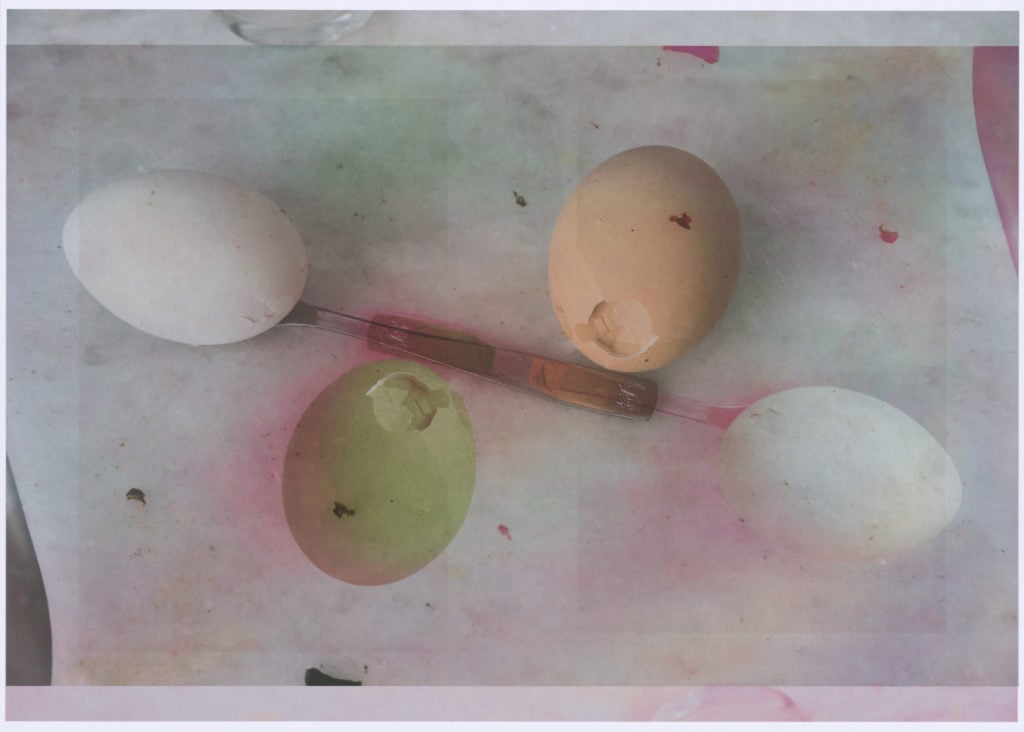
Wolfgang Tillmans, Philharmonie
Bloch I (2017.) © the artist, courtesy Galerie Buchholz,
Berlin/Cologne, Maureen Paley, London, David Zwirner, New York,
Galerie Chantal Crousel, Paris.
Do you see your work as political? Does it become
difficult to disentangle your political activism and your
work?
The reason I wanted to speak with photographs that stem out of
the vicinity of my life didn’t come from the motivation that I
wanted to talk about my life. I wanted to talk about what it
feels like to live today. I had a sense of wanting to get
involved because I understood the political nature of
picture-making from the start. It is record keeping, which is never
neutral. What is recorded and what isn’t recorded and what‘s kept
and isn’t kept is always political. It was about the new freedoms
of personal expression, living your sexuality in the early 1990s,
the freedom of Eastern and Western Europe to come together, the
power of techno to work and bring people together across borders on
dance in various states of connectivity and physicality. I
understood those things as new and they would not have happened if
other people had not fought battles for women’s rights, racial
equality, and gay rights in the decades before.
Because they were newly won rights, I also had a sense of how
special it was and that it wasn’t always like this. On the one
hand, I wanted to be a genuine contributor to it, and at the same
time I wanted to be an amplifier by making pictures of it, to
spread the feeling. As a third angle, I saw it as a story to write.
When I published my first book with TASCHEN in 1995, I was 26 and
some friends had questioned the move, because it is such a big
publisher, thinking that putting out a book so young might frame me
and pin me down. But I had a strong sense that I wanted this to be
in this high-quality print and have a high reach so that the story
is on record. Now, we do see that there are rights moving forward
but there are constantly people that want to turn back the
clock.
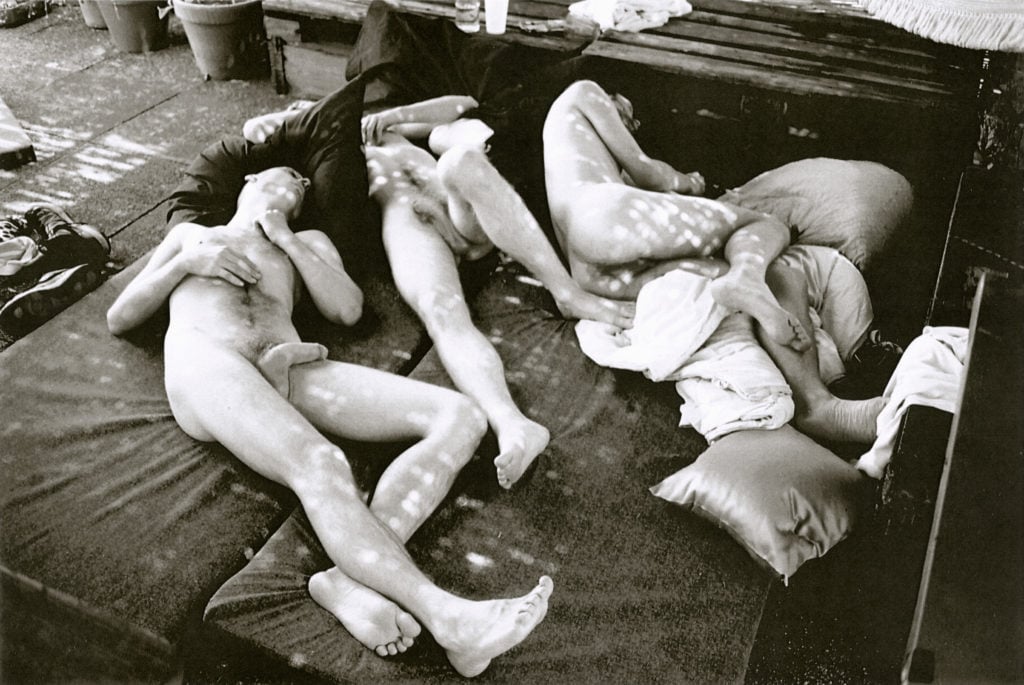
Wolfgang Tillmans, FKK naturiste
(2008). © the artist, courtesy Galerie Buchholz,
Berlin/Cologne, Maureen Paley, London, David Zwirner,
New York, Galerie Chantal Crousel, Paris.
What is at the core of your love for photography? What
continually draws you to it?
I love photography and I am acutely aware how difficult
photography is to make because it is so “simple.” I take great joy
when I see good photographs, that “goodness” is of course
determined by very different criteria. A science picture or an
animal wildlife photograph each have their own criteria and that is
quite unique to this medium. “Photography” is used across the board
to mean everything from X-rays to a large format Jeff Wall. In that
sense, I enjoy it on many levels. News photography had always
interested me and I was touched by the potential of the photograph
in a newspaper.
I do, for example, love the portraiture of Peter Hujar. When you
see them, you just see. Photography is so hard because it is so
hard to fake it. What you sense in a Hujar portrait, it could not
be there if it had not been between these two individuals. What you
see in his pictures is a record of a psychology that found a shape
on these silver crystals on the film.
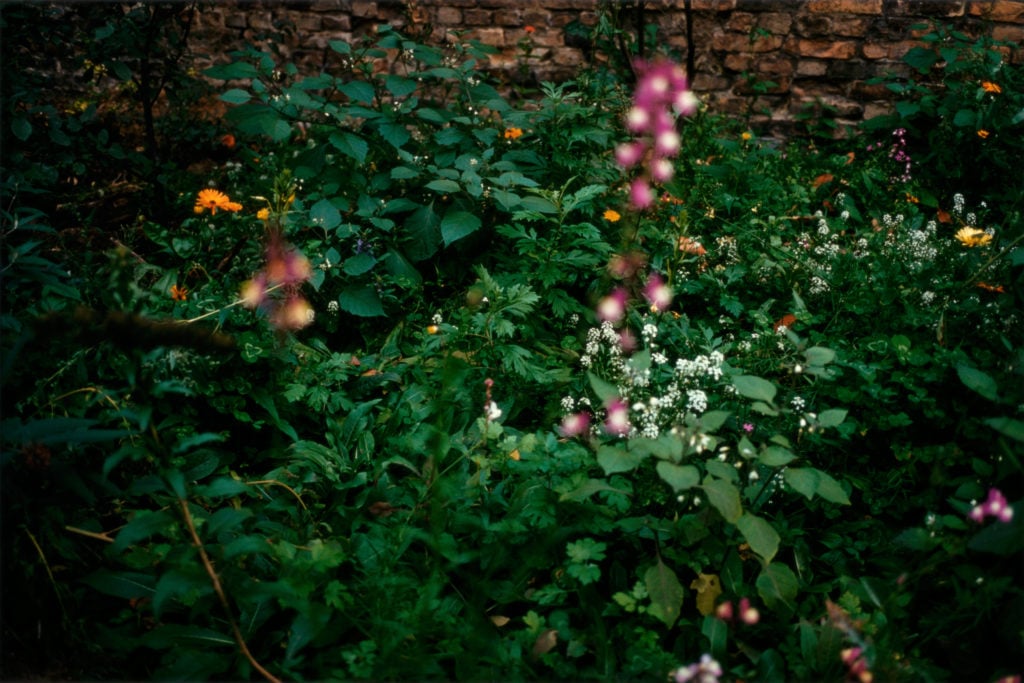
Wolfgang Tillmans, Garten (2008).
© the artist, courtesy Galerie Buchholz, Berlin/Cologne, Maureen
Paley, London, David Zwirner, New York, Galerie Chantal Crousel,
Paris.
Can you tell me a bit about what you are planning for
this major retrospective at MoMA?
MoMA is a big institution that wants to plan well in advance and
I am using this challenge as a creative challenge in that I am not
going to leave everything sort of fluid until the end. Somehow, we
are going to be onto a show plan fairly soon. It is interesting
that preparing for this MoMA retrospective mode has caused me to
actually think forward into the next 30 years.
In May next year, I am invited to MoMA for a month to “the
Studio,” which is part of the extension that opened in October. It
is dedicated to performing live arts and forms of time-based art
that, in the past, has usually been physically segregated from the
picture and sculpture part of museums. For that, I am further
developing a project that I did at the Tate Tank where, for 10
days, I did an installation called South Thank which was a
100-minute soundtrack and 20 programmable lights that I made a kind
of choreography for. There was a video, sound, and live program in
the evening. I will be expanding on those performative
interests.
The elements are also present in Brussels. For example, there is
a video from 2013 where I explore being myself and using my voice
differently. Looking at these works has reinvigorated my interest
in my photography. It wasn’t that I was uninterested in my
photography, but it is somehow now a more complete whole, now that
all these new interests over the last five years have somehow been
matched by a renewed interest in photography. But my home is
photography.
Wolfgang Tillmans’s exhibition, “Today Is the First Day,” is
on view at WIELS in Brussels until May 24, 2020.
The post ‘Record-Keeping Is Never Neutral’: Wolfgang
Tillmans on How Photography Can Be Used as a Potent Political Tool
for Change appeared first on artnet News.
Read more https://news.artnet.com/art-world/wolfgang-tillmans-interview-brussels-1798353
Further reading


Leave a comment