
‘Who Will Worry About Art Now?’: The European Art World Reacts to the Coronavirus Outbreak and Trump’s Latest Travel Ban
On
March 11, when President Donald Trump announced he was
suspending travel from Europe to the US for 30 days, the leading
European gallerist Thaddaeus Ropac was in Paris for the
opening of a show
of Antony Gormley’s
newest work.
And his thoughts, like those of seemingly everyone else, were on
the coronavirus—and how to stay safe.
“Because we are concerned about the wellbeing of our
visitors and our own team, we have been trying to spread out
attendance [to the show] by encouraging people to come at different
times during the day,” Ropac tells Artnet News. “We can’t have the
usual kind of crowded opening in these circumstances. We have a
responsibility to adapt the way we do things.”
As
people stop traveling and begin to self-isolate, Ropac says he is
looking to the gradually improving situation in Asia as an
indicator for how things could go in Europe. And from a business
perspective, he’s also starting to think about the usefulness of
the internet to his operations.
“I was
never a big believer in online sales since I always prioritized
encouraging collectors to see the works in galleries where they
have the best view,” Ropac says. “This is the first time I’m putting my weight
behind online sales.”
The
gallery is now launching its first online viewing room and
participating in Art Basel’s online
edition, which the
Swiss fair brought forward after it canceled its 2020 Hong Kong
edition. But Ropac doesn’t think the current travel
restrictions will become a long-term issue.
“We
just have to look ahead,” he says.
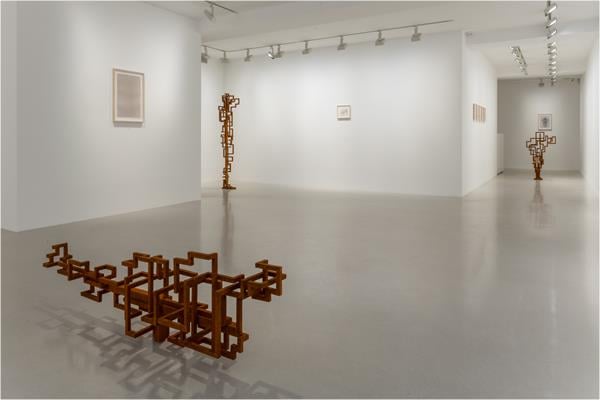
Antony Gormley, IN
HABIT (2020). Installation view, Galerie Thaddaeus Ropac,
Marais, Paris, France. Photograph by Charles Duprat. © the
artist.
Staying Home
But
the road ahead has doubtless been made rockier by Trump’s shock
announcement that travelers, excepting US citizens and permanent
residents, from 26 European countries would not be allowed to
travel to America for a month. (The ban does not apply to the UK
and Ireland.)
“I am
not getting on a plane anytime soon,” says Joe La Placa, a director
of London- and Milan-based Cardi Gallery and a US
citizen. While being
careful, he refuses to become paranoid, and says the gallery’s
sales have not fallen off a cliff edge.
“Oddly, we have just had one of our best
weeks,” he says, referring to the galery’s Mimmo Rotella show in
London and its booth at the truncated TEFAF Maastricht, which saw
lower attendance and was cut short by coronavirus.
While
Cardi’s Milan location has been forced to close, he says the
gallery plans to keep its London space open “as long as
possible.”
Another ex-pat American gallerist, Berlin-based
Javier Peres, notes
dryly that “not all national governments are taking the most
prudent, science-based approaches to the handling of
Covid-19.” He is
working out the implications of the travel ban for his gallery, his
clients, and his artists while a show by Chinese artist Shuang Li
goes on—albeit by appointment.
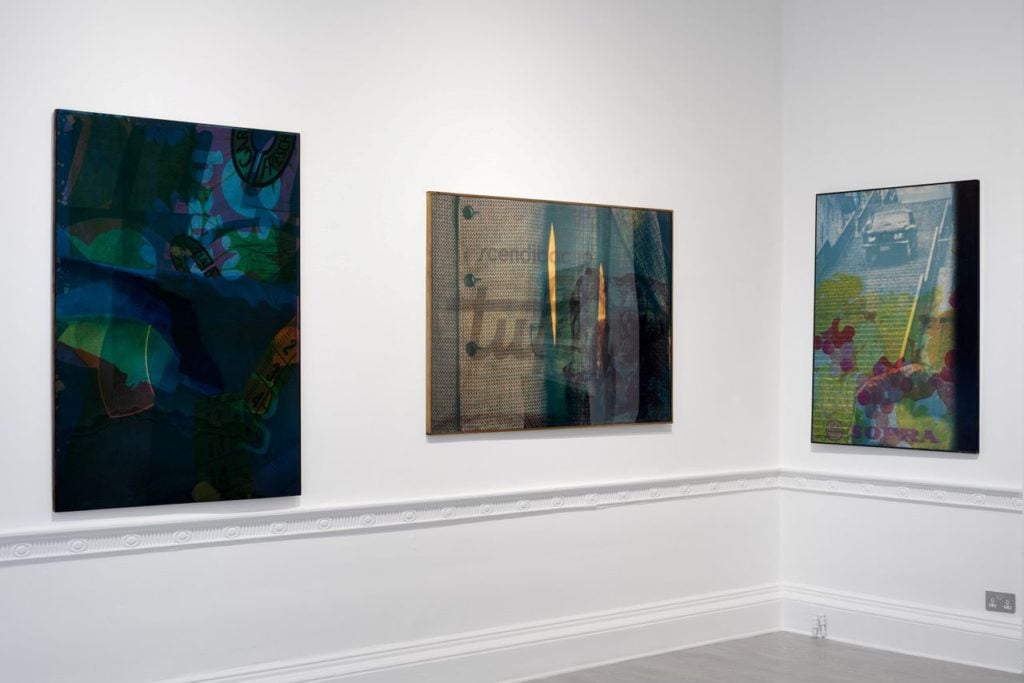
Mimmo Rotella’s show, “Beyond Décollage:
Photo Emulsions and Artypos, 1963–1980” at Gardi Gallery,
London.
There
was a day of confusion in the immediate aftermath of Trump’s
announcement. Some alarmed US dealers at TEFAF Maastricht
reportedly rushed to airports in an effort to return home before
the ban took effect, not understanding that Americans were exempt
from the restrictions.
And there was anger from a portion of the art world as well.
The Berlin-based artist Hannes
Koch, a cofounder of Random International, says it’s time for
international cooperation, not the building of
walls.
“Above all, we need solidarity,”
he says. “Germans fending for themselves with little masks while
Italy is in crisis is as unacceptable as it is for the orange man
to shut down flights unilaterally.”
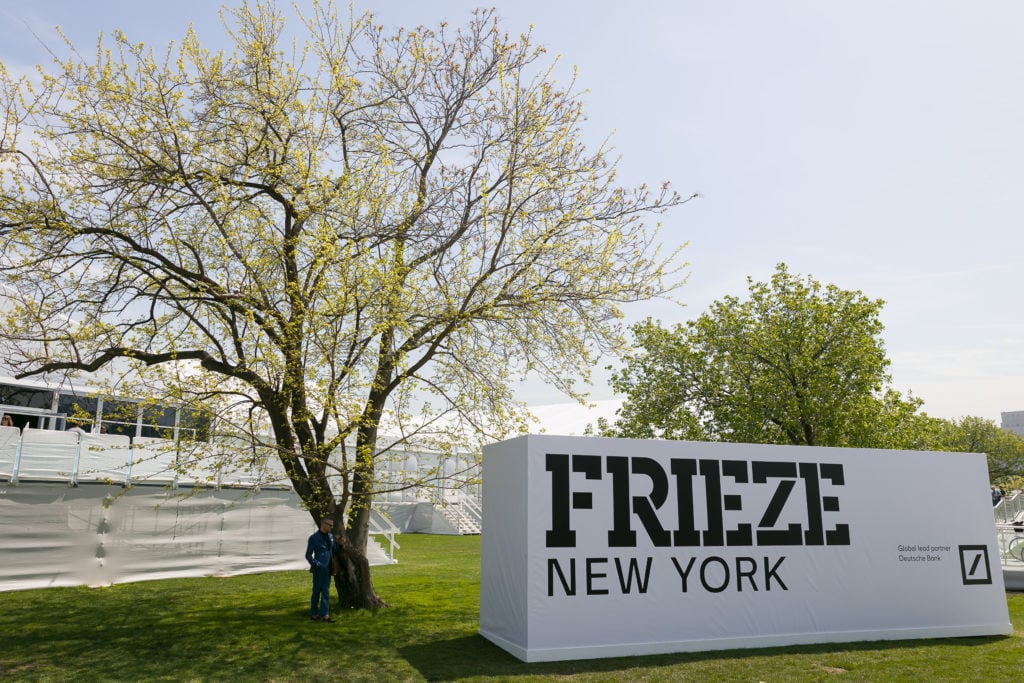
The outside of Frieze New York 2019.
Photo: Mark Blower, courtesy of Frieze.
But the big question now is how
Trump’s travel ban will impact European exhibitors, collectors, and curators
due to attend Frieze New York in May. The opening of the show is
now looking increasingly uncertain.
Asked about the impact of
Trump’s new travel policy, a Frieze spokesperson said: “We are
assessing the impact of this development on our plans for Frieze
New York.”
Yet others in the European art world
are fixated on other issues.
The
Brussels-based collector Alain Servais thinks the travel ban is
“irrelevant” compared with the impact of tumultuous financial
markets and the risk of recession.
“The
few Europeans I know who are active in the speculative New York art
market have their agents in New York to catch works in
exhibitions,” he says. “But who will worry about art
now?”
The post ‘Who Will Worry About Art Now?’: The European Art
World Reacts to the Coronavirus Outbreak and Trump’s Latest Travel
Ban appeared first on artnet News.
Read more https://news.artnet.com/art-world/trump-europe-travel-ban-coronavirus-1804050
Further reading


Leave a comment