
‘It’s the First Domino’: After the Museum of the Bible Discovered Its Dead Sea Scrolls Are Fake, the Field Braces for More Revelations
There’s more bad news for the Museum of the Bible in Washington, DC.
Every single one of its 16 fragments of the famed Dead Sea Scrolls
have been found to be modern-day forgeries—not just the five
previously identified
fakes. And since the Museum of the Bible’s trove was a small
part of a much larger group of scroll fragments that have since
spread around the globe, the finding could have big implications
for the field.
The museum announced the news at an academic symposium on
Friday, presenting the results of a battery of tests conducted by
outside experts between May and October of 2019. In a 200-page
report, the five-person team judged the artifacts to be
20th-century forgeries meant to mimic the famed Dead Sea Scrolls
first discovered in 1947 in Israel’s Qumran caves. The findings
were first announced by National
Geographic, and have already launched a contentious debate
on Twitter.
“We came to an unanimous conclusion that they were all
forgeries,” Colette Loll, founder of Art Fraud Insights, which conducted the
tests, told Artnet News. “There were a lot of anomalies that
we identified through microscopy.”
How the Fakes Were Caught
Loll cited several pieces of evidence that led her team to its
conclusion. Instead of being made from tanned or lightly tanned
parchment, like the real Dead Sea Scrolls, the Museum of the
Bible’s fragments were made of leather—likely ancient, perhaps from
the soles of old shoes.
“After 2,000 years, leather and parchment look very similar,”
said Loll. “Until you do a high magnification analysis, as well as
a chemical and elemental analysis, you really can’t tell the
difference.”
But under a microscope, there were several dead giveaways—first
of all, the leather was very bumpy and rough. “It was obvious
to us that the scribe had a very difficult time writing on the
surface, unlike the clean smooth parchment that would have been
used 2,000 years ago,” Loll explained.
More damningly, a close examination showed that the writing had
been applied to a surface that was already fragmented—the ink
dripped over the sides and fell into cracks that wouldn’t have
existed when the leather was new.
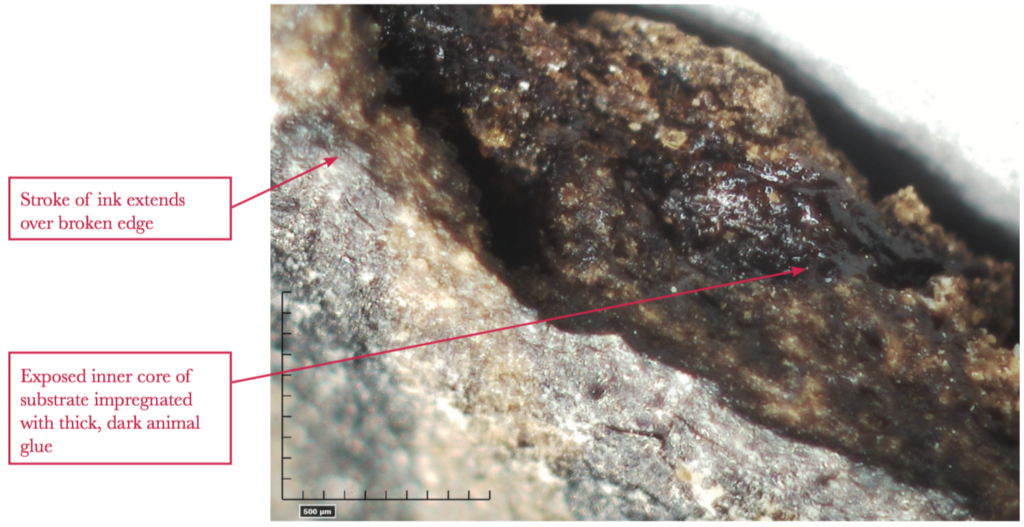
One of the fake Dead Sea Scrolls from
the Museum of the Bible at high magnification, revealing anomalies.
Photo courtesy of Art Fraud Insights.
“This confirmed our conclusion that ancient materials were
repurposed for the creation of these fragments,” said Loll.
Another clue was that parts of the real Dead Sea Scrolls look a
bit like they’ve been coated in glue, because the collagen in
parchment breaks down over the millennia, turning into gelatin. The
fragments from the Museum of the Bible were “heavily impregnated
with an amber-colored animal skin glue,” Loll said. “Not only did
the coating facilitate the writing on these uneven and bumpy
surfaces, but it also served to mimic the degradation you would see
in the authentic scrolls.”
“It’s the First Domino”
The Dead Sea Scrolls are the oldest-known Biblical texts, and
most of them belong to the Israel Museum in Jerusalem. There are
some 100,000 authenticated fragments, but the Museum of the Bible’s
holdings—reportedly acquired for millions of dollars—were all among
a group of some 70 previously unknown Dead Sea Scroll fragments
that came to market after 2002.
An antiquities dealer named Khalil Iskandar Shahin, also known
as Kando, acquired many of the original Dead Sea Scrolls in the
1950s. The post-2002 fragments reportedly were first sold by his
son William Kando.
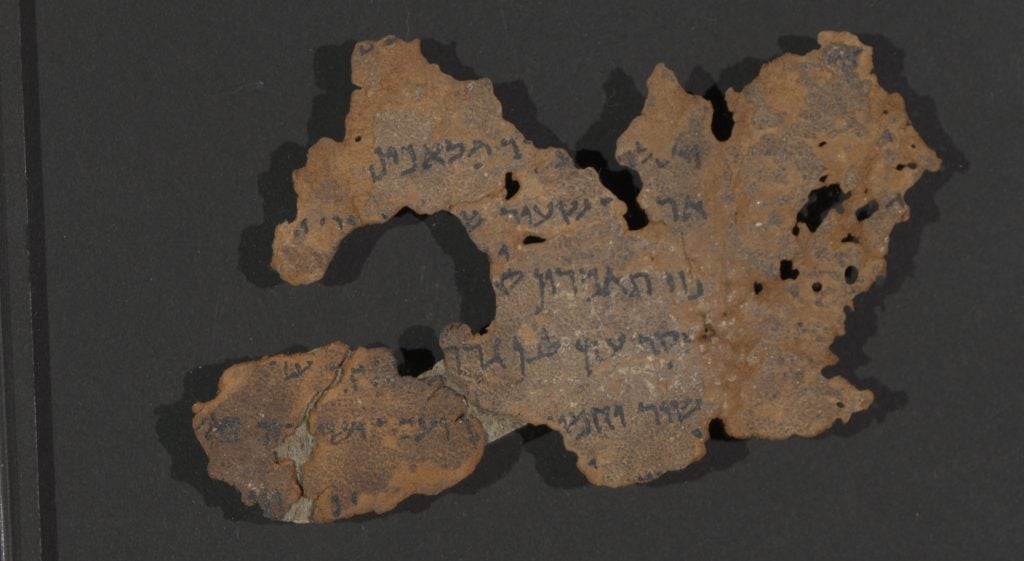
One of the fake Dead Sea Scrolls from
the Museum of the Bible at high magnification. Photo courtesy of
Art Fraud Insights.
Since the new artifacts appeared on the market, institutions and
private collectors have spent somewhere between $35 million and $45
million to purchase them, Dead Sea Scroll expert Rabbi Lawrence
Schiffman told those assembled at Friday’s symposium. All those
fragments, considered suspect for years, are now definitively
called into question—and it seems all but certain other forgeries
will be identified.
“This is the first domino,” said Loll.
A Debate Over the Findings
Between 2009 and 2014, Hobby Lobby tycoon Steve
Green snapped up 16 of the post-2002 fragments for his
planned Museum of the Bible—seven directly from Kando, the rest
from bookseller Craig Lampe, collector Andrew Stimer, and book
collector Michael Sharpe. Before the institution even opened, it
put together a 2016 book, Dead Sea Scrolls Fragments in the Museum
Collection, published by Brill. It offered a
scholarly analysis of the artifacts, but no scientific testing had
been conducted.
Despite Loll’s damning findings, one of the lead editors of the
2016 book, biblical scholar Emanuel Tov, contests the new report
because similar tests were not conducted on authentic Dead Sea
Scrolls as a baseline of comparison. “The report expects us to
conclude that abnormalities abound without demonstrating what is
normal,” he told Nat Geo.
But other experts have been suspicious for quite some time. As
the 430,000-square-foot museum’s November 2017 opening
date approached, concerns over the fragments’ authenticity
began to mount—one of the book’s other authors, Kipp Davis, even
published an article raising
the possibility of forgery. At the same time, the institution
itself became the subject of controversy.
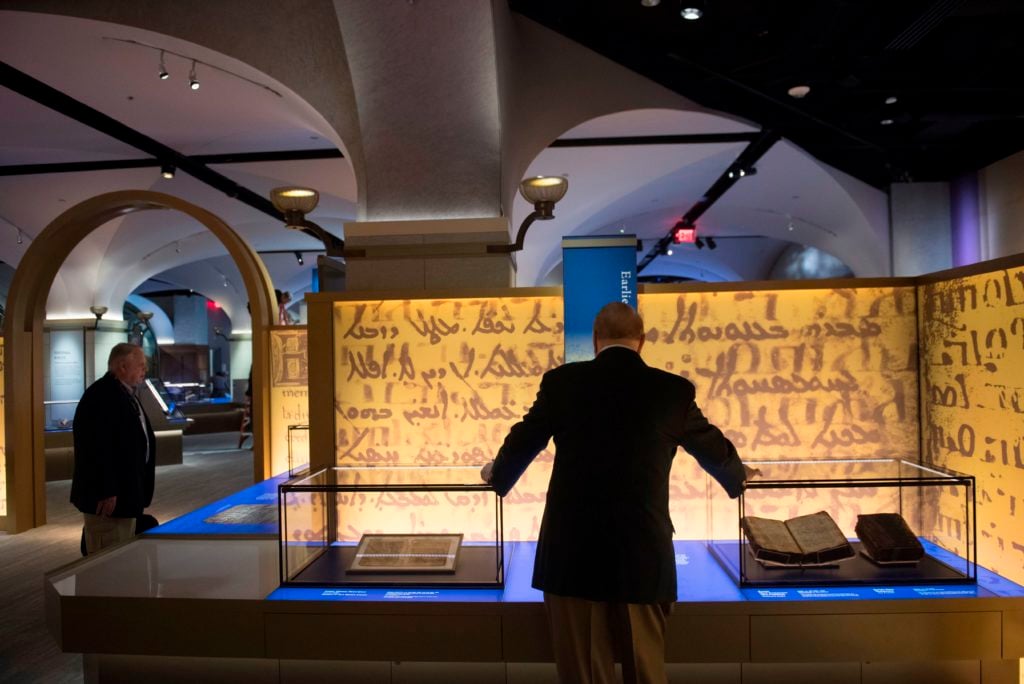
Visitors tour the “History of the Bible”
exhibit at the Museum of the Bible n Washington, DC. Photo by Saul
Loeb, courtesy of AFP Photo/Getty Images.
A Trouble-Plagued Museum
Investigators questioned the provenance
of the $30 million collection that Green began amassing in
2009, and found that the company had imported looted artifacts. Hobby
Lobby ultimately reached
a settlement, returning 5,500 smuggled Iraqi
artifacts and paying a $3 million fine. They were forced
to return 13 Egyptian Biblical
artifacts in 2019.
By that point, an initial analysis of five of the Dead Sea
Scroll fragments had already been carried out, showing them to be
inauthentic. That’s when they called Loll to amp up the search.
“The Museum of the Bible really wanted to put this question to
rest, and they committed significant resources. I recruited an
incredible team of scientists, conservators, and imaging
scientists,” said Loll, who only agreed to carry out the necessary
scientific analysis if the institution promised total
transparency.
“The Museum of the Bible has had some pretty significant
criticism, justifiably so, given these missteps in their
collecting practices,” she added. “We were clear as a team that in
order to take this project it had to be completely
independent.”
The museum is currently closed to the public due to the current
global health crisis. Before it reopens, the remaining scroll
fragment forgeries will be removed from view. What remains to
be seen is who, exactly, created these modern-day forgeries and how
they found their way to the marketplace.
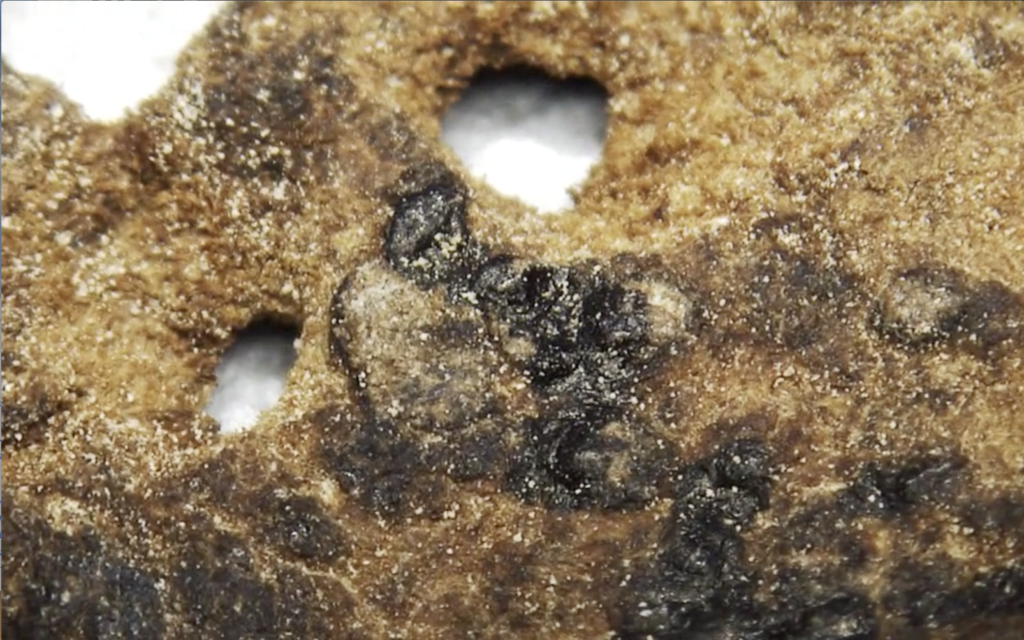
One of the fake Dead Sea Scrolls from
the Museum of the Bible at high magnification. Photo courtesy of
Art Fraud Insights.
What’s Next
“As for who was responsible,” said Loll, “the scope of my
research was confirm or refute authenticity. The next phase of the
research will likely look into where and when and who. But there
are a limited number of dealers whose hands have touched these
post-2002 Dead Sea Scroll fragments.”
The museum will be making Loll’s report available to the public
in the hopes of identifying other forgeries. “The
sophisticated and costly methods employed to discover the truth
about our collection could be used to shed light on other
suspicious fragments and perhaps even be effective in uncovering
who is responsible for these forgeries,” said Jeffrey Kloha, the
institution’s chief curatorial officer, in a statement.
The uncovering of such high-profile forgeries stands as a
reminder that antiquities collectors are perhaps particularly
vulnerable to fraud. “Doing extensive due diligence is always
really important, especially when you’re looking at biblical text,”
said Loll. “Often times, the collectors are ideologically
motivated—and the market takes advantage of that.”
The post ‘It’s the First Domino’: After the Museum of the
Bible Discovered Its Dead Sea Scrolls Are Fake, the Field Braces
for More Revelations appeared first on artnet News.
Read more https://news.artnet.com/art-world/all-the-museum-of-the-bibles-dead-sea-scrolls-are-fake-1804395
Further reading


Leave a comment