
What Is the Role of a Museum in One of Polarized America’s Most Purple States? Oklahoma Contemporary Offers a Case Study
Clad in a turtleneck and chic
blazer, architect Rand Elliott—a dead ringer for the magician Penn Jillette,
at least from certain angles—leaned back onto a couple of the
16,800 aluminum “fins” that comprise Oklahoma Contemporary’s
facade. It was a gloomy day, but he explained that his design of
the new museum reflects the city’s rapidly changing light. At
different times, the sky’s color can turn the building’s “skin”
pink, navy blue, or yellow.
“We planned that, hoped that
would happen, and chose the proper finish to do this,” he
said.
Elliott avoided mirrored
surfaces on the building because they would diffuse light and
sparkle. But metaphorically, the art center is poised to offer the
city a self-portrait. The most important color the building
reflects may be purple—not of a stunning Oklahoma sunset, but the
city’s stereotype-eschewing nature in this election
year.
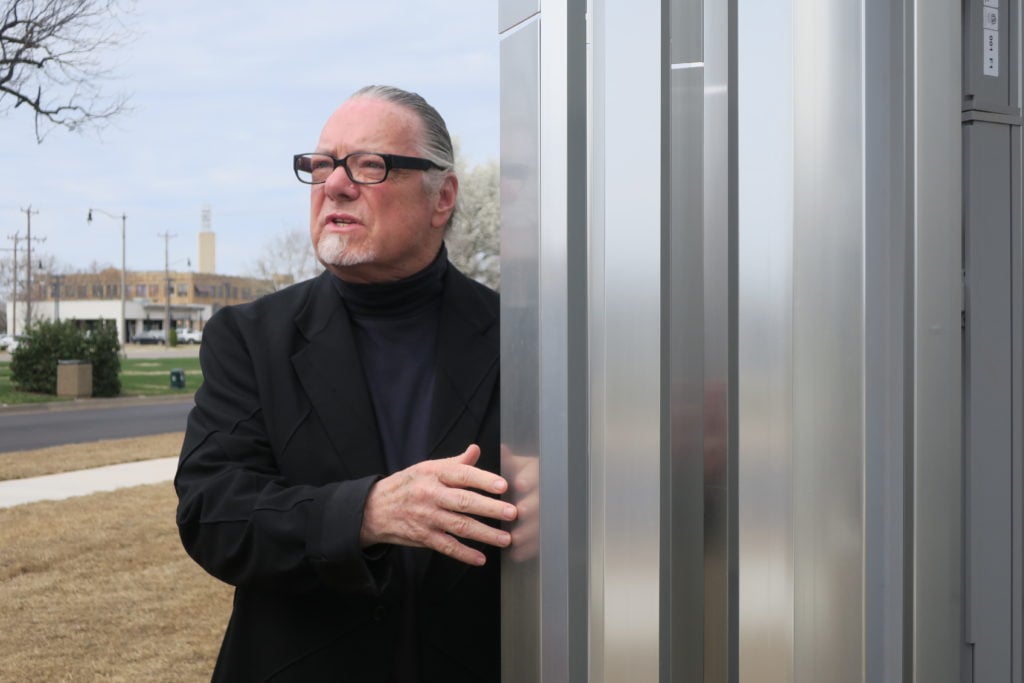
Architect Rand Elliott at Oklahoma
Contemporary. Photo: Menachem Wecker.
“The city is politically very
purple,” said Oklahoma City Mayor David Holt. “People around the
country seem to have accepted that Texas can be red, Austin can be
very blue, and that those two things can happen simultaneously. I
guess maybe they haven’t quite wrapped their mind around the idea
that Oklahoma City could be very purple.”
Outsiders may be aware that
every Oklahoma district went for Donald Trump in
2016, and the last time
a Democrat carried the state in a presidential election was 1964,
when President Lyndon B. Johnson was elected. Yet the city’s winds
blew in a different direction two years ago when Democrats
flipped
Oklahoma’s 5th congressional
district, and fifth-generation Oklahoman Kendra Horn became its first elected Democrat
in 44
years.
As museums work to appeal to
constituents, regardless of political affiliation, in an
increasingly polarized political moment, the Oklahoma Contemporary
offers a case study in retaining institutional convictions while
remaining welcoming and approachable.
Oklahoma, Art Hub?
Oklahoma City hasn’t registered
on many people’s radars the way Holt—the Republican mayor and
former board president of Oklahoma Shakespeare in the Park—would
like. The city that birthed the Flaming Lips used to be the
blue-collar step-sibling to more sophisticated Tulsa, but has since
outpaced its northern neighbor’s arts offerings.
“Our first challenge is that
they don’t think of us at all, and then if you force them to think
of us, they may have silly images of the Wild West, the musical,
college football, or something,” Holt said.
That’s why the stakes are high
for Oklahoma Contemporary, a 53,916-square-foot, custom-built space
that sits on 4.5 acres and includes a dance studio, classrooms,
studios for ceramic and fiber artists, and 8,000 square feet of
gallery space. Its construction was one of the aims of a
$30 million
capital campaign, with Oklahoma
City native Ed Ruscha as honorary chair, which has brought in $26
million to date from more than 200 donors. Among the largest donors
are the Chickasaw Nation, museum
founder and president Christian Keesee, and bank owner George
Records and his wife Nancy.
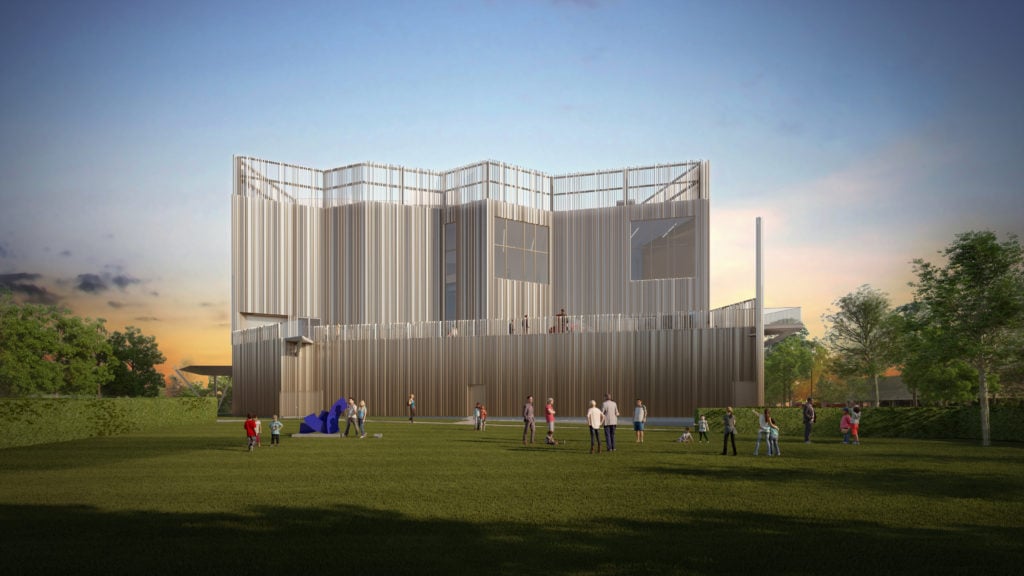
Rendering of Oklahoma Contemporary
Facade. Courtesy of Oklahoma Contemporary.
Keesee founded the museum in
1989 as the City Arts Center in State Fair Park, a comparatively
isolated location without much foot traffic, while the new downtown
location has a dedicated stop on the new city streetcar. As before,
the museum will operate without a collection, but it expects its
increased programming, classes, exhibitions, and performances in
its much larger space to draw 100,000 visitors per year.
In an unfortunate turn of
events, however, the museum was forced to delay its grand opening
festivities last weekend after a visiting Utah Jazz player, in town
to play the Oklahoma City basketball team the Thunder, tested
positive for coronavirus.
Before the museum closed its
doors, Artnet News had a chance to visit. Oklahoma Contemporary,
whose facade echoes Reykjavík’s iconic Hallgrímskirkja, is the
city’s biggest financial commitment to its cultural character to
date. “This is really a statement of where we are—that we feel as a
community that we could sustain a contemporary art center featuring
exhibits that are not literal Western paintings,” Holt
said.
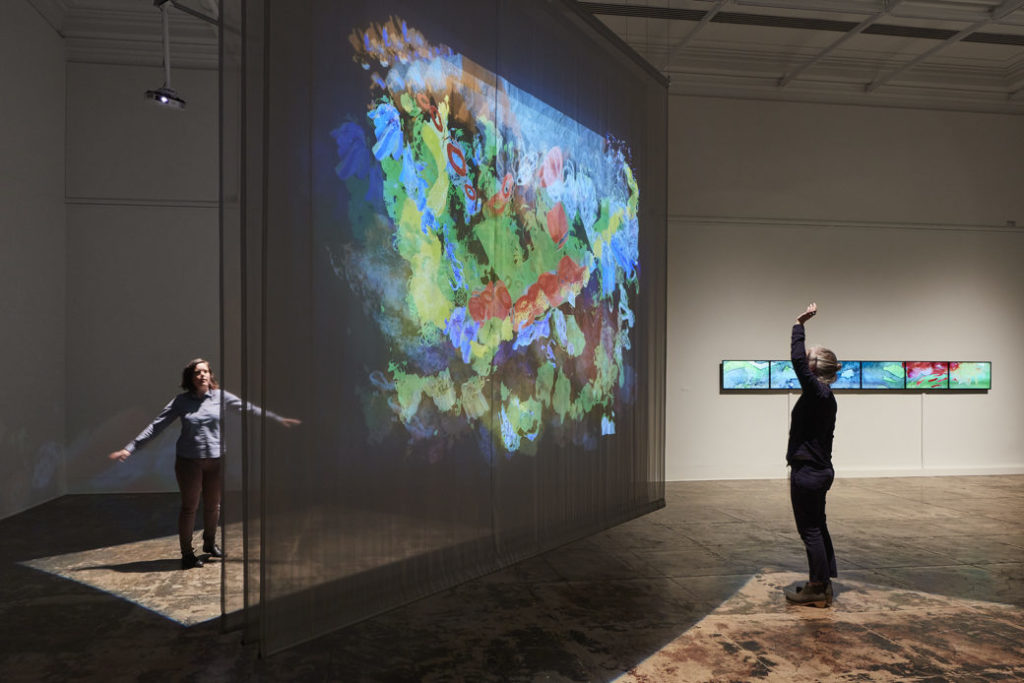
Camille Utterback, Entangled
(2015). Photo by JKA Photography.
A Sneak Preview
The inaugural exhibition,
“Bright Golden
Haze” (whose opening is
now delayed), immediately reveals a different kind of work than the
Frederic Remington sculptures or William R. Leigh paintings that
were frequently on display before. The show, whose title derives
from the opening words of the musical Oklahoma, explores the way artists use light—from
Olafur Eliasson’s Black
Glass Eclipse, a
rotating disc that bathes the room in yellow-orange, to work by
Light and Space pioneers Robert Irwin and James
Turrell.
Meanwhile, Tavares Strachan’s
neon, which spells out the phrase “I Belong Here,” gestures toward
a kind of hospitality that may surprise those who expect Oklahoma
to conform to a monolithic conservative flavor. And it’s not the
only such symbol. A large sign in the lobby reads: “We honor the
Indigenous people who inhabited these lands before the United
States was established,” adding that 39 distinct tribal nations
reside in Oklahoma. Another large text, this one in a “learning
gallery,” states that “this is an inclusive space, open to people
of every background, race, ethnicity, sexual orientation
gender/gender expression, language, immigration status, ability,
age, and faith/worldview … You are welcome here.”
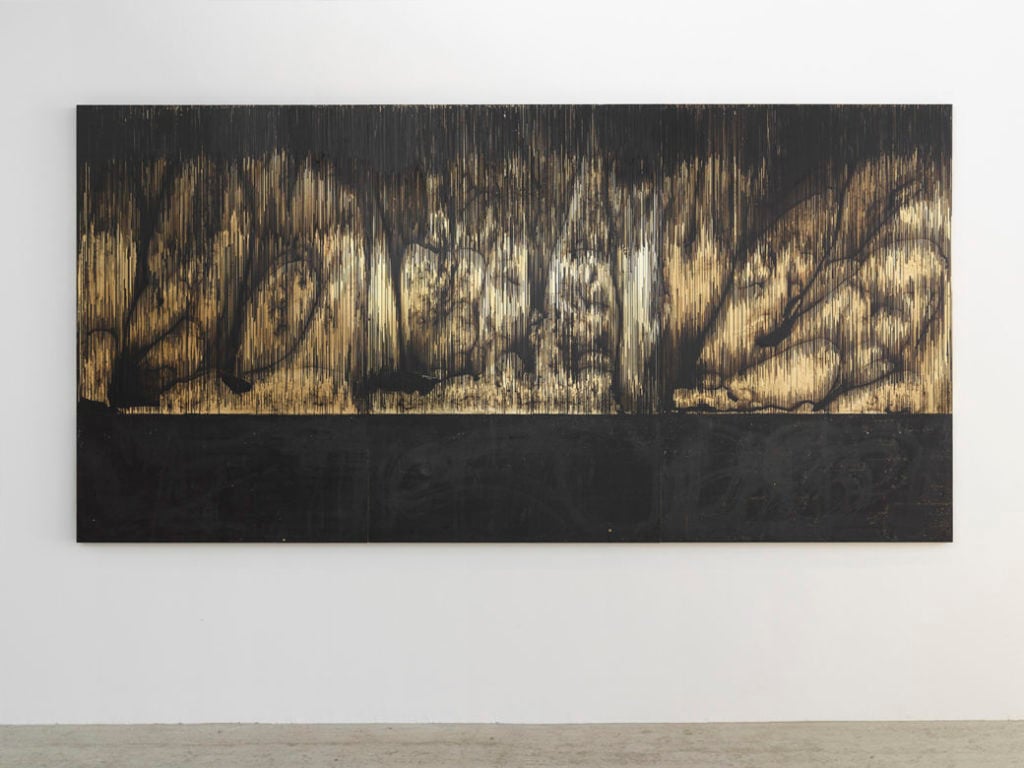
Teresita Fernández, Golden
(Odyssey) (2014). Courtesy the artist and Lehmann Maupin, New
York, Hong Kong, and Seoul.
According to Oklahoma
Contemporary’s artistic director Jeremiah Matthew
Davis, the museum tries
to get ahead of potential controversies by contacting local
communities ahead of potentially sensitive exhibitions. (For
example, curators spoke with city police and the local chamber of
commerce before a graffiti show, which they knew some might see as
vandalism.)
“We’ll see once we have this
brighter spotlight on us, there may be some various perspectives on
any number of things that we’re doing,” he said, noting that a
current photography show, “Shadow on the
Glare,” provides labels
in Spanish and Vietnamese, the city’s two most-spoken languages
other than English.
A Political Agenda—Sort of
In the Oklahoma office of his
family foundations and his banking, oil, and gas businesses, museum
founder Christian
Keesee agrees with
the mayor about out-of-towners’ assumptions. As someone who divides
his time between Oklahoma, Colorado, and New York, where he sits on
the Frick Collection’s board and is a trustee emeritus at the
American Ballet Theatre, Keesee is aware of how his native city
strikes different people.
“Our only political agenda is
artists for everyone. Period,” said Keesee, a member of the
Kirkpatrick family (on his mother’s side), which played a central
role in the city’s development and growth, and whose philanthropic
efforts span the arts, education, the environment, and humane
treatment of animals. “I hope that people would feel comfortable
coming to Oklahoma for any reason, just as I hope Oklahomans would
feel comfortable going to California or New York,” he said. “I know
they do.”
Part of that mission will be
carried out by the museum’s new leadership. Sitting in his office
at Oklahoma Contemporary, with a clear view of the state capitol
and a deep-blue balance ball chair in front of his computer,
Eddie
Walker, the museum’s
executive director, talked about the his decision to join the
museum last April after 30 years at the Oklahoma City Philharmonic
Orchestra, where he had been executive director since
1999.
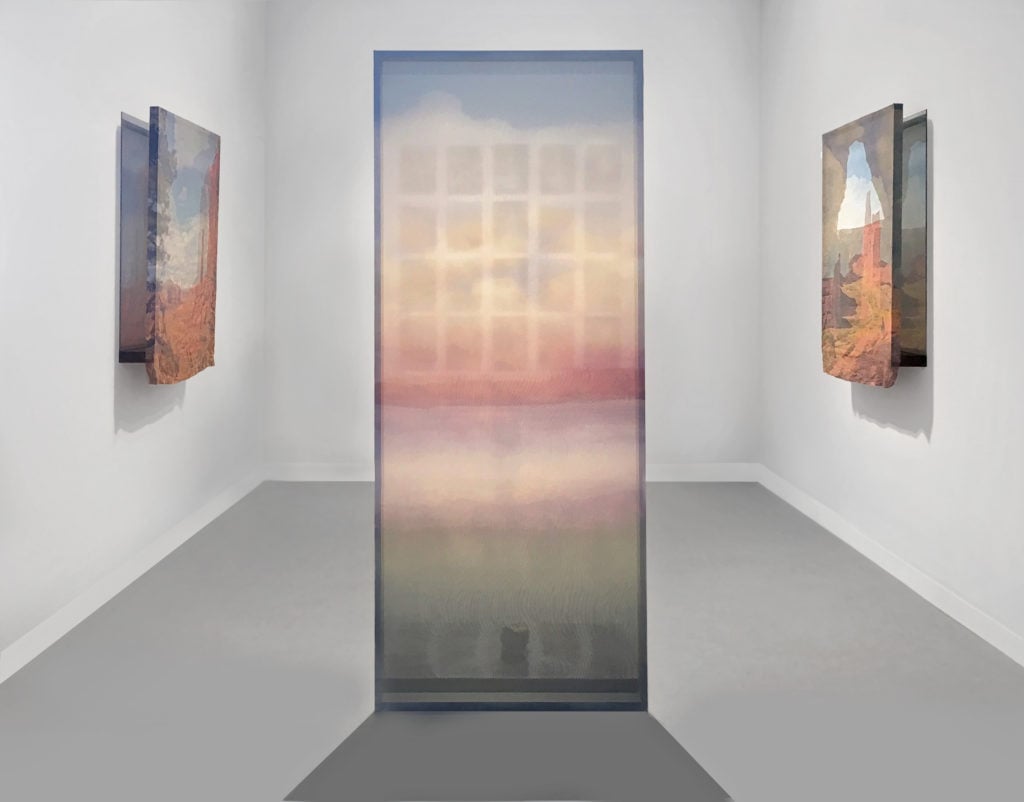
Installation view of Doty Glasco’s work
in “Bright Golden Haze.” Courtesy JR Doty.
When Walker saw the building
renderings two years ago, he thought it was going to be a fun job
for somebody to run the institution. “Who knew Chris Keesee was
going to call me and talk about the position?” he said. “I was
sweating. I said, ‘Well, I’d be lying if I wasn’t
interested.’”
“I don’t think we even
understand what we will or can become,” he said. “I really believe
that as we figure out what the building can do—because it’s so
flexible—I think we’re going to have two or three years of just fun
exploration, dreaming, and visioning. We’ve already had patrons and
visitors make suggestions, and some of them are darn
good.”
Looking Ahead
The museum—whose original
location is north of the city’s Automobile Alley and the memorial
commemorating the victims of the 1995 bombing—sees its mission as
twofold. In addition to offering itself up as a welcoming place in
a divided city, it is also working to boost arts education in a
region where it has been decimated. “Arts education within public
and private and in homeschooling has been basically eliminated over
the last 15 or 20 years,” Walker said. “We know that we’re going to
have busloads of kids coming from Tulsa and from the outside of
Oklahoma City to see what we’re doing and to take part.”
Oklahoma Contemporary’s shows
will have regional appeal, he thinks. “My hope is that what we do,
and the currency we print in the form of arts exhibitions, are
going to be appealing to people in Dallas, Tulsa, Kansas City, and
Little Rock and that they’re going to come in the same way that
Oklahomans will go to those places to see exhibitions that are of
interest to them.”
A decade from now, Keesee will
evaluate Oklahoma Contemporary’s effectiveness by the people who
have participated in its programs. “Hopefully the little pebble
that goes into the water will create ripple effects that educate
and enlighten people,” he said. “If we can just give a lot of
people a little bit of exposure, that’s going to have a terrific
impact on our community and our state and hopefully the
region.”
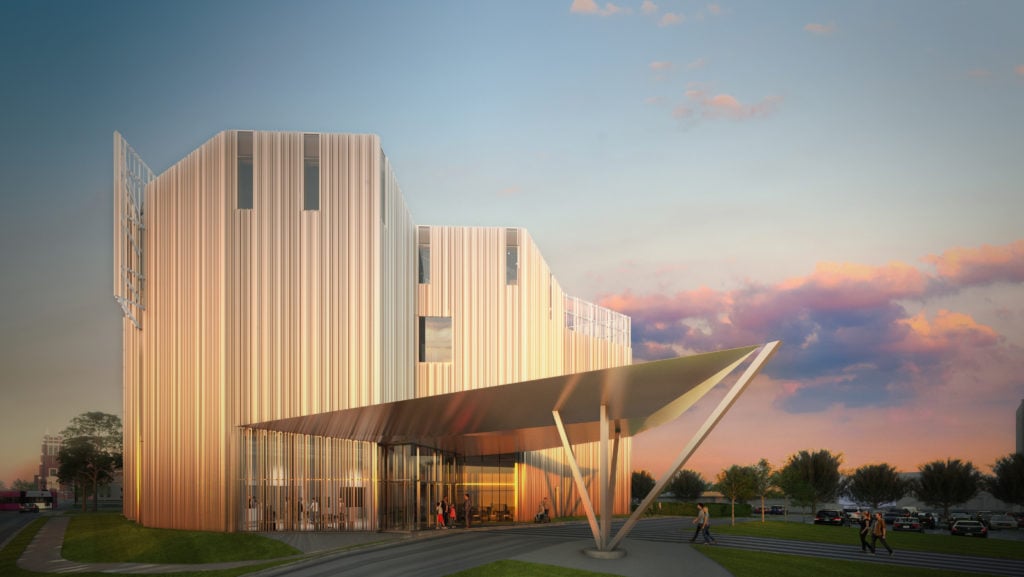
Rendering of Oklahoma Contemporary
Facade. Courtesy of Oklahoma Contemporary.
Museum visitors will find a few
surprises in the building itself if they keep their eyes peeled.
For one thing, they will notice three diagonal beams holding up a
corner of the overhang, while a fourth doesn’t touch the roof—a gap
in reaching appendages reminiscent of the space between
Michelangelo’s Adamic and divine fingers. “This is my tall grass
coming out to support the canopy, that there just happens to be one
that decides, ‘I don’t want to play with anybody else,’” said
Elliott, the architect. “I’ve had people come back and go, ‘Dude,
you missed it.’”
In the lobby, Elliott points out
a rectangular panel surrounding a digital screen behind the
admissions desk. “It represents the classic, most beautiful
proportion there is, created by Vitruvius in 45 BC,” he said. “This
is the proportion of 1:1,618, which is the golden section or the
golden ratio. We felt like it is really important to take
technology, which is 21st century, to something that is ancient
that is germane today.”
It’s hard to imagine a better
metaphor of reaching to the ancient past to frame the contemporary
to explain a museum that may well be Oklahoma City’s most effective
ambassador to the country, and indeed to the world. Put
differently, the museum may well be singing to itself in coming
years, “I’ve got a wonderful feeling,/Everything’s going my
way.”
The post What Is the Role of a Museum in One of Polarized
America’s Most Purple States? Oklahoma Contemporary Offers a Case
Study appeared first on artnet News.
Read more https://news.artnet.com/exhibitions/oklahoma-contemporary-1806381
Further reading


Leave a comment