
Artists Carrie Moyer and Sheila Pepe Have Been Together for 25 Years—But Their Latest Collaboration Surprised Them Both
Carrie Moyer and Sheila Pepe,
the artists and partners in life, met in 1995 at the Skowhegan
residency in Maine. Now, a quarter of a century later, the two have
returned to the northeastern state for their first institutional
collaboration.
Occupying the middle gallery at
the Portland Museum of Art (PMA), their show, “Tabernacles for
Trying Times,” is
loosely conceived as a kind of sanctuary where visitors can come
together and worship at the altar of contemporary art.
The show is centered on a pair
of works the two artists cocreated for the occasion, including a
sprawling, ceiling-mounted installation and a series of spiritually
inclined drawings.
The installation looks like what
you might expect from the pair: it’s made of a network
of woven fibers
connected by drooping pieces of fabric that have been painted by
Moyer, like the work of a spider viewed through the lens of an acid
trip.
The other collaboration—a
symmetrical set of illustrations depicting ornate eaves and
cornices that together form a kind altar—is less obvious, but not
less interesting. It’s what happens when two well-established
artists meet in the middle and see what happens.
Shortly after the PMA exhibition
opened, Moyer and Pepe sat down with Artnet News to discuss their
collaborative process.
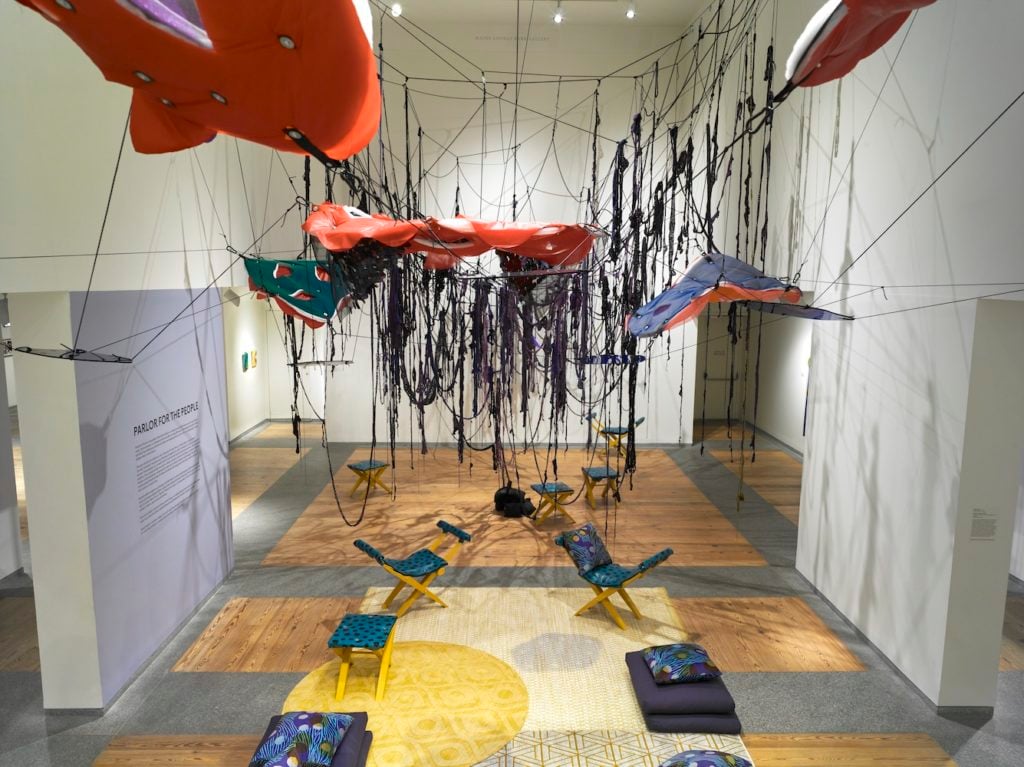
Installation view of Carrie Moyer and
Sheila Pepe: Tabernacles for Trying Times” at the Portland Museum
of Art. Courtesy of the Portland Museum of Art.
How did the show come about? What was the idea behind
it?
Carrie Moyer: The genesis
of the PMA show was that the curator, Jamie D. Simone, read Sharon
Louden’s book The Artist as Culture
Producer, in which I
wrote about meeting Sheila
at Skowhegan. [Simone] was tasked with programming artists who had
some relationship with Maine. We’ve both been to Skowhegan a lot—I’m a governor
there—and Sheila’s been to the Haystack School of Crafts many times
too. So we have a great love
of Maine and associate it with good things. I mentioned in that
essay that Sheila and I had worked on some small collaborations
together while doing residencies at Yaddo and at the Joan Mitchell
Foundation.
Shiela Pepe: Most recently we collaborated at
the Civitella Ranieri Foundation, which is in Umbria. That was more
focused because we already knew we would have the PMA show. We got
the residency and then we got the show and it was like, “Oh, this
is perfect.”
Did you apply to those residencies together?
SP: We apply as
collaborators. The first time, when we went to Yaddo around 2011,
it was like, “Oh, this’ll be fun. We’ll do a little collaboration
and see how it goes.” We made our own work and then we did a few
things together.
CM: It was very modest to
begin with because we weren’t sure if it would work. We’d basically
pass the object back and forth between the studios. Then we went to
the Joan Mitchell Foundation in New Orleans and again, we pitched
it as a collaboration. We were there for a month together in this
huge studio, which was insane. And we were more
ambitious.
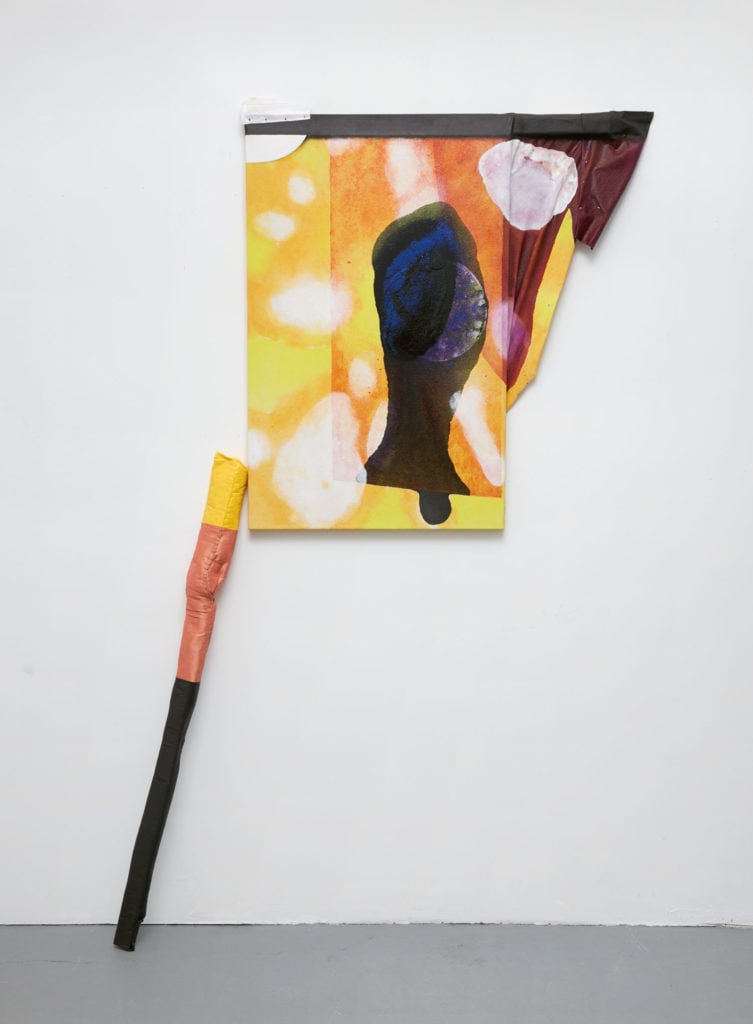
Carrie Moyer and Sheila Pepe, Carries
a Soft Stick (2016). © the artists.
You collaborated on two new artworks for the PMA exhibition
as well, including the central piece, Parlor for the
People. What was the process of making that
like?
SP: This was the first
time where it was like, “Carrie, can I paint? Give me a brush!”
Then I would paint and she would say, “Okay, let me fix it.”
[Laughs.]
CM: Yeah, I was the
cleanup woman. [Laughs.] We have very different aesthetics. The
works we made are funky and precise in certain ways. They feel like
they’re made by a third artist, you know? I think if you pull any
of that collaborative work into a space that was devoted to either
one of us, it would look like it was a sibling.
SP: If we had a kid and
that person made art, that’s probably what it would look
like.
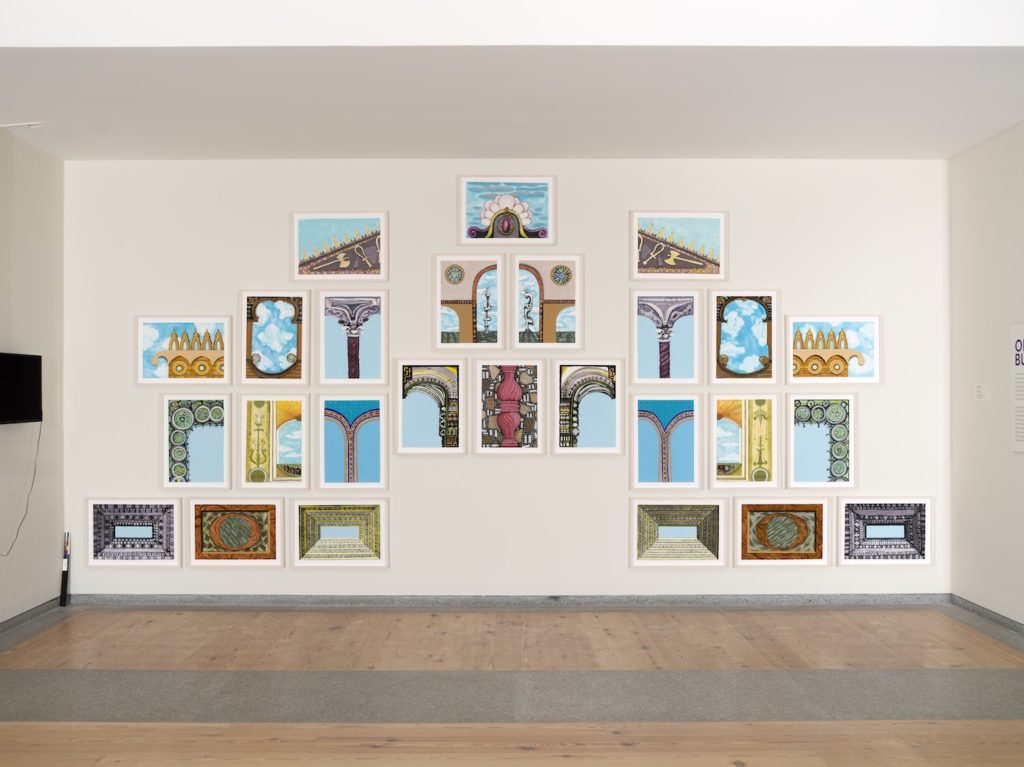
Carrie Moyer and Sheila Pepe, Opera
Buffa (2020). Courtesy of the artists and the Portland Museum
of Art.
CM: The other
collaboration we did for this show is this installation of 26
drawings made when we were at this residency in Italy and traveling
around and looking at churches. One of the interests that Sheila
and I share is in how compositional devices in religious art
operate, like a mandala or an altarpiece—these things that sort of
fix your gaze in a space that’s meant for meditation. So that was
something that we played with in this work on paper, which is
called Opera
Buffa. You’ll notice
they’re paired drawings—we each would make a pair and then as we
got towards the center, we worked together on some, passing the
drawing back and forth, exquisite corpse-style.
The thing that our
collaborations rely on is setting up a system before we do it. So
each time we work together, we have a different formula. It took us
two weeks to sit on all this new information we’d been getting in
Europe, all the things we’d been looking at. Finally, Sheila came
up with the thought of creating our own altarpiece because we’re
both interested in symmetry and Sheila has a native relationship to
religion—she grew up Catholic. I am interested in a more ambient
kind of spirituality. I’m always referring to mid-century nature
painting in my work—people like Marsden Hartley and Arthur Dove.
Those are people I think of as being my ancestors.
SP: Also, because we both
grew up in modernism, there’s this understanding for us that art
can be a secular place of spirituality. I don’t think I understood
transcendence as a kid, but art always felt expansive; it felt like
church to me.
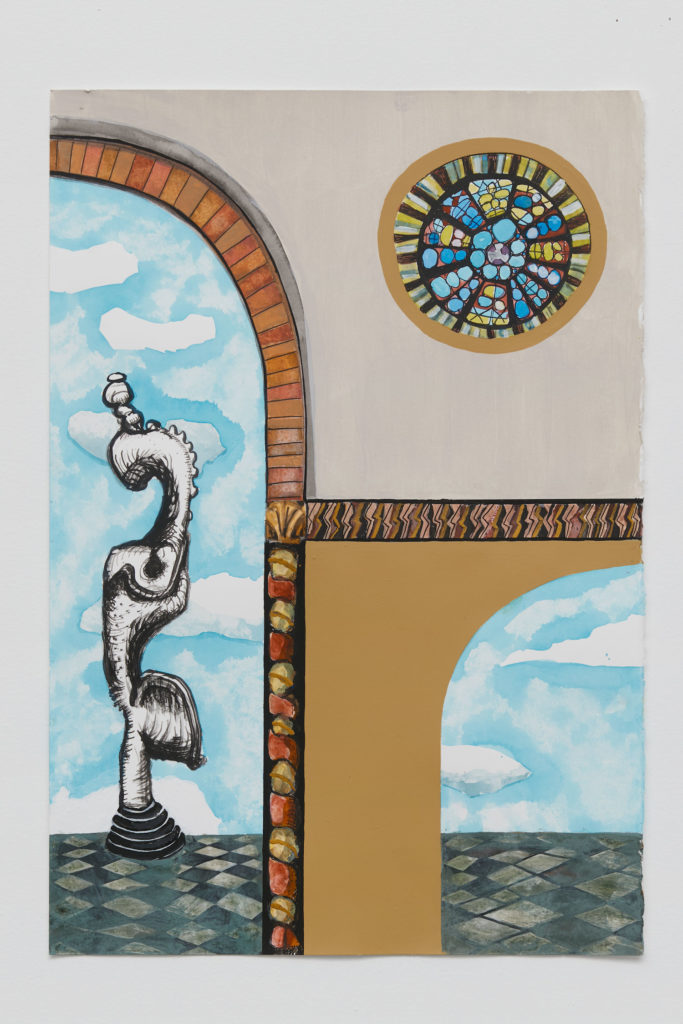
Carrie Moyer and Sheila Pepe, Opera
Buffa (2020), detail. Courtesy of the artists and the Portland
Museum of Art.
If I were to come across Opera Buffa in
a gallery, I wouldn’t think it was done by Carrie Moyer and Sheila
Pepe. It doesn’t necessarily look like your other
work.
CM: I think we’ve both
been pondering that, wondering, “Really, that’s what we did? How
did that end up being the result?” For me, part of it was the fact
that we were in this place where all of this stuff was so real and
vivid. I don’t think I had a chance to process it and turn it into
a kind of abstraction.
What about the title of the show, “Tabernacle for Trying
Times”? The word tabernacle has varied meanings across different
cultures and religions. What does it signify to you?
CM: When we were
brainstorming about how we would collaborate using the gallery
after we’d done the site visit, we talked about how there’s a
natural gathering space in the room we were offered. So Sheila and
I just started brainstorming, asking, “What are the values we want
to communicate?” The phrase “big tent” came up—the idea of creating
a space for all kinds of people. We were also thinking about tent
revivals in the 19th century.
SP: There’s
also the Jewish Tabernacles that were created when Rome destroyed
the temple. They were portable tents that people would worship and
use as a kind of protective space. We had a hunch that everybody
could buy into this word.
CM: I grew up in a very
nonreligious family, so the word tabernacle gave me the creeps for
a while. [Laughs.]
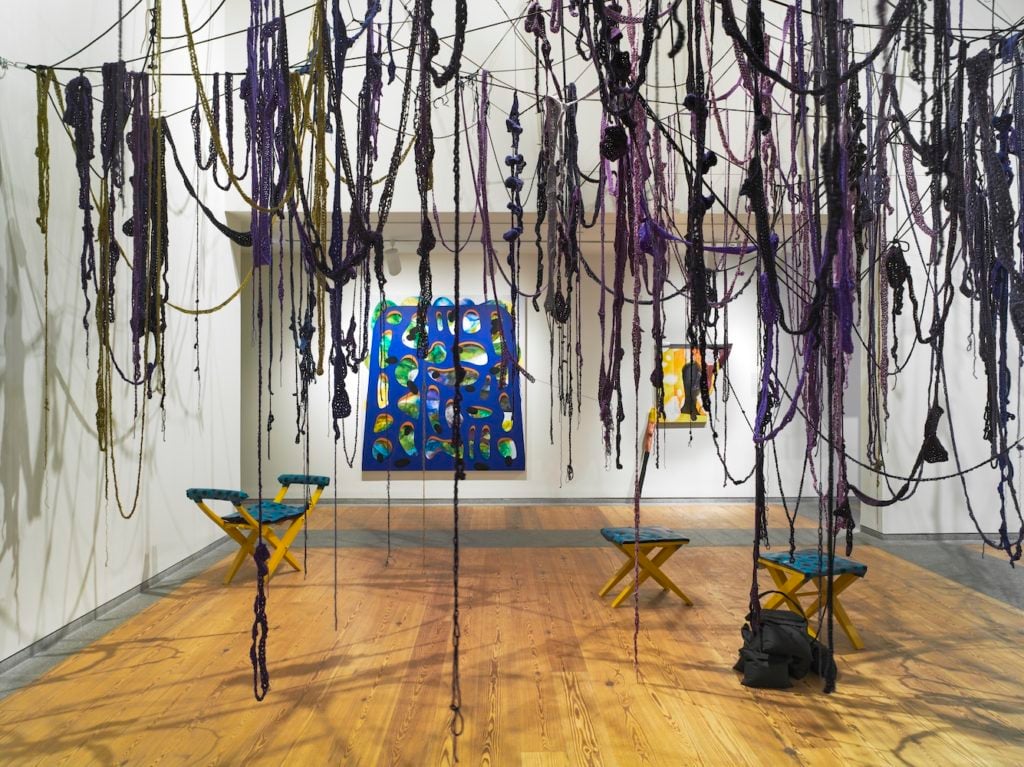
Installation view of Carrie Moyer and
Sheila Pepe: Tabernacles for Trying Times” at the Portland Museum
of Art. Courtesy of the Portland Museum of Art.
When you see all these works from different periods in the
same space, what effect does that have?
CM: I’m someone who
always thinks every painting looks really different from the last
painting, even though they totally don’t. So when I was looking at
all that work, the feeling I had was, “Oh, I really do know what
I’m doing. I really have a group of ideas that I’ve had for quite a
while.” This back-and-forth play between the kinds of space that
can exist in a painting—that’s really the thing that gets me very
excited. The way a painting can have one pocket where you’re
convinced of its spatial reality—you feel like you can stick your
hand in it—and then you move your eyes and it’s like suddenly flat.
The idea that this thing could be destabilizing—I’m really
interested in that. From painting to painting in that show, it’s
happening in different ways.
SP: I’m asking the
question too. I loved seeing those little paintings that you made
15 years ago next to something that you made last year or the year
before. They looked amazing together. And they had a related
palette. Even though you can put out a body of work where, in one
room, every painting looks different than the other, there are
these categories that keep piling up. That’s something that I love
about my own work, but it’s just much more scattered, you know? My
interests are more scattered. And Carrie’s a better craftsperson in
painting than I am in fiber—on purpose. She’s very interested in
the craft of painting. I am too, but as a visitor.
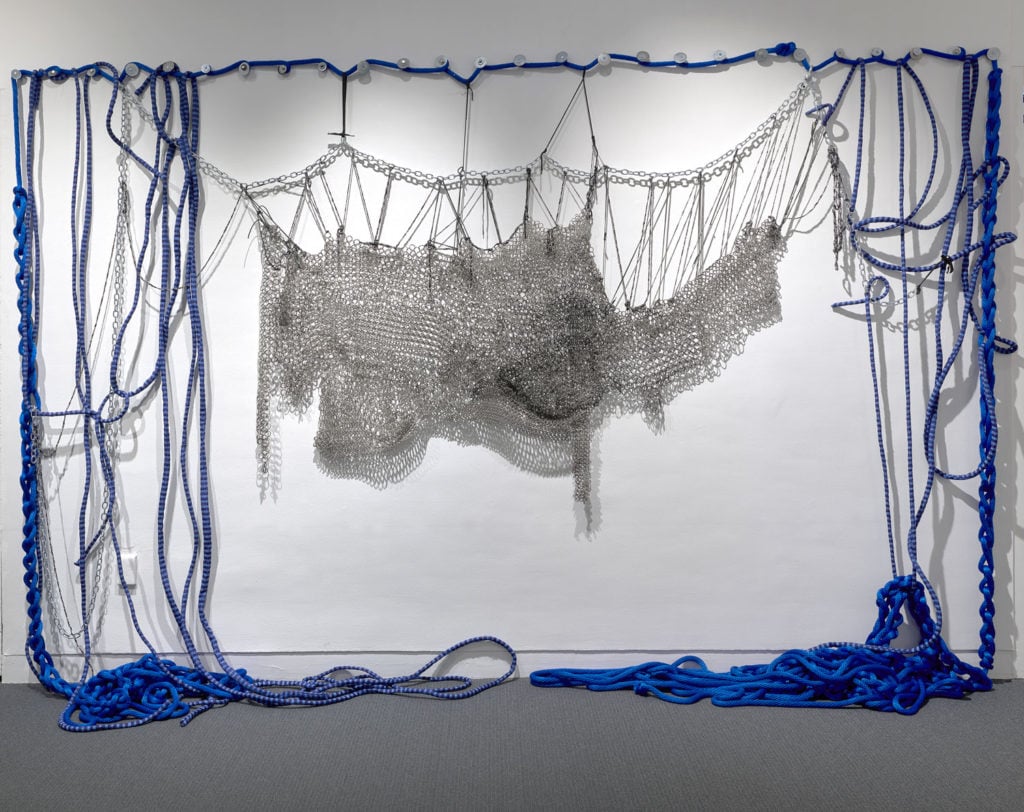
Sheila Pepe, 91 BCE, Not So Good for
Emperors (2017), detail. Courtesy of the artist. Photo:
Clements Photography and Design, Boston. © Sheila Pepe.
CM: Sheila doesn’t like
this idea of having any kind of expertise. Though recently, she has
a renewed interest in making quote-unquote “real sculpture” that
stands on its own. She’s made furniture off and on for maybe the
last 10 years in different shows, some of it out of crocheting. But
the sculpture in this show is different—this is a very formidable
object that doesn’t feel like it’s gonna disappear when you pull a
string.
SP: It felt amazing to
make something that was not possibly temporary or overtly
ephemeral! I think it’s a couple of things. One is Carrie’s
influence. I just realized this the other day actually. I always
see Carrie’s paintings as these amazing objects because I just
can’t see painting as anything else first. I feel like I’m joining
you and working towards this new threshold problem, which is making
things pretty much alone in the studio without an army of 40 people
making your work. To just make something on your own with your own
hands feels so luxurious. It’s less about the cult of the
individual and more about the mom and pop business-scale of making
good stuff.
As we move from the art world to
the art industry, this is the line in the sand that I now want to
draw. I also realized a couple of years ago that destroying your
own work is just generally not a good idea.
CM: It defeats the
feminist core of the work.
SP: Yeah, erasing
yourself is not a good idea. On the other hand, it does express a
value that I really believe in—that is, that art can have all of
the hardcore formal attributes that we want it to, but it doesn’t
need to be there forever. It can disintegrate and go back to the
earth.
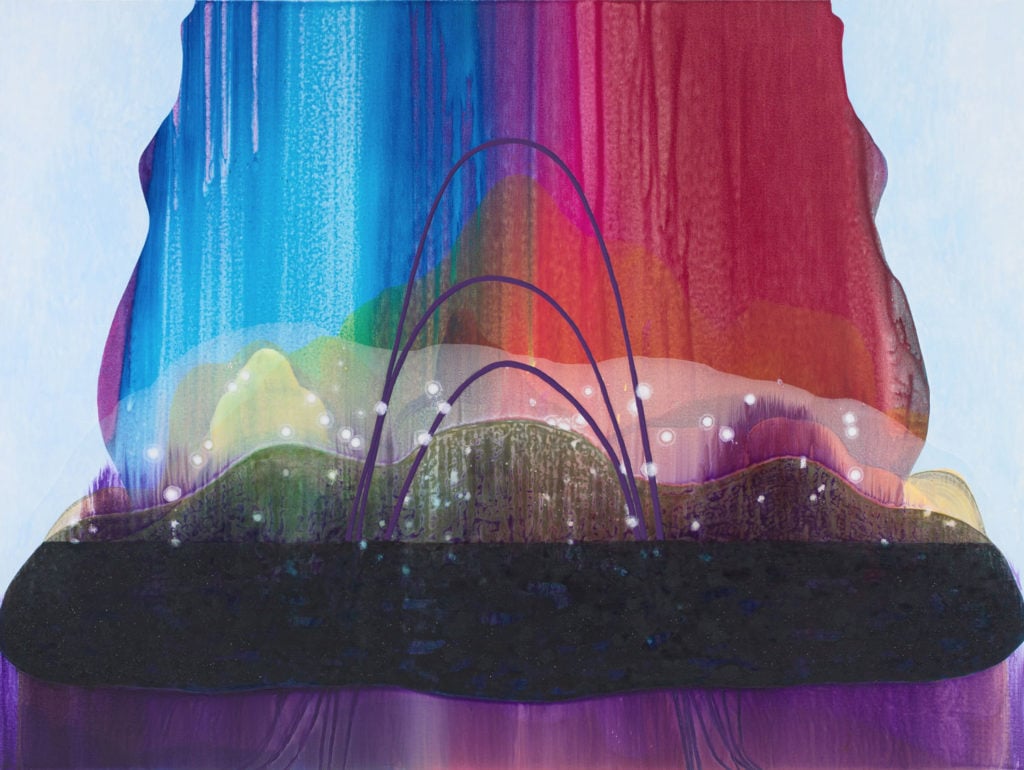
Carrie Moyer, Intergalactic Emoji
Factory (2015). Courtesy of DC Moore Gallery, New York. Photo:
Steven Bates. © Carrie Moyer.
Editor’s Note: the Portland
Museum of Art will be closed through April 13.
“Carrie Moyer and
Sheila Pepe: Tabernacles for Trying
Times” is
currently scheduled to run through June 7,
2020.
The post Artists Carrie Moyer and Sheila Pepe Have Been
Together for 25 Years—But Their Latest Collaboration Surprised Them
Both appeared first on artnet News.
Read more https://news.artnet.com/art-world/carrie-moyer-sheila-pepe-portland-museum-1806690
Further reading


Leave a comment