
Letter From Florence: One Museum Director’s Account of How He’s Bringing Art to the Public During a Lockdown
Italy has been in lockdown since March 9. On day 17, Arturo
Galansino, the director of Florence’s Palazzo Strozzi, told us how
his institution is keeping in touch with its public, the importance
of Tomás Saraceno’s work as a symbol of hope, and Ai Weiwei’s
message of solidarity.
As you can imagine, these days have been very long, even if, at
the same time, everything is happening really fast. Of course, I
feel worried—but we are trying to do our best to keep working hard
while we are forced to stay in our houses. We are lucky to have
internet, to be constantly in touch with our public through social
media, and to be able to work remotely with our colleagues.
Our first response has been to create an integrated platform
with our blog and social media, an editorial project called
“IN CONTATTO / IN
TOUCH,” where different contributors will help us to reflect on
our present. Our institution is currently facing an unusual
challenge: the absence of direct interaction with works of art,
which normally lies at the very heart of what we do. This is what
prompted us to devise this project, creating a new form of
interaction with our audience in an effort to “remote-trigger” a
debate through the language that we know best: the language of
art.
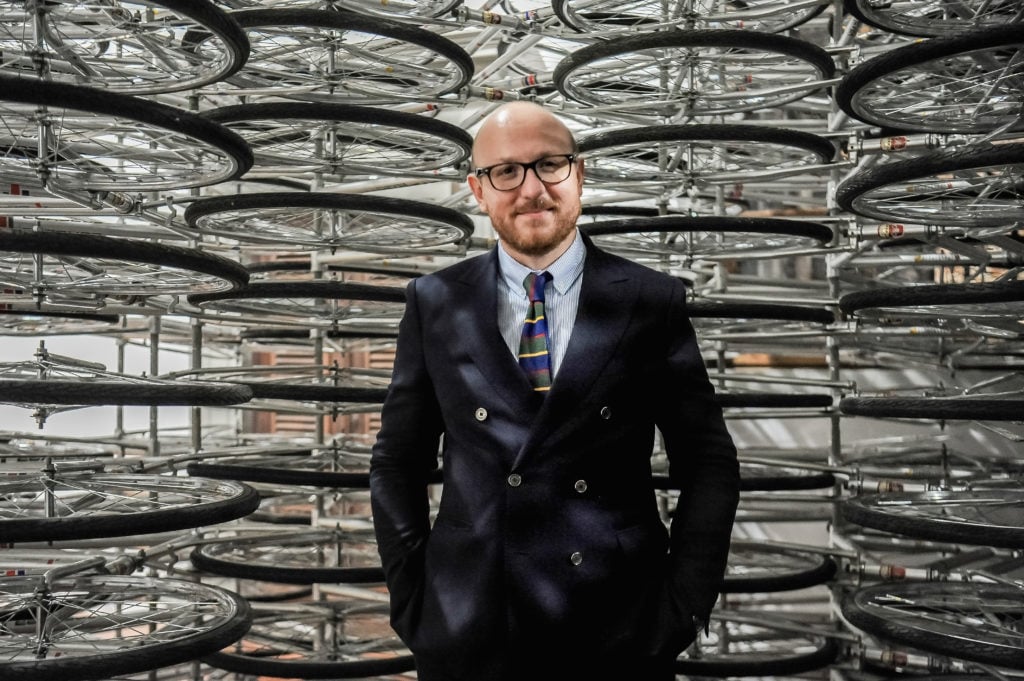
Arturo Galansino, director of Fondazione
Palazzo Strozzi at the opening of “Ai Weiwei: Libero” in 2016 in
Florence. (Photo by Laura Lezza/Getty Images)
Sadly, my colleagues abroad, in Europe and the USA, are now
facing the same problems we experienced just two weeks ago, and all
their museums are closing. We are all in the same boat. I feel very
sympathetic toward my fellow directors and curators, who sent me a
lot of messages of empathy weeks ago. We are now, unfortunately,
further into a cycle that is still in store for them.
Recently, we received the support of Ai Weiwei. He filmed a video for our
platform to encourage us because this situation touches
him very deeply. He said that this emergency must make us think
about our freedom, something we always take for granted. He
suggested that this virus is almost “democratic,” because it is
really affecting everybody with no distinction in terms of
nationality or social class.
We didn’t expect we would have to shut the Palazzo Strozzi so
quickly. Now, we realize that it was a good choice. So my advice to
other countries is: the sooner, the better.
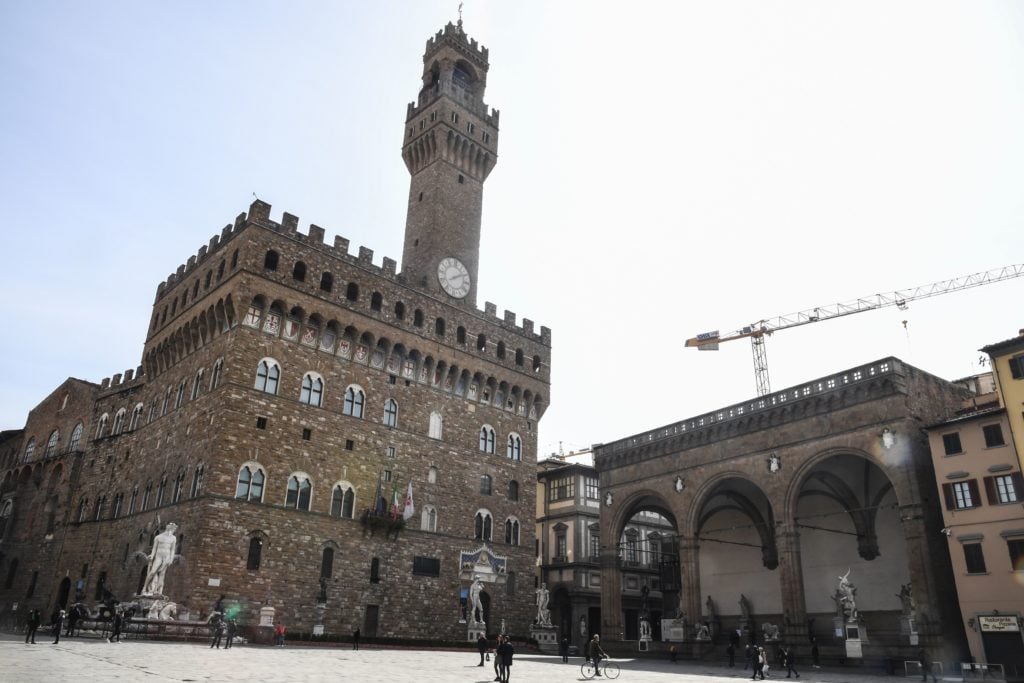
A vacant Piazza della Signoria and
Palazzo Vecchio in Florence, as Italy imposed unprecedented
national restrictions on its 60 million people on March 10 to
control the deadly coronavirus. (Photo by Carlo BRESSAN / AFP via
Getty Images)
The situation in Florence and Tuscany is better than in the
North of Italy but, of course, the epidemic is growing here, too.
The main issue is the capacity of the hospitals to treat so many
sick people with special care, and specifically to supply them with
ventilators. However, we have to underline that our public health
system is working very hard and how it is coping is heroic.
As the director of a cultural institution, I am trying every day
to understand what is happening and to be ready to react
strategically. It is too early now to change our plans or to make
impulsive decisions. We need to move ahead day by day—thinking
about our individual work as part of a network with other local,
national, and international institutions. Synergistic choices and
plans will be fundamental in the near future—in no small part
because of the tough economic situation we are going to face.
So, at the moment, we are sticking with our plan. We hope to
reopen our exhibition “Tomás Saraceno: Aria” as soon as it is safe.
In a way, this is the perfect show for the moment in which we are
living. Tomás feels like a kind of prophet: his work imagines a
more responsible way of living.
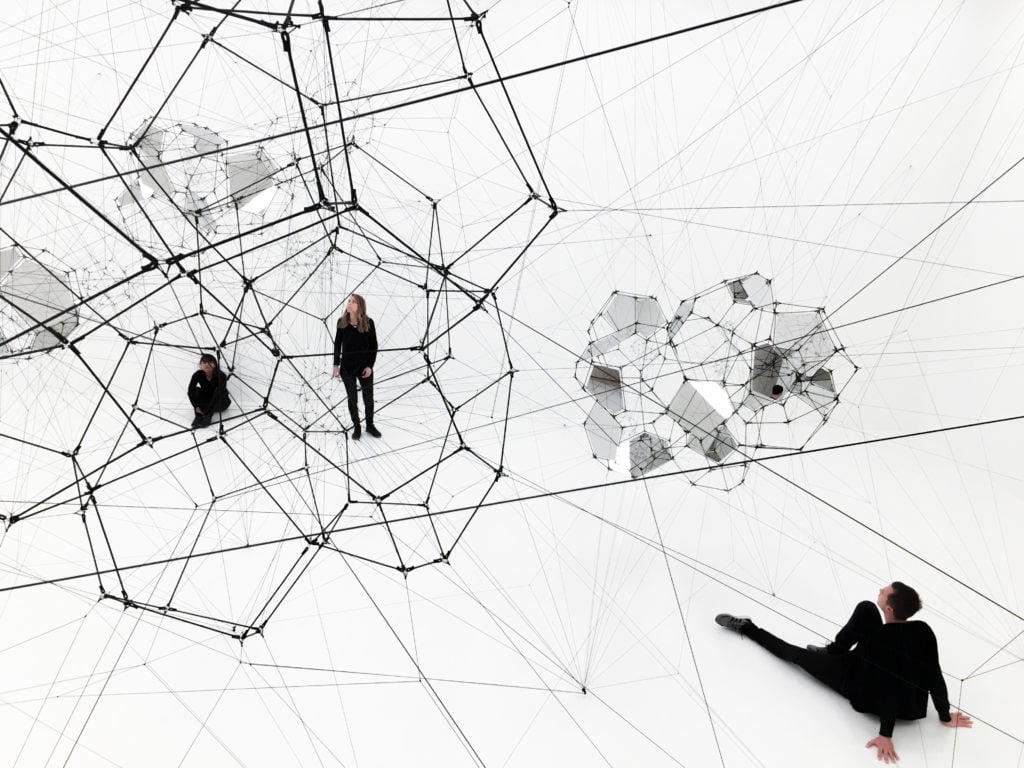
Tomás Saraceno, Stillness in
Motion–Cloud Cities(2016). Installation view at San Francisco
Museum of Modern Art (SFMOMA), USA. Courtesy of the artist;
Andersen’s, Copenhagen: Ruth Benzacar, Buenos Aires; Tanya Bonakdar
Gallery, New York/Los Angeles; Pinksummer contemporary art, Genoa;
Esther Schipper, Berlin. ©Photography by Studio Tomás Saraceno,
2016.
“Tomás Saraceno: Aria” was a good starting point for our blog,
which began last week. Because we don’t have a collection, I
thought we needed to do something more mediative. Saraceno’s
exhibition is mainly about the sensation of being in the space
experiencing his work, so it is not easy to put it online. That’s
why we opted instead to explore the themes of the
exhibition in-depth, including through a video message directly
from the artist.
Meanwhile, even though the museum is closed, you can still enter
our courtyard in the heart of Florence, which currently hosts
Saraceno’s major site-specific installation Thermodynamic
Constellation (just make sure to keep an appropriate distance
between you and others).
It is important that, even in this situation, we offer a sign
that we are still “open” and fighting. Of course, there are not a
lot of people around, but some people still need to go to work, or
to the pharmacy, or to buy food, and at least they can see
Saraceno’s magical installation along the way. Today, from a
distance, this installation can still offer a space for conceptual
collective participation in which visions and physicality forge a
powerful bond.
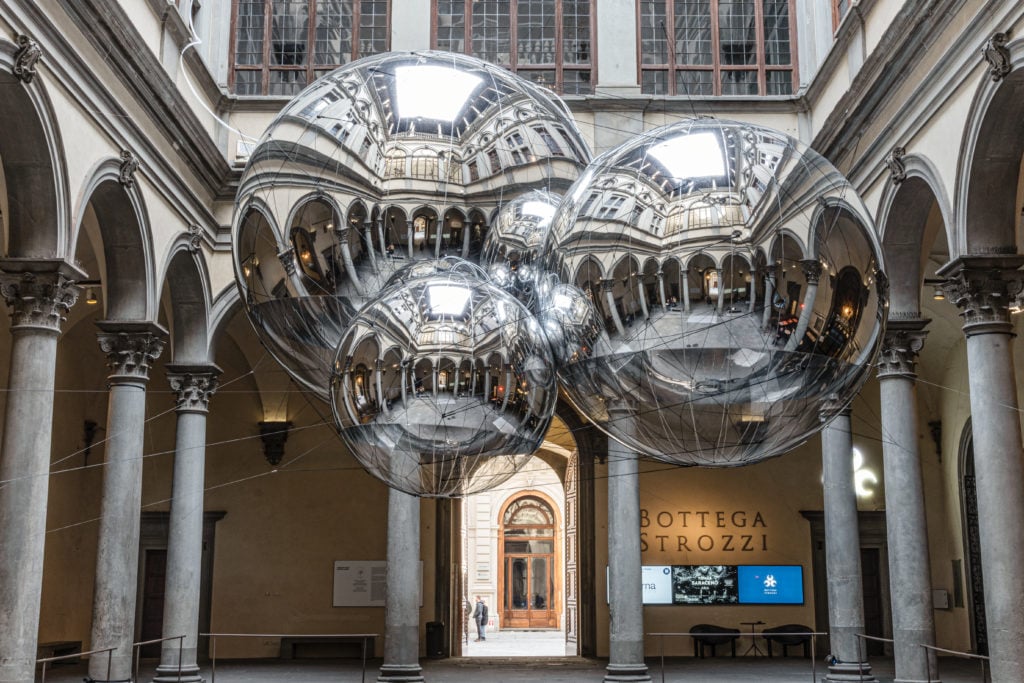
Tomás Saraceno’s Aria
installation at Palazzo Strozzi, Firenze; Photograph ® Studio Tomás
Saraceno 2020
The installation is a manifesto of hope for a better future. And
now, more than ever, we really need hope.
As told to Javier Pes
The post Letter From Florence: One Museum Director’s Account
of How He’s Bringing Art to the Public During a Lockdown
appeared first on artnet News.
Read more https://news.artnet.com/opinion/letter-from-florence-1807782
Further reading


Leave a comment