
Anybody Home? A Search for the Last Places Where New Yorkers Can Still Safely See Art in Person During the Coronavirus Crisis
For years, the See Saw iPhone app has been an indispensable tool
for gallery goers in New York and other global art cities, with its
clean interface allowing users to scroll through a list of
exhibitions on view. One section of the app highlights shows that
are opening in the coming week, another highlights which are
closing. After selecting from the rich buffet of open shows, the
user can watch, with joy, as the See Saw map becomes peppered with
flags, each one marking the location of the gallery they want to
visit.
But by the end of last week, art fans were looking to See Saw
for something else. They wanted to get news on which galleries were
still holding their openings this weekend, and which galleries were
closing for the foreseeable future.
“We’re obsessed with making sure See Saw is accurate, so we
began updating the temporary closure status of individual galleries
in response to COVID-19 on the app last Wednesday afternoon with no
idea of the ultimate number of closures to come,” said Ellen
Swieskowski, See Saw’s co-founder.
A week later, New York’s world-leading constellation of museums
and galleries were shuttering due to the coronavirus crisis, and by
a need for six feet of social distancing—and a state-wide ban on
gatherings over 50 people. Now, See Saw serves less as a way to get
from spot to spot than as a reminder of the enormity of what has
closed.
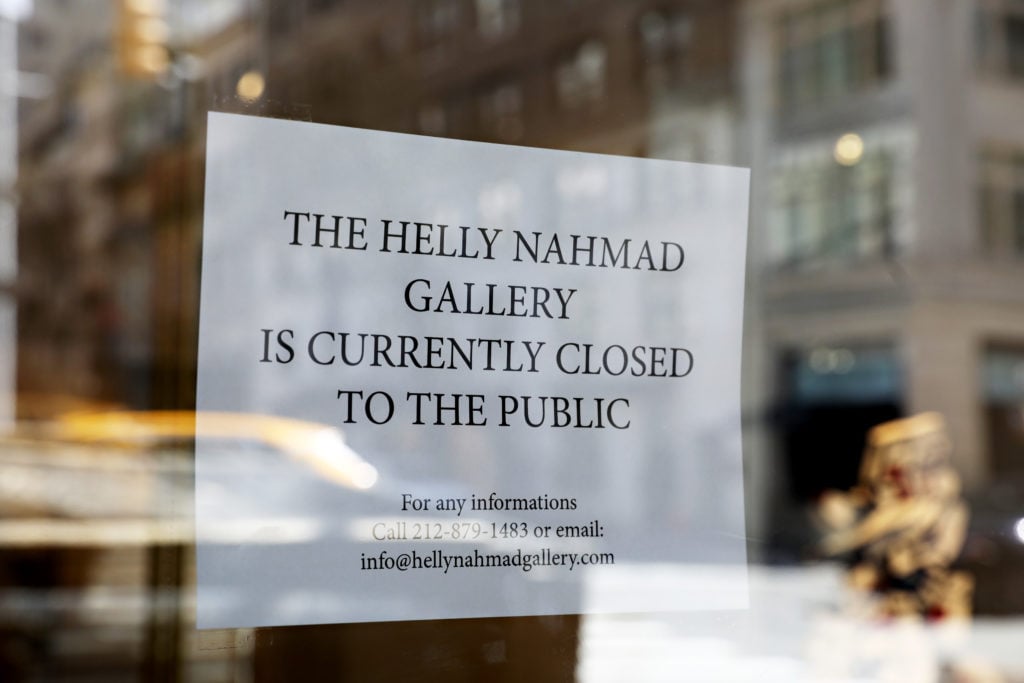
A sign is seen in the window of Helly
Nahmad Gallery on Madison Avenue on March 13, 2020 in New York
City. Photo by Cindy Ord/Getty Images.
“At this point it’s clear that the overwhelming majority of
galleries are temporarily shuttered, so we’ve taken a ‘closed until
proven open’ approach and updated all galleries on See Saw
worldwide with the note ‘Please contact gallery for hours,’”
Swieskowski said. “It felt a little eerie having to make that
decision, but public health is clearly the number one priority
right now.”
And yet, even with the city on lockdown, there’s still a high
amount of art that you can see. There’s been a push to develop
online viewing rooms, virtual gallery tours, and new ways to
circumvent the fact that long-established norms of the art world
were shattered in just days. And there’s no reason why you
shouldn’t go outside. Asaf Bitton, the health systems innovation
leader at Ariadne Labs who wrote a harrowing guide to the desperate
need for social distancing that went viral over the weekend, told
The New Yorker “the recommendation is to please go outside
if you can.” Even if New York gets slapped with an order to
shelter-in-place, going outside and taking a walk is listed under
“essential activities.”
And if you do go outside, you might be even to see art the old
fashion way, in person—through windows, public spaces, or even at
the last open gallery in New York.
The Last of the Open Galleries
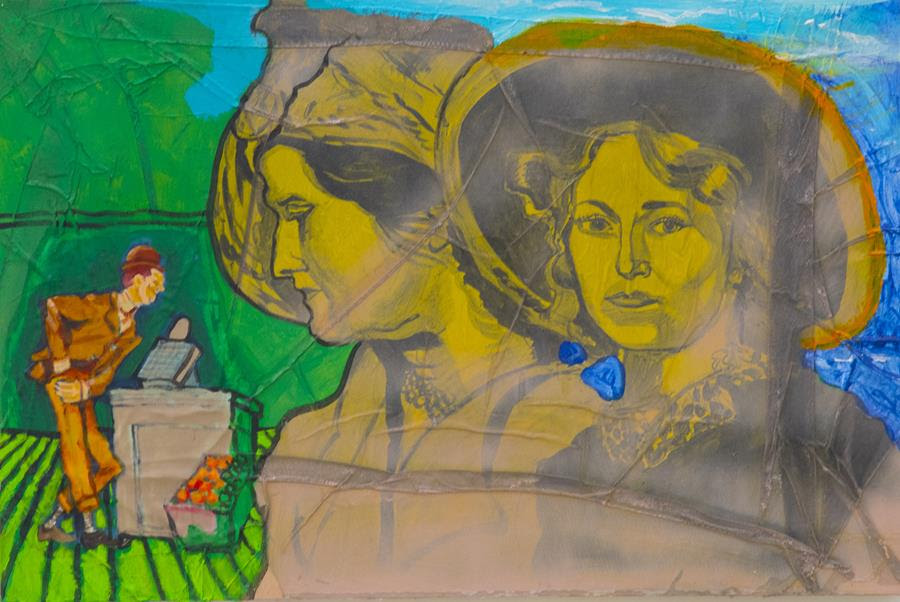
Archie Rand, Motet #1 (2013), a
work in a show at BravinLee, which is, as of now, still open to the
public. Photo courtesy of BravinLee.
On Monday, Swieskowski mentioned that two galleries had—for the
time being—decided to stay open. The first was Mrs., a small
artist-run space in Maspeth, Queens, known for its fiercely loyal
locals. It’s also very far away from the rest of the city’s art
scene.
“By design, Mrs. is set aside from the fray and somewhat ‘self’
isolated here in Maspeth,” the founders Sara Maria Salamone
and Tyler Lafreniere wrote in an Instagram post Friday. “We will
avoid shaking hands and will continue to disinfect the
gallery.”
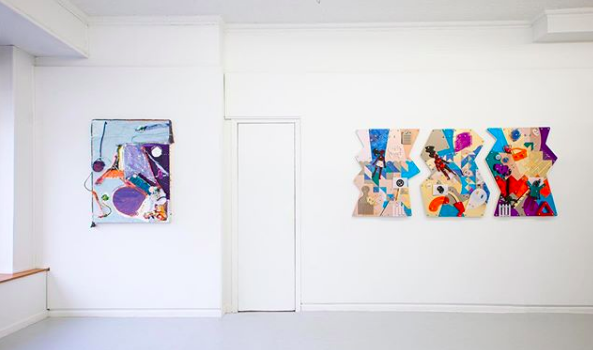
Installation view of “Assembly,” a show
of work by Damien Davis, Rachel Eulena Williams and Sun You, at
Mrs. in Maspeth, Queens.
Likewise, Team, the gallery on Grand Street in Manhattan, had
said it would keep the space open for anyone who wants to see its
shows by Petra Cortright and Will Sheldon, as two of its staff live
in the back of the space. The gallery posted on Instagram that
keeping the gallery disinfected would not waste any city resources
that need to be directed toward flattening the curve of
infections.
But by Wednesday, both had reversed course and closed.
That puts BravinLee, the gallery founded by husband-and-wife duo
John Lee and Karin Bravin in 1991, in the unique position of being
quite possibly the only publicly operating gallery in New York
City.
And it’s not out of a dismissal of the dangers of spreading
coronavirus—Lee understands that quite well.
“I’m already and always have been about a 7 to 8 on the afraid-of-cooties Howie
Mandel scale and have always had hand sanitizer in every
drawer,” Lee said in an email.
Lee said he sought advice from a doctor who specializes in
infectious diseases and he said that, while the situation could
change at any time, right now it would be possible to keep the
gallery open and still keep everyone safe. Granted, the situation
at BravinLee is quite unique: Lee rides his bike to work—no risk of
picking up something on the grimy subway!—and has no employees to
infect. His space—which is currently showing works by the artists
Archie Rand and Ali Shrago-Spechler—is already isolated on the
second floor of a building in Chelsea, and other galleries on his
floor vacated long before the crisis hit. He also removed the
sign-in book—no touching of pens!—and posted a sign on the door
limiting traffic to two to three people at a time, all of whom must
stand six feet away from each other.
“I am pained to touch men’s room doors, and I Windex the fuck
out of the gallery’s door hardware at least once a day—though the
door is now propped open to make the issue moot,” he said.
Lee added that, even while he’s technically open, he only
expects friends, family, and die-hard fans of the artists to come
by.
Window Shopping
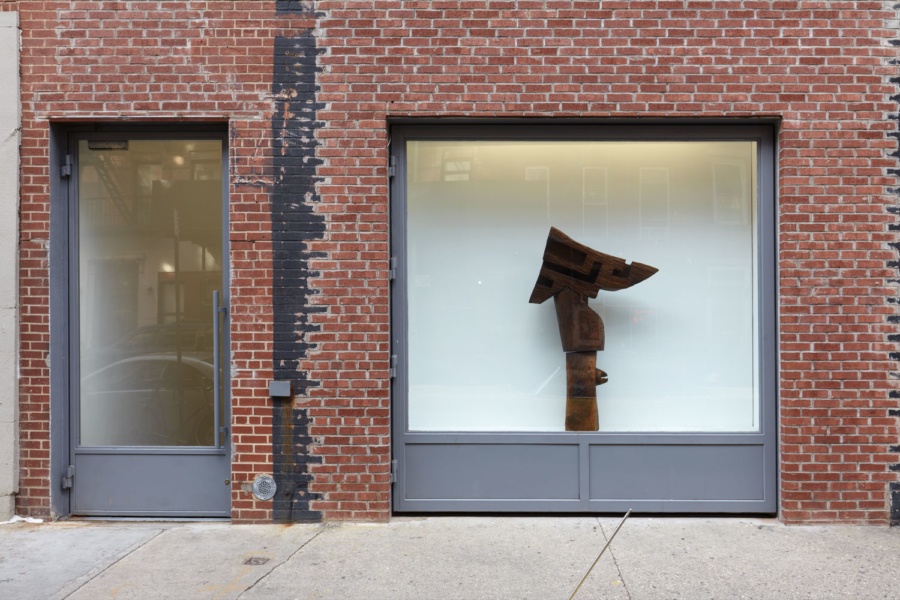
The exterior of Karma, a gallery in the
East Village, showing a work by Thaddeus Mosley. Photo courtesy of
Karma.
Some galleries never needed people to come inside in the first
place—they were built as window spaces, solely to be seen from the
outside and never entered. In what now seems like incredible
timing, Anton Kern Gallery opened a window-only space in Tribeca in
January, on the corner of Walker and Lafayette streets, showing a
David Shrigley neon work and a sculptural and video installation by
John Bock. In late February, right before Armory Week brought the
art world together for what now seems like an extremely ill-advised
spree of art fairs and openings, the gallery opened a show of two
works by Lothar Hempel that was supposed to be up until March 30,
but now could be there much longer. Gallery director Brigitte
Mulholland noted that, technically, the gallery can stay “open”
without breaking any restrictions.
“Maybe Anton was wildly ahead of his time with this concept!”
Mulholland said.
Other spaces throughout the city have windows that reveal part
of a show, or the entire thing. The East Village gallery Karma has
two spaces on East 2nd Street, between Avenues A and B. One is a
small space where the entire show can be glimpsed from the street,
and the other, while larger, still has a tiny white cube cut into
the exterior brick big enough to house one work. Right now it has a
Thaddeus Mosley show up, and while you can’t go inside, you can see
one gorgeous wooden sculpture while you walk six feet away from
everyone else.
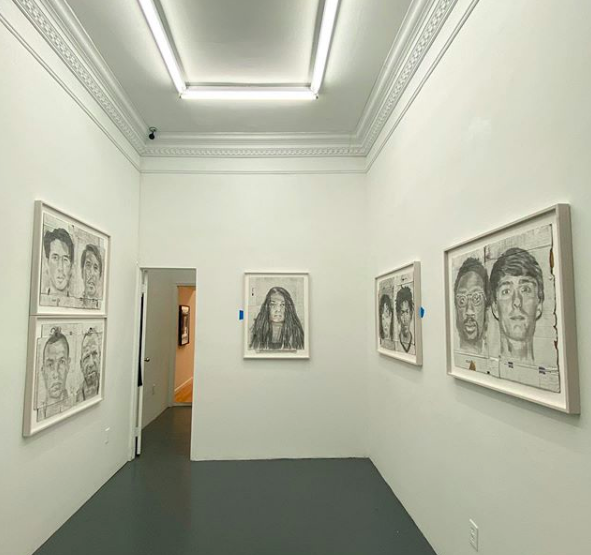
Installation view of the Kunle Martins
show at 56 Henry. Photo via Instagram.
On the Lower East Side, several galleries with ground-floor real
estate have long sported full windows to entice passersby to come
inside, stay for a while, get within six feet of another human
being, and maybe buy work.
Well, can’t do that anymore!
And given the risks involved in leaving a big window open when
no one’s around, Nicelle Beauchene—who shares a two-floor space on
Broome Street with veteran dealer Jack Hanley—put down the metal
grates, leaving the show by Bruce M. Sherman up inside but visible
to no one. Her solution? A bespoke online viewing room, which
launched today, that lets her release upon the internet precisely
the kind of shows that are now behind the metal. First up will be
Sherman’s show, followed by a work by John Evans, the late, great
East Village collagist who Beauchene just began representing.
“How I can stay engaged and keep supporting my artists?”
Beauchene wondered on the phone while driving back to the Hudson
Valley (where she lives and has a project space in the
summer). She had just photographed more than 80 works by Evans
at the gallery for the viewing room.
“Every two weeks we’ll add a new show,” she said. “Its a way to
stay relevant.”
Beauchene’s third show will be something appropriately
apocalyptic. It’s called “Noah’s Ark” and includes two works by
every gallery artist.
Meanwhile, anyone walking through the Two Bridges neighborhood
will see all of the Kunle Martins show through the window at 56
Henry—gallery owner Ellie Rines said she’s keeping the lights on.
And Rines added that she plans to—safely, while following all
precautions—install a new show after Martins’s show come down in
late March “so that people can see some art at a distance.”
Going Public
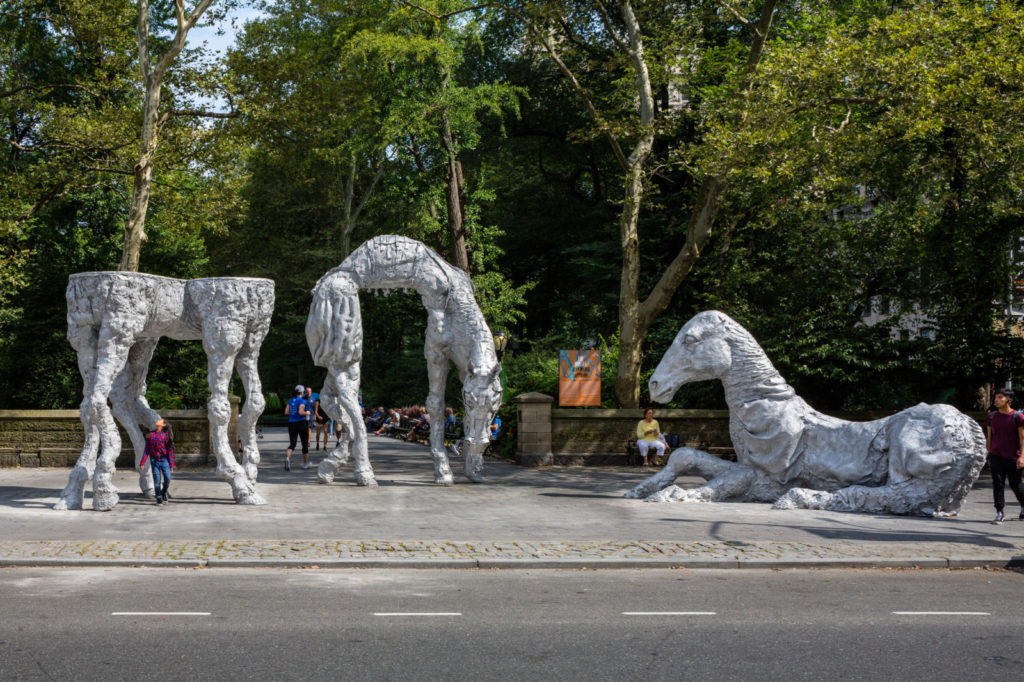
Jean-Marie Appriou, The Horses, 2019.
Courtesy of the artist and CLEARING, New York/Brussels; Galerie Eva
Presenhuber, Zürich/New York. Photo courtesy of Public Art Fund,
New York.
Over the weekend, countless indoor arts institutions had closed
or delayed exhibitions due to the new health guidelines, including
a statewide ban on gatherings of more than 50 people. Even High
Line Art, which commissions work that can be seen while walking the
popular and very outdoor park on an old train track, had to shut
down on Monday amid concerns that people wouldn’t properly social
distance on the narrow paths.
The last major institution that remains active might be Public
Art Fund. The non-profit currently has two shows open, and after
consulting with city authorities, its directors decided it would be
appropriate to encourage New Yorkers to seek them out, as long as
they followed all the necessary precautions.
Even if shelter-in-place is enacted, people are still allowed to
leave their homes. “Shelter-in-place, what it does is it formalizes
the shutdown of bars and all of that—you should be at home, but you
can go out,” said Daniel Palmer, the Public Art Fund’s curator, who
spoke on the phone from his apartment as the offices had,
naturally, been closed. “We want to encourage people to go home,
but if have they have to go outside, they can see the
work.”
He noted that one exhibition, Farah Al Qasimi’s “Back and Forth
Disco,” is installed on 100 bus stations across the five boroughs.
The stops each show one of the artist’s eye-popping photographs of
vibrant micro communities: Yemeni bodegas, barbershops in Astoria,
curtain stores in Ridgewood.
“There’s pretty good odds that there is one near your house if
you’re taking your dog out,” Palmer said. “Even if you’re now
taking the buses, you can still see the sculptures.”
The other Public Art Fund exhibition, a series of large-scale
aluminum statues of horses by Jean-Marie Appriou, is installed only
at the entrance to Central Park near Grand Army Plaza, but it can
have a powerful, maybe cathartic affect of those who live
nearby.
“It’s more for people who need to walk their dogs through
Central Park, but they are as powerful as ever,” Palmer said.
“They’ve become kind of eerie, they’re standing there as
sentinels to the park. They’ve always been so surreal—even more so
given the surreal moment we’re living.”
The Age of
Appointment Only
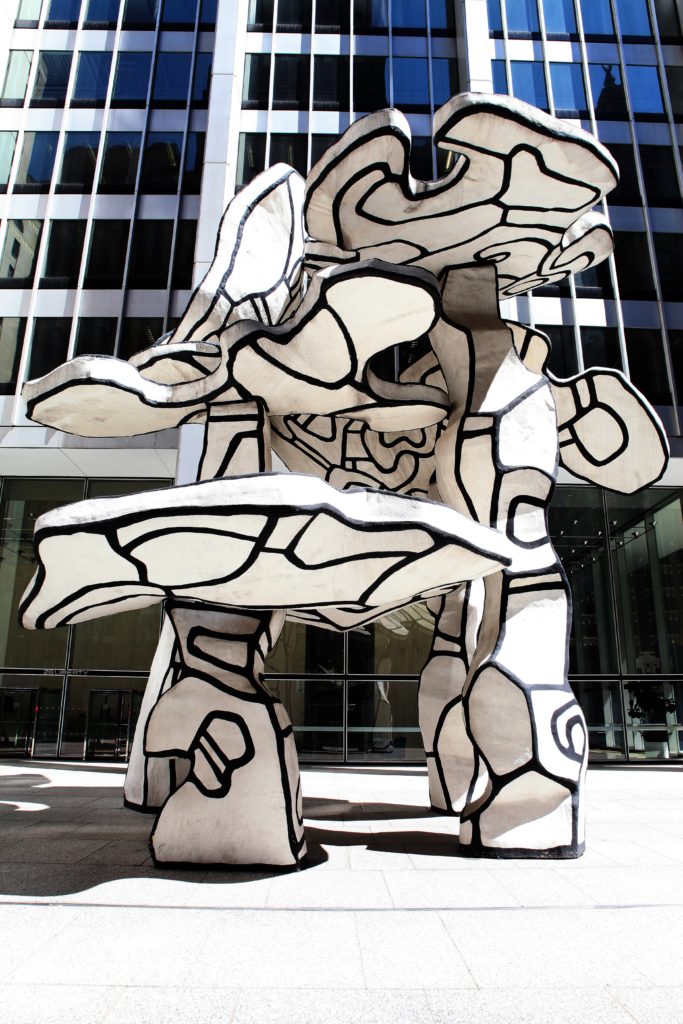
Jean Dubuffet’s Group Of Four
Trees sculpture sits in One Chase Manhattan Plaza in New York,
New York on April 15, 2016. Photo by Raymond Boyd/Getty Images.
The Public Art Fund does an amazing service of commissioning
contemporary artists to make new works for the city, but of course
there’s dozens of permanent works of public art that one can savor
during these lonely, lonely months to come. There’s the large-scale
sculpture by Jean Dubuffet that sits amid the row of midtown
citadels, temples of finance titans already reeling from a looming
economic meltdown. Someone yearning for the halcyon days of Jeff
Koons hysteria can swing by Astor Place and see Balloon Rabbit
(Red) in the lobby on 51 Astor. Or perhaps the right work for
these hectic times is Joseph Bueys’s 7000
Eichen (7000 Oaks), in which basalt stones are
paired with oak trees running down West 22nd Street.
The more inquisitive solo walker can investigate this
map—compiled over the course of years by Surface
deputy editor Andrew Russeth—which marks hundreds of
art-historically important spots in the city: apartments of
pioneering collectors once stuffed with masterpieces, storefronts
once home to illustrious galleries, the studios where famous
artists got their starts, and the sites of epoch-shifting
performances.
And there’s one more sign that the art world in New York may not
have come to a complete halt during the coronavirus shutdown. By
the middle of this week, many of the galleries that were forced to
close have become appointment-only, allowing for a single viewer to
email and arrange solo visit, with all the social distancing they
need accounting for.
See Saw is even planning to add a “Make an Appointment” button
on each gallery listing that lets art-seekers email the gallery
with just one touch of a well-sanitized iPhone. Even in a crisis,
the app is making a sprawling gallery circuit accessible.
The post Anybody Home? A Search for the Last Places Where
New Yorkers Can Still Safely See Art in Person During the
Coronavirus Crisis appeared first on artnet News.
Read more https://news.artnet.com/art-world/last-places-where-new-yorkers-can-still-safely-see-art-1807944
Further reading


Leave a comment