
What Actually Works When It Comes to Selling Art Online? Successful Early Adopters Share 5 of Their Business Secrets
When we rang in the new year just over three months ago,
thousands of participants in the global art industry thought they
would be spending the week of March 16 in Hong Kong, ping-ponging
between Art Basel’s latest edition in the city and a slew of
gallery openings, institutional programs, and networking
events.
Instead, much of this same population is now hunkered down
inside their homes in an attempt to slow the spread of the novel
2019 coronavirus that has all but shut down not just the art world,
but the world at large.
This unprecedented crisis has
finally forced every dealer and artist to turn toward the digital
horizon. Most notably, Art Basel moved up—and
scaled up—the
long-planned launch of its first online viewing rooms to the same
dates as its cancelled Hong Kong fair, in an attempt to replace the
opportunities its exhibitors and collectors lost. Several respected
dealers, including Los Angeles’s Susanne Vielmetter and New York’s
Di Donna Galleries, also announced the imminent debut of their own
in-house online viewing rooms in the preceding days. Put it all
together, and the market is now in the midst of a massive new
commitment to the virtual experience.
But while necessity is often the
mother of invention, panic is often the father of hasty mistakes.
Thankfully, the art market does harbor a small group of early
adopters who have already been embedded online for years. And
although there are no magical solutions for galleries exploring
e-commerce, some important—and often counterintuitive—themes emerged from discussions with some of
these veterans of virtual space.
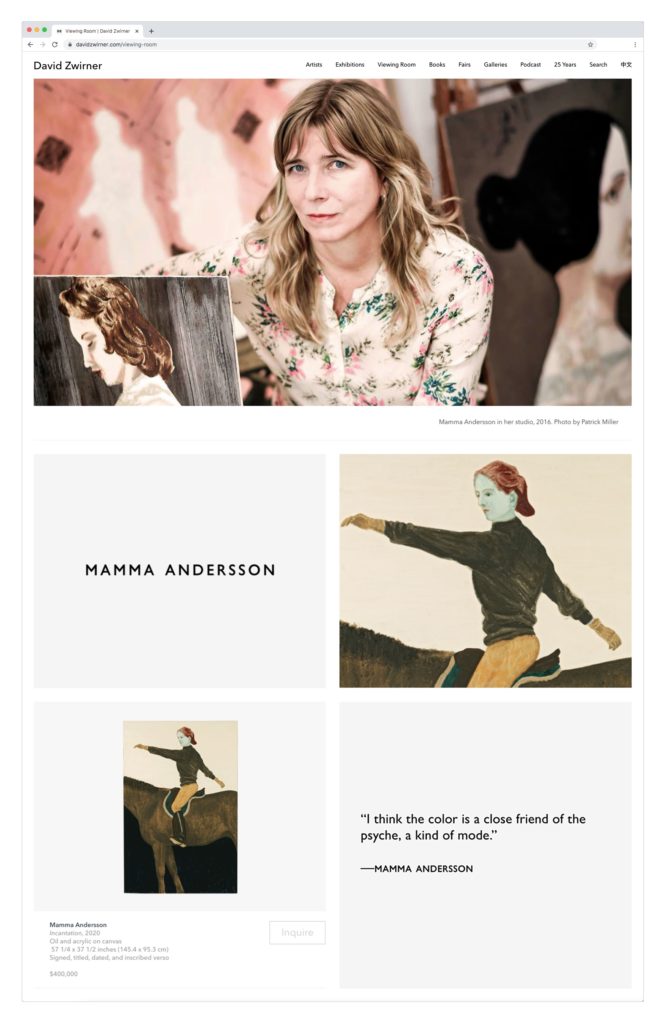
David Zwirner Online’s “On Painting: Art
Basel Online,” March 20–25, 2020. Courtesy David Zwirner.
1. Forget the Conventional Wisdom About What
Sells—and Who Buys—Online
Six years after the publication
of the first articles about selling art through
Instagram, some common
expectations have coalesced around art-market e-commerce: for
instance, that the best works to offer are vibrant, poppy
paintings, drawings, and photos; and that the artists who sell well
are either stars with brand equity, or emerging talent at
approachable price points.
Well, throw those expectations
out the window, according to experts.
“I wouldn’t limit a certain
price point or medium to online platforms,” advises Elena Soboleva,
who in 2018 joined David Zwirner as the gallery’s first digital
director after working as an independent curator and
customer-relations manager at Artsy.
Although Zwirner has offered
works priced as low as $1,000 in past online viewing rooms (which
it has been consistently programming since January 2017), the
gallery says it sold a $2.6 million work by Swedish figurative
sensation Mamma Andersson on the first preview day of its new
virtual exhibition, “On Painting: Art Basel.” Soboleva also says
that, contrary to popular belief, the gallery has also had “lots of
success with large sculpture,” arguably the polar opposite of what
is supposed to sell well online.
Nor are online buyers
predominantly young and internet-savvy upstarts, says Pace Gallery
president and CEO Marc Glimcher. After launching in-house online viewing rooms
for private clients in 2019, the gallery made them public amid the
coronavirus crisis. What draws digital consumers “isn’t a
personality type, or some kind of Generation Z [and] millennial
phenomenon,” he says.
Soboleva says that 40 percent of sales inquiries that come
through Zwirner’s in-house
online viewing rooms are from new clients, but that visitors and
buyers span regions,
lifestyles, and professions. Longtime collectors, museum trustees,
and even other artists are all active, she says.
This isn’t just outlier data from
mega-galleries. Julia
Dippelhofer and Michael Navin, who run the Journal Gallery in
Tribeca, have also, since 2017, had an online sales complement
titled Tennis Elbow. Although
Dippelhofer and Navin are reassessing how exactly to proceed in the
social-distancing era, the gallery has traditionally shown
one-week-only exhibitions in its physical space while Tennis Elbow
has offered concurrent one-week-only online presentations of
available works by the same artists.
While Dippelhofer says she and
Navin knew they would use Tennis Elbow to feature some “work that
would appeal to newer collectors in a lower price range,” they have
also benefited from mixing in “work by established artists that
won’t be in that same price range.” The attraction in that latter
case, you ask? That leads us to our next tip…
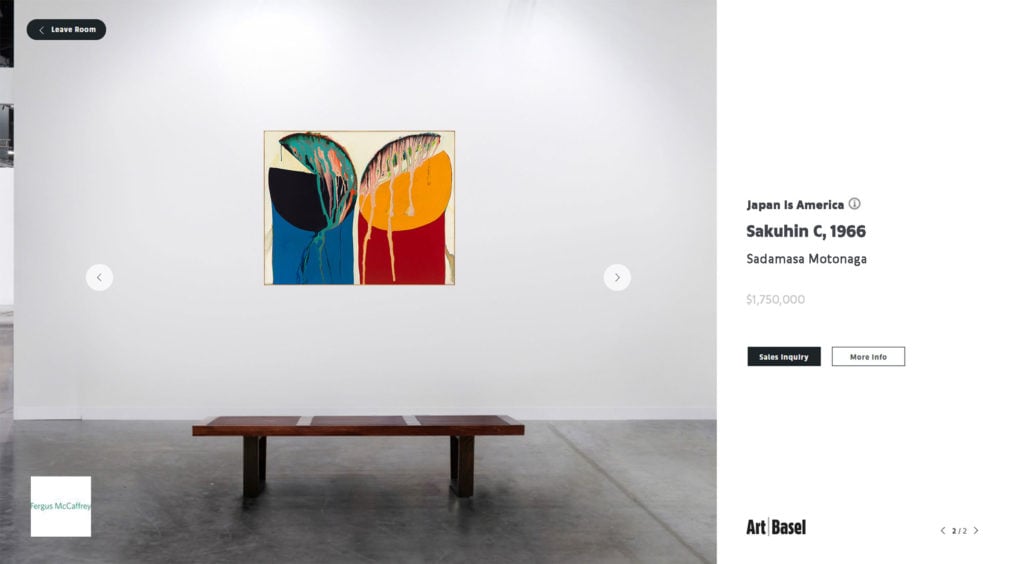
Art Basel’s March 2020 Online Viewing
Room, featuring a work from exhibitor Fergus McCAffrey’s exhibition
“Japan Is America.” Courtesy of Art Basel.
2. Transparency and Accessibility Work—for Buyers and
Sellers Alike
One key part of Tennis Elbow’s
longevity and what Dippelhofer calls its “more democratic approach”
has been its membership program. To join, applicants are merely
asked to supply a few basic details (name, email, phone number) and
a written summary of who they are and what they collect. Members
also accept terms that include a promise not to resell work within
two years of acquisition and grant the Journal right of first
refusal thereafter.
Once accepted, members get to
access new Tennis Elbow offerings a full day before non-members.
They are also “pre-approved” to acquire what they find on the
platform. The process means that higher-priced, more in-demand
works by established artists are more accessible to members than
they might otherwise be. And the concept is resonating. Dippelhofer
says that membership now numbers in the hundreds, and has roughly
doubled since Tennis Elbow added the program in May
2019.
Similar transparency is at work
in Art Basel’s nascent online viewing rooms. Although the virtual
fair will open to the public on Friday, March 20, visitors to its
two preceding VIP days gain access by logging in with their Art
Basel credentials. These credentials correspond to limited but
useful data about each user’s history, such
as which events they’ve
been invited to and whether they are members of Art Basel’s Global
Patrons Council. This information is transmitted to dealers
automatically when a VIP inquires about an artwork, acting as “a
kind of verified lead” for galleries working with clients for the
first time, says Art
Basel global director Marc Spiegler.
Transparency extends to the
pricing side, too. “Although historically there’s been some
hesitancy to show prices in a fair environment, we wanted to create
the conditions for success,” Spiegler says. In consultation with
the more than 30 galleries comprising the selection committees for
its three fairs, Art Basel’s leadership “evaluated extensive
research that artworks with price data are exponentially more
likely to be sold.” The result? Every piece in Art Basel’s online
viewing rooms includes either an exact price or a fair-approved
price range, from under $10,000, to over $1 million, with six
increments in between.

JiaJia Fei, 2019. Photo: Michael
Avedon.
3. Digital (and Analog) Engagement Drives Online Sales, Not
the Other Way Around
But when asked about some of the
misconceptions revolving around making art experiences available
online, JiaJia Fei was
quick to point to “the fallacy of, ‘If you build it, they will
come.’”
In January, Fei launched the art
industry’s first digital-media
agency after spending
four years running the Jewish Museum’s online presence as its
director of digital, as well as the previous six years building the
Guggenheim’s digital-marketing department. Her warning: launching
an online viewing room does not automatically guarantee you’ll find
an audience.
“The most successful digital
initiatives now are people activating their collections and
artworks through social media, as opposed to a very
difficult-to-build custom solution,” she says. “It’s about more
than building a space. It’s about building the conversation around
it.”
What the art world needs to do
most, in her experience, is engage its audience. Social media
provides an efficient, effective, and no-cost technology to forge
or strengthen the connections that can translate into visitorship,
sales, and other tangible benefits. That’s also why she says
“analog outreach” remains hugely important to any digital effort;
the clients most likely to buy remotely are still the ones that
dealers already know well.
Joe Kennedy, cofounder of the
contemporary gallery Unit London, agrees. Since opening a pop-up
space in Chiswick in 2013, Kennedy has used social media and
digital content to construct what he calls “our own community”
outside the traditional art-world infrastructure. The strategy
propelled the gallery into a 6,000 square-foot space in Mayfair in
2018 and Kennedy onto the Serpentine Gallery’s Future
Contemporaries Committee—all
without Unit ever exhibiting at an art fair.
“Art is not about viewing a
piece in an empty room and wanting to buy. It’s about having a
social experience, discussion, seeing who else is participating,”
says Kennedy. “You get that with social media. You can’t really
translate it into a virtual walkthrough.”
This is why Unit does not
operate an online viewing room. However, it does employ a dedicated
four-person content team. Although, like nearly every other
gallery in the Western world, the gallery has temporarily closed
its physical space, Kennedy says Unit will channel much of the
budget for its suspended exhibitions into precisely targeted
digital and social-media ads, as well as robust content. His team
will also be using its off time to get in touch with clients the
old-fashioned way: by picking up the phone and calling.
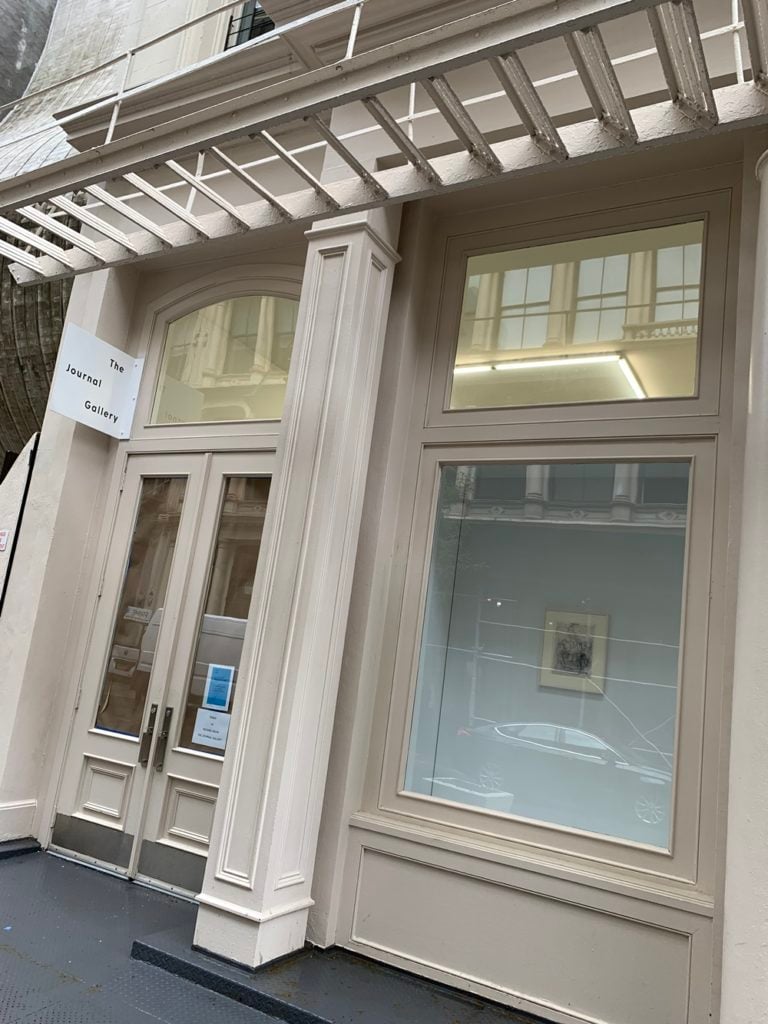
Journal Gallery’s new space in
Tribeca
4. Know Yourself—and Your Limits
It would be self-destructive for
a modest gallery to try to mimic a mega-gallery’s analog strategy,
and the same is true for any digital strategy.
“As a larger gallery, we have a
brand and an audience that come to us,” Soboleva, the Zwirner
dealer, says. “But I’d argue
there are a lot of younger galleries that can be quite creative and
nimble online. They just won’t use the same format.”
This advice is especially
relevant while the coronavirus bends day-to-day life into its
current surreal state. “Everyone’s feeling that panic across every
economic sector,” Fei says. But “it takes months or years to set up
something online as sophisticated as some of the larger
galleries.”
So while galleries need to forge
into cyberspace for survival’s sake, they also need to think about
what’s achievable—which doesn’t necessarily mean abandoning
ambition. Dippelhofer
and Navin are now working to create an editorial element
around Tennis Elbow and its Instagram presence. They are
considering content such as Q & A’s with their artists about how
they’re dealing with the professional and personal fallout of the
pandemic.
Supporting a larger mission can
also strengthen a gallery’s online presence. To that end, a portion
of the proceeds from every Tennis Elbow purchase during the
pandemic will be donated to Food Bank for New York City.
Of course, online storytelling
and editorial content can be scaled up dramatically if resources
allow. Gagosian’s March 2019 online viewing room
for Albert Oehlen’s Untitled (1988) included video interviews between COO Andrew
Fabricant and director Sam Orlofsky, as well as charts on the
artist’s market trajectory. Zwirner’s recent online viewing room
for James Welling’s super-saturated photographs juxtaposed
reference images and historical background alongside available
works in an attempt to create “an educational and cultural
experience,” Soboleva says—just like a traditional
exhibition.
The possibilities are infinite,
but each decision communicates something about the gallery and
impacts the works’ reception. So choose wisely.

Alphabet CEO Sundar Pichai at Google’s
Developers Conference in 2018. Photo by Justin Sullivan/Getty
Images.
5. Think About What’s Next (Yes, Already)
Part of what restrains
innovation is also what makes us vulnerable to new crises:
insufficient effort combined with insufficient imagination. Among
professionals tasked with managing risk in all spheres, there is a
maxim that people tend to prepare for the disaster that already
happened, not the one that may come next. The past is concrete
and easy to understand; the future is abstract and difficult to
imagine.
Similarly, flawed technology
tends to address the world as it is now, not the one we might be
hurtling toward. Online veterans of the art industry suggest that
dealers moving aggressively into the digital world would do well to
keep this in mind.
Kennedy says this is part of the
reason Unit London’s cyber-first strategy has worked so well:
because social and digital media have been the program’s bedrock
since 2013. “Everything is viewed through that prism. It’s not a
bolt-on at the end,” he says.
Galleries that have not
seriously invested in social or virtual resources until recently,
however, risk skipping important steps for expediency’s
sake—and failing to align
themselves with what’s ahead.
“There is no finite endgame in
tech products,” Fei says. “The minute you release something, you
have to be thinking about version 2.0.”
So just as many galleries
ignored the early stages of e-commerce in years past, they now risk
missing an even larger industry shift—one that has been a decade in
the making—if they merely focus on playing catch-up.
In this moment of flux, then, the
question is which galleries will manage to address their current
challenges while continuing to relentlessly evolve for the brave
new world to come.
The post What Actually Works When It Comes to Selling Art
Online? Successful Early Adopters Share 5 of Their Business
Secrets appeared first on artnet News.
Read more https://news.artnet.com/market/art-world-online-art-market-1808664
Further reading


Leave a comment