
How We Should Reimagine Art’s Mission in the Time of ‘Social Distancing’
Honestly, I have no idea about how best to write about art right
now. What I had wanted to say, when I began this essay last week,
is very different than what feels urgent now. This is a full-spectrum disaster.
It is unfolding fast.
I keep thinking about those video clips that people were sharing
from Italy last week of people singing on their balconies, offering
a little bit of joy to each other amid the mandatory
shelter-in-place order.
That feels long ago. And I don’t blame you if these clips
already feel trite, just as thoughts about art in general probably
feel trite right now.
Yet times of crisis bring clarity. For myself, the realities of
“social distancing” are throwing into relief what the socially
necessary uses of art actually are. And I keep thinking about those
balcony singers as a basic metaphor for how to think about the
problem.
Isolated Together
Right now, except for health care providers and other essential
workers, we need to be keeping
apart to starve the virus of new hosts. That act of “social
distancing” is the most basic act of social solidarity.
As even the first real week of attempted mass self-isolation in
New York shows, this is hard. Humans are naturally gregarious
animals; we define ourselves by our social interactions. It is not
for nothing that “solitary confinement” is considered a
particularly cruel form of punishment.
What will make self-confinement bearable?
Immediately an answer was ready to hand: cultural consumption—or
whatever cultural consumption can be done remotely, at least.
And so, as the weight of the new shut-in reality settled in, you
have probably been hit by a deluge of articles offering
helpful lists of things to stream while stuck inside. So many
people are streaming in quarantined Europe that Netflix and YouTube
are being forced to slow
down, to cope with the strain.
If you follow art, I am sure your feed has also been peppered
with articles about “virtual tours” you can take of the world’s great museums. You’ve been
offered virtual art exhibitions, virtual panel discussions, and
virtual viewing rooms to keep your mind engaged and entertained and
edified.
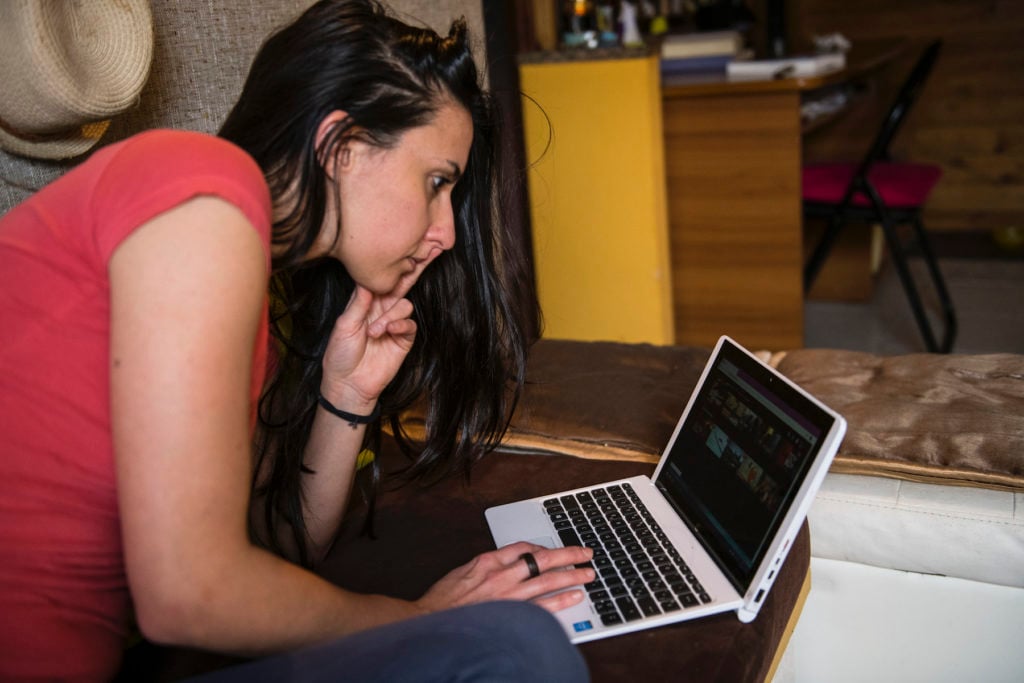
A woman watches a Netflix TV series on
the laptop at home to pass the time after the Italian government
advised citizens to stay at home in an attempt to slow the spread
of the Coronavirus on March 15, 2020 in Turin, Italy. Photo by
Stefano Guidi/Getty Images.
The Technology of Isolation
When the “social distancing” edict arrived, I’m sure that I am
not the only one who was comforted by the first, naïve thought:
well, this won’t be that different than my ordinary life.
How much time do I already spend reading on the web or
otherwise, or streaming TV, or playing video games? How much of my
knowledge of my peer group is filtered through social media? How
much of my work as a writer can be done indifferently from home? A
lot!
The “digital divide” in internet access is very real, and more
cruelly felt than ever right now.
Still, the culture industries have been preparing its core
consumers for our new shut-in life for some time. Americans had
already been going out
less. They had also been spending staggering amounts of
time with screens—about half the waking day.
Young people are going out to date less, going to parties less,
having sex less, drinking less—pretty much everything less except spending time with
screens.
Last year, the second-most-read
article on the New York Times—above the Epstein
scandal, the Notre Dame fire, and real-life UFO sightings—was a
list of suggestions for what to watch on Netflix.
As for art, it’s been clear for some
time that experiencing it through the lens of social-media
pictures and online debate has been crowding out interest in the
in-person experience of the art object. At the very least, the
social media feed had already become the main
gateway of interest for culture.
Anti-Social Media
What kind of culture makes us feel sustained and whole, rather
than furthering feelings of isolation and angst?
That’s actually a non-trivial question right now, because so
much depends on pulling off the trick of sustaining lots of people
through a period of being cut off from their communities for an
extended period of time.
If the mandatory “social distancing” regime appears likely to
dramatically extend the pre-existing trend of cultural life
migrating into mediated spaces, it will also be felt as a dramatic
ratification of another trend: the so-called “loneliness epidemic,”
with more and more people saying that they feel left out and
alienated.
Just how much of the recent (pre-corona) spike in depression and
anxiety is directly attributable to technology, and how much to
the hyper-competitive and unstable capitalist world that technology
is embedded in, is worth debating. What’s
clear, however, is that the tools that make social connection and
diversion easier can also make people feel more disconnected and
alienated.
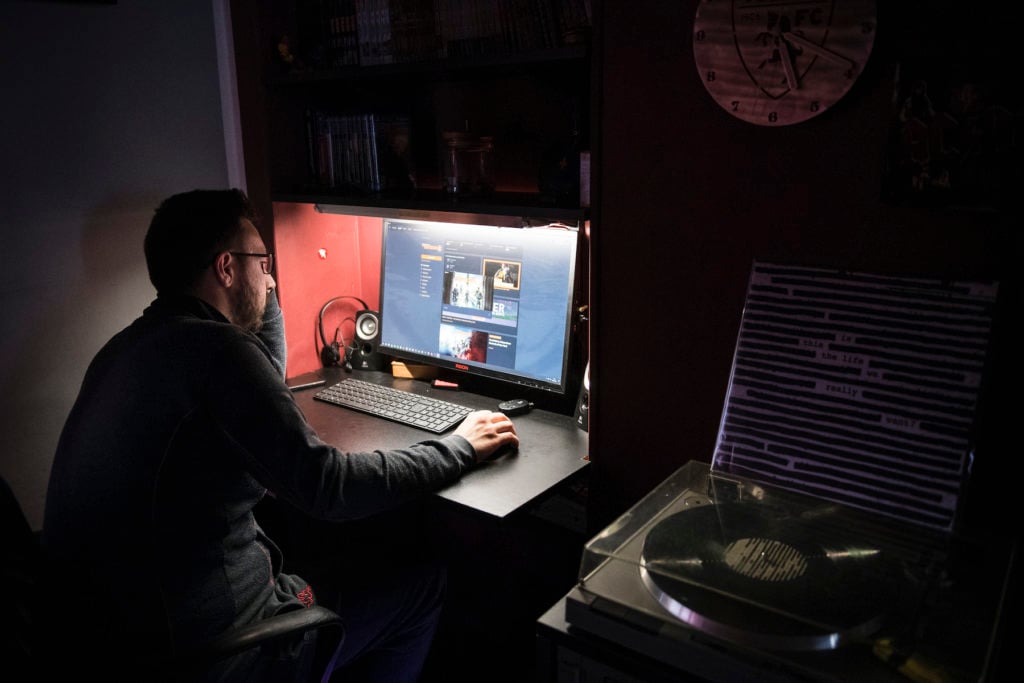
A man plays a video game at home to pass
the time after the Italian government advised citizens to stay at
home in an attempt to slow the spread of the Coronavirus on March
15, 2020 in Turin, Italy. Photo by Stefano Guidi/Getty Images.
Binge watching and video games offer ready worlds to vanish
into. Apart from serving as entertainment, such immersion in media
can be a form of coping, a way
to block out thoughts of outside reality.
Yet precisely because streaming TV or video games can be so
absorbing, both have the potential to foster a sense of being cut
off from others as well, if consumed to excess. In
both cases, researchers talk
seriously of potential addiction, which both thrives in people who
are isolated and further intensifies feelings of isolation—very
real dangers in this particular moment.
There has been earnest psychological concern that, for some
people with social anxiety, forming fictional “parasocial
relationships” with TV characters or
YouTube stars has been
a way to substitute for the messy work of tending to real
networks.
If there’s truth to that concern at all, then the very plethora
of “good enough” substitutes for going out that now make it easier
to practice “social distancing” at the start of this crisis also
mean that the social fabric is more fragile when it comes to the
actual mutual aid and emotional support needed to sustain over the
long haul.
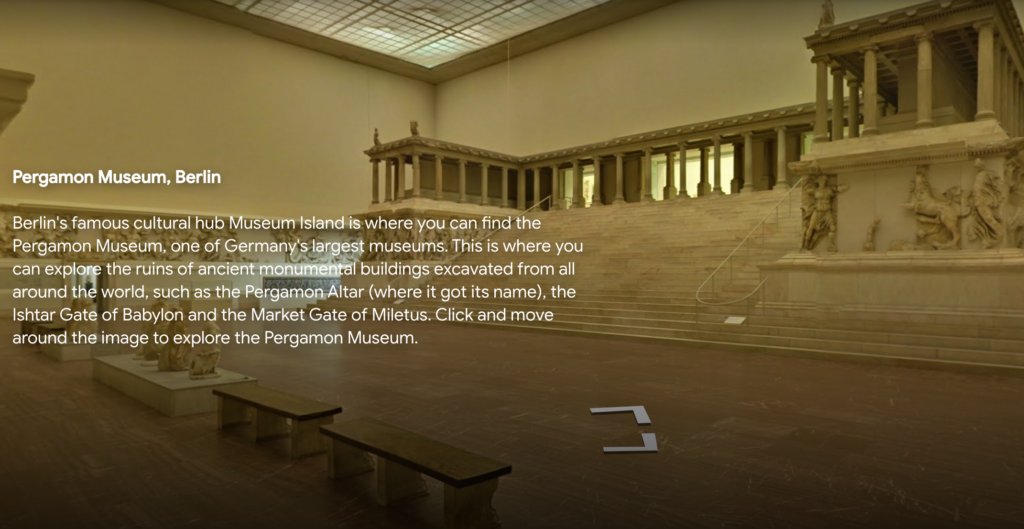
Street view of the Pergamon Museum in
Berlin on Google Arts and Culture.
Art as Consumption vs. Art as Connection
Which brings me back to the question of how to think about art
in this moment.
Why, I ask myself, do I find most of the virtual museum tours
available online so disheartening? I roam the halls of the virtual Uffizi or the
virtual Met in the
Google Art Project and find it good for a few clicks worth of
novelty and not much more. I find
it hard to imagine such experiences giving anyone much lasting
comfort, unless they are studying for a test.
I find it makes me feel the lack of that experience more.
We tend to think of the ideal imaginary type of museum
experience as solitary—the solo pilgrim going to be inspired by
art. Yet in this period of enforced solitude, the paradox is that
this way of valuing art is probably the least likely
to lend itself to remote simulation.
Leaving your everyday space and going somewhere special is part
of the point of that kind of experience (and one we’ll probably all
appreciate more when we are through this).
But the “solo pilgrim” model is just one way of thinking about
what art does—and not the most common one, either. The more common
reason people visit a museum is social, as a prop for being
together, as a sort of puzzle to figure out with friends or
companions. Art is, at its most stripped down level, something that
people like to talk about and make meaning with.
And while we can’t literally be together just now, our
hyper-mediated tools do offer ways to tap into the social parts of
aesthetic experience.
For culture to do its most nourishing work in helping us through
this difficult moment, we need to shake the idea that it is about
the isolated consumption of images. Consuming culture
passively mirrors a sense of helplessness and atomization.
Maybe realizing that mission looks as simple as the example all
the virtual discussion groups, virtual study sessions, virtual film
clubs that are springing up now, where you can turn isolated
experiences into more shared ones about how it feels to try and
make sense of the world right now, amid a plague.
Or maybe people have better models. I’m on the active lookout
for them.
“All One Thing”
There’s another video from filmmaker Olmo Parenti that you may have seen, posted
by the Atlantic posted. It’s titled “Urgent Messages from Italians in Coronavirus
Quarantine.”
The conceit is that it features ordinary Italians advising their
own selves of just 10 days before about how naive they were back
then—actually a message to the rest of the world about the need to
wake up to what’s coming their way.
But there is a little consolation in it. “You’ll live moments of
unity you would’ve never imagined,” one woman says, consoling her
earlier, naive self, “like yesterday when we all got out on our
balconies. Everyone was singing their own song, but somehow we were
all one thing.”
Pareti’s video was posted a week ago. Its jaunty tone already
dates it. Who knows if the same woman’s self of today would find
the comfort she took in that moment of chaotic togetherness very
naive again.
We will need to be outraged and alert as society rattles all
around us. The world is very frightening right now. A lot of our
creative energies will be faced outwards: towards protest, towards
offering solidarity to front line workers, towards public
mourning.
But as of now I still believe in the basic message. We need to
sustain each other for the long haul through a period of seclusion
while maintaining a sense of common purpose. To be helpful in that
task, we need to think about art as a social connector, even as we
have to be physically apart.
The post How We Should Reimagine Art’s Mission in the Time
of ‘Social Distancing’ appeared first on artnet
News.
Read more https://news.artnet.com/opinion/social-distancing-art-1810029
Further reading


Leave a comment