
Dawn of the Online Biennial Era? The Biennale of Sydney Becomes the First Major International Art Show to Go Virtual
The Biennale of Sydney has become the first major biennial
exhibition to move into the virtual realm as its physical
exhibition has been forced to shutter just 10 days after it opened
to the public on March 14.
The shift is a blow for the many creators—including a large
number of First Nations artists—who were poised to gain
international exposure through the exhibition for the first time.
The show, titled “NIRIN” (a word meaning “edge” in Wiradjuri, an
Aboriginal Australian dialect in central New South Wales), included
700 artworks by 101 artists and collectives at various venues
across Sydney.
Despite the setback, however, the exhibition’s artistic
director, Brook Andrew, is finding reasons to stay positive.
“My curatorial vision has been ramped up during this epidemic to
truly make this biennale one that serves many communities,” Andrew
tells Artnet News. Already, he notes, the exhibition had a number
of components, such as a podcast series and an artist-produced
newspaper, that extended beyond physical artworks.
Following advice from government authorities, the show will
close its doors tomorrow, March 24, until further notice. “We
will continue to adapt and innovate in the face of this global
crisis,” the biennale’s organizers write in a statement. “Our doors
close across Sydney, and they will open online—for everyone,
everywhere across the world.”
The biennale is working swiftly with Google to create a virtual
biennale that is accessible online through the Google Arts &
Culture platform. It will include live content as well as filmed
walk-throughs, podcasts, interactive question-and-answer sessions,
curated tours, and artists’ takeovers. “At times like these, it is
more important than ever that we find ways to connect, to help each
other, listen, collaborate, and heal—all core themes of ‘NIRIN,’”
the organizers write.
Andrew insists that moving the biennale online does not diminish
its core message. Many exhibiting artists work far beyond major art
centers and already have digital dimensions to their work. He
mentions Dion Beasley, an Alywarr artist who is deaf and has
muscular dystrophy. Beasley, who lives in Tennant Creek in the
Northern Territory, gave the biennale’s keynote through his
collaborator, Johanna Bell.
“Many artists such as Dion can often only reach out to the more
popular art audience through the internet or an online presence,”
Andrew notes. “We can also reflect on remote communities from
Haiti, Australia, and those artists who are maybe not even seen as
‘official artists’ from a dominant Western art scene,” he says.
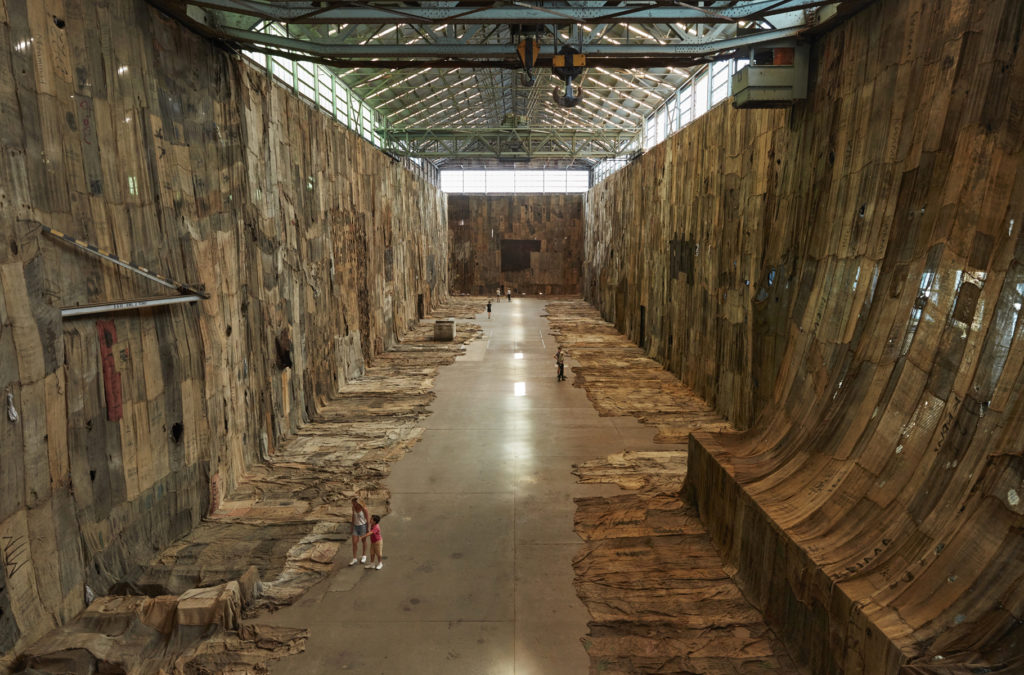
Ibrahim Mahama, No Friend but the
Mountains (2012-2020). Installation view (2020) for the 22nd
Biennale of Sydney, Cockatoo Island. Courtesy the artist; White
Cube; and Apalazzo Gallery, Brescia. Photo by Zan Wimberley.
While some of the biennale’s physical installations, such as the
artist Ghanaian artist Ibrahim Mahama’s spectacular installation of
sewn-together jute sacks on Cockatoo Island, will be more difficult
to translate online, sound and video art does not face the same
hurdles.
The biennale includes work by the Papua New Guinea artist and
radio broadcaster Namila Benson, who has produced a six-part
podcast series called Behind the Biennale, which invites
leading intellectuals and creatives to discuss and critique
structures and systems “that continue to keep far too many on the
Edge.”
Andrew adds that some artworks in the biennial incorporate
augmented reality and may find a second life online, such as
banners by the late Anangu artist Kunmanara (Mumu Mike) Williams.
The piece is about the lessons to be learned from traditional
cultures in the artist’s native Pitjantjatjara, which is translated
into English through AR goggles.
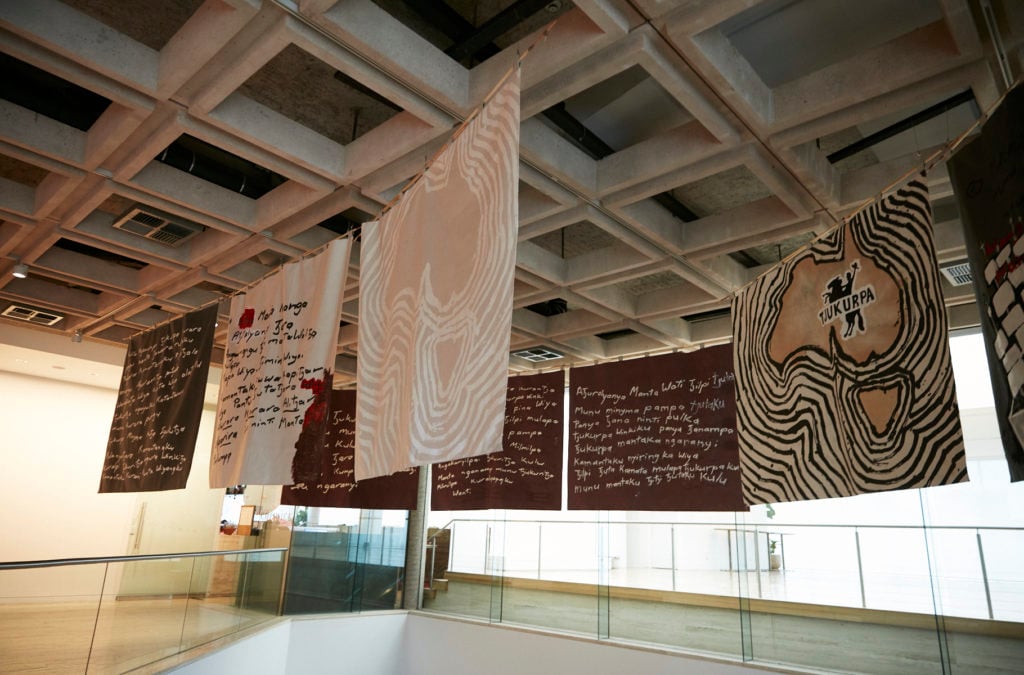
Kunmanara (Mumu Mike) Williams,
Kulilaya munu nintiriwa (Listen and learn) (2020).
Installation view, detail (2020) for the 22nd Biennale of Sydney,
Art Gallery of New South Wales. Courtesy Mimili Maku Arts. Photo by
Zan Wimberley.
The physical artworks, Andrew estimates, account for only half
of the biennale’s program, publications, and ideas. He points to an
artist book project called “NIRIN NGAAY (to see the edge)” by Trent
Walter and Stuart Geddes, as well as other publications, such as a
newspaper project by Maria Thereza Alves, who created the first
Brazilian Indigenous newspaper to address the urgent issues of
those communities. Both will now be published online.
Meanwhile, the biennale’s public art program, “NIRIN WIR (edge
of the sky),” also includes expanded notions of art that translate
well to online viewing. As part of his “Alchemy Garden” project,
for example, the artist Andrew Rewald hopes to present public
workshops in Indigenous permaculture, soil science, and
biodiversity, which now can attract a global audience.
Sydney’s Art Gallery of New South Wales and the Museum of
Contemporary Art, which are both biennale venues, have both
shuttered along with Australia’s other major institutions.
The post Dawn of the Online Biennial Era? The Biennale of
Sydney Becomes the First Major International Art Show to Go
Virtual appeared first on artnet News.
Read more https://news.artnet.com/art-world/the-biennale-of-sydney-is-moving-online-1811871
Further reading


Leave a comment