
‘I Had to Fight to Show What I Could Do’: How Artist Elias Sime Emerged as One of Africa’s Leading Contemporary Artists
Five years ago, the Ethiopian
artist Elias Sime, who is known for his sculpted aerial landscapes
and river scenes and colorful striated patterns, didn’t have
gallery representation in New York.
Sime had shown work regularly in
the Ethiopian capital of Addis Ababa since the 1990s, and was
included in group shows at the Metropolitan Museum of Art and the
Studio Museum in 2008. A year later, theater director Peter Sellars
commissioned the artist to stage his production of
Oedipus
Rex, which inspired a
2009 retrospective at the Santa Monica Museum of Art. After the
show, Sime turned his focus to making new work back
home.
Five years later, Meskerem
Assegued—an anthropologist and Sime’s longtime collaborator, who
curated the show in Santa Monica—was introduced to New York dealer
James Cohan by the writer Lawrence Weschler. Cohan asked to visit
the LA warehouse where Sime’s works were stored.
“How often is it that you
encounter someone who’s got 25 years worth of fully realized work,
and you get to make an assessment?” Cohan asked me. He called the
artist and asked to represent him. “It was a
no-brainer.”
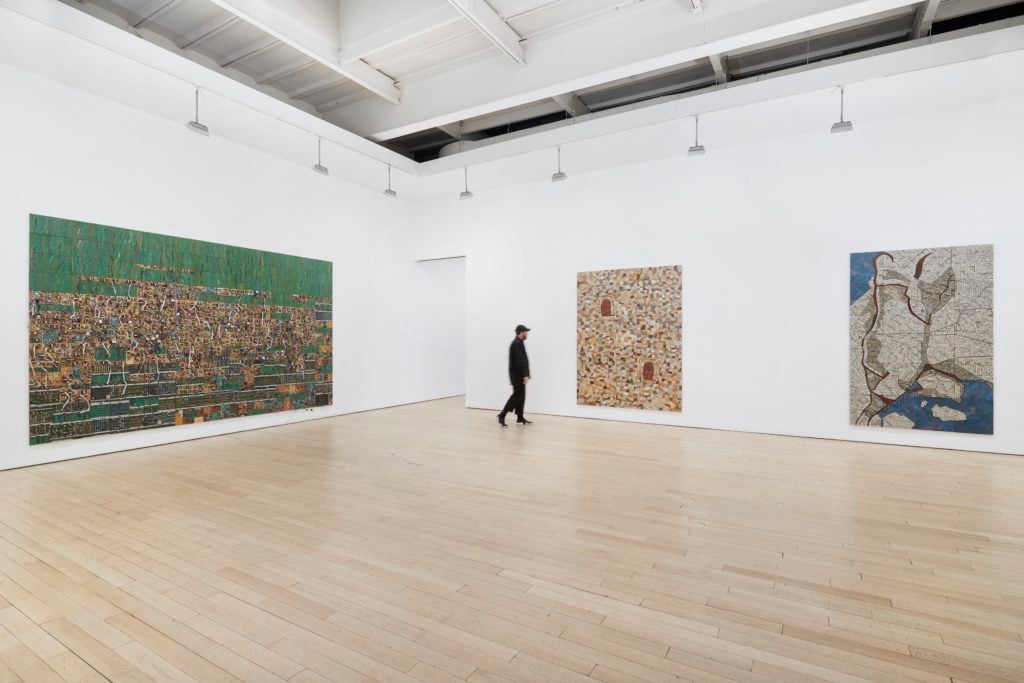
Works by Elias Sime in his exhibition,
“Noiseless,” at James Cohan gallery in New York in 2019. Phoebe
d’Heurle.
Cohan hosted Sime’s first US
gallery show in 2015. From that exhibition, the Met became the
first public collection in the US to purchase one of his artworks,
which are made of braided electrical wires, motherboards,
keyboards, buttons, canvas, and carved wood panels. And suddenly it
seemed that everyone wanted a Sime.
In North America, he’s currently
the subject of a traveling exhibition organized by Tracy Adler at
Hamilton College’s (temporarily closed) Wellin Museum. Facebook
recently commissioned him to make a 63-foot mural for the company’s
Frank Gehry-designed Menlo Park headquarters.
In October, the Smithsonian
National Museum of African Art commissioned several works to
inaugurate its redesigned pavilion, and in April (assuming the
museum is open then), he will open a solo exhibition at the St.
Louis Art Museum, where Sime will show new sculptures inspired by
the nearby pre-Columbian Cahokia Mounds. (The works are based on
research by Assegued.)
On top of all that, Sime—who is
quickly becoming recognized internationally as one of Africa’s
leading contemporary artists, alongside El Anatsui and Wangechi
Mutu—was shortlisted for the Hugo Boss Prize in
November.
But one of Sime’s biggest
projects is being undertaken back home, where he and Assegued have
spent much of the past few years working to re-establish Addis
Ababa as a preeminent city for contemporary African art.
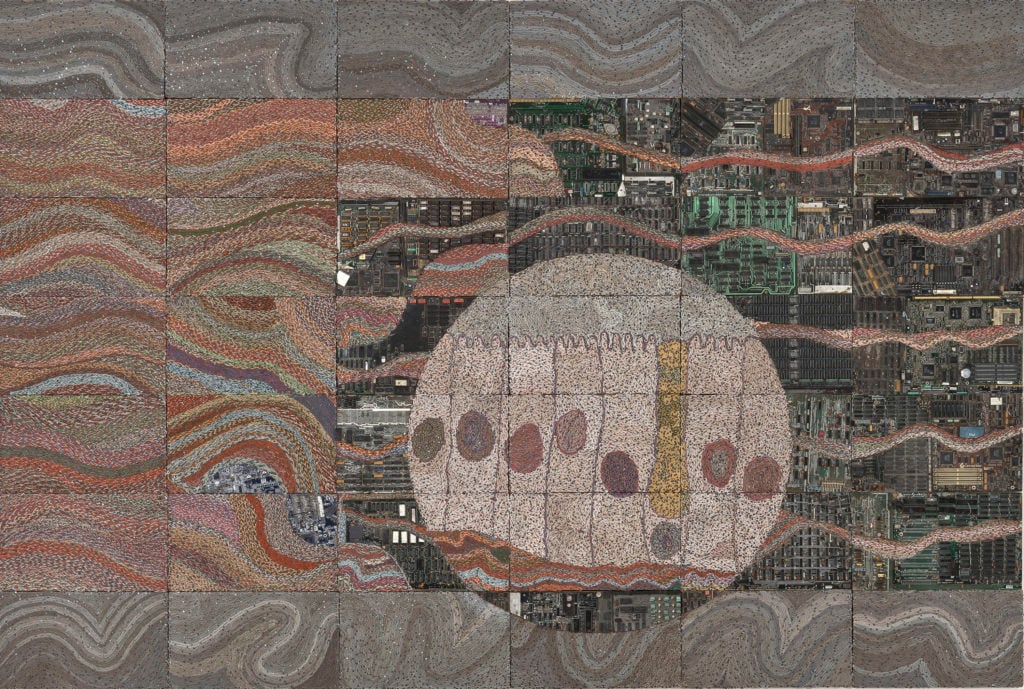
Elias Sime, Tightrope:
Internalized (2017). Courtesy of the artist and James Cohan,
New York.
A Collaborative Practice
Last May, Ethiopian Prime
Minister Abiy Ahmed visited the Zoma Museum in Addis Ababa, which
Assegued and Sime cofounded in 2019. Within a week, Ahmed
commissioned the pair to construct two gardens in the city: one at
the Allé School of Fine Arts and Design, and the other at the
Menelik Imperial Palace.
“Think about it: here’s the
Prime Minister telling you what to do,” Assegued told me on the
phone from Addis Ababa. “He wanted it done in a month, which was an
impossible task, but we got into it right away.” The garden at Allé
was finished last fall, and work at the palace should be done by
this summer. “I feel
strongly that the public will see the gardens as collaborative
works between us,” Sime said.
The sites for the two parks are
important for the artist. Sime enrolled at the Allé School of Fine
Arts and Design in 1986, during the final years of Ethiopian
communism. By then, many artists had been forced into
exile.
But the university’s professors,
who were fluent in Russian, expected their students to paint images
of Lenin and to adhere to Socialist Realist conventions. Sime’s
experimentation with materials was verboten, and his teachers
discarded much of his university work. But there was no alternative
school to attend, and if he wasn’t a registered student, he would
be conscripted into the army and placed on the front lines of the
civil wars raging throughout Ethiopia.
So Sime stayed.
“In retrospect, my teachers’
control helped me think differently,” he said. “I had to fight to
show what I could do, and I had to wait until I graduated to do
it.”
When Sime finished his schooling
in 1991, the Soviet Union had just ended support of the People’s
Democratic Republic of Ethiopia. Marxist rule collapsed that
May.
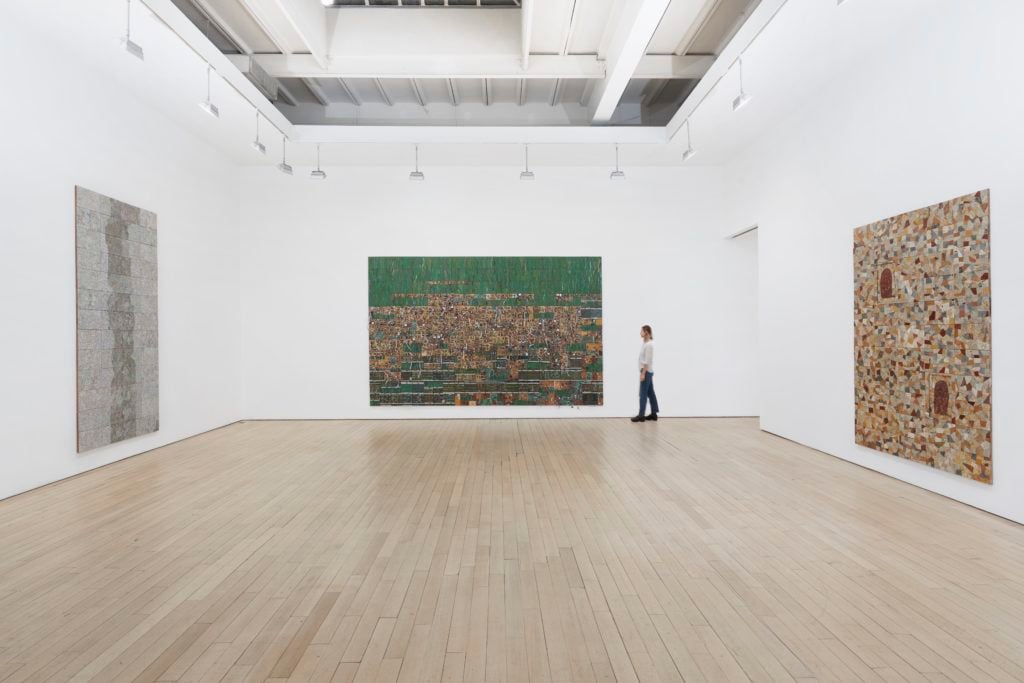
Works by Elias Sime in his exhibition,
“Noiseless,” at James Cohan gallery in New York in 2019. Phoebe
d’Heurle.
Rewriting Old Narratives
Sime, who was born in Addis
Ababa in 1968, has made sculptures from various materials since he
was a boy. “His hands are everywhere in his childhood home,”
Assegued said. “Even the coffee table is completely carved
out.”
“It was always one thing leading
to another,” Sime said of his development. “When I started working
with fabric, I had a bunch of string and buttons. So I added the
buttons. And then I had to stitch them, and it looked pretty good.
It was smooth, like painting.”
“Elias’s work is beautifully
crafted,” Cohan said.
But he and Sime are quick to
condemn the superficial narrative of “up-cycling” that’s often
applied to African artists who repurpose waste. Critics have
suggested that artists from developing nations who work with
scraps, such as Sime and El Anatsui, posses a down-to-earth
simplicity and redeem a global economy that has pushed the world to
the brink of ecological collapse.
But Sime’s intention isn’t to
turn waste—electronic or otherwise—into sublime compositions.
Rather, he wants to tell stories about our relationship to the
earth and to each other. A landscape of braided wire represents
connectivity, but also the extraction of rare minerals from the
earth and technology’s intervention into our social order. Sime
repurposes materials without irony, and Assegued says he braids
wires the way another artist mixes paint.

Unity Park in Addis Ababa, Ethiopia.
Photo by Minasse Wondimu Hailu/Anadolu Agency via Getty Images.
Unity Park
In newly democratic Ethiopia,
Sime was able to follow his own rules. But 17 years of military
rule had damaged the country, which was once a bastion of modern
art. The Imperial Palace where Sime and Assegued are constructing
their 15-acre park was used a torture site under the Derg military
junta.
But Ahmed, the prime minister
and a Nobel Peace Prize winner, understands the political power of
art. Last October, he
reopened the Palace as a public park with a national museum to
strengthen unity among the country’s nine semiautonomous
ethnolinguistic regions. At its center is Sime and Assegued’s Unity
Park.
“Opening up the seat of power
speaks volumes about what the government is up to,” Cohan
said.
Like Sime’s constructions and
sculptures, Unity Park is embellished in extraordinary detail:
Every stone is hand-carved and based on Sime’s drawings. Benches
and buildings are wreathed in filigree. Ornamented pathways cut
through terraced gardens. Even the restrooms were carved by masons
using ancient techniques.
“When you come there, you see a
wholesome thing,” Assegued said. “Thousands of people walk in every
day. They can’t believe they’re inside a building that they feared
for so many years.”
“Here they can see,” Sime added,
“that we thrive by working together and sharing our
knowledge.”
The post ‘I Had to Fight to Show What I Could Do’: How
Artist Elias Sime Emerged as One of Africa’s Leading Contemporary
Artists appeared first on artnet News.
Read more https://news.artnet.com/art-world/elias-sime-interview-1807065
Further reading


Leave a comment