
‘There Will Be Enough for Everyone’: Berlin Distributes €500 Million to Artists and Freelancers Within Four Days of Launching Its Grant Program
Imagine you are a small
businessperson or freelancer suffering a deep financial loss as a
result of your city’s lockdown. You apply for a grant from the
government on a Friday, submitting nothing more than your mailing
address, a tax number, banking details, and a legal form with your
company’s name. On Tuesday,
you wake up to find €5,000 has been wired into your
account.
This might sound as if it’s a bureaucratic fever dream—but in
Berlin, it is reality. Despite
technical difficulties and panic at the outset, the state of Berlin
has launched an immensely successful bid to save small businesses
and freelancers from financial free-fall, including artists and
small cultural businesses who are suffering due to the current
global health situation and economic downturn.
The local government acted rapidly to pull
together an emergency relief program and, on Friday last week,
it launched online grant and bridge loan applications in
partnership with the local bank Investitionsbank Berlin (IBB). It
is offering €5,000 to individuals freelancers and up
to €15,000 to small
businesses.
As of yesterday, 50,000
applications had been successfully submitted from creative sectors
and other industries, including restaurants, hotels, nightlife, and
events businesses. A staggering €500 million has already been given
out, according to a spokesperson from the cultural
ministry.
“I Am Pleasantly Shocked”
Many Berlin artists reported
receiving money within just a day or two of submitting their
application. Social media was littered with screenshots of a little
green stick figure, seemingly stuck in a perpetual line—the symbol
to represent those in the middle of the application
process.
“I was number 110,000 in the
line,” Berlin-based artist Zuzanna Czebatul told Artnet News on
Sunday, adding that she was skeptical about whether the government
would keep its word. “But overall the process was satisfyingly
uncomplicated.” Today, she confirmed that €5,000 had been deposited
into her bank account. “I am pleasantly shocked,” she
said.
Berlin’s art community on the
whole sounds unequivocally grateful. Berlin’s association of visual
artists, BBK, conducted an online
survey that revealed
that more than half of the city’s artists anticipate losing at
least 75 percent of their monthly income due to the lockdown. More
than three quarters expressed fears they would not be able to make
April’s rent or other basic costs.
More financial assistance is
coming as Germany rushes to ensure that its economy is protected
from the full blow of a recession. The federal government has
announced that it will be
delivering a €50 billion bailout package for freelancers and
small businesses, including artists. These will be single grants of
up to €9,000 available to self-employed artists and businesses with
up to five employees, and larger €15,000 grants available to
businesses with up to ten employees. They are expected to be ready
for applicants in the coming weeks.
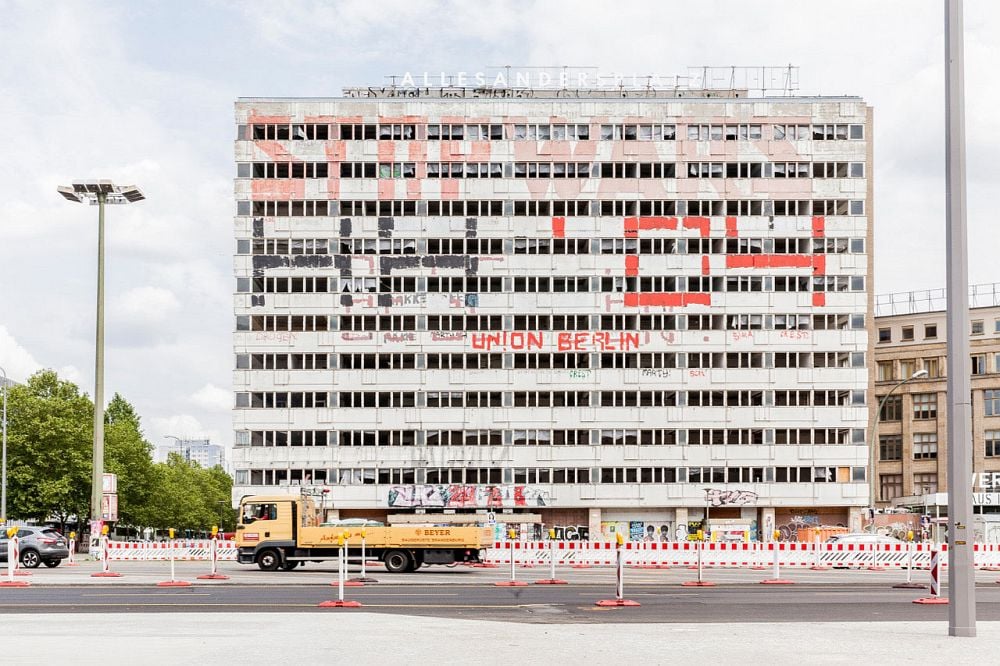
Haus der Statistik during Berlin Art
Week 2019. Photo: Victoria Tomaschko.
Crashing the Gates
Several artists Artnet News
spoke to described major technical difficulties on the program’s
launch day. During the opening hours, the system was so overloaded
that it temporarily crashed. The local bank IBB told Der
Taggespiegel that
60,000 attempted applications were submitted on the first day; the
program is used to handling between 20,000 and 100,000 applications
during the entire year.
Faced with wait times of
multiple hours, applicants were initially wracked with panic. “I
had to install an auto refresh plugin on my browser to continually
check my place in the line,” Benjamin Busch, a creative freelancer,
told Artnet News. “Information about the application process was
sparse right up until it went live. There was a fear that the money
would almost immediately disappear.”
The Culture Ministry’s office
took to social media to try to quell that worry, saying that the
money was not “first come, first serve” in the hopes of slowing the
online barrage. “There will be enough for everyone,” culture
minister Klaus Lederer wrote to his followers. “Don’t panic! It’s
not a greyhound race!”
"background:#FFF; border:0; border-radius:3px; box-shadow:0 0 1px 0 rgba(0,0,0,0.5),0 1px 10px 0 rgba(0,0,0,0.15); margin: 1px; max-width:500px; min-width:326px; padding:0; width:99.375%; width:-webkit-calc(100% - 2px); width:calc(100% - 2px);">
View this post on Instagram
The panic was somewhat
understandable. Germany’s social security system is notoriously
bureaucratic and many were concerned the offers sounded too good to
be true. Most citizens are all too familiar with the reality of
waking up before dawn to line up in the cold at the mayor’s office
simply to get one stamp on a form. Those who are not naturalized
Germans were also hesitant to apply for funding for fear that state
support would throw the standing of their work visas in jeopardy.
(The local government has since clarified that this is not the
case, though it remains to be seen how the situation will work on
the national level.)
It seems that, despite some
bumps on the way, the government is transforming itself under the
pressure of this crisis and proving to be impressively spry while
doing it. And it’s not alone: the Southern state of Bavaria, one of
the states hardest hit by the outbreak, has also released a similar
package, and Artnet News understands that the western state
of Nordrhein-Westfalen is also planning an aid
program.
Data Breaches
Still, other concerns remain:
there were also some reports of data breaches. According to
Der
Taggespiegel, a
freelance cameraman reported that his data had mistakenly been sent
to a stranger. The application process, which required little more
than a name and some basic details, is also ripe for fraud,
according to a radio report on rbb. The situation seemed to have been resolved by
Friday and the IBB tried to quell this concern by saying that any
fraudulent claims would be sorted by the time individuals file tax
returns—that is, if they do.
But overall, Berliners seem to
recognize how extremely fortunate they are. “Our feeling is that
the program is working very well right now and that it is
addressing the urgent needs of Berlin’s independent artists and
creative freelancers,” a spokesman for Lederer’s office said.
“Their e-mails and messages, which reach us in large numbers,
confirm that the program was necessary and fits the immediate needs
of many artists and creative workers in Berlin. It is our absolute
aim to preserve the overwhelming richness and variety of Berlin’s
cultural life for a vibrant future.”
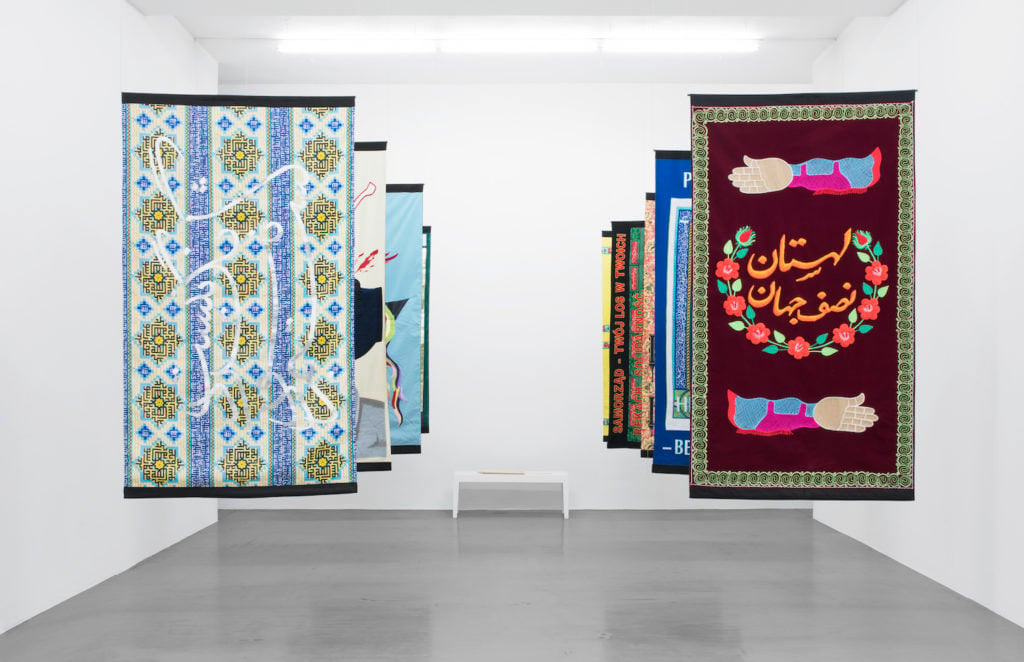
Slavs and Tatars Friendship of
Nations: Polish Shi´ite Showbiz, (2011).
After sharing their approved
application on Twitter, the art collective Slavs & Tatars told Artnet
News that they were “absolutely floored” to see results so quickly.
“The waiting takes longer than the actual application, which takes
all of 10 minutes,” Slavs & Tatars said in an email. “The very idea
of this particular grant is to provide a band-aid, quick, efficient
and it proved to be that way.” The collective plans to use the
funds, which are due to arrive in their account tomorrow, to keep
their studio running—including salaries for their team and
production—during the lockdown, even if they may operate at a
“reduced rhythm.”
“The fact that this program was
undertaken shows us that Berlin knows how important the creative
industries are to its economy,” said the art critic Mitch Speed,
who applied for an emergency grant this week. He wondered if the
rapid grant-making was also an attempt to prevent a rent strike, a
measure that has been gaining ground on social media both in
Germany and around the world. Regardless, he noted, “it’s a huge
privilege to live in a country capable of providing this kind of
support.”
The post ‘There Will Be Enough for Everyone’: Berlin
Distributes €500 Million to Artists and Freelancers Within Four
Days of Launching Its Grant Program appeared first on artnet
News.
Read more https://news.artnet.com/art-world/berlin-senate-bailout-process-1820982
Further reading


Leave a comment