
In Germany, Almost 98 Percent of Antiquities From Middle Eastern Countries Including Iraq and Syria Are of Questionable Origin
Germany is an international
hotspot for trafficking illegal antiquities from places like
Syria and Iraq, according to a damning new report.
Released by the German Federal
Cultural Foundation in March, the investigation looked at the more
than 6,000 antiquities from the Eastern Mediterranean offered for
sale in Germany over a three-year period. It found that a mere
2.1 percent had proven legal provenance. The numbers are
particularly troubling as the funds from black market antiquities
often make their way back to terrorist organizations.
A task force made up of
researchers from different German institutions investigated the
issue between 2015 and 2018 as part of the “ILLICID project, funded
in part by the UN and the Federal Ministry of Education and
Research. During the
course of their research, the experts found objects from Egypt,
Iraq, Iran, Israel, Jordan, Lebanon, Syria, Turkey, and Cyprus were
on sale despite unverifiable provenance and the absence of legal
export documentation. Indeed, more than half (56.3 percent) of the
artifacts analyzed could not be authenticated at all.
Speaking to Artnet News about
the findings, Dutch art crime investigator Arthur Brand (sometimes called “the
art world’s Indiana Jones”) explains that Germany is a particular
nexus for the market in illicit antiquities for a number of
reasons.
“To begin with it is a very rich
country, it has a long tradition of collecting, and it is home to a
lot of immigrant groups with good ties to their countries of
origin, some of whom are art smugglers,” Brand explains. “Another
reason is that Germany has very strict laws for protecting
collectors. So it’s very hard to get something out of the hands of
German collectors.”
Markus Hilgert, head of
the “ILLICID“ project and general secretary of the German
Federal Cultural Foundation, says in a statement that it is
“alarming” that almost 40 percent of the archeological cultural
goods that were investigated likely came from Iraq and Syria
“despite the strict import, export and trade restrictions” imposed
on those countries by EU regulations, not to mention other laws
that have prohibited the export of archeological assets from those
states since 1869.
After examining 2,387
antiquities highly likely to have originated in Iraq and Syria, the
new report discovered only 0.4 percent of the objects originating
from Iraq and only 9.6 percent of the objects originating from
Syria were found to be on the German market legally. “In view of
the ongoing, extensive destruction and looting of archeological
cultural assets in Iraq and Syria, this is an alarming finding,”
Hilgert adds.
The Problem With Provenance
Researchers from the Prussian
Cultural Heritage Foundation, the GESIS Leibniz Institute for
Social Sciences, and the Fraunhofer Institute for Secure
Information Technology all took part in the project. Using publicly
available information, they investigated objects being traded on
online platforms, in auction catalogues, and at trade fairs. The
goal was recommending ways to protect consumers and crack down on
crime.
Clear regulations will
“strengthen providers as well as buyers, and thus Germany as an art
trading location as a whole,” Hilgert says. The report makes a
series of recommendations, including the initiation of public
awareness campaigns, as well as expanding research and training in
provenance research.
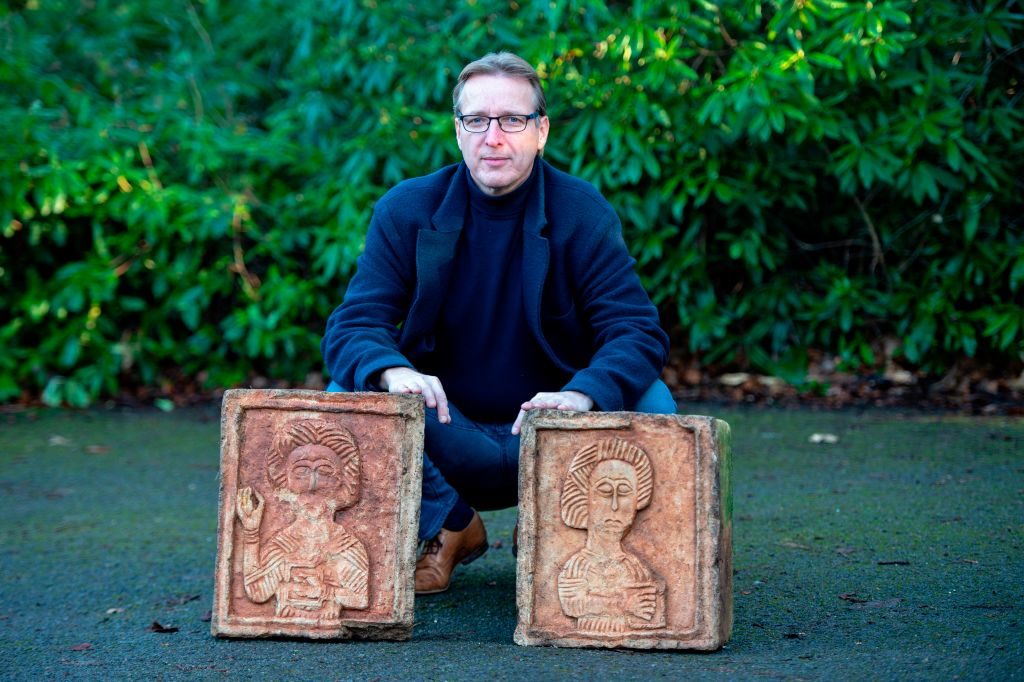
Dutch art detective Arthur Brand. Photo:
Niklas Halle’n/AFP/Getty Images.
But Brand, who has worked on a
number of high-profile cases involving illicit antiquities in the
past, does not think the matter is that simple.
“Provenance research for
antiquities is very hard,” says Brand. “While many artworks will
show up on databases like the Art Loss Register as
stolen or fake, these are things that have been on the market or in
museums for a long, long time. But with antiquities, especially
fresh antiquities, you will not find them because these pieces have
been in the ground for thousands of years.”
Brand says that even the
artifacts that are legal often do not have good provenance. When it
comes to antiquities, it is very difficult to determine their
correct place of origin because ancient empires spanned modern day
borders. Just because an artifact originated in the Roman empire,
for example, does not mean it was unearthed in Italy or that it
properly belongs in Rome. This is compounded by the sheer number of
antiquities on the market, many of which have very vague provenance
details that are difficult to verify.
“In the past I have done
investigations, but even when you can prove a provenance is fake,
often nothing can be done,” the art investigator says. “In the
absence of photographs or witnesses or other documents, you can’t
prove that it has been looted or where it has come from. In most
countries, the police are not very eager, for those reasons, to dig
into these stories.”
What Can Be Done?
Among the report’s
recommendations is the establishment of a forum for stakeholders in
the marketplace for cultural goods to agree on mutual guidelines to
protect their clients. But Brand says that the problem of illicit
antiquities is often exacerbated by the attitudes of some auction
houses. “They know their collectors want it, so they sell
it.”
The investigator adds that there
is also a problem with corruption among the authorities charged
with fighting illicit trade. There have been instances in which
confiscated loot has found its way back onto the black market, so
calls for increased monitoring of trade will not necessarily yield
the desired results.
That said, Brand acknowledges
that improving the resources for provenance research and
transparency could be a good first step, and the
“ILLICID“
report offers a number of ideas for
how this could be done.
First, it suggests that all
trade publications after 1945 should be digitized for wider
accessibility, and that any existing documentation about objects
offered for sale that demonstrates their legal provenance or export
is made public at the time of sale. It also recommends setting up a
database of known or allegedly counterfeited cultural
goods.
Another resource that it
suggests is a “transparency register” that would record all
archeological cultural assets that can be legally traded,
regardless of whether they are currently on the market. Such a
register could function as a certification system for potentially
legally tradable goods, modeled after the system that was
introduced to crack down on the trade in blood diamonds.
It remains to be seen whether
the recommendations will be implemented in German law, and if so
whether the issue will be a priority given all the more urgent
events rattling the world right now.
Many collectors buy in good
faith and are dedicated to conserving ancient artifacts.
Nevertheless, the difficult issues relating to provenance, and the
connection of the black market to terrorist financing, is leading
many to ask the serious question: should private collectors be
allowed to buy antiquities at all?
The post In Germany, Almost 98 Percent of Antiquities From
Middle Eastern Countries Including Iraq and Syria Are of
Questionable Origin appeared first on artnet News.
Read more https://news.artnet.com/art-world/germany-illicit-antiquities-1826016
Further reading


Leave a comment