
Conceptual Photographer Thomas Demand on Why He Designed a Store Window for Every Prada Boutique in the World
For years now, German
photographer Thomas Demand has stressed the fragility of our
perceptions. His pictures, which he shoots after painstakingly
recreating scenes from everyday life with cardboard and paper, have
always played with replication and transience, and he has
always insisted on destroying his sets as soon as he’s finished
shooting.
“The minute a work shows
something, it’s over,” he tells Artnet News. “Like any other moment
in life that passes you by.”
For the past ten years, he has also maintained a close relationship with Miuccia
Prada and her Milan-based contemporary art museum, the Fondazione
Prada. While Prada and her couture house have long supported the
arts, they’ve never collaborated with an artist in any official
capacity—until now.
Though viewers may not be able
to visit them in person, the storefront of every Prada store in the
world is showcasing Demand’s images of cherry blossoms, which he
created meticulously in
his first-ever project for a fashion
brand. The series,
titled “Hanami,” which references the centuries-old practice
Japanese custom of enjoying the fleetingness of flowers, celebrates
the onset of spring by invoking perhaps its most obvious symbol,
inviting viewers to question the reality of what they see—and also
of the world around them,
Demand spoke with Artnet News
about working with Prada on the project and why he suspects artists
and fashion brands are working more and more
closely.
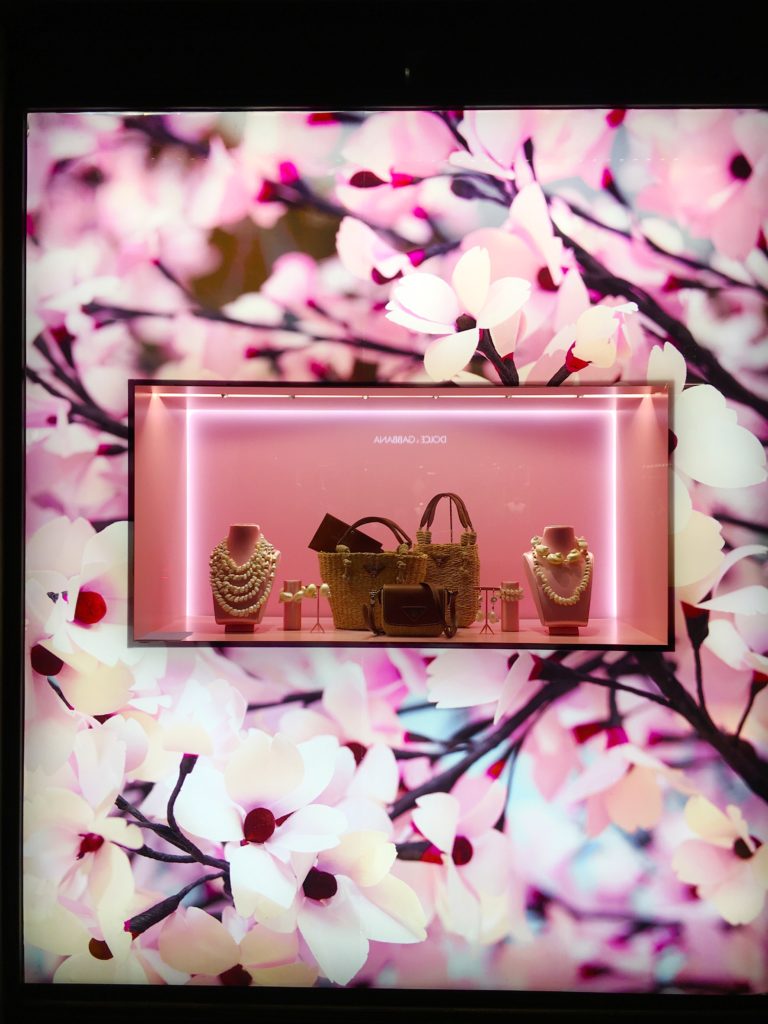
A closeup of Demand’s work at Prada
Faubourg in Paris. Photo courtesy Prada.
Tell me about how Prada came to you with the opportunity to
collaborate. How did it all happen?
I have a long history with the
Fondazione Prada. I’ve done about 11 shows with them over the years
and they have a permanent installation of
mine, The
Grotto. At some point,
Miuccia [Prada] told me she loved the work and asked whether we
shouldn’t do something together. And I thought, “What would that
look like?” I trust the company and I trust that they wouldn’t
exploit it if we did do something, and that they’d do it in a chic
way. But also, when they proposed to me that they wanted to show
[my work] in every shop window around the world at once, I thought,
“That’s really quite amazing. It’s a worldwide sweep.” Of course,
their audience doesn’t have a clue who I am, so the fun part for me
was really about testing whether the work I do, which is quite
niche within the art world, in and of itself, would work for a
wider audience. It was a good way to test if the work could stand
on its own—without the name, without the institution and
background, all of that.
Walk me through the nuts and bolts of what the collaboration
actually consisted of.
They came up with a proposal of
how it would look. To my surprise, it wasn’t at all what I thought
it would be—you know, a standard set of six modules that they’d use
in every shop window. There’s a team in northern Italy that plans
every set of windows globally and it’s a very specific, involved
process.
In terms of the artwork, for a
while, I was quite fascinated by the presence of a cherry blossom
tree [near] my studio. I started taking photographs of it during
different times of the day, as the light shifted. So I had, I don’t
know, 900 photographs of different states of that tree. I never did
much with them—I did a book with Ben Lerner, which featured maybe
42 of them—but other than that, all the other materials were just
sitting there, sleeping, waiting to be used. And so when the Prada
proposal came up, I went through the whole selection with the team,
all the files, and we chose a surprisingly wide variety to use in
all the different shops, keeping in mind their unique aspects. And
we experimented with size—I’d never blown up things before. The
petals were way bigger than even human beings, so it was kind of
interesting to see how that works in the context of a street
view.
Because the work looks so highly
artificial and realistic in terms of color scheme, I wanted to see
how people would interpret it. It’s not about cherry blossoms,
really. It’s about our expectations of cherry blossoms and what
they emotionally connote, and what that says about
us.
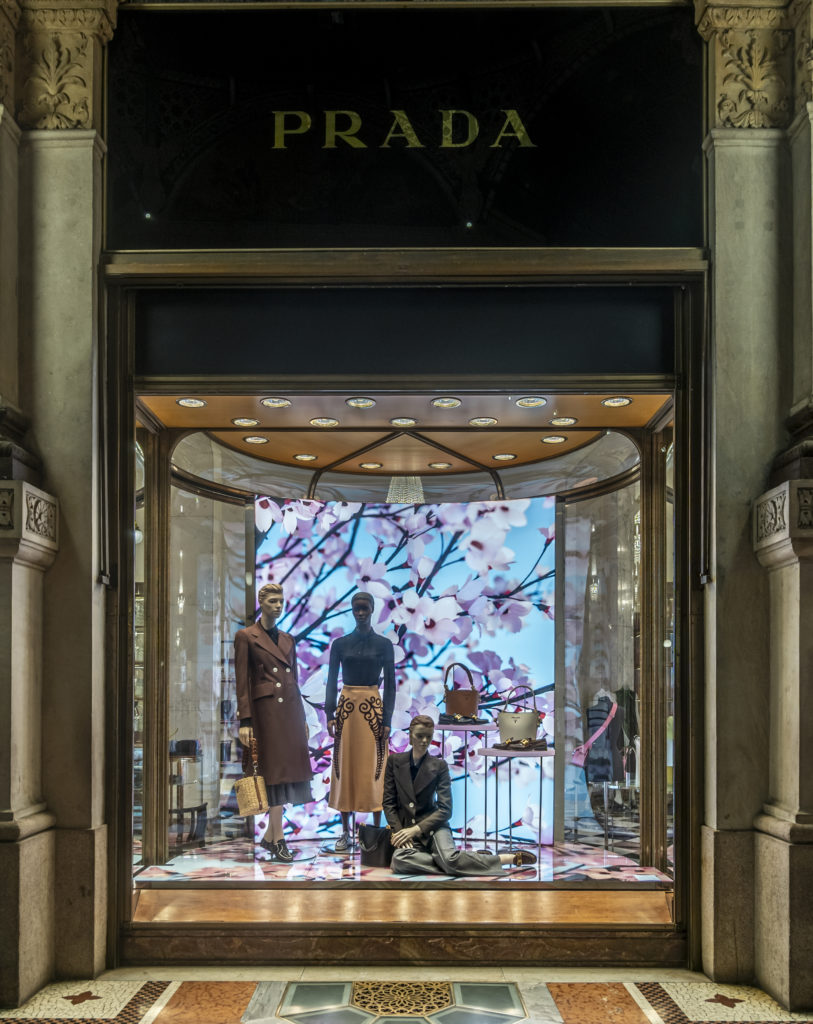
Prada at the Galleria Vittorio Emanuele
in Milan. Photo courtesy Prada.
So you weren’t thinking about climate change or the fragility
of nature as you were making these images?
Right. I wasn’t thinking of that
specifically, but the artificiality of nature sort of implies that,
doesn’t it? You build an artificial tree and the whole construction
of nature is, in this case, a symbol for awakening—fresh energy,
love, spring, getting back to it all after a long winter. So it’s
kind of implied within that framework. The artificiality of that
is, of course, that it’s art, but the pictures in the windows are
more about our expectation of time and what’s coming next. The
experience is the same, but it’s completely
artificial.
Is there any reading material for visitors to the Prada shops
to learn more about the images?
We were discussing whether my
name should be on the photos, and I found it a little vulgar to do
that because a shop window is a shop window, after all, and it’s
supposed to showcase the goods inside the store. If you put your
name on the work, that’s another message on top of the first
message. So I thought it would be a little weird to put my name on
it. In terms of communication about the work, Prada has
communicated the background to anyone who asks and some of the
shops even have the book I did with Ben Lerner. Enough people are
informed, and you know, Prada’s very proud of all the artistic
things they do. If you go online, you can find out about the
project, it’s all there. It’s just not right in your face. I didn’t
like that idea. It opened on the 10th of February, and it’s closing
on the 15th of April, and then it’s going to be destroyed. I wanted
it to be just like a breeze going through the shops.
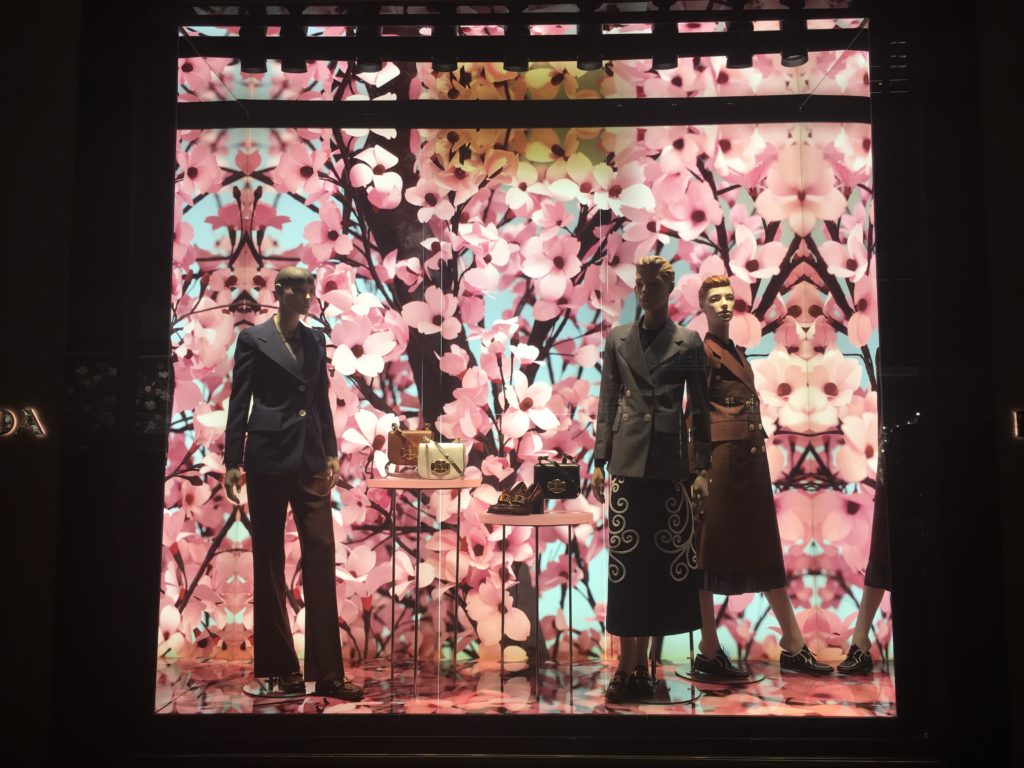
A view of Demand’s work in the window of
a Prada shop on Old Bond Street in London. Photo courtesy
Prada.
What drew you to doing this project in the first
place? Was it because of your history with Prada, because
they’ve earned your trust over the years?
Yeah. In the beginning, when I
started out with them, around 15 years ago, I was like, “Okay, now
I have to wear their clothes whenever I need to do something at the
Fondazione.” And, to my surprise, there was never anything like
that. At some point, I spoke to Miuccia about it, and she was like,
“You know, that’s actually not what we want.” As far as I know,
this is the first time Prada is doing something like this. They’ve
never done another artist project before because they didn’t want
to mix the two worlds—they didn’t want to instrumentalize one with
the other. I’m kind of one of the few people who have developed
quite a few projects with them, so it doesn’t really look like
exploitation if I do something with them in the official
collaborative sense. But I really like that they’re making an
effort to make the two things truly distinct from each
other.
Do you think this will be your last fashion
collaboration?
I mean, who knows? The thing is,
it’s about respect. Fashion is a huge machine, and usually the
problem is that you’re so inexperienced in what they know so well
that they can really throw you under the bus. There’s no chance of
keeping up with that machine. And with Prada, I knew that I could
talk to them and say, “I really need this and that” because I knew
they were going to respect me. I knew that this was going to be a
pleasant collaboration, but my hesitation with other companies—and
I had many offers over the years—was that I just really don’t have
any control over the execution of the project, and that’s probably
what’s held me back. I think the world has also changed. Ten or 15
years ago, it would have been frivolous to do anything
collaborative in this sense, and I think now the lines of
communication—the awareness, the economy of images, everything—has
changed. I think it’s completely okay to do it
now.
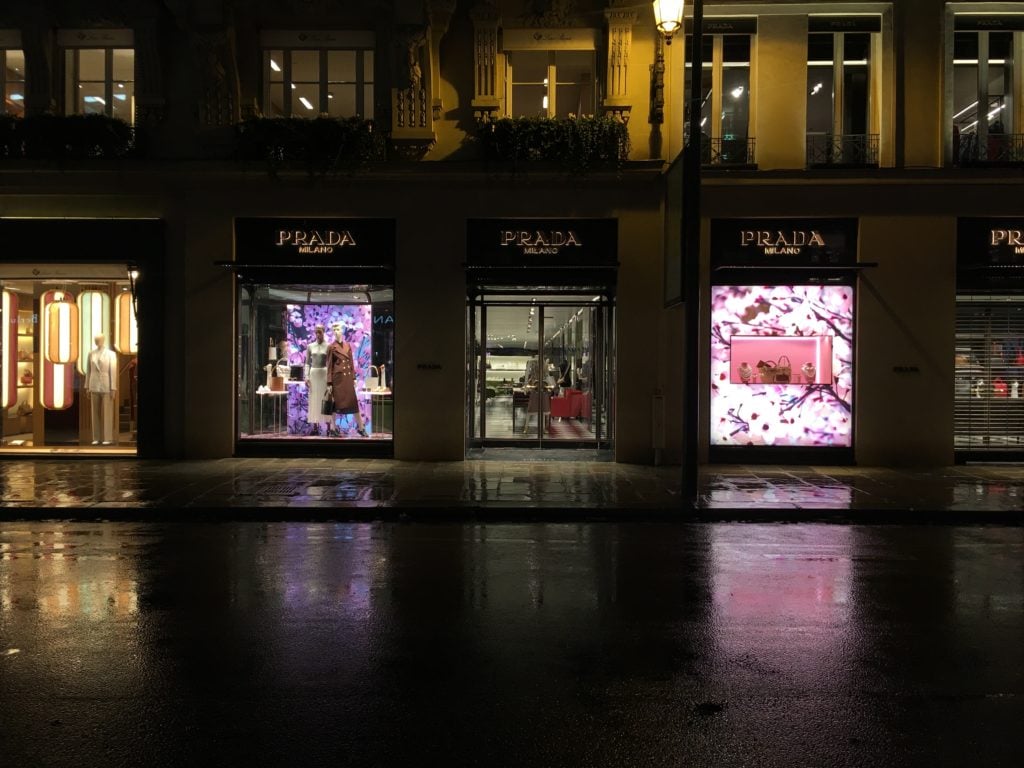
A street view of Prada Faubourg in
Paris. Photo courtesy Prada.
Why do you think that’s happening more these days, that
fashion brands are reaching out to artists? Why do you think
artists are more willing to work with them?
That’s a hard one
[laughs]. I think the obvious answer would be because they’re
both luxury goods. But I don’t think that’s it, really. I don’t
think art is a luxury good. If you want to own it, it is, but if
you want to look at it, there are many ways to look at it. With
art, the experience still very much exists in the public, so I
don’t think it’s about luxury necessarily. The fashion industry is
very open to all kinds of influences from normal life, which is not
interesting. Think of Balenciaga or Helmut Lang, who were inspired
by the mundane or the everyday. Lang started the concept of the
artist as a fashion idol. I think artists have become more
receptive to that and they’re not so afraid anymore of being
incorporated.
It’s a different thing if you
make something in collaboration, or if you actually make an object.
What Sterling Ruby does is make objects—that’s a very different
thing than a collaboration. And I think many of the newer fashion
designers—like Rick Owens or Virgil Abloh—are working like artists.
It’s one person in charge, and everyone kind of associates the
design with that one person. There are lots of
parallels.
What about in a runway show, where art is forced to take a
backseat to fashion? Doing a show like that really can’t be
primarily about commercial value, for the artist at least, because
it’s just so short lived.
That’s another format that is
very tricky and very difficult. Because, you’re right, it’s only
for 12 minutes. You sit there, and it has to work, but it shouldn’t
take the attention away from the effort of the designer. If you’re
honest, there’s not much return on something like that. The
pictures will be about the collection, the fashion line, and not
about the goods on the floor or the staging. But nevertheless, it’s
kind of fantastic—like an opera design or something. For those 12
minutes, that’s what all the effort is for. And that’s really quite
amazing, that the artist and the companies would be willing to do
that. The best one I saw, in that discipline, was Martin Boyce for
Sonia Rykiel. It struck the right balance between the fashion and
the setting. And the way the event was staged was very good for the
work.
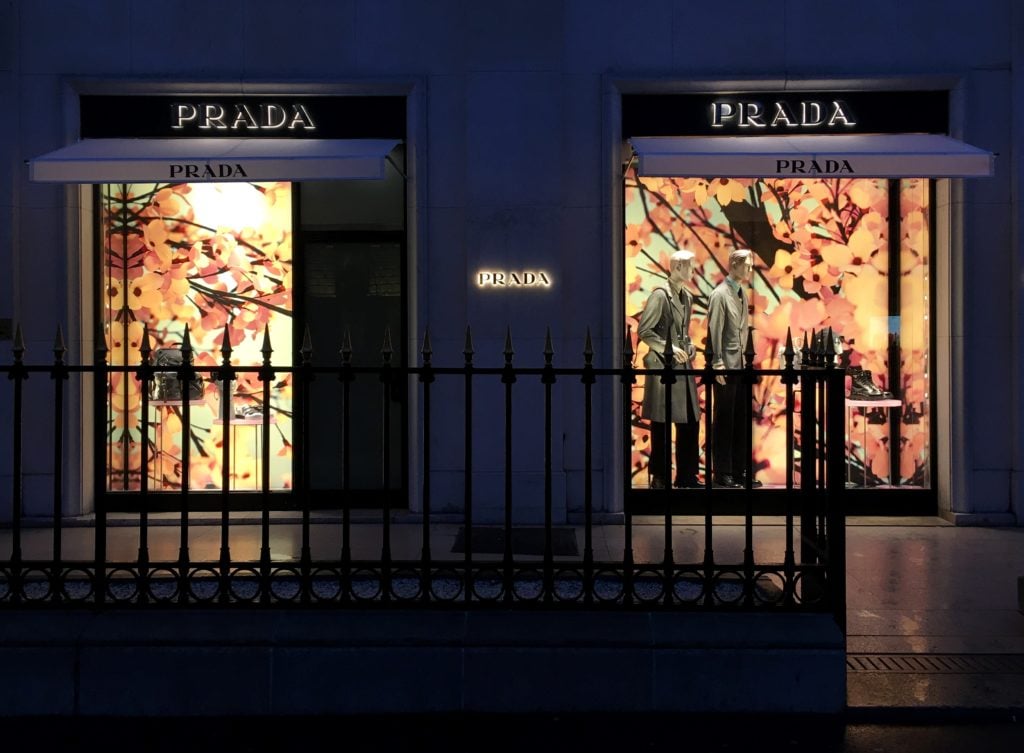
The Prada shop on Avenue Montaigne
Paris. Photo courtesy Prada.
So what’s next for you?
I’m dipping into the world of
architecture now, actually. I’m doing all the covers for
Domos magazine. The April issue is great—they gave me
complete freedom for the work, and the cover is completely separate
from the content. I don’t have to illustrate anything from
the magazine. To be able to do that for a whole year is actually
really quite fantastic.
Then I’m building a building in
Ebeltoft, a remote part of Denmark. I’ve been asked to design some
kind of meeting place, with a scheme of three pavilions. It’s three
buildings which are quite funky. They’re meant to open in September
or October. So, I’m busy. [laughs]
Also, I did a calendar, which
I’m very proud of. It’s called The Daily Flower Report, and it’s a
picture of a flower for every day. It’s such a beautiful object. I
did it with Irma Boom, and I look at it everyday. If you get a hold
of it, it’s actually a really beautiful object. Living in LA,
there’s all this sunshine and to compensate for going to buy your
$5 coffee every day, I took a photo of a blossoming flower, because
something is blooming every day. So I have a whole archive of 900
pictures and we made a big book of 150 pictures. And the idea of a
photo calendar is so trite. But it’s lovely.
The post Conceptual Photographer Thomas Demand on Why He Designed a
Store Window for Every Prada Boutique in the World appeared
first on artnet News.
Further reading


Leave a comment