
The Gray Market: Why the Art World Should Be Encouraged by the Odd Resilience of Cruise Bookings (and Other Insights)
Every Monday morning, Artnet
News brings you The Gray Market. The column decodes important stories from the
previous week—and offers unparalleled insight into the inner
workings of the art industry in the process.
This week, looking for leading
indicators about the other side of this mess…
OPENING DAY
On Wednesday, Chinese officials
allowed outbound travel from Wuhan, where the current
transcontinental crisis quietly originated near the close of 2019,
for the first time in more than 10 weeks. Early reports from the
city suggest that, even after social distancing relaxes in the
global West, a true economic recovery will be slower than
businesses would otherwise hope. But as one wild counterexample
shows, whether or not the art market follows suit may depend on
just how differently the various stakeholders are wired than the
average person.
Although life in Wuhan is now
ostensibly freer than it has been since the Communist Party imposed
the world’s most aggressive
lockdown there in late
January, several restrictions still stand between the city’s
population and a true reunion with normalcy. On the commercial
side, the government has opened up the definition of “essential”
businesses to include industries such as car manufacturing,
allowing roughly 94
percent of the city’s
enterprises to resume operations—at least, if you take its deputy mayor at his word.
However, many of those
businesses have called back only a fraction of their workers, and
others, such as real-estate agencies, remain shuttered.
Bloomberg relays that “shopping malls have re-opened, but they’re
largely empty, most people still too scared to go out for anything
but essentials.” Case in point: one retail worker relayed that he
and his associates at a Wuhan mall’s Calvin Klein store, which
normally does about $2,800 in sales every weekend, had collectively
witnessed a grand total of two purchases since welcoming customers
again on March 30.
In fact, the bulk of the
activity in Wuhan’s malls so far seems to consist of demonstrations for
rent relief from the
owners of the small shops inside, most of whom “haven’t had any
business” at all.
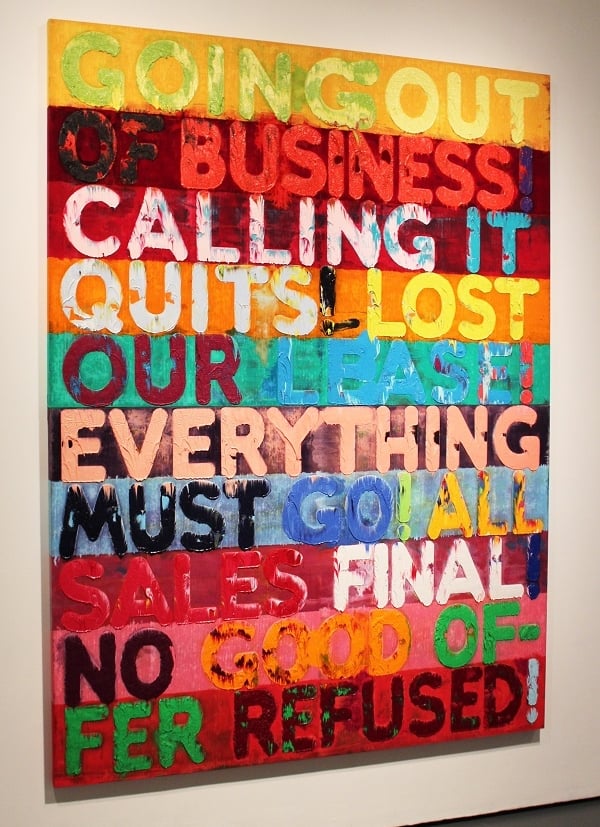
Mel Bochner, Going Out Of
Business (2014). Monoprint with collage, engraving and
embossment. Photo: Rebecca Lax.
It’s not hard to see why when
you zoom out to the state of daily life. Authorities continue to
regulate people’s coming and goings in Wuhan, according to
the New York
Times; office buildings even require visitors to show
a smartphone app that tracks their health before entry, per
the Washington Post. Some apartment
buildings refuse to allow non-residents in under any circumstances,
and schools have not yet been reopened.
All of the above seems
especially ominous for New York, both as a city and as the fulcrum
of the art market. From a statistical standpoint, New York state
became the global
epicenter of the crisis
last Friday. That was the same day that the Guggenheim became the
latest major museum to announce a wave of furloughs
and salary reductions,
and just one day after news broke that Pace had furloughed
roughly 25 percent of the staff at its (reminder: colossally
expensive) flagship in
the Empire City.
In general, it’s only fair to
expect Western economies to mimic the sluggishness we’re now seeing
in China once we catch up to the public-health progress they’ve
made. But when it comes to the art market in particular, it’s worth
remembering that this trade—and the people who drive it—are
abnormal in all kinds of ways. And there is at least one industry comp that
already suggests abnormal demographics can lead to abnormal
strength in their commercial niche of choice.

Park West art auctioneer Alex White
offering works including a tree painting by David Najar. Photo by
Park West.
COME SAIL AWAY
On Thursday, Hugo
Martín of the Los Angeles
Times relayed the
most stunning fact I heard all week: cruise ship bookings for 2021
have significantly increased compared to the same reservation
period in 2019—i.e. months before most of us had ever even heard of
the concept of social distancing, let alone needed to engage in
it.
Remarkably, the bump holds even
once you subtract re-bookings for cruises cancelled (for obvious
reasons) this year. Here’s Martín with
some specific figures:
In the last 45
days, CruiseCompete.com,
an online cruise marketplace,
has seen a 40% increase in bookings for 2021 compared with 2019,
said Heidi M. Allison, president of the company. Only 11% of the
bookings are from people whose 2020 trips were canceled, she
said.
A separate report by Swiss
banking behemoth and longtime Art Basel partner UBS found cruise
bookings were up nine percent in March 2020 compared to March 2019.
This number included plenty of makeup trips for itinerary changes
this year. But the report concluded that overall demand “still
shows a surprising resilience” in the cruise
industry.
Although my snap response to
this news was a level of disbelief that can only be replicated by
the immortal Billy Bob
Thornton, the more I
thought about it, the less surprised I was. Why? Cruise fans are
absolute junkies. From what I can tell, there is truly no other
place they would rather be than on a massive ship feeding them a
steady supply of tropical drinks, mediocre food, and in-house
entertainment only a few notches of exploitative decadence above
what you’d find in a decent nursing home. (Ethically dubious
high-seas art
auctions aside, that
is.)
The rabid fandom in this niche
has overcome or ignored plenty of other risks before. Keep in mind
that cruise ships have been oceanic petri
dishes long
before recent
episodes in our current
fiasco; every vessel is
legally required to have a morgue onboard (for good reason); and it’s not uncommon for them to run aground in historic
coastal cities. Real cruise heads do. not. care. They
live for these experiences, and the data shows that
they’re already lining up their next voyages at the first moment
the coast is clear (metaphorically and literally).
I don’t think it requires
Olympic-level mental gymnastics to equate the cruise-ship ecosystem
to the art-market ecosystem. Yes, their respective value systems
and economic classes are often vastly different (although let’s not
forget the Louvre’s partnership with
luxury cruise line Ponant). But both industries thrive on a
self-selecting subset of the population that is obsessed with a
particular lifestyle experience they can’t get anywhere else. They
don’t just want it—they need it to feel complete. Just think of how many
times you’ve heard a collector describe themselves as an
“art
addict.”
Does this mean I’m predicting an
immediate rebound for artists, galleries, art fairs, and auction
houses as soon as social distancing ends? No, and there will be
plenty of damage done before they do. But I’m inclined to believe
that some of them may need less time to recover than sellers in
several other sectors of the economy.
Just as it’s important to
recognize that cruise fans comprise a specific subculture among
travelers, it’s important to remember that the many different
parties that make up the art trade comprise a specific subculture
within the sales sphere. We are special, for better and worse,
meaning comparisons to typical retail are only so helpful. My
impression is that social distancing has only amplified art lifers’
collective desire to experience exhibitions, openings, and
gatherings IRL. I can’t say when that will be an option again, or
whether collectors will immediately lose their commercial
inhibitions once it is. But because of the unique fixation that
drives the art world, I tend to think it could leading the charge
in re-emerging from isolation.
That’s all for this week. ‘Til
next time, remember: if we weren’t all a little atypical, we’d
probably all have stepped away from this game long before
now.
The post The Gray Market: Why the Art World Should Be
Encouraged by the Odd Resilience of Cruise Bookings (and Other
Insights) appeared first on artnet News.
Read more https://news.artnet.com/opinion/gray-market-cruise-bookings-1831950
Further reading


Leave a comment