
A Collapsing Art Market Will Hurt Underrepresented Artists the Most. Here’s How to Ensure Their Voices Are Not Lost
Last month, as we switched off
the lights at Goodman Gallery, closing our spaces alongside fellow
galleries around the world in response to COVID-19, my head was
spinning.
I tried to find comfort in the
innovative possibilities of online art-viewing and to seek solace
in the healing impact of reduced emissions on the environment, not
to mention the joy of extended quality time with my eight-year-old
son.
But my mind kept returning to
the huge overheads attached to running three galleries across the
United Kingdom and South Africa. We are facing a worldwide
recession and it is predicted that the economies of African
countries will be hit particularly hard.
It dawned on me that the future
of the global art world, and whether it will include the diverse
kinds of galleries that have been sorely lacking until recently,
lies very precariously in the balance.
A week later, South Africa went
into lockdown and our fragile economy was downgraded to junk
status. For a country that already suffers from the highest
inequality on the planet, with unemployment levels impacting almost
a third of the population before the coronavirus pandemic, this is
a serious blow.
Then I received a call. It was
from Dr. Jean Bassett, executive director of the nonprofit
Witkoppen Clinic, which gives free medical care to 1.3 million
disadvantaged people living in and around
Johannesburg. Pulled
upright, I was reminded of the already overwhelmed healthcare
system in South Africa and my responsibility—as a local business
owner—to lend support wherever possible to meet the broader social
need.
What Galleries Can Do
Driven by a steadfast belief
that art can be a conduit for social change, I bolted into action.
Days later, Goodman Gallery launched an urgent appeal, partnering
with our artists on limited-edition blankets with all proceeds
going towards the clinic as they expand their services to extend
care to COVID-19 patients.
As the appeal gained traction,
orders for blankets flooded in from around the world. The response
from collectors was beyond moving, with some people giving
generously to the clinic in addition to purchasing a
blanket.
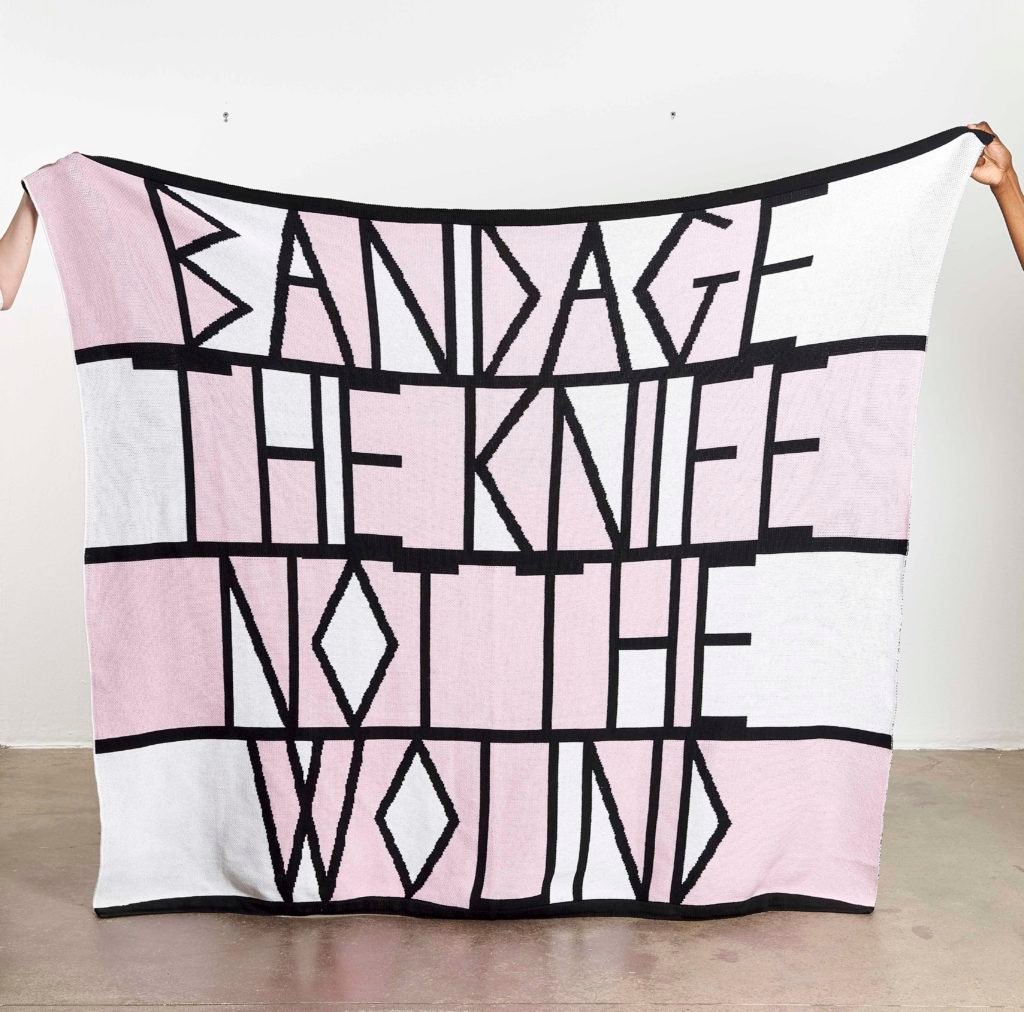
Adam Broomberg & Oliver Chanarin,
Bandage the knife not the wound (2019). Edition of 50.
Courtesy Goodman Gallery.
I felt a renewed sense of hope
for the profound facilitating role that galleries, with artists,
can play to reach beyond themselves and bring aesthetic joy along
with financial aid in times of need. Artist duo Broomberg &
Chanarin immediately followed our Witkoppen appeal by slashing the
prices of their iconic Chopped Liver Press posters to £25, with all
proceeds going towards the clinic. The posters sold out within
three hours.
I’m pleased to see that the
gallery and artist communities in London—our new home since October 2019—have
come together much like our South Africa community. Although the
contexts couldn’t be more different, the shared values are
strong.
Since Goodman Gallery was
founded 54 years ago during the apartheid years, it has faced
choppy waters. From opening its doors as a non-discriminatory space
for artists of all races in 1966, to fighting a public battle
against censorship in the arts in 2012, the gallery has always been
steadied by its core values: believing in the power of art as a
means for human connection, a critical tool for self-expression,
and a catalyst for social change.
These binding values have
connected us with galleries around the globe, especially in the
Global South, such as Sfeir Semler in Beirut, with which we had
planned to share a stand at Frieze New York 2020—a collaboration
that I hope to realize in another form this year. The
responsibility to sustain one’s business and to contribute towards
propping up the fragile infrastructures both within developing art
scenes and more broadly within society weighs heavier than
ever.
In this moment of heightened
need, I have tried to leverage my position as a businesswoman and a
gallerist by facilitating across networks, connecting collectors
and philanthropists to help purchase 100 more ventilators in local
hospitals and, as part of YPO (a global leadership community of
chief executives), getting 2,000 “dignity bags” of sanitary
essentials to South Africa’s homeless.
Galvanizing the Grassroots
In South Africa, along with the
rest of the developing world, there is a resounding lack of
government funding for freelancers—and by extension, most
artists—compared to the support structures available in countries
like Germany and the
United Kingdom. This is
leading the local arts community to mobilize in generous ways
through digital platforms.
The Lockdown Collection is one
such initiative, launched on Instagram to support the Vulnerable Visual Artist Fund
for individuals or organizations in the visual arts as well as the
President’s Solidarity Fund, a scheme set up to help vulnerable
South Africans in this time. Twenty one of South Africa’s most
prized creative minds, including William Kentridge, Sam
Nhlengethwa, and Gerhard Marx, have donated works to the
initiative, which has already raised hundreds of thousands of Rands
(tens of thousands of dollars).
The Centre for the Less Good
Idea, an incubator space founded by Kentridge to support emerging
creative talents based in Johannesburg, has also proved resilient
and resourceful. The center broadcast its entire seventh season of
performances online via Facebook, bringing this critical local
platform to global audiences for the first time.
Shirin Neshat, still from Land of
Dreams. Courtesy Shirin Neshat and Goodman Gallery.
Innovations such as these are a
testament to the possibilities for immediate and intimate reach
enabled by online platforms. To tap into this, Goodman Gallery is
launching new virtual exhibitions and an extended digital program,
including a Shirin Neshat film festival and a weekly Instagram Live
program—#ThursdayLIVE—to bring people close to our artists’
developing practices in this moment of introspection and
alternative thinking.
There is amazing global momentum
to shift towards the digital within the arts, but with all the
innovation in the world, sales are not guaranteed and rent and
general overheads remain in place, which could cripple our
businesses. Indeed, nothing can be taken for granted at this
stage.
On a brighter note, for
collectors this is an unprecedented moment in which artists at all
levels are prepared to give much deeper discounts for their work.
It has been heartening and important to see serious collectors
strive to continue the momentum of addressing major gaps in their
collections, especially with work by artists from the African
continent and the diaspora.
Keeping Diversity Intact
I received another call not long
after South Africa entered lockdown, this time from Gabrielle
Goliath, last year’s winner of the Standard Bank Young Artist Award
for Visual Art. She is an artist of great integrity who has
dedicated her practice to exposing and unpacking the epidemic of
gender-based violence in South Africa and around the
world.
Gabrielle talks about the
desperate situation faced by many women trapped with abusive
partners under lockdown, especially in South Africa, which has some
of the most gutting statistics of rape and femicide. During week
one of lockdown, reports of gender-based violence leapt up to
2,320—37 percent higher than the weekly average. This alarming
statistic included a policeman who was arrested for allegedly
raping his wife.
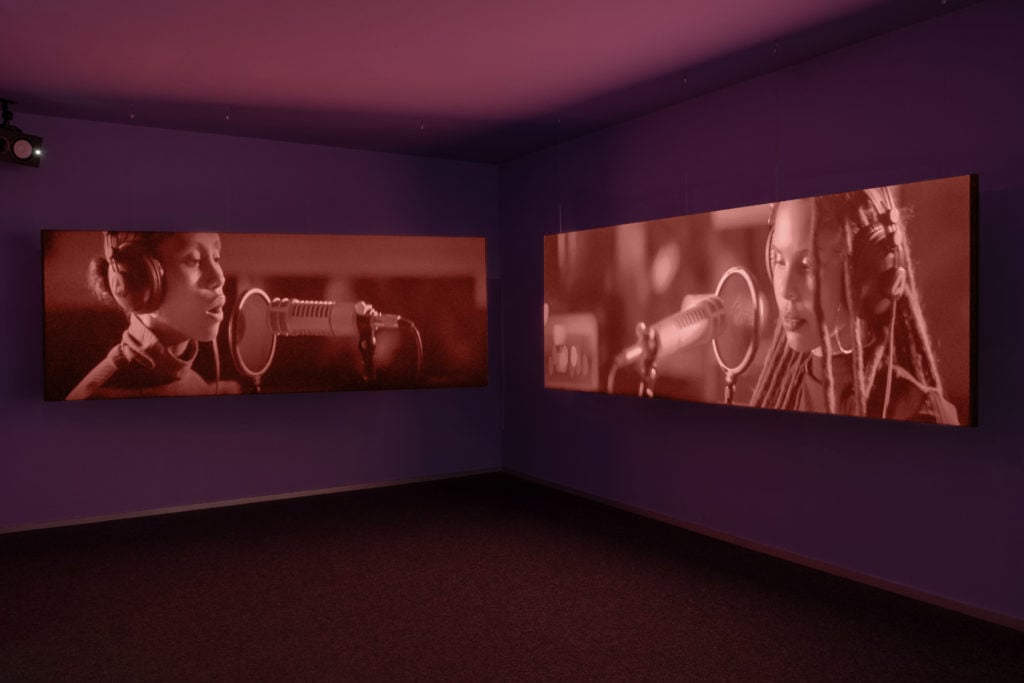
Gabrielle Goliath, This song is
for…. Installation view. Photo by Maksim Belousov.
Our conversation was another
sobering reminder that supporting artists in Africa can be a
lifeline to supporting entire communities. It is so important to
ensure that the art world remains outward-looking, engaging in
diversity at a time when nationalism is on the rise and borders are
becoming more impenetrable.
Like most artists, Gabrielle has
had her projects postponed, suspending her reach in a time when
issues such as gender-based violence require heightened
visibility.
Artists around the world are
responding to lockdown conditions in different ways, with some
pausing their practices and taking stock (not all by choice), while
others are making work with renewed momentum and verve. We need our
artists to be able to press pause or play with the security of
future support in the form of diverse platforms and sustained
support from collectors and institutions.
In the coming weeks and months,
I hope to find a balance between inward- and outward-looking
initiatives, and to be part of an art world that is supportive,
seeking out collaborative models to connect with collectors in new
and meaningful ways and pooling resources where possible. We are
already beginning to see this happening in pockets of New York and
London. This collaborative effort needs to extend far beyond the
traditional art centers.
As galleries and museums adapt
with remarkable speed, opening our virtual doors to exciting new
online experiences of art, it is also the time to pause ourselves
and reflect on how each of us can contribute towards preserving the
diverse arts ecosystem that has taken so long to bring into
being.
The post A Collapsing Art Market Will Hurt Underrepresented Artists
the Most. Here’s How to Ensure Their Voices Are Not Lost
appeared first on artnet News.
Read more https://news.artnet.com/opinion/liza-essers-op-ed-1834695
Further reading


Leave a comment