
Can My Artist Ex-Boyfriend Sell an Artwork We Made Together? + Other Thorny Artists’-Rights Questions, Answered
Have you ever wondered what
your rights are as an artist? There’s no clear-cut textbook to
consult—but we’re here to help. Katarina Feder, a vice president at
Artists Rights Society, is answering
questions of all sorts about what kind of control artists have—and
don’t have—over their work.
Do you have a query of your
own? Email knowyourrights@artnet.com
and it may get answered in an
upcoming article.
My ex is an artist and he is trying to sell a painting that
we made together. Can he do that?
It depends on the circumstances
under which you parted. If the painting is at his place and he
technically owns it, then he may in fact sell it. Sorry,
heartbreak, but that whole thing about possession being nine-tenths
of the law turns out to be true.
Still, there’s a bright side: an
author has clear, definitive copyright protection over their work
as soon as it is created. And when it comes to works with two
authors, the law is clear.
The Second Circuit ruled in the
1998 case of Lynn Thomson v. Jonathan Larson that “each joint
author has the right to use or to license the work as he or she
wishes”—as long as any profits are shared equally between the
co-authors. (That case involved the true author of the play
Rent; Thomson blew the case after she was unable to
recall some of “her” lyrics on the stand.)
Since you and your ex created
the piece together, the underlying copyright belongs to each of
you—and you both have the right to reproduce the work, produce
derivative versions, sell copies, or otherwise exploit
it. Whether or not the
physical work is sold, you can get the painting on skateboards and
t-shirts (as long as you split the money with him). Adapt it into a
screenplay and get a Netflix deal! Spite can be a powerful
motivator. Good luck.
I’m a monochrome painter and I’m pretty sure I just saw a
Zara dress that steals my shade. What recourse do I
have?
Shade, indeed! The short answer:
not much recourse at all. Unless you developed a hue that that was
not scientifically possible before you invented it, you are
probably out of luck.
The long answer is worth
sticking around for, though, because it helps parse the
often-confusing distinction among copyright, trademark, and
patent.
Here’s what you need to know:
Copyrights protect all original pieces of work, such as paintings
or literature, while a trademark is a word, phrase, symbol, or
design that indicates and distinguishes the source of goods (like
the Olympics logo or McDonald’s Golden Arches). A patent is
essentially the same thing as a trademark, except that it protects
a tangible invention (think: iPhone or 3D printer).
Creators are the automatic
owners of the copyrights to their work, while trademarks and
patents are granted by regulatory bodies in response to formal
applications.
So what’s this got to do with a
Zara dress? Well, under certain circumstances you can trademark a
color, but only if it is so strongly associated with a product
or service that a regulatory
body like the Office of Patent and Trademark would deem it trademarkable. Think “Tiffany
Blue” for those cyan jewelry boxes, or “Louboutin Red” on the soles
of fancy shoes.

A sample of Vantablack. The material is
so dark it makes crinkled aluminum foil appear flat. Courtesy of
Wikimedia Commons.
Artists, too, have tried to
patent colors, but without broad success. The only exceptions that
come to mind are Yves Klein—who, in 1960, worked with a Parisian
chemist to create a deep blue hue dubbed “International Klein
Blue.” Another interesting case is that of Anish Kapoor, who,
nearly 50 years later, purchased the exclusive rights to the
blacker-than-black pigment “Vantablack.” (It’s worth noting that
Kapoor does not own a patent on Vantablack; he was only able to
obtain exclusivity of the color through a deal he made with
Surrey NanoSystems, a British
company that developed the pigment for military equipment like
satellites and stealth jets.)
What am I getting at here?
Patents on colors are basically impossible. You can trademark a
color, but in order to get the trademark, you must be able to make
a very compelling case for its undeniable association with a very
established brand.
This brings us back to
copyright, which unfortunately cannot be used to protect one color.
You can
protect an arrangement of colors,
even an incredibly abstract one. And as a monochrome painter, you
can copyright your painting—you just can’t copyright the shade you
used to paint it. (The whole thing gets a little philosophical,
right?) My advice is to let it go.
My artwork was in the background of Ivanka Trump’s recent
Instagram post. Can I sue her to take it down?
Let’s cut to the chase:
Technically, you can sue her. Your work is your intellectual property, and as
such, you are the only one who is entitled to reproduce or license
it. But there are nuances here. How prominently was your piece
featured in the post? If it is just incidental—if it
was in the background and not in focus—then
you don’t have much of a claim. Of course, this is a subjective
judgement.
You may think that the work prominently featured
while someone else may not.
"background:#FFF; border:0; border-radius:3px; box-shadow:0 0 1px 0 rgba(0,0,0,0.5),0 1px 10px 0 rgba(0,0,0,0.15); margin: 1px; max-width:500px; min-width:326px; padding:0; width:99.375%; width:-webkit-calc(100% - 2px); width:calc(100% - 2px);">
View this post on Instagram
One thing to note is the degree
to which Ivanka was using the ‘gram to promote herself, her
political agenda, or her super classy jewelry line. If the post was
clearly promotional, you would have a clear claim, as no one can
use your work to market their product without your explicit
permission. Republican politicians frequently encounter this
problem when they play songs at campaign rallies, since basically
no good musicians are conservative.
All that said, my advice is to
skip the lawyers. Going to court probably isn’t worth the trouble
or cost. Courts generally do not find for the copyright holder in
matters like these, and your chance of recouping any money is slim.
Maybe just disavow the work
instead?
I have always been in love with Ingres’s
Violin by Man Ray and I would
love to get sound holes tattooed on my back, just like Kiki de
Montparnasse has in the photo. Can I just go for it or do I have to
get some sort of permission?
Well, this is definitely a
unique question. And unlike the location for your proposed ink, the
answer is rather nuanced.
On March 26th, while the rest of
us were on lockdown, New York’s Southern District settled a major court case
over body ink that happens to be relevant to your
question.
In 2016, a tattoo-licensing
company called Solid Oak Sketches sued Take-Two Interactive,
publisher of the NBA
2K video game franchise,
claiming to own the copyright for the tattoo designs featured on
the digital avatars of NBA stars LeBron James, Kenyon Martin, and
Eric Bledsoe.
The US Copyright Office
maintains that any creative illustration “fixed in a tangible
medium” is subject to copyright—so this applies to a painting or a musical
score, or even the broadcast of an NBA basketball
game. The game itself,
viewed in real life, is for these purposes considered intangible,
and not copyrighted; if you can take a thing and show it to someone
else in a different time or place, then it’s tangible and
copyrightable.
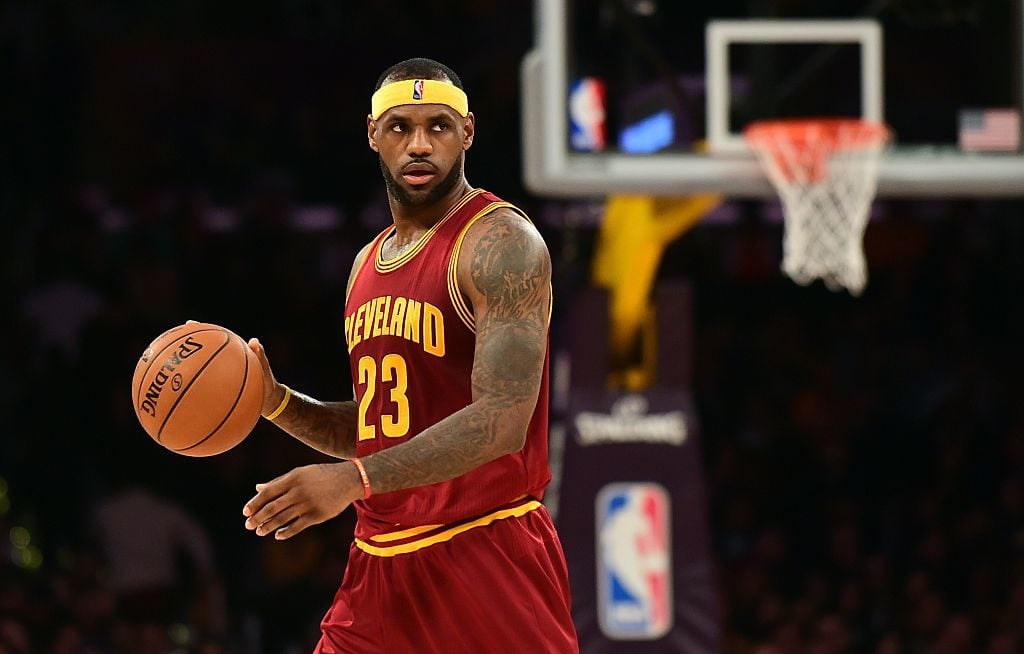
LeBron James and his tattoos at Staples
Center in Los Angeles, California on January 15, 2014. (Photo:
Frederic J. Brown/AFP via Getty Images.)
The tattoo artists who actually
inked the ballers had previously sold their designs to Solid Oak in
the hopes that they might be licensed for a clothing line, and
Solid Oak, in turn, went after Take Two, alleging unauthorized
reproduction of the designs.
“I always thought that I had the
right to license what I look like to other people for various
merchandise, television appearances, and other types of creative
works, like video games,” James said during the
case.
US District Court Judge Laura
Taylor Swain agreed, citing the fact that the featured tattoos are
“small and indistinct,” and could hardly be discerned by a typical
game-player. “Furthermore,” she added, “the tattoos are not
featured on any of the game’s marketing material”—which means it
was impossible to argue that Take Two profited off the tattoo
designs.
All this is to say that you’re
more than welcome to copy Kiki and transform your back into a
violin. But if you end up
modeling that ink and making money off of it, the estate holders
just might come after you, and play your lawyers like a
fiddle.
The post Can My Artist Ex-Boyfriend Sell an Artwork We Made
Together? + Other Thorny Artists’-Rights Questions, Answered
appeared first on artnet News.
Read more https://news.artnet.com/opinion/know-your-rights-artists-advice-1839207
Further reading


Leave a comment