
‘I’m Just Trying Not to Avert My Eyes’: How Rashid Johnson, George Condo, and Other Artists Are Taking on the Pandemic in Their Work
For an artist, addressing this
unprecedented moment in history might feel both necessary and
daunting. Distilling
the complexities of any era while that era is still playing out
isn’t easy, and, historically speaking, many works of art that
have come to represent a significant point in time were made
later—often addressing not the moment itself, but the conditions it
incurs.
And yet, intimidating though the
task may be, artists can’t seem to help
themselves—making art in
reaction to the world is what they do. And, in this particular case, they also happen
to be locked in their homes with little else to
do.
There’s no one way to define
“Coronavirus art.” A number of artists of Asian descent, such
as Taeyoon
Choi, Lisa Wool-Rim
Sjöblom, and
Laura
Gao are confronting
the latent racism in pandemic panic through illustration.
Photographers are making ad-hoc still
lifes with a quarantine
flair, or taking
somber portraits of
people from outside.
Street artists the world over are filling their
neighborhoods with
coronavirus-themed designs.
And online “museum” dedicated
to “art born during Covid19 quarantine” has even popped
up.
“It’s tough,” says artist Rashid
Johnson of the current moment. Holed up in a Long Island house with
his wife (the artist Sheree Hovsepian), their son, and his in-laws,
Johnson has churned out a series of disquieting oil stick drawings
in a makeshift basement workspace. They works are on view now in
an online exhibition
at his gallery, Hauser & Wirth.
“They’re not the most joyful
things I’ve ever made,” he says. “They’re not intended to be
illustrations of a time and space, but rather of a feeling. And
that feeling isn’t the most comfortable.”
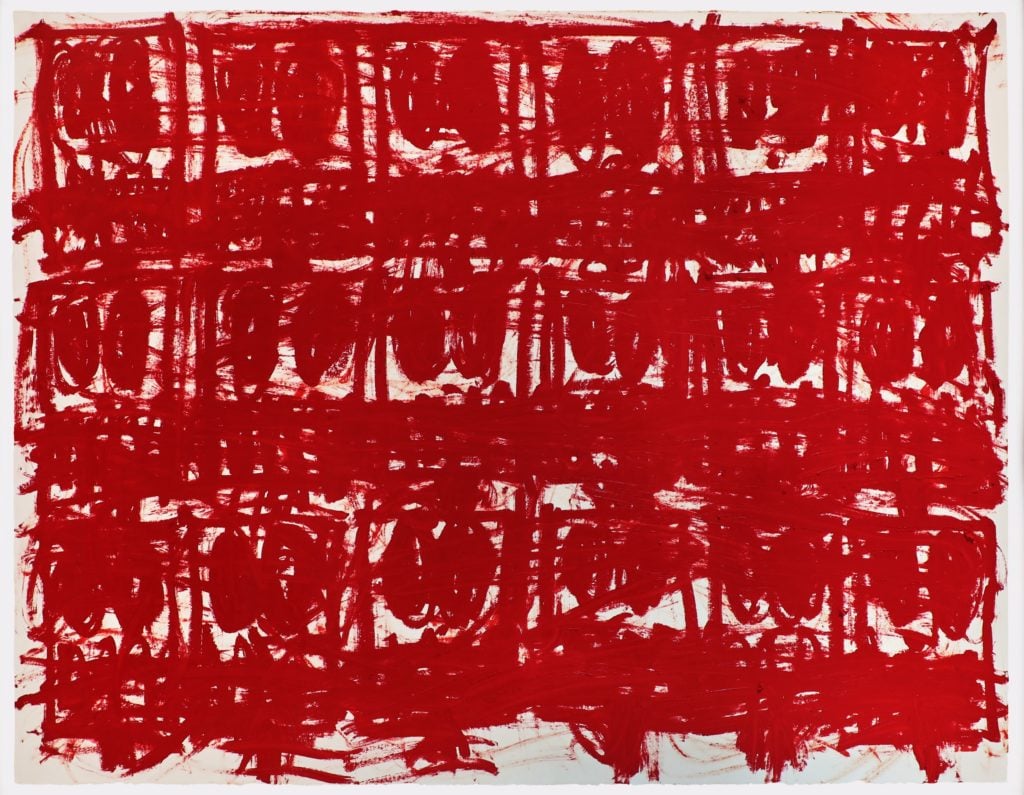
Rashid Johnson, Untitled Anxious Red
Drawing (2020). Courtesy of Hauser & Wirth.
An evolution of the artist’s
“Anxious Men”
series, which features boxy
figures scrawled in black, Johnson’s new drawings series are
rendered solely in red.
“I just felt like that was the
color,” he says. “I wish I had a more philosophical position to
take on it, and I could probably conjure one if I wanted to. But to
me, that color just looked like what I felt and I think what a lot
of people were feeling, which is this sense of urgency and
fear.”
Johnson’s new “Untitled Anxious Red Drawings”
are also more abstract than their
figurative forebears. They’re messier, more menacing—a result of
his effort to “deconstruct the image” through almost automatic
mark-making. His description of the process feels itself like a
response to the present moment’s new rules of
distance: “Rather than
having a grand commitment to separation and delineation, I’m really
focused on the gesture and stretching out the abstract mark-making
to find holes in the space.”
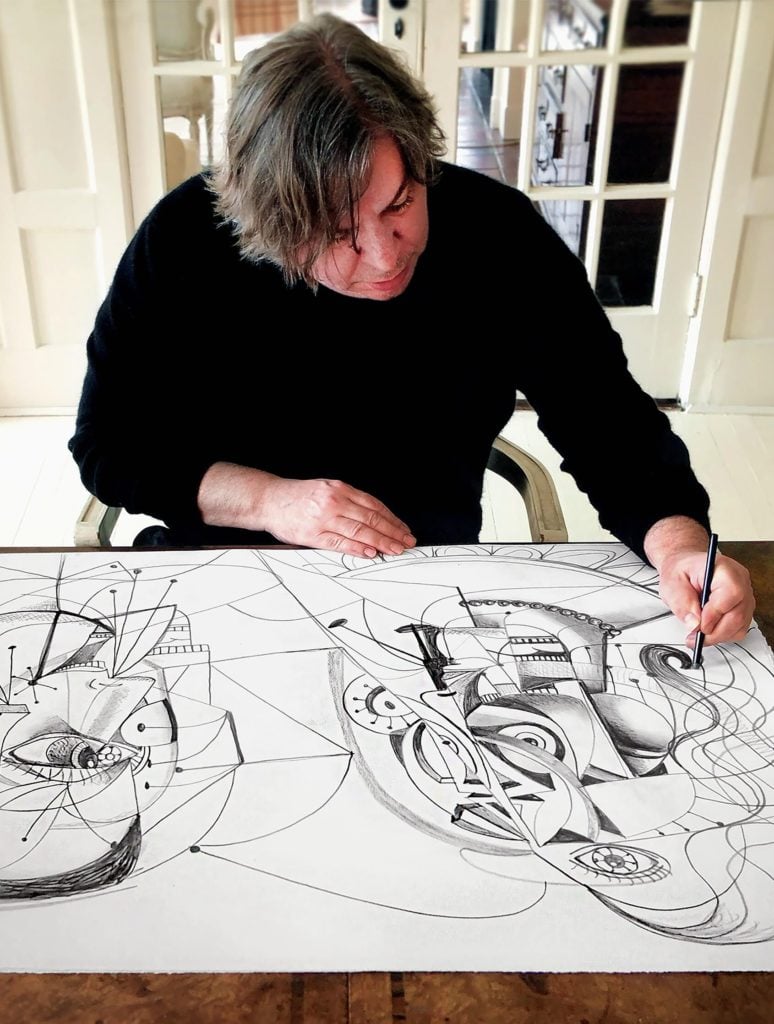
George Condo with his work Linear
Contact (2020). Courtesy of the artist and Hauser & Wirth.
Meanwhile, working out of a
garage in the Hamptons, George Condo has produced a new body of
paintings and drawings that channel the idea of social isolation
through cubist abstraction, an approach that conjures a world
mediated by screens as much as it does the history of
modernism.
“I’m hoping they depict the
moment where figures are forced to be separated from loved ones, as
I am, and that they show the never ending power of the human
imagination,” the artist says of his “Drawings for Distanced
Figures,” which are also on view in an online exhibition.
Human connection, or the lack
thereof, is a predominant theme in many artists’ work right now.
“Coronavirus art” is rarely that; more often it’s art in the time
of coronavirus. It’s human art positioned against the backdrop of a
pandemic.
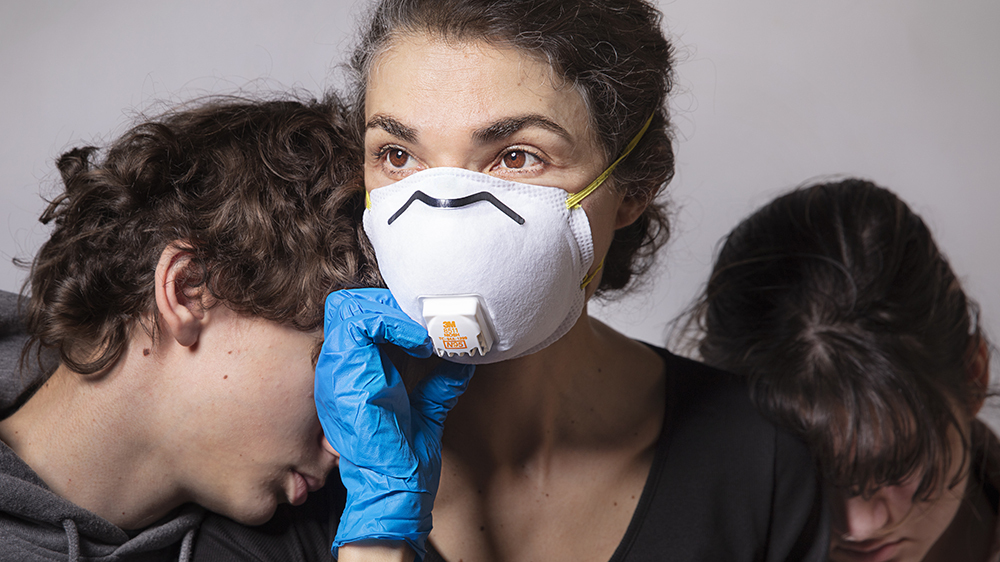
Elinor Carucci, Love in the Time of
Corona (2020). Courtesy of the artist.
For New York-based photographer
Elinor Carucci, the urge to make work in the moment is stronger than the urge to make
sense of
it. “I never stopped to think, ‘Oh, this is an
interesting time. Should I make a project?’ Who knows!” she says.
“I can’t even think about it in the usual project terms. This is
not like anything else I’ve done before.”
Carucci, who put out her fifth
book, Midlife, last fall, often spends upwards of a decade
working on a single body of work, during which time she’ll wait to
share individual images until she’s completed the project as a
whole.
But over the last five
weeks, the artist has taken to
Instagram to share a
series of photos that capture the little details of lockdown life
in her Chelsea apartment: video-chatting with her parents for
Passover, a tear-soaked tissue left on the couch after watching the
news, a mask marked with a faint lipstick trace.
"background:#FFF; border:0; border-radius:3px; box-shadow:0 0 1px 0 rgba(0,0,0,0.5),0 1px 10px 0 rgba(0,0,0,0.15); margin: 1px; max-width:500px; min-width:326px; padding:0; width:99.375%; width:-webkit-calc(100% - 2px); width:calc(100% - 2px);">
View this post on Instagram
“This is the first time in my
life where I’m posting almost every day, and it’s the work I did
today or yesterday or maybe two days ago,” she
says.
Surprisingly, Carucci says, “I
think the people who have been following my work have never been so
close to me.”
For now, it’s safe to say that
many artists, like the rest of us, are just waiting to see what
happens next, how the pandemic will unfold and change life as we
know it.
“I’m just trying not to avert my
eyes, to be present in the world that we’re living in,” says
Johnson. “As an artist, I’m trying to express myself without being
didactic, without pandering, and with a sense of presence and
thoughtful engagement during the course of something that we’re all
experiencing.”
The post ‘I’m Just Trying Not to Avert My Eyes’: How Rashid
Johnson, George Condo, and Other Artists Are Taking on the Pandemic
in Their Work appeared first on artnet News.
Read more https://news.artnet.com/art-world/how-artists-are-addressing-pandemic-1842672
Further reading


Leave a comment