
Ahead of Mother’s Day, See Some of the Most Tender Depictions of Mothers and Children Throughout Art History
There’s an old saying that goes, “If it’s not one thing, it’s
your mother.” Poking fun at the sometimes overbearing nature of
mother figures, the maxim highlights a universal truth: that
life-giving often means succumbing to a future fraught with
complicated emotions and worry.
And while mothers bear this responsibility and burden with a
great deal of courage, if they’re especially lucky, they may be
paid back with love, affection, and gifts when their offspring grow
up—or, better yet, be portrayed in
a work of art for all the world to see.
Indeed, mothers have always made wonderful subjects for artists,
who have long explored the space between their roles as individuals
and as caregivers. Just ahead of Mother’s Day, we’ve rounded up
eight famous artworks that beautifully depict the bond between
mother and child.
Elisabeth Louise Vigée Le
Brun, Self-Portrait with Her Daughter, Julie
(1780–1819)
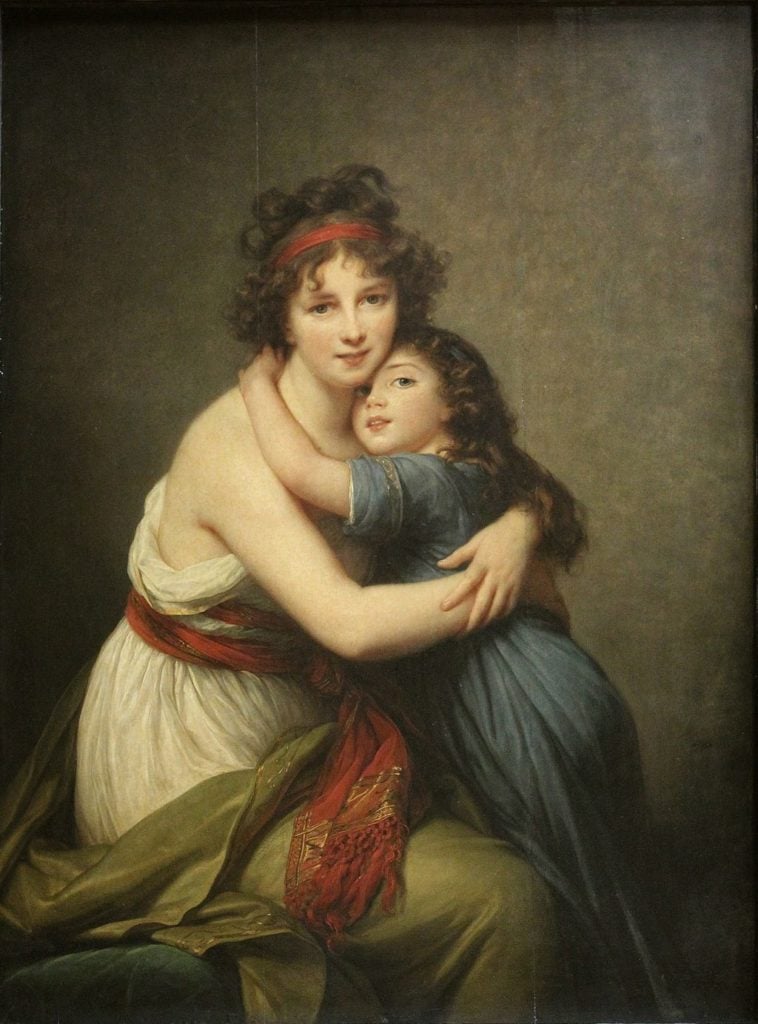
Elisabeth Louise Vigée Le Brun,
Self-Portrait with Her Daughter, Julie (1780–1819).
Courtesy of Wikimedia Commons.
Neo-Classical French painter
Elisabeth Louise Vigée Le Brun was the beloved royal portraitist of
Marie Antoinette and created history’s most enduring images of the
infamous French queen (including a tender portrait with her
children). Le Brun was also a mother herself—she had one daughter,
Julie, whom she adored, and frequently used as a model. Here, she
portrays them both in a warm embrace, with Julie’s face partially
nestled into the crook of her neck. Le Brun’s toga-like drapery
harkens to the popular à la Grecque style of the age, which drew
inspiration from the artwork of the ancient world. Nevertheless,
through her depiction of a blank background, she reminds her
viewers that she is an artist at work in her studio with a very
contemporary child.
Kitagawa Utamaro,
Midnight: Mother and Sleepy Child (1790)
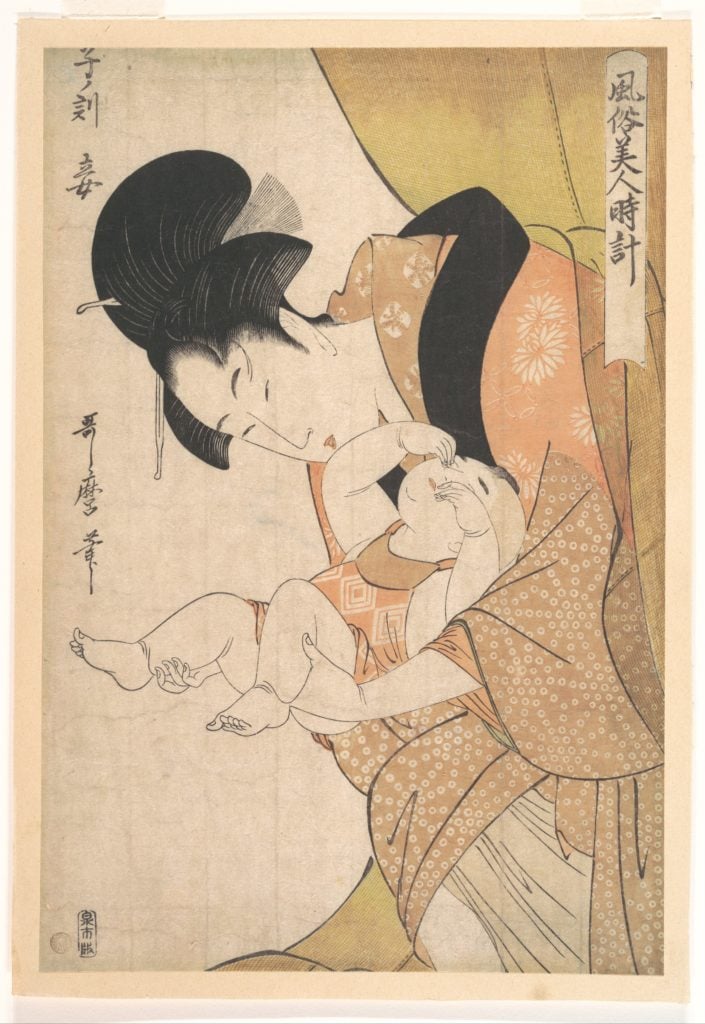
Kitagawa Utamaro, Midnight: Mother
and Sleepy Child (1790). Courtesy of the Metropolitan
Museum.
One of the leading artists of
Edo-era Japan, Kitagawa Utamaro was lauded for his tender
depictions of beautiful women and his talent for capturing quiet
moments between mother and child. In this nighttime scene, a woman
emerges from the mosquito net that would surround her bed and
attends to her baby, who is sleepily rubbing his eyes. These tender
moments of daily life were of particular interest to the Edo-era
artists, and their work would prove deeply influential to the
European Impressionists later on.
Mary Cassatt, Breakfast
in Bed (1897)
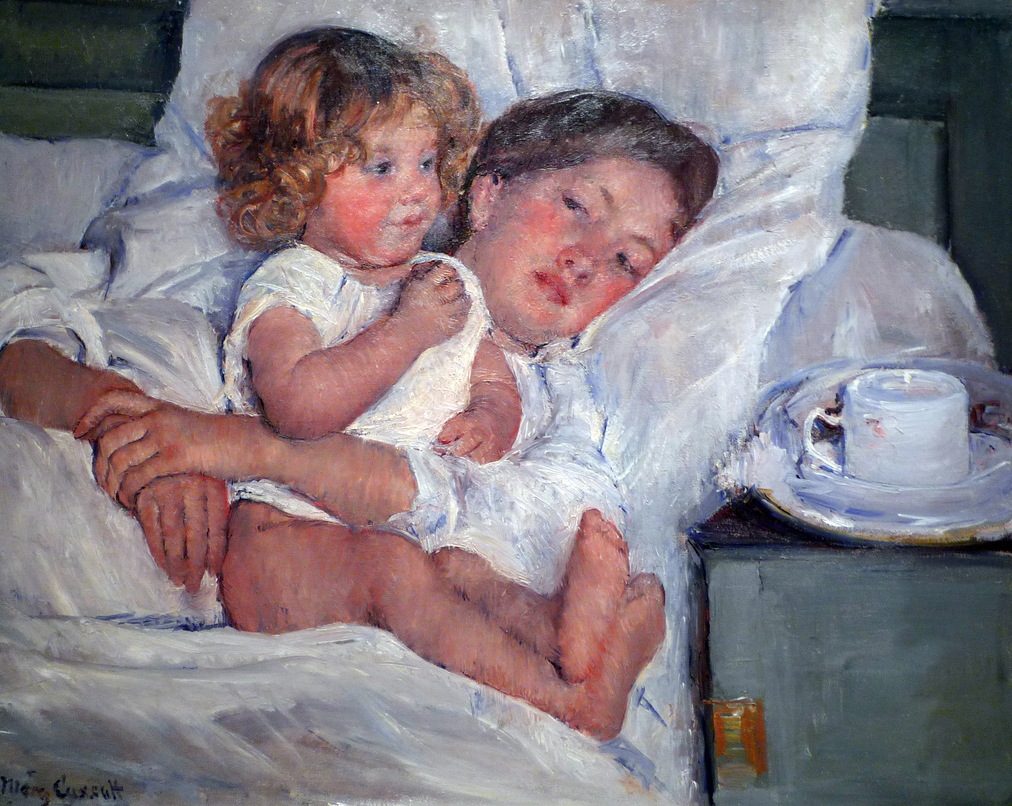
Mary Cassatt, Breakfast in Bed
(1897). Courtesy of the Norton Simon Museum.
The Impressionists were
enthralled by the quotidian coming-and-goings of bourgeois life.
For Manet, Degas, Renoir, and the other male artists of that
period, city streets, the ballet, cafe settings, and horse races
collectively served as fruitful ground for their creations. But for
women Impressionists, the domestic interior, and the life of the
mother—worlds into which their male counterparts had no
access—became their subject matter. American-born, French artist
Mary Cassatt was most famed for her many images of mothers and
children. In this particular work, a young mother, seemingly lost
in thought, holds up her rosy-cheeked child, as they rest, floating
on white clouds of pillows and blankets.
Gustav Klimt, Hope
II (1907-08)
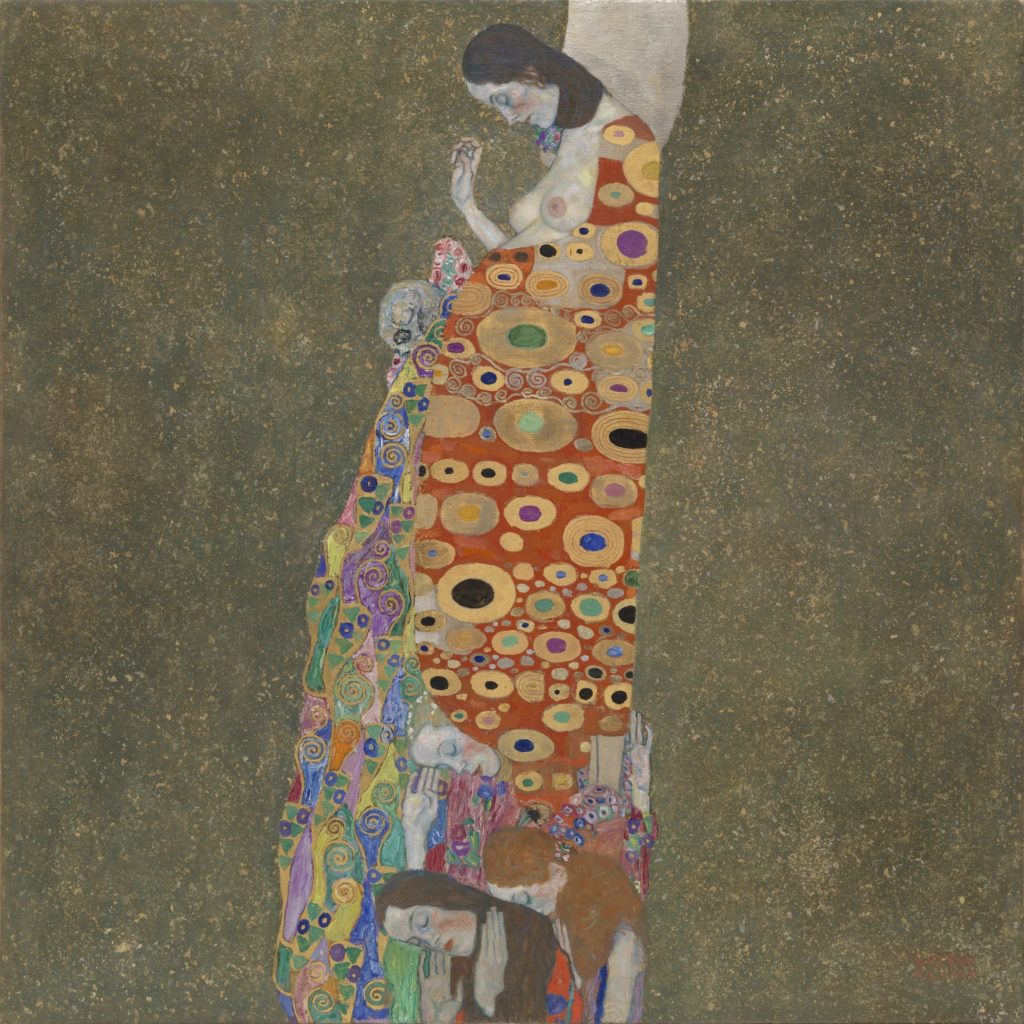
Gustav Klimt, Hope II (1907-08).
Courtesy of the Museum of Modern Art.
The Austrian artist Gustav Klimt was one of seven children, and
he himself is said to have fathered at least 14 of his own, so he
was no stranger to the intimacy of parenthood. The painting,
titled Hope II, was the second of his
works to focus on a pregnant woman, which at the time was still
uncommon, and not entirely welcome. Here, we see a woman swathed in
a patterned garment, enveloping several other women kneeling at her
feet with their heads bowed solemnly. In the early 20th century,
pregnancies were especially precarious, and complications
common.
Alice Neel, Mother
and Child (Nancy and Olivia) (1967)
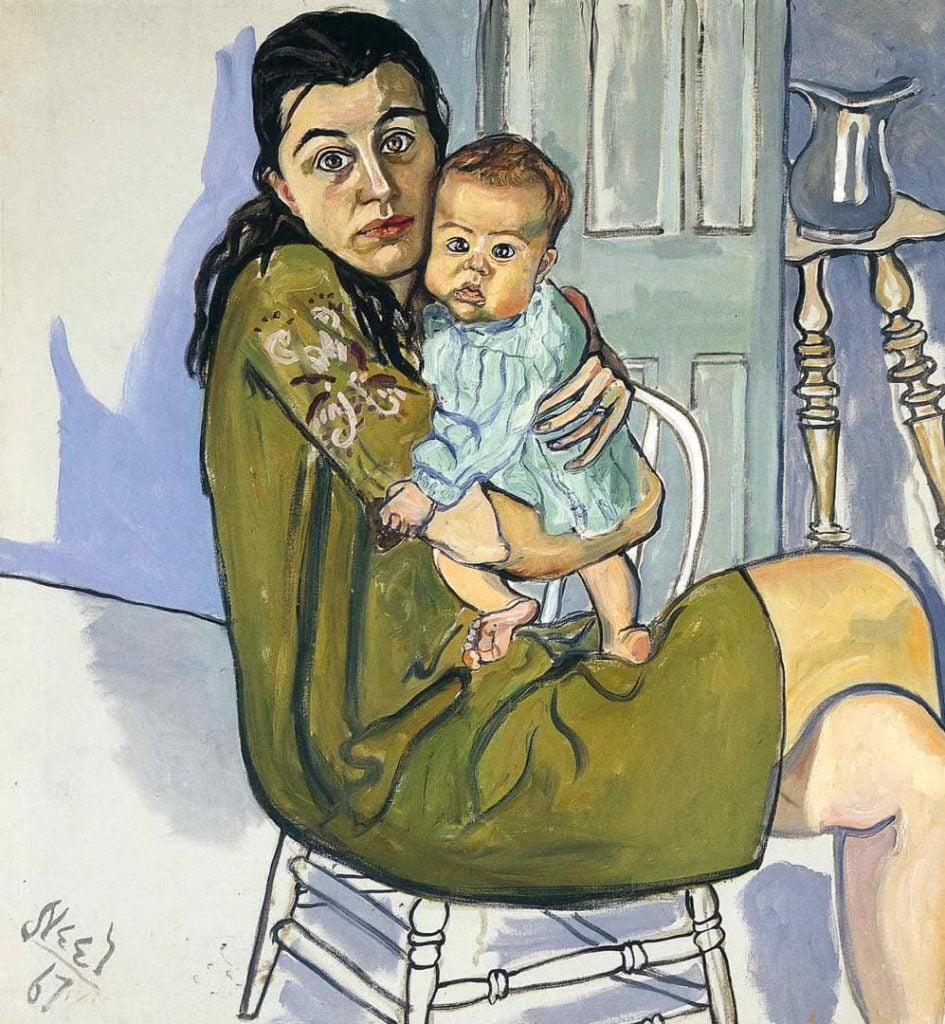
Alice Neel, Mother and Child (Nancy
and Olivia) (1967). Courtesy of Artnet.
Lauded as one of the great portraitists of modern painting,
Alice Neel struggled in her personal life greatly. Her first child
died from diphtheria, and though the trauma lasted through her
life, permeating her work, she became more invested in depicting
portraits of her remaining family and friends. In this image, we
see Neel’s daughter-in-law Nancy, a new mother to her own daughter
Olivia, Neel’s first grandchild. The tenderness of Neel’s work is
balanced by her obvious pride in Nancy’s courage and strength as a
new mother—Neel was an advocate for women as individuals, and the
heroics of early motherhood, which she surely knew herself, are
evident in this painting.
Carrie Mae Weems,
Untitled (Woman and daughter with
makeup) (1990)
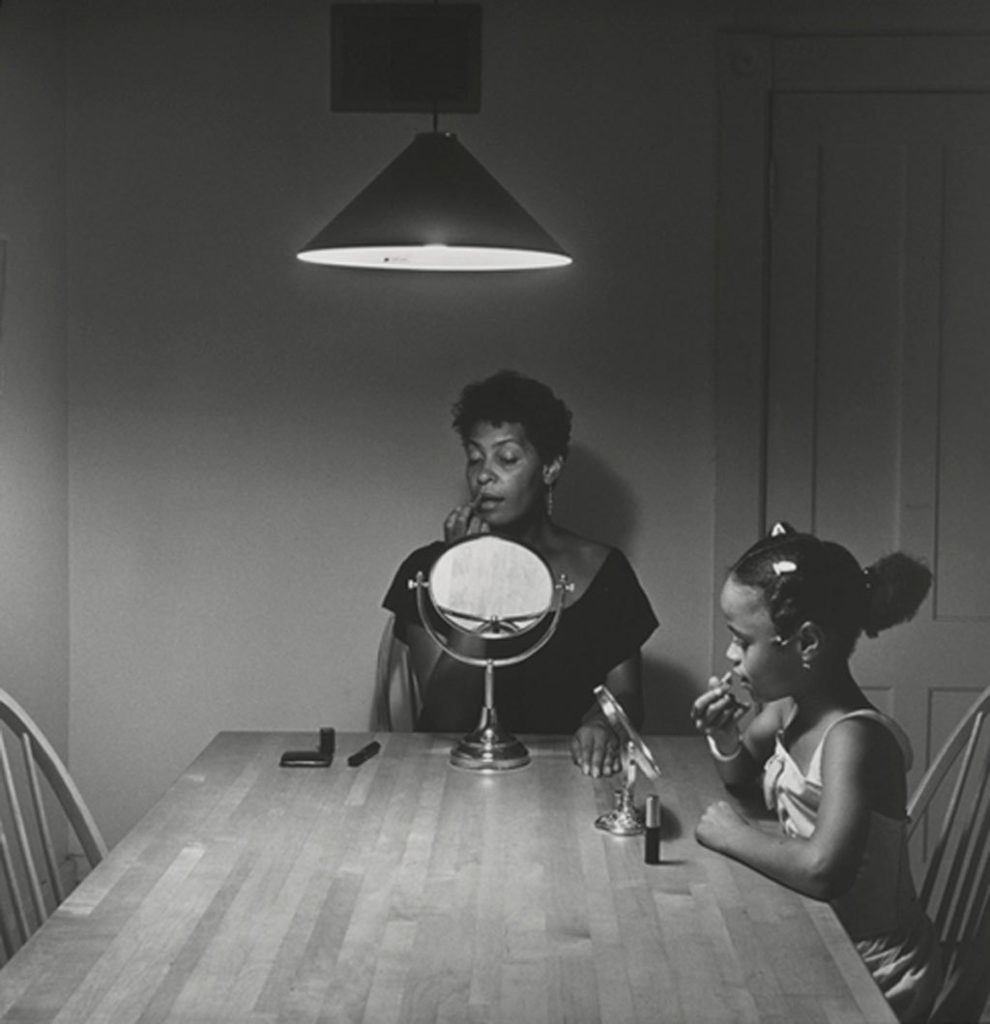
Carrie Mae Weems, Untitled (Woman and
daughter with makeup) from Kitchen Table Series (1990).
Image courtesy of Phillips London.
In the late 1980s, while
living in Northampton,
Massachusetts, the young Carrie Mae Weems began to stage
photographs of herself at the kitchen table playing a character of
a woman with a complex life—as lover, friend, and mother. The work
would become her seminal “Kitchen Table” series, revered today as
an important touchstone in the self-representation of black
womanhood. Among the most poignant moments in the series is the
image of Weems’s character and her daughter applying makeup
together at the kitchen table—an act of bonding, and theatrical
disguise, shared by women across generations.
Zenib
Sedira, Mother, Daughter, and
I (2003)
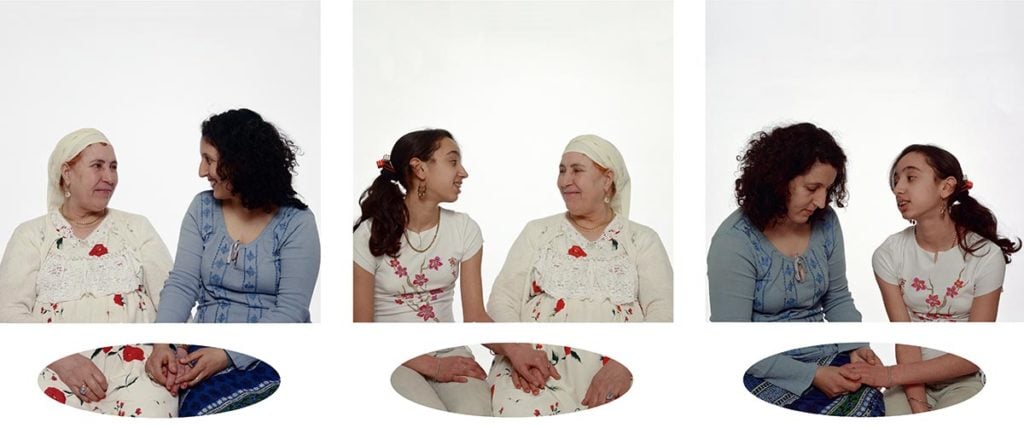
Zenib Sedira, Mother, Daughter and
I (2003). © Zineb Sedira / DACS, London. Courtesy the artist
and kamel mennour, Paris.
Born in Paris in 1963 to parents who emigrated from Algeria,
just before the country won independence from France, Zenib
Sedira’s practice has long explored issues of identity, politics,
and racism. She often uses her parents as direct subjects to help
her come to terms with her own place in the world. “How do you tell
your identity when your identity is quite complex, perhaps painful
at times, but also very rich?” she once mused in an interview,
adding that her work seeks to answer that very question.
In Mother, Daughter, and I, Sedira acts an interpreter between her elderly
mother and her young daughter, contemplating the multigenerational
relationships that, although sometimes riddled with
miscommunication, are all fluent in the language of family ties.
Sedira will be the first artist of Algerian descent to
represent France at the Venice Biennale in 2021.
Amy
Sherald, Mother and Child (2016)
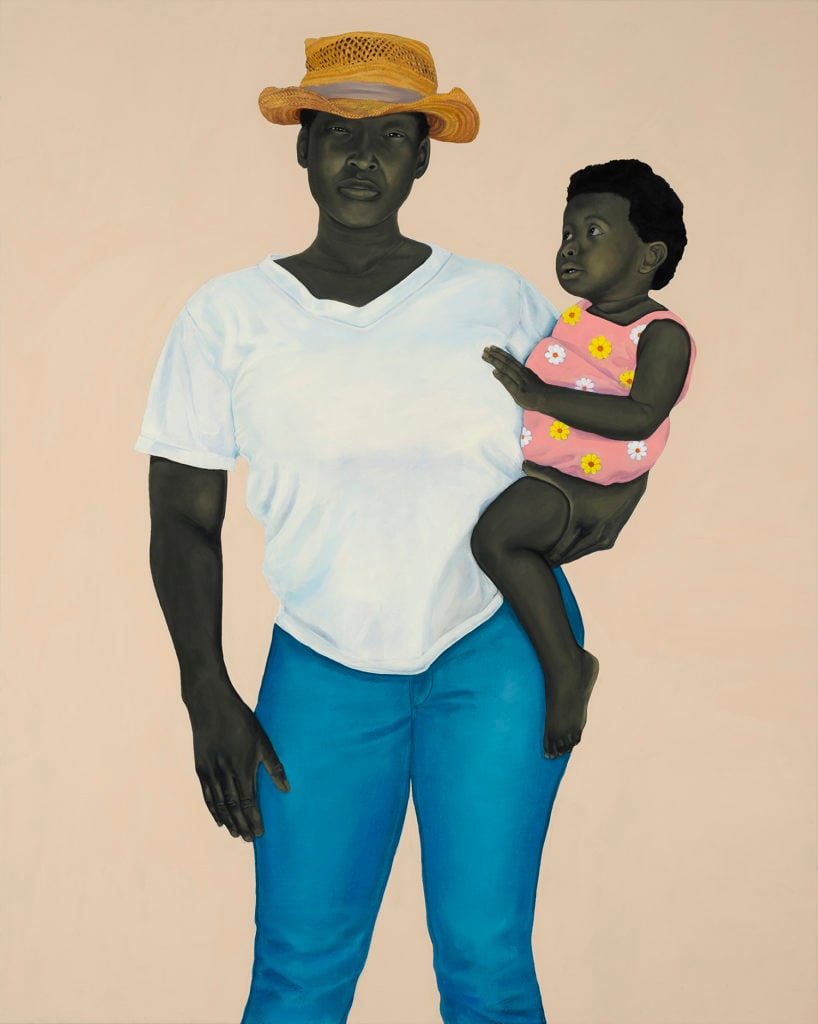
Amy Sherald, Mother and Child
(2016). Courtesy of the artist and Hauser & Wirth, ©Amy
Sherald.
When Amy Sherald was selected as the official portraitist for
Michelle Obama in 2018, she was catapulted to superstardom from her
humble beginnings in Baltimore, Maryland. “I’m painting the
paintings that I want to see in museums,” Sherald said of her
stirring, larger-than-life works. In this painting, Mother
and Child, the traditional pose of Madonna and child has been
reframed for a contemporary context, with a young girl hoisted up
onto her mother’s denim-clad hip. She looks amorously at her
protector, while the elder woman stands tall, her broad shoulders
back, and her gaze firmly on the viewer.
The post Ahead of Mother’s Day, See Some of the Most Tender
Depictions of Mothers and Children Throughout Art History
appeared first on artnet News.
Read more https://news.artnet.com/art-world/mothers-in-art-history-1832367
Further reading


Leave a comment