
‘I Shift Into Emergency Mode Pretty Easily’: Miranda July on How to Handle the Creative Obstacles—and Opportunities—of Quarantine
This was meant to be Miranda
July’s big year.
Yes, she’s a multidisciplinary
artist known for holding down several gigs at once. But this was
supposed to be a landmark year. July has just released a
monograph, fittingly titled Miranda July, and her
most ambitious film to date, Kajillionaire, is ready for lift off. She is also
getting renewed recognition for past accomplishments, as her first
feature-length film, Me and You and Everyone We
Know from 2005, is being added to the Criterion
Collection next week. The 46-year-old artist-filmmaker-writer was
looking forward to a busy year of travel and publicity.
Speaking to Artnet News from her
studio in Los Angeles, July says she is still getting used to the
rituals of our new reality, and is trying to organize her
priorities. “When it’s not my shift to teach second grade to my
child, I’m here trying to work,” she says.
While she sounds a little
crestfallen, she tells me she is as mentally prepared as
ever.
“I think I am the kind of person
who shifts into emergency mode pretty easily,” she says. “Maybe a
little too easily for regular civilian life.”
The Pandemic Arts Festival
On top of everything else, July
somehow managed to organize an impromptu international arts
festival from quarantine.
She came up with the idea for
the Covid International Arts Festival and made a call for
submissions last month, which doubled as a way for her to let her
Instagram followers know she was looking at them, too.
In the first couple of hours
after her announcement, just a few artworks trickled in. But by the
time the 24-hour submission window had closed, she had hundreds of
works to sift through, sent in from cities as far apart as
Hertfordshire and Istanbul.
"background:#FFF; border:0; border-radius:3px; box-shadow:0 0 1px 0 rgba(0,0,0,0.5),0 1px 10px 0 rgba(0,0,0,0.15); margin: 1px; max-width:500px; min-width:326px; padding:0; width:99.375%; width:-webkit-calc(100% - 2px); width:calc(100% - 2px);">
View this post on Instagram
“It was pretty wild going
through them,” she says, adding that it reminded her of the work
she did setting up Joanie 4 Jackie, a
Portland-based distribution network for films made by women,
when she was living in the city in her 20s. (The Getty Research Institute acquired Joanie 4
Jackie’s entire 300-video archive in 2017).
“The joy of discovering someone
else’s work and looking at each submission, that was a very
familiar and comforting feeling,” July says—especially considering
the extreme present circumstances.
“When you think in terms of your creative process, what does it
mean to make anything when you are in a state of shock, and you
know your audience is too?” July has since teased a follow-up edition of
the festival for a later phase of quarantine.
All the Wrong Turns That Led July Here
Two recurring themes in July’s work have been finding
interesting ways to connect with people, and using the internet as
a tool of community-building.
Possibly her best known
artwork, Learning to Love
You More, was a website
and exhibitions series in which she uploaded artworks made by the
general public in response to prompts created by herself and
collaborator Harrell Fletcher.
The seven-year project, launched
in 2007, broke new ground in the early days of the internet art,
and SFMOMA acquired it for its permanent collection in 2007. Then,
in 2014, July created a messaging app
titled Somebody, where chats between friends were sent to
surrogate strangers, who acted as intermediaries and delivered the
messages verbally.
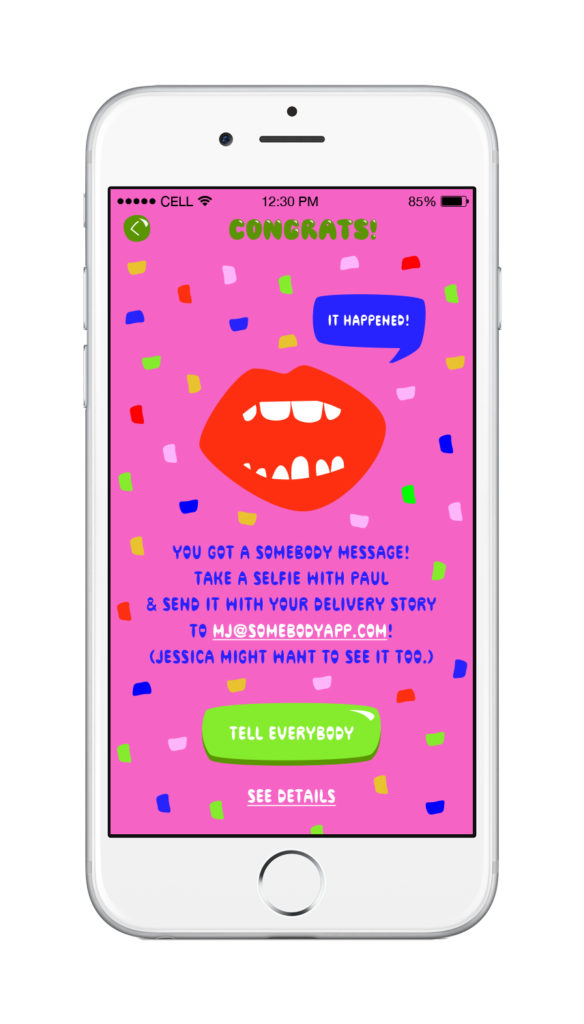
SOMEBODY. Courtesy Miranda July.
Both Learning to Love
You More and Somebody are included in July’s self-titled
monograph, which was released on April 14. The mid-career
retrospective looks back at 25 years’ worth of art projects, films, and books, peppered
with interjections and anecdotes from July’s friends and
collaborators, including Hans Ulrich Obrist and Lena
Dunham.
“It’s not just a list of works,” July says. “It’s all the work
and relationships and wrong turns behind all that work. And that’s
half a life, right there.”
Using the Tools You Already Have
July has just finished making
the biggest, most expensive movie of her career.
Kajillionaire, which premiered at Sundance, is an absurdist
comedy-drama that follows a family of scam artists played by an
all-star cast including Evan Rachel Wood. It was scheduled for theatrical release in June,
but has now been pushed back to a yet-to-be-determined
date.
Meanwhile, the Criterion
Collection is giving July
the ultimate indie seal of approval by reissuing her 2005
film, Me and You and
Everyone We Know,
on April 28. The release will
include a new documentary about July’s interfaith
charity shop, which she
created in collaboration with Artangel in 2017.
But despite July’s seeming
ability to do whatever she wants with whatever she needs, she still
has an attachment to the virtue of resourcefulness.
“There are always real
limitations—of money or time or energy—and then those eventually
develop into almost a creative practice,” July
says.
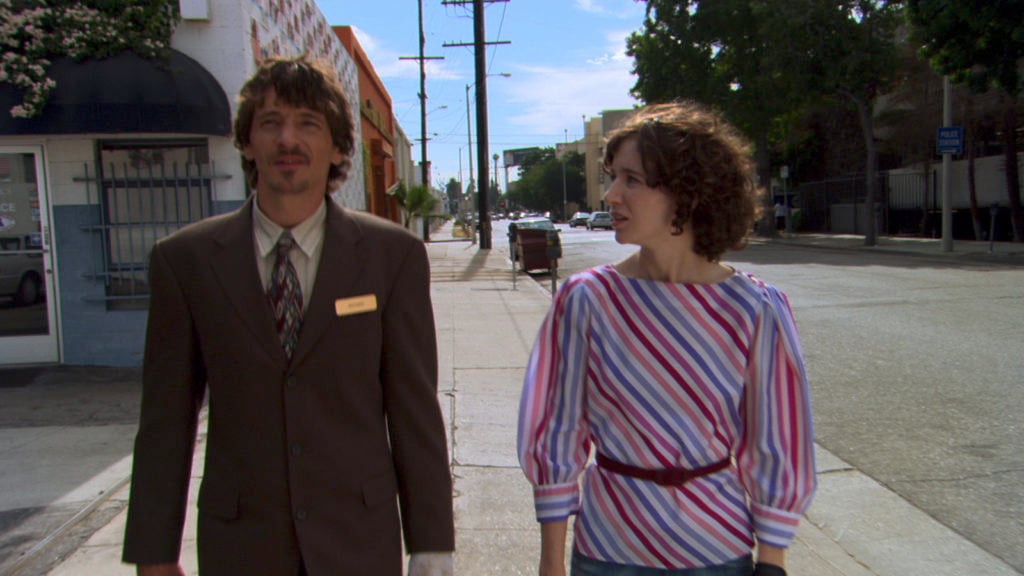
Miranda July, Me and You and Everyone
We Know (2005). Still courtesy Criterion.
Right after
Kajillionaire, she made an utterly
captivating reality
series with the actress and dancer Margaret Qualley that unfolded
on their Instagram pages, which could have been done in
quarantine.
“There were already limitations
before this one, and I think that’s something I have in common with
everyone,” she says. “But when you make something, you’re trying to
dig down to a very elemental, human current that runs through all
of us emotionally.”
While at home, the artist is
currently working on three different projects in three different
media. “I noticed that,
kind of weirdly, they would seem to have been created for
quarantine,” she says. “They would seem already to be alternative
ways of making things, if your circumstances were incredibly
limited, but they were actually pre-quarantine ideas.”
And even though many people around the world are still
paralyzed by shock and grief,
July sees scope for creativity and connection.
“I think we will see that we
have a ridiculous wealth of tools for creating and connecting, and
now they have a reason,” she says. “Now we can put them to use for
something other than distraction.”
The post ‘I Shift Into Emergency Mode Pretty Easily’:
Miranda July on How to Handle the Creative Obstacles—and
Opportunities—of Quarantine appeared first on artnet
News.
Read more https://news.artnet.com/art-world/miranda-july-interview-1842993
Further reading


Leave a comment