
Zarina, the Indian Artist Who Chronicled Her Peripatetic Lifestyle in Delicate Prints, Has Died at 83
Zarina, an artist whose elegant
works on paper ruminated on her elusive relationship to the concept
of home, has died.
The news was first reported by
the Hindustan
Times, which
explained that the Indian-born artist passed away Saturday, April
25 in London after a “long illness.” She was 83.
Though Zarina largely lived in
New York for the last four and half decades of her life, she didn’t
consider the city her home. She likened her identity to that of a
perpetual exile, saying once, “I do not feel at home anywhere, but the idea
of home follows me wherever I go.”
This sense of deracination
featured in much of her work, including her 1999 series of
minimalist prints, “Home is
a Foreign Place,” which was
a highlight of the new
permanent collection installation of the Museum of Modern Art’s
contemporary art galleries last year.
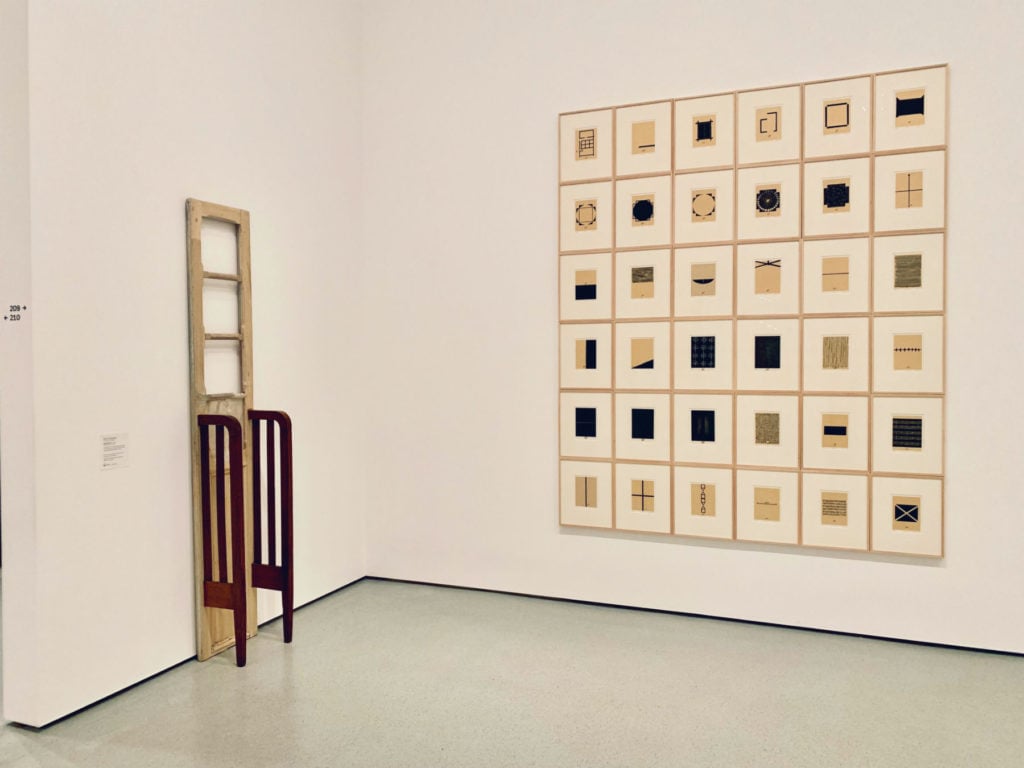
Zarina, Home is a Foreign Place
(1999) to the right of Doris Salcedo’s
Widowed House IV (1994). Photo: Ben Davis.
In 1947, Zarina and her family
were among the several million Muslims displaced to Pakistan in the
Partition of India. After that, she embraced a peripatetic
lifestyle, living for stints in Bangkok, Delhi, Paris, Bonn, Los
Angeles, and Tokyo, before moving to New York in 1975.
Topographical silhouettes of five of these locations were featured
in Zarina’s 2010 portfolio of woodblock prints on handmade Nepalese
paper, “Cities I Called Home.”
Long an admired figure in
feminist art circles, Zarina garnered more universal appreciation
over the last decade. In 2011, she was one of four artists chosen
to represent India at the 54th Venice Biennale—the country’s first
pavilion. A well-regarded retrospective of her work,
“Zarina: Paper Like
Skin,” opened at the
Hammer Museum in Los Angeles a year later and travelled both to the
Guggenheim Museum and the Art Institute of Chicago.
Another survey of the artist’s
career, “Zarina: Atlas of
Her World,” opened last
fall at the Pulitzer Art Foundation in St. Louis in September 2019,
closing just this February. The artist’s work is included in the
collections of the San Francisco Museum of Modern Art, the Whitney
Museum of American Art, the Solomon R. Guggenheim Museum, and the
Metropolitan Museum of Art, among others.
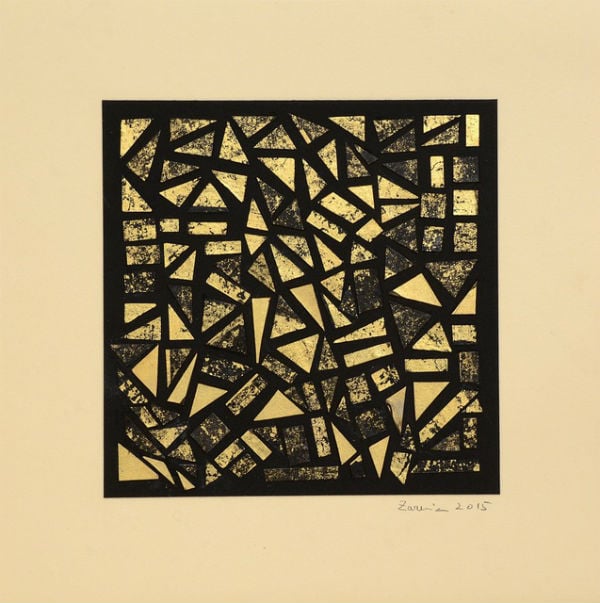
Zarina Hashmi, Untitled (2015).
Courtesy of Gallery Espace.
Zarina, whose full name was
Zarina Hashmi but preferred to go only by her given name, was born
in 1937 in Aligarh, India. At 21, she married a diplomat whose work
moved the couple around the world. The artist was able to study
printmaking in Paris with Stanley William Hayter at the famed art
school Atelier 17, and in Tokyo with artist Toshi
Yoshida.
She returned to India for six
years starting in the late 1960s, then settled in New York in 1976
and decided to remain there after her husband died unexpectedly in
1977. Zarina quickly became part of New York’s feminist art
community. She was a member of the Heresies
collective of feminist artists and
activists and edited the group’s short-lived but influential
journal.
A master printer, Zarina also
worked in sculpture and poetry. Across each medium her output was
marked by a sense of seriality, minimalist repetition, and an
abstracted sense of place.
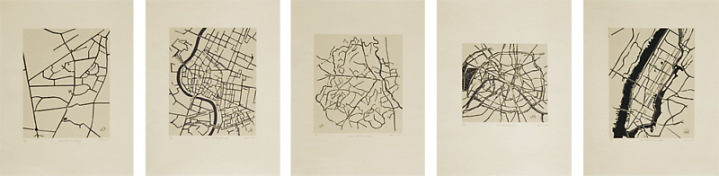
Zarina, Cities I Called Home
(2010). Courtesy of Luhring Augustine.
“Zarina’s was a quest of
individuality,” curator Uma Nair told India’s Economic Times, “one that has grown out
of her own meditative moorings, one that has refused to be bogged
down by time and one that has found its own artistic integrity
because of its silent intensity. Her life embodied that
signature.”
The post Zarina, the Indian Artist Who Chronicled Her
Peripatetic Lifestyle in Delicate Prints, Has Died at 83
appeared first on artnet News.
Further reading


Leave a comment