
The Painter Lee Krasner Has Long Been Eclipsed by Her Much More Famous Artist Husband. Now, a New Book Is Rewriting Art History on Her Terms
In this excerpt from the book More than a Muse,
which highlights creative women who have been overshadowed by their
more famous spouses, see how the artist Lee Krasner worked her way
up to the apex of New York’s art scene, only to often find herself
reduced to the role of Jackson Pollock’s wife.
Coming up as an artist during the Great Depression was a
crippling financial struggle for Krasner, as she came from a
working class background, there was no family money to fall back
on. Even if she could get a gallery show, people could barely
afford to buy bread, let alone an oil painting. Her hours as a
nightclub waitress and model didn’t provide enough to get by, so
she took a job with the Federal Art Project, part of the United
States Government’s New Deal. When Roosevelt put people’s jobs on
the line by slashing funding, Krasner would be out protesting with
her fellow artists and models, calling for justice. “I was
practically in every jail in New York City,” she said. “Each time
we were fired, or threatened with being fired, we’d go out and
picket. On many occasions we’d be taken off in a Black Maria
[police van] and locked in a cell.”
Nobody could afford to buy paintings, but the New York
avant-garde was coming into its own. At this time, Krasner was
pinballing from one style to another. Initially she took her lead
from the European modernists, and crowded her canvases with
colorful Miró-esque shapes. After a visit to MoMA’s Fantastic Art,
Dada, Surrealism show in 1936, she experimented with a desolate
Kay-Sage-like landscape that feels so far removed from her later
abstract works. Artistically, she simply didn’t like to stay in one
place. She loved the poetry of Arthur Rimbaud, and scrawled his
words on the wall of her Greenwich Village studio: “Finally I came
to consider my mind’s disorder as sacred.”
Krasner was a respected figure in the New York art world, not
just for her position in the Federal Art Project, but for the
reputation she’d developed for her ‘strict eye’ for art. By the
late 1930s, she was already friendly with Willem de Kooning and
Arshile Gorky; at one point, she and her ex-boyfriend Igor
Pantuhoff had shared a flat with Harold Rosenberg, a powerful
American art critic. Krasner became a part of the American Abstract
Artists group (AAA). At their group exhibition in 1941, she began
talking with Piet Mondrian. The two hit it off so well, they met up
again to spend the night dancing to jazz at Café Uptown. It’s
probably not much of a surprise that, Mondrian, the man who painted
Broadway Boogie-Woogie, could cut some serious rug, “I
loved jazz and he loved jazz, so I saw him several times and we
went dancing like crazy,” said Krasner. Mondrian was a hero figure
to her. In her experiments with abstraction in the 1930s she would
sometimes limit herself to his signature palette of just primary
colors plus black and white in a kind of Mondrian homage, so she
was understandably anxious as he approached her painting at the AAA
exhibition that night. He told her she had a “very strong inner
rhythm; stay with it.”
It’s clear that by the 1940s, Krasner was an established part of
the city’s Abstract art scene. If they were in secondary school,
she’d be sitting at the back of the bus sharing Lucky Strikes with
de Kooning. And Pollock? He’d be carving his initials into a table
in the common room, taking slugs from the whisky flask tucked under
his school jumper. Soon after their relationship began, there was a
shift in her work. Krasner, convinced of Pollock’s ability, began
introducing him to friends in the art world in an effort to boost
his career. And at the same time, Krasner entered a battle with her
own painting, producing what she called “gray slabs.” Much has been
made of this ‘dead’ period in her work, as it fits neatly into the
narrative of the all-consuming Pollock, with a painting style so
original it could overwhelm a talent like Krasner’s. The year after
they’d married, she wrote to her friend, the artist Mercedes
Matter, saying, “I showed [Sidney] Janis my last three paintings.
He said they were too much Pollock–it’s completely idiotic, but I
have a feeling from now on that’s going to be the story.” What’s
rarely mentioned is that, around this time, Krasner lost her father
and was in a state of grief, “in spite of his age, he was 81, it
pretty well tears you to pieces and is like some terrific eruption
with everything being torn up … I must wait until spaces are closer
and time changes feeling.” When speaking about her process, Krasner
reiterated again and again the importance of waiting, of taking a
deep breath, and sitting through the “dead” periods. She would
never force it, no matter how painful the experience might be. When
an interviewer asked Krasner what her husband had been working on
during those years, she clipped back, “I don’t know, I had my own
problems.”
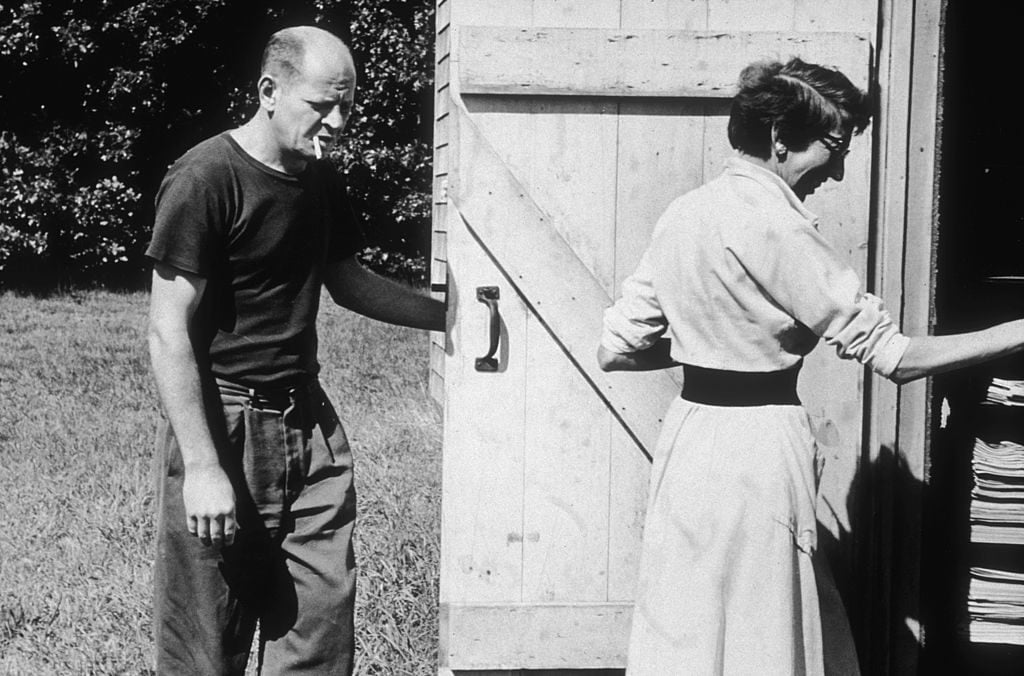
Jackson Pollock and Lee Krasner enter
their studio in East Hampton, New York, in 1953. Photo by Tony
Vaccaro/Hulton Archive/Getty Images.
‘A very destructive act’
In an attempt to break away from Manhattan, Krasner managed to
convince art collector Peggy Guggenheim to lend her the down
payment on a house in the isolated hamlet of Springs, Long Island.
Out there, in nature, she and Pollock made their entire lives about
the work, surviving on very little cash, eating whatever clams they
could dig out of the sand. But structurally, the balance was off.
While he took over the famous “barn”—a factory for drip painting
where he had space to splash, pour and slash the canvas with paint,
Krasner took on the bedroom as a studio, a smaller space, that
resulted in smaller pieces, her ‘Little Images’. They were her
moments of controlled chaos, rectangles of white noise, sometimes
featuring a pattern of swirling glyphs that Krasner called ‘a kind
of crazy writing of my own’. The critics weren’t speaking her
language. When she showed her ‘Little Images’ alongside Pollock’s
works at Artists: Man and Wife, an exhibition at Sidney Janis
Gallery, they were dismissed as tight, tidy imitations of his. It’s
a theme that would follow her for a large part of her career. It’s
true that she was no Jackson Pollock, but only in the sense that he
was no Lee Krasner.
Her work spoke for itself at a solo show in Betty Parsons
Gallery in 1951, and was better received, but still the paintings
didn’t sell. Frustrated by her lukewarm reception and with
Pollock’s aggressive drinking, in 1953, she grabbed the drawings
that hung from the walls and ceiling of her studio—and started
ripping them to shreds. “Walked in one day, hated it all, took it
down, tore everything and threw it on the floor, and when I went
back … it was seemingly a very destructive act. I don’t know why I
did it, except I certainly did it.” After cannibalizing her
creations, she started reassembling them into a series of collages
made up of old drawings, rough shards of paintings and bits of old
burlap sack. When these trophies of iconoclasm went on display at
the Stable Gallery in 1955, the same reviewer who had bashed her
“Little Images,” Stuart Preston, said “The eye is fenced in by the
myriad scraps of paper, burlap and canvas swobbed [sic] with color
that she pastes up so energetically. She is a good noisy colorist.”
The destruction was the catalyst she needed to make her
Frankensteinian pieces. Even Pollock’s drawings got hoovered up in
the frenzy for Bald Eagle, a piece that contains both of
their DNA. When you look at it, you can hear the paper being ripped
in two.
Cover of More Than a Museby Katie
McCabe.
‘Painting is not separate from life. It is
one’
Lee Krasner had two jobs. A full-time artist and crisis manager.
Living with a heavy-drinking, quick-tempered Pollock was not easy.
When he began an affair with Ruth Kligman, and made no effort to
hide the betrayal from her or their friends, Krasner had enough,
deciding to take a break from the destruction to travel to Europe.
Before she left, she made a start on the painting
Prophecy, pink and menacing, like a liquid cadaver; even
she admitted to being frightened by it.
Krasner was in Paris when she got the call from Clement
Greenberg that Pollock had died in a car crash along with one of
Ruth Kligman’s friends. When she returned home, she had to face
that painting: Prophecy. Within months, Krasner had taken
over the barn as her studio, filling the negative space he had left
behind. Her grief became a vehicle, and its scale can be seen in
the enormous, rectangular paintings she produced after his death.
Plagued by insomnia and a hatred of working in color without
natural light, she began to use umber so she could cope with
working at night. These are the paintings that move me most:
stripped back to reveal Krasner’s exhausted, emotionally charged
gestures as she jumped to mark her canvas, paintings like The
Eye is the First Circle, which, in my opinion, was
unjustly ridiculed when it was presented without proper context in
2016.
When asked how she managed to face the canvas again, she said,
“Painting is not separate from life. It is one. It is like
asking—do I want to live? My answer is yes—and I paint.” With
Krasner, there is never a singular style, even if she wanted one,
“My own image of my work is that I no sooner settle into something
than a break occurs. These breaks are always painful and depressing
but despite them I see that there’s a consistency that holds out,
but is hard to define.”
By the 1960s, she was working in full color, monumental
paintings with a flux of oranges and pinks and a dark arc peeking
out from underneath. Sometimes her marks are bulbous and awkward;
other times, diffused into concentrated splatters of paint. To see
them together in one room is like experiencing an abstract
expressionism group show.
In the 1970s, Krasner expressed regret that she had not yet been
offered a retrospective in America, only in London. The opportunity
to see a real period of work was something she considered important
for a painter. When Pollock died, and she became the executor of
his estate, she had a clear vision for how she wanted his art to be
handled; she was generous with the work, lending it out to museum
and gallery collections. If Krasner had only served her own
interests, she could have taken advantage of certain connections to
boost her own reputation, but she was a pugnacious character that
had no interest in filling the pockets of art collectors, “I
behaved with the paintings as I saw fit. I stepped on a lot of
toes. And I think even today it’s difficult for people to see me,
or to speak to me, or observe my work, and not connect it with
Pollock. They cannot free themselves.”
For a long time, she was correct. Plenty of art critics could
not be trusted to assess her work without bias. The Whitechapel
show received dozens of reviews that painted her as the second
fiddle widow, even in their veiled compliments. The
Observer turned on the tap of that cold shower compliment
issued by Hofmann in the 1930s: “I doubt whether anybody would
guess from the paintings that they are by a woman. On the other
hand, they are unmistakably American.”
Things began to look brighter when, in 1984, MoMA honored
Krasner with a retrospective of her work. Although the term “woman
artist” never sat well with her, and she never really identified as
a feminist, Krasner recognized the importance of the women’s
movement. Just over 10 years before she got the news of the MoMA
show, she was on the steps of the same gallery, protesting the
dearth of female artists in its collection. She passed away months
before the MoMA retrospective was due to open.
Excerpted with permission from More Than a Muse by Katie McCabe,
published by Quadrille April 2020, RRP $23.99 Hardcover.
The post The Painter Lee Krasner Has Long Been Eclipsed by
Her Much More Famous Artist Husband. Now, a New Book Is Rewriting
Art History on Her Terms appeared first on artnet
News.
Read more https://news.artnet.com/art-world/lee-krasner-more-than-a-muse-1854144
Further reading


Leave a comment