
Why Conspiracy Theories Have Become the Most Influential Art Form of Our Time
This is going to be a longer essay than I initially thought I’d
write about conspiracy theory. It began in my head as me thinking
about a few points I would have added to something I’d recently
written explaining the unexpectedly virulent
online conspiracy theory that the performance artist Marina
Abramović is secretly at the center of a Satanic mind control
plot.
But the more I thought about it, the more of these points I had,
and the more they seemed to connect together as a way to explain
the present. The subject, it seems to me, reveals itself to be
more important the longer you look at it. The rabbit hole goes
deeper and deeper.
The obvious reason the topic comes up right now will be clear to
anyone who reads the news: conspiracy theories of various
kinds are literally moving people into the streets right now. The
recent wave of #ReOpenAmerica rallies were festooned with signs
about QAnon and a coup plot against President Trump. Meanwhile, the
president himself is promoting the idea that COVID-19 was
deliberately released from a Chinese lab, while
some of his more prominent supporters are beginning to push back
against the death toll as being
inflated to make Trump look bad.

Protesters rally from their cars as they
call for the state to lift stay-at-home orders and reopen the
economy in downtown Richmond, Virginia near the State Capitol
complex on May 6, 2020. Photo by Drew Angerer/Getty Images.
What accounts for the intensifying grip of conspiratorial
thinking in the present?
“Conspiracy theory” is customarily a term used a bit the way
people used to use the term “hipster”: always to dismiss someone
else’s tastes, never to describe one’s own. This gives a kind of
infinite regress quality to the attempt to criticize it, as if two
mirrors have been placed facing one another: conspiracy theorists
will argue that the term “conspiracy theory” itself was invented by
the CIA to discredit seekers of the truth about the JFK
assassination—a claim which, in turn, itself seems to be a
conspiracy theory.
Emphasizing what is repellent, delusional, and outlandish in
various “conspiracy theories,” it seems to me, only makes it more
difficult to understand why they have traction in the first place.
What I want to focus on here is how difficult it is to distinguish
“conspiracy” thinking from some clear-cut “ordinary” way of
thinking about the world in the first place. In the end, I think
that “conspiracy” is closer to the ordinary way of
thinking about the world; “non-conspiratorial” thinking is actually
the eccentric, fringe way in need of figuring out how to explain
itself.
The Good, the True, and the Beautiful are what you call
philosophy’s three “transcendentals,” the three cardinal values of
Enlightenment thought. And, whereas “conspiracy” thinking appears
in the conversation as an irruption of outlandish and irrational
belief, the place to start is understanding how it actually
directly touches on each of these three dimensions.
The Political Dimension
The Cold War liberal historian Richard Hofstadter is the
go-to reference on this
first, most obvious factor accounting for the intensification of
conspiracy, via his 1964 essay “The Paranoid Style of American
Politics.” There, Hofstadter charts how fantasies about Catholic
cabals, Freemasonry, and foreign plots have been a deep, animating
feature of US political life.
Sharp critics have pointed out problems with Hofstadter’s
framing of the “paranoid style”: Chris Lehmann, writing recently
in the New Republic, showed how his enduring popularity is
due to how he conflates left- and right-wing populisms; in another
register, Eve Sedgwick’s classic argument about “paranoid reading”
damns Hofstadter for idealizing a rational political center-ground
that does not exist.
But I appreciate the clarity of this line from Hofstadter’s
famous essay: “[The] central situation conducive to the diffusion
of the paranoid tendency,” he writes, “is a confrontation of
opposed interests which are (or are felt to be) totally
irreconcilable, and thus not susceptible to the normal political
processes of bargain and compromise.”
This provides a credible mechanism to explain the rise of
conspiracy in the present: as inequality has set record-busting
extremes in the US, a variety of not-at-all radical
commentators have declared that we live in an oligarchy rather
than a democracy, given that the preferences of ultra-wealthy
people and big corporations seems to rule our public
institutions.
In such a situation, the gulf between the outward rhetoric of
politics and the felt reality of how institutions actually function
grows; the theater of politics seems to be doublespeak covering
over some deeper and malicious reality. That fantasy space is thus
ripe to fill up with all kinds of dark images.
The Epistemological Dimension
To this political explanation, you can also supplement a
second, epistemological explanation for the
intensification of conspiracy thinking. This axis is what Marxist
literary theorist Fredric Jameson explores in his 1992 book
The Geopolitical
Aesthetic, where he analyzes various forms of then-recent
“conspiracy narrative” in film, from The Parallax View to
Videodrome.
Essentially, what Jameson proposes is that high-tech, globalized
capitalism has made the world more and more difficult for the
average person to feel as if they adequately understand it. The
forces governing lives are more and more difficult to comprehend
using inherited explanations and traditional symbols. The food you
eat, the commodities you encounter—none have origins that can be
connected to any community experience, and local reality is ever
more governed by mysterious forces half a world a way. (The
recently intensified consumer emphasis on recovering “local”
production in food and crafts is, in this sense, another avatar of
this same intensified alienation.)
The leaps of logic in conspiracy, in Jameson’s reading, are an
attempt to recover a concrete narrative for a world that has grown
too willfully complex to wrap one’s head around, offering “a
narrative structure capable of reuniting the minimal basic
components: a potentially infinite network, along with a plausible
explanation of its invisibility.” The conspiracy makes an
inscrutable world seem knowable. Instead of being adrift in a
shifting sea of disconnected signifiers, you have a master
signifier of a plot that gives meaning to it all—and a
corresponding sense of subjective power (of being able to interpret
the world) and intellectual purpose (of sharing that
knowledge).
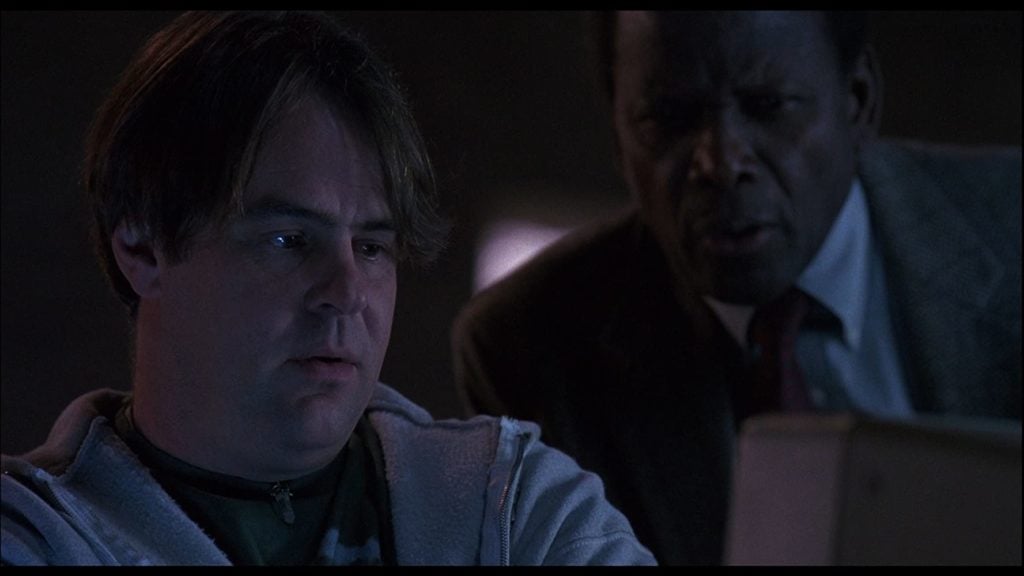
Dan Aykroyd and Sidney Poitier in
Sneakers (1992)
(It’s interesting to note that in Jameson’s text “conspiracy
theory” is not yet synonymous with “right-wing conspiracy” theory,
so that he is able to be more sympathetic to the positive impulse
behind conspiratorial thinking, as a kind of proto-systematic
attempt to grasp the contemporary world. The Geopolitical
Aesthetic came out the same year as the early
cyber-thriller Sneakers, where Dan Aykroyd’s
conspiracy-loving computer expert is an eccentric force for good.
Compare him, 19 years later, to Jude Law’s evil blogger
in Contagion, peddling fake cures and fomenting
distrust in experts.)
The sheer mass of disconnected information in an internet
culture makes simple—and simplifying—schemas to filter and navigate
it all the more alluring, while the inner workings of digital
technology is orders of magnitude more confounding than
analogue technology to the non-expert. The cultural historian Mike
Jay has even pointed
out that the increasingly inscrutable and invasive
contemporary tech has more and more literally come to resemble the
most fundamental images associated with clinical paranoia:
invisible institutions monitoring your thoughts and desires and
tweaking your reality to fit interests that aren’t your own.
The Aesthetic Dimension
Probably the most novel dimension we can consider, however—and
the least obvious and most thought-provoking—might be that
conspiracy theory also serves a kind of artistic function. This is,
perhaps, ultimately why bits of art tend to get pulled up into it
so easily.
One theory of the very
wide prevalence of conspiracy theory is that it relates to the
natural aptitude of humans for identifying and making
patterns. Spotting shapes in the clouds is an enduring symbol
of creative imagination.
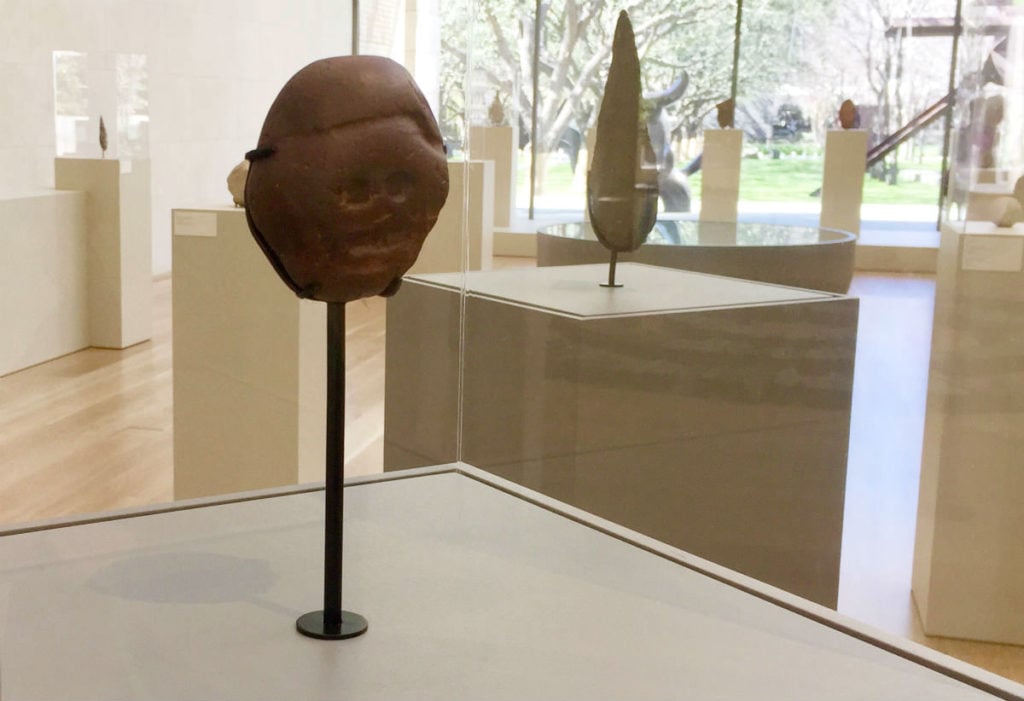
Installation view of the Makapansgat
Pebble in “First Sculpture.” Image courtesy Ben Davis.
For that matter, the oldest kind of art-like activity, very likely, is not
painting on cave walls but instead the way that our very distant
ancestors would collect rocks in which they recognized the echo of
human features. Recognizing patterns is a very primal skill for
human survival, and pleasurable to show off. But as with, say, sex,
the pleasurable side of the faculty can overshoot the
utilitarian.
The natural activity of grouping together elements to form a
picture may become the conspiracist cliché of “connecting the dots”
to find the secret plot that makes a satisfying pattern of a random
reality.
It’s important to reckon with this last, aesthetic dimension of
the phenomenon. It helps account for a notable feature of
conspiracy thinking: the fact that, as if in some kind of reversal
of Occam’s razor, its theories tend to be likelier to thrive if
they are elaborate and outlandish, rather than more simple and
logical. They are, for this reason, very nearly impervious to
mockery, and constantly cross over from fiction to reality in a way
that can be hard to keep track of, let alone argue with.
In some accounts, the very
first, ur-conspiracy fantasy of a secret order, the Rosicrucians,
was birthed as a piece of proto-science fiction
(The Chymical Wedding of Christian Rosenkreutz
of 1616) and may even have been an attempt to mock the era’s other
obsessions with secret societies—before then taking on a life of
its own as both an actually believed alchemical doctrine and a
phantasm of evil puppet-masters.
One of the earliest internet-era conspiracy theories, “Ong’s Hat” (look it up)
also began as an online art project by Joseph Matheny. It took
on an eerie life of its own, and despite Matheny’s explanations
that the project was born as an attempt at culture jamming—hacking
the media to propagate a fake, so as to make people second-guess
the narratives they are consuming—there are those who still believe
this is all part of the cover-up of a secret world of parallel
dimensions. (People have alleged that the origins of QAnon are a
similar prank, though, as I’ve said, I don’t believe
this.)
Conspiracy is flamboyant and colorful and involves leaps of
imagination—and for that reason it makes life seem, not just
righteous (as in the political explanation) and meaningful (as in
the epistemological explanation), but also exciting.
Though unvoiced, that clearly is part of its traction, particularly
in societies where declining social mobility disconnects people
from any image of an appealing narrative of achievable
self-development.
The Inversion
In the underrated 2018 conspiracy-comedy-noir Under the Silver Lake, you follow
Andrew Garfield’s unemployed LA fail son Sam as he begins to
believe that a spooky comic book has important messages hidden in
it. The quest slowly leads him down more and more fevered and
sociopathic paths. It becomes harder to tell what’s real from
what’s imagined.
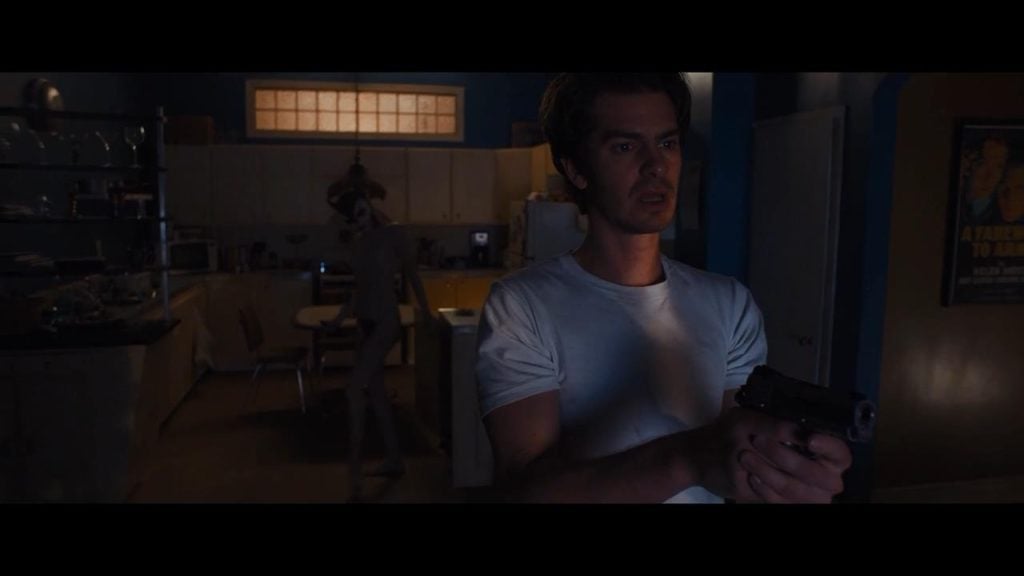
Andrew Garfield in Under the Silver
Lake (2018).
The film has a lucid dream quality to it, but I actually think
that a moment early on lays out its thesis rather clearly.
“You ever feel like you fucked up somewhere a long time ago?”
Garfield’s Sam wonders aloud while sharing an idle beer with a
friend on a directionless evening. “That you’re living the wrong
version of the life you supposed to have? I used to think that I
was going to be someone people cared about, maybe do something
important.”
His friend dismisses the sentiment as normal.
“I feel like somebody’s following me,” Sam confesses
abruptly—and you see in that moment the disconnected parts of
conspiracy clunk together. Going “through the looking glass” is a
conspiracy cliché, but the metaphor works: the idea of being at the
center of a plot provides you with a coherent self-image, but only
by inverting reality, turning a sense of abandonment and
disconnection into the very thing that makes you special and worthy
of attention.
But here I’ve already slipped into talking about conspiracy as a
false mode of thinking again, and I want to emphasize, in the full
spectrum of philosophical channels it broadcasts on, how robust it
is as a way of thinking, and thus how difficult it will be to
disentangle from “ordinary” modes of thinking. I’ll talk about the
consequences of that fact in a second part of this essay.
The post Why Conspiracy Theories Have Become the Most
Influential Art Form of Our Time appeared first on artnet
News.
Further reading


Leave a comment