
‘How This Moment Will Be Misremembered’: An Internet Theorist on What Social-Media Images Hide About the Pandemic
Empty streets, yawning spring
blossoms, sourdough starters: These are the images filling our
social-media feeds against the backdrop of an unprecedented
pandemic in which hundreds of thousands of people have died. Why
the disconnect?
For Nathan Jurgenson, a social
media theorist and the founder of Real Life magazine, these images shed light not only on
our relationships to the health crisis, but to photography in
general. In his book, The Social Photo: On
Photography and Social Media, Jurgenson suggests that in today’s ocean of
images, the traditional way we have looked at pictures is outdated.
He suggests a new way to understand them, one that is “less art
historical and more social theoretical.”
We spoke with Jurgenson about
his idea of the “social photo,” the usefulness of the term “viral,”
and what pandemic image trends tell us about the world
today.
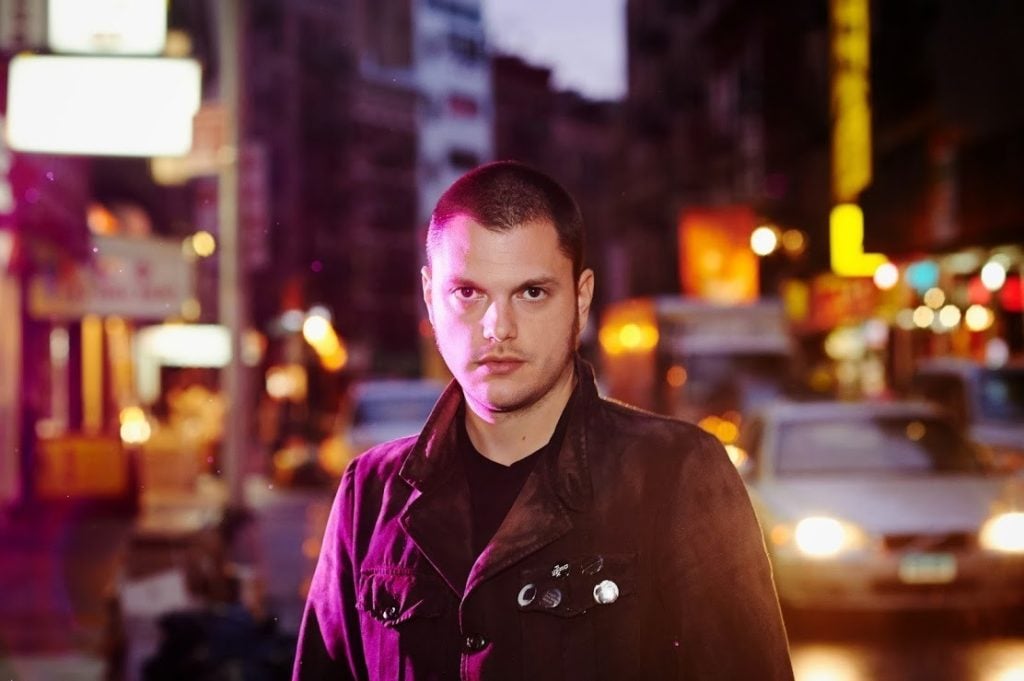
Nathan Jurgenson. Courtesy of the
author.
Can you briefly walk us through your notion of the social
photo?
The Social
Photo is about the
vast majority of images taken today, not so much art images or
photojournalism, but the everyday practice of taking and sending
your snaps, sometimes posting them to many people, more often to
one person or a small group. Social photography is more discursive
as a practice, less concerned with making art or recording accurate
information about a scene. It is more like talking, visually
expressing what it is like to be doing what you’re doing and
feeling what you’re feeling.
During this pandemic, for people
fortunate enough to be safe and able to stay home, the photos being
routinely sent back and forth might not be terribly different in
content than usual. But
I think the bigger point, again for those who are healthy and home,
is that our everyday visual communication is probably a lot more
mundane than the crisis around us. Our images don’t often depict
the pandemic explicitly, say with an ambulance or an unusually
empty street, but they likely convey how you are feeling through
this. Anxiety, grief, boredom, fear, and exhaustion are often the
content of social photos right now, even if they don’t depict
something like a face mask. That’s sort of the “social photo” way to read this—that any social photo taken
during a pandemic is a pandemic photo. Most photos today deal with
our crisis not by what they literally depict, but what they mean,
what they are trying to express.
We’ve seen a number of micro-trends in image sharing over the
last couple of months: pictures of empty streets, masks, sourdough
starters, and so on. Why do you think these are the tropes that
have emerged during this time?
There are certainly some new
pandemic photo trends. For some reason, I’ve kept a very
non-exhaustive list of some of the common image-tropes I see posted
right now.
You mentioned sourdough, and
that’s certainly been the photo-food of the moment. I think bread
photos signify home; or, better, the work of running and maintaining
a thriving home. It all contrasts with a pandemic. Usually there
are wood tables and cutting boards in the frame. A good knife.
Bread creates quite a domestic scene. Sometimes the bread is
broken, which conveys eating and health as well as togetherness
with others in the home. It’s a scene of living. I’ve seen a lot of
images of the starters, or “mothers,” so it makes the nurturing
aspect of bread more obvious, as the starter is kind of like a
companion, a living thing you take care of as it sustains you.
Bread photos also show off the effort and leisure time as well as
some special knowledge, supplies, and skill. So the bread photo
also conveys cultural capital, an image of how well you are using
your time at home.
With mask selfies, like any
other selfie, sometimes they are taken, shared, and kept as a
reminder of what I look like right now, and future-me might be
especially curious about what it was like to be me during this
pandemic, to have some evidence that I was here during all of this.
It helps remind ourselves that we are in an important moment in
time right now, and helps locate ourselves within this
moment. I was here, I was
doing this.
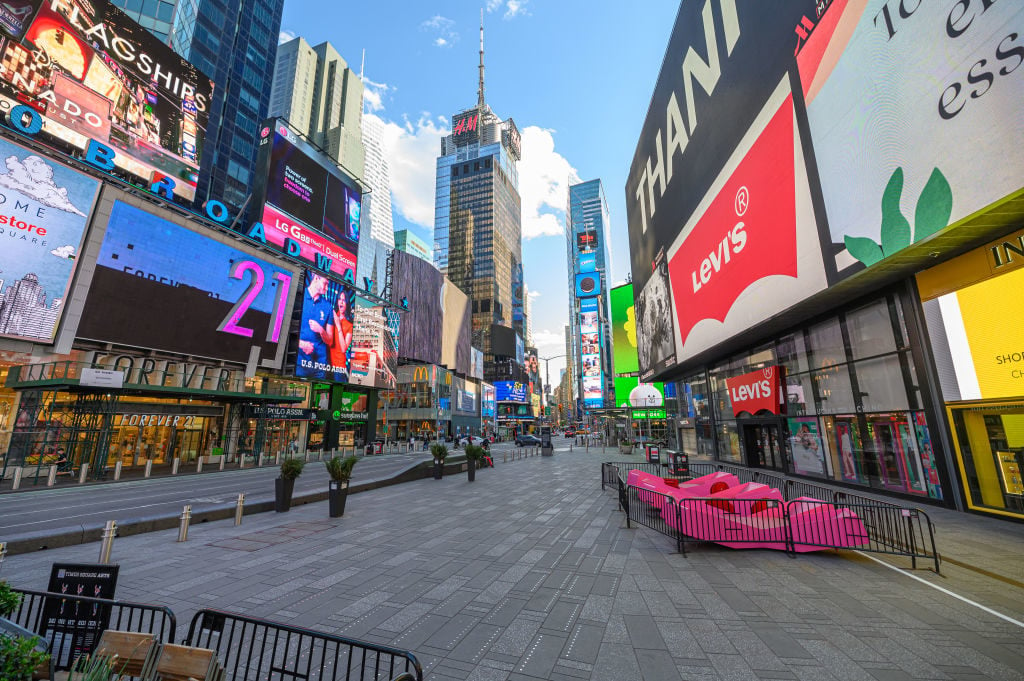
A view of Times Square on May 7, 2020 in
New York City. Photo: Noam Galai/Getty Images.
With video-chat
backgrounds—video-chat is ostensibly about the foreground, the
people talking to each other. But as these video meetings and
hangouts are more common right now, people seem more interested in
the backgrounds. For friends, coworkers, and public figures, the
domestic spaces behind them as they talk have been scrutinized and
critiqued in a voyeuristic way. I think a lot of people find having
to make part of their private home public to coworkers or even a
larger audience is pretty unwelcome. It’s been interesting to see
how people deal with that by organizing part of their home to now
be “public-ready,” usually some books or something that isn’t too
private. I’ve been disappointed by the talk that seeing your
coworkers bedrooms makes for more “authentic” conversations or
something, because preserving the integrity between private and
more public spaces is important.
Many newspapers illustrate their
stories about the pandemic with pictures of once-crowded streets
that are now empty as people self-isolate. Fortunate enough to be healthy and home, I
don’t see much evidence of this world-altering crisis outside my
window other than the emptier streets. The inverse is the crowded street, beach, park,
or even protest. Every day we are asked to not live our lives as
normal, for some at an inconvenience and for others at great
sacrifice. Meanwhile, we see images of some people going on as if
there wasn’t a pandemic. These folks probably seem greater in
number than they are because it’s easier to depict people crowding
about than staying in. The photos of empty streets and crowded
parks are political images. They are statements of how people in
that space are reacting to the virus, most by staying in, and some
by going out. A bunch of people all having fun together right now,
just doing normal things in abnormal times, appears more shocking
to me than an empty Times Square.
— Hugh Jackman (@RealHughJackman) May 4, 2020
 .
. How do these images memorialize this moment?
I’ve thought mostly about what
is being left out, how this moment will be misremembered. Of all
the pandemic photo-trends listed above, I didn’t include photos of
the crisis itself. At least here in the United States, there’s so
many shots of empty streets and wild animals downtown but very few
of the hospitals, the medical workers doing their jobs, the sick,
dying, and dead bodies. This exists but is far from ubiquitous,
it’s something I have to seek out rather than what I would happen
to see. I understand there are various administrative reasons for
this, and maybe it says more about being in the US or how poorly
I’ve curated my feeds, but I know so many thousands of people are
dying all the time and it’s just not depicted as much.
When I look at illustrations and
photographs of past plagues and pandemics, I don’t see bread and
interiors or calm people in masks, I see bodies in pain, twisted,
dead, piled up. But, right now, I have a better visual sense of the
small anti-lockdown protests than the much larger lived reality of
this medical crisis, which probably serves the ends of those
protests.
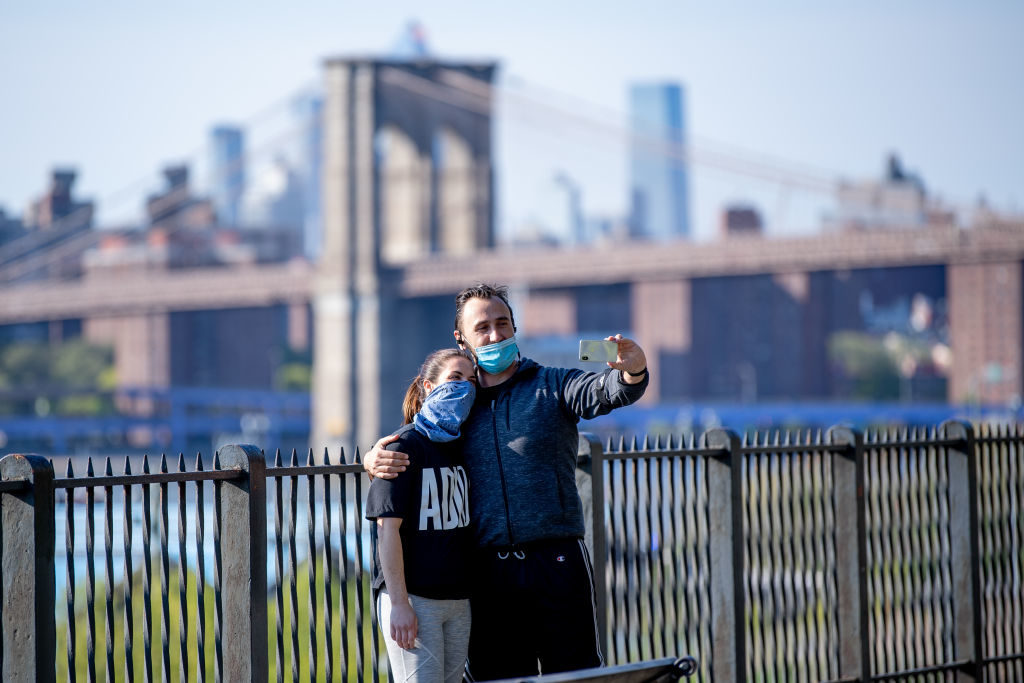
Visitors take a selfie and wear masks at
the Brooklyn Heights Promenade with the Brooklyn Bridge in the
background on May 10, 2020 in New York City. Photo by Roy
Rochlin/Getty Images.
The term “viral” has long been used as a metaphor for the
spread of popular images. In the age of the internet, it’s become
common parlance. Do you think our relationship to that term will
change?
I’ve certainly used that
metaphor in the past, that content virality online is like a
biological virus. My point is usually that when you design a
product or service with viral mechanics in it, those metrics and
scores will tend to dominate everything else.
But, right now, I must admit
that people doing word play with “viral,” how it conveys both
popularity on the internet and the actual pandemic, is a little
frustrating. First, it’s too easy. Also, it’s disrespectful to the
gravity of our situation. Using the pandemic as a metaphor for
talking about how content spreads feels glib against the suffering
happening around us.
How are we using the internet or social apps different during
this pandemic than before?
A big difference right now is
that we are using social, digital tools to replace in-person social
interaction rather than to facilitate it. I think a common mistake
has always been to assume this was the case, that we are trading
in-person contact for the screen. But there is a lot of research
that shows quite the opposite, that many use social media to
facilitate doing more when away from the screen. What you talk
about in a messaging app often has everything to do with what
happens when not using a device, and sometimes what you talk about
in-person had to do with what you saw on screens. It’s all
intermixed.
However, during the pandemic,
the internet has
been more of a replacement than
usual. I’m talking to a lot of people over video and I don’t know
when I will see them in-person again. We are doing more of what
social media critics have always overstated, using the screen as a
replacement. But I’ve been happy that many of those who dismissed
screen-based sociality as inherently lacking depth or intimacy seem
to better understand its importance and potential right now.
Missing friends and family, being able to talk over video is
obviously important. It’s obviously real.
The post ‘How This Moment Will Be Misremembered’: An
Internet Theorist on What Social-Media Images Hide About the
Pandemic appeared first on artnet News.
Read more https://news.artnet.com/art-world/nathan-jurgenson-interview-social-photo-1860240
Further reading


Leave a comment