
‘Art Doesn’t Need Glamour, Glamour Needs Art’: Designer Duro Olowu on What Fashion Brands Must Do to Collaborate Successfully With the Art World
Over the course of his career,
Nigerian-born British designer Duro Olowu has made fans of women
like Michelle Obama, Solange Knowles, and Iris Arpfel, all of whom
have flocked to his brightly patterned, eclectic dresses that draw
on his experiences as a child raised in Lagos, London, and
Geneva.
Yet unbeknownst to many, in
recent years, Olowu—who splits his time between London and New
York, where he shares a home with wife Thelma Golden—has begun
parlaying his love for color and pattern into a second career in
the art world, curating shows for Salon 94 gallery and the Camden
Art Center in England.
But it’s his third and most
recent show, “Duro Olowu: Seeing
Chicago”—a 400-piece exhibition at Chicago’s Museum of
Contemporary Art—that he’s most proud of. A love letter to the city
and its women who have long supported his designs, the show brings
together objects belonging to the Chicago’s public
institutions and private collections.
Recently, after a hugely
successful opening in February, the exhibition was put online and
extended through September. From his home in London, Olowu called Artnet
News to talk about how the show and its online edition came to be,
how the fashion business needs to change in the age of COVID-19,
and how growing up around the world has informed his creative
ethos.
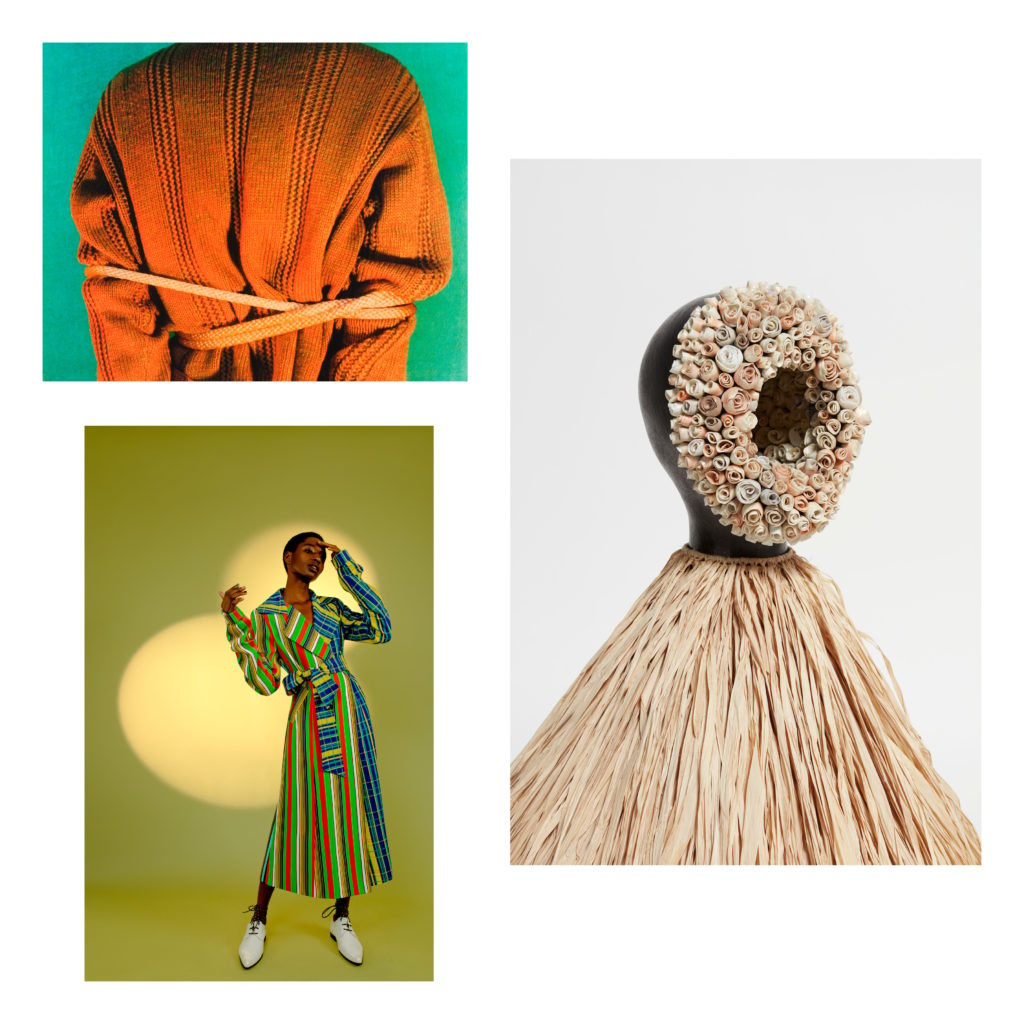
Clockwise from top: Bruce Nauman,
Bound to Fail (from the portfolio Eleven Color
Photographs) (1966-67/1970/2007). Collection Museum of Contemporary
Art Chicago, © 2019 Bruce Nauman/Artists Rights Society (ARS), New
York, Photo: Nathan Keay, © MCA Chicago. Simone Leigh, No Face
(House) (2017). Photo: © Simone Leigh; Courtesy of the
artist and Luhring Augustine, New York. Duro Olowu, Spring/Summer
2020, Look 7. Photo: Christina Ebenezer.
As a designer, how has life changed for you? Obviously, you
don’t have the same access to your team or to your atelier. How
have you had to adapt?
I actually closed my atelier on
March 10, just before the MCA show in Chicago, which, thank god,
was open for two weeks. I have a very small team. I have people
that make my samples, but I design everything myself. And so the
only question was financial. The way I run my company, I have total
control, so there were certainly decisions for everyone’s benefit
that I could make. I didn’t have to think, “Oh, do I keep paying
this person?” I just said, “Well, I’m going to
keep paying them until I can’t.”
So these decisions are really
easy to make, in a way, although of course they’re more difficult
to execute financially. But people have been through worse. I know
there’ll be huge challenges ahead for this business. Like for
magazines—you can’t shoot or have more than a few people in a room.
I don’t make things in big factories. I have a small atelier, but
you still have to think of how things are going to be
made.
As far as shows go, five years
ago, I stopped doing runway. But I was lucky, because I was in a
position where I had the space to say, “It’s just not fulfilling to
do this, it’s all over in 15 minutes.” It’s just a waste, you know?
I decided to make the presentation process more creative, so I did
these salon-type things and it was great because all the editors
would come in small groups, and they would see all the clothes up
close on the models. I would shoot and style the collection
beforehand, so that they could take home the pictures right after.
And that worked really well.
But now, even in a small
setting, you can’t bring in groups of more than two people, so even
that has to be rethought.
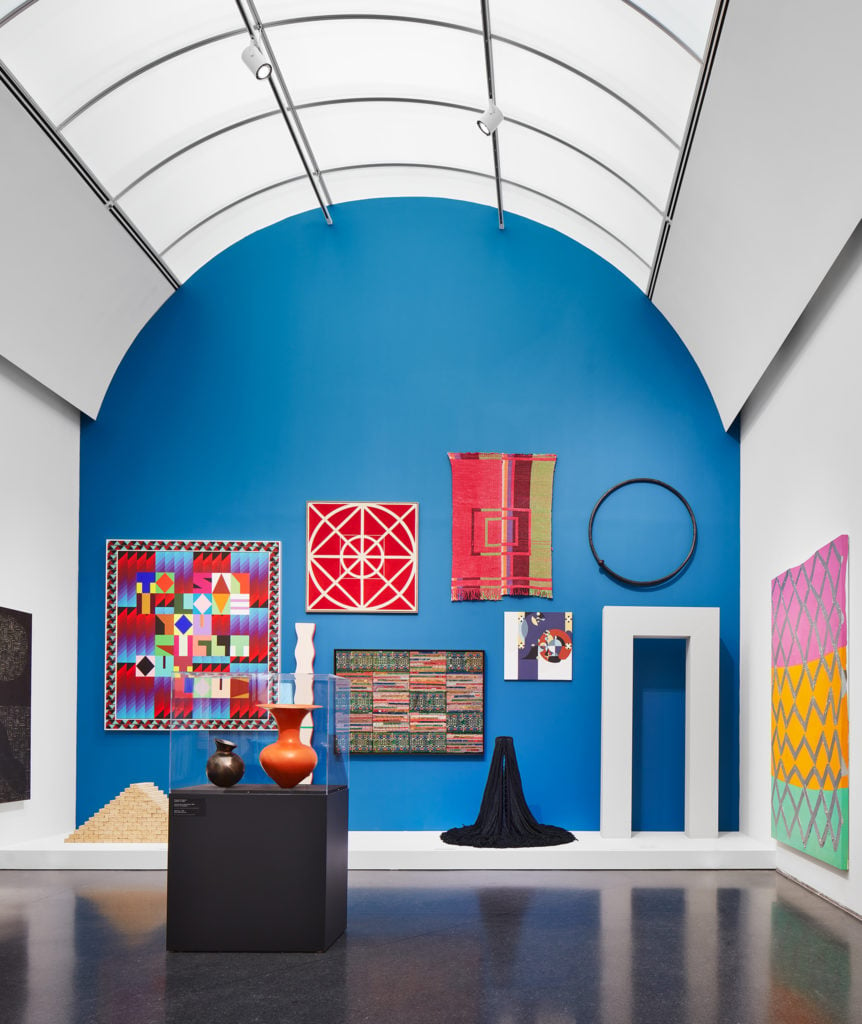
Installation view, Duro Olowu: Seeing
Chicago, 2020. Photo: Kendall McCaugherty.
Your exhibition, “Seeing Chicago,” at the MCA
has been extended through September. In the meantime, the museum
has launched a virtual version of the show with video footage,
supplementary imagery, and audio interviews. Tell me about how the
digital show came to be and how involved you were. How do you feel
it compares to the real thing?
First of all, I feel really
grateful that it opened and that the public really started going to
see it. I’m thrilled that the MCA has decided to make a virtual
version and extend it, especially because some people can only
afford to go see it on a free day. So, this way, people can either
see it when it opens back up again or at least have a visit while
they’re at home.
It has about 400 pieces in
it—for me, they’re amazingly joyful, incredible works of art.
It was an amazing
opportunity to be around all that art and to work with the MCA
team, from the hangers to the book editors. The funny thing is, I
only do Instagram, and until eight years ago, I had a flip phone.
I’m not the most technically savvy person. So of course, whenever I
see anything virtual, I go, “Oooh!”
Honestly, I only saw the final
version a week before it went up, and normally I have final
approval of every detail, down to the lettering on the door. But I
approved it immediately, and I changed only one thing. I’m very
conscious about my face and my voice on the web, but really, if I
just went online and saw this, I’d be impressed. The city of
Chicago is represented beautifully in the virtual version. The MCA
team deserves an Academy Award for virtual interpretation of this
show, truly.
Tell me about how the exhibition happened in the first place.
You aggregated all these great works from the private and public
collections of Chicago largely to show the breadth of the city’s
art and culture to its own community. What were you interested in
doing that?
Chicago is such an incredible
city, and people can’t imagine the kind of art there is there, in
both the private collections and the institutions. Initially,
[museum director] Madeleine Grynstztejn wanted me to do an
exhibition of my fashion work, and I said, “No, that’s not the show
I’m interested in doing.” So then she said, “Okay, whatever you
want to do is fine.”
It’s funny because as we were
working on it, the team said, “Okay, this looks good. Might we have
a mannequin here, maybe?” And I said, “No, no mannequins! No
fashion!” [laughs] I’m not saying fashion and art are not the same
or similar in any way, but I wanted to recontextualize that
relationship. So you’ll
see that any mannequins we have in the show are actually there to
represent the women of Chicago who have always bought my things for
all these years and have been so supportive. They are viewers of
the show, you know? The fashion or style elements are there to
represent the personalities of these people who are responsible for
all of this art being in the museums. And the thing about it is,
honestly, fashion doesn’t interest me at all. It never has. I like
style. I like the culture of style and I love art as a cultural
endeavor. I think that style is an art, but in the sense that style
is informed
by art.
What is really interesting for
me is just to show people what they’ve got. It’s almost like
opening your wardrobe that you’ve had for 20 years and thinking,
“I’m always trying to go for the next thing, but have I really
looked at what I have in here?” And the thing about Chicago is that
the Matisse at the Art Institute, or the Cindy Sherman at the MCA,
or the Stanley Whitney or Dawoud Bey or Lynette Yiadom-Boakye or
Lorna Simpson or Alma Thomas they have are very different from what
is elsewhere in the world, and they were obtained really
early.
A lot of things in the show are
works you’ve never seen by those people. That is the distinct
nature of the sort of Midwestern ethos. It’s a “We don’t follow
trends, we go from the gut” Chicago thing that I
love.
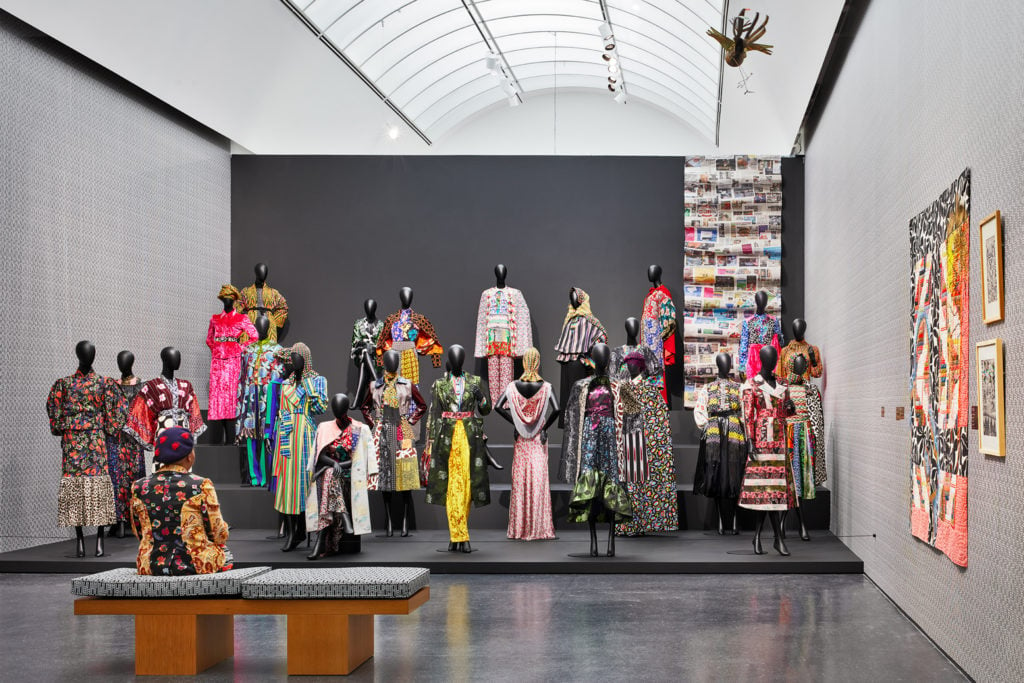
Installation view, Duro Olowu: Seeing
Chicago, 2020. Photo: Kendall McCaugherty.
I know you grew up spending your formative years amongst
multiple cultures and different cities, which has informed a lot of
your work. What did you notice about the texture of Chicago’s
culture? And how do you feel your internationalism has shaped your
eye, as a curator and a creative person?
I think we are definitely where
we come from, and where we’re going also determines that. I don’t
believe in nationality, as a banner of identity—it’s why I don’t
really like flags. I never have. I consider myself a Nigerian-born British
designer, but I’m Nigerian, you know? And Jamaican, because my
mother’s Jamaican. I use those sub-definitions only because, in
relation to what I do, people will say, “Oh, my god African
prints!” And I’m like, “They’re not African prints.” Maybe it’s the
color combination, but none of them are. So you have to teach
people a lot.
I think that where you’re from
is important as a kind of explainer for your particular aesthetic.
And living in a place is certainly different than just visiting.
It’s not enough just to say, “Oh, I’m going to Cairo to have a tea
at the Ramses Hilton,” and think you’ve had the Cairo experience.
No! And I have very eloquent, sophisticated people who come up to
me and say, “Oh, you’re from Africa. I’ve been to Africa.” I always
say, “I’m from Nigeria,” and, “Can you tell me where in Africa
you’ve been?”
I stop myself from saying things
that are too general because those categorizations are restrictive.
And I think that comes through in this show—it’s an incredibly
international show. When you have this multicultural background, it
really teaches you to keep your eyes open and sort of inhale
everything. It’s like switching languages or switching
attitudes—they co-exist within you.
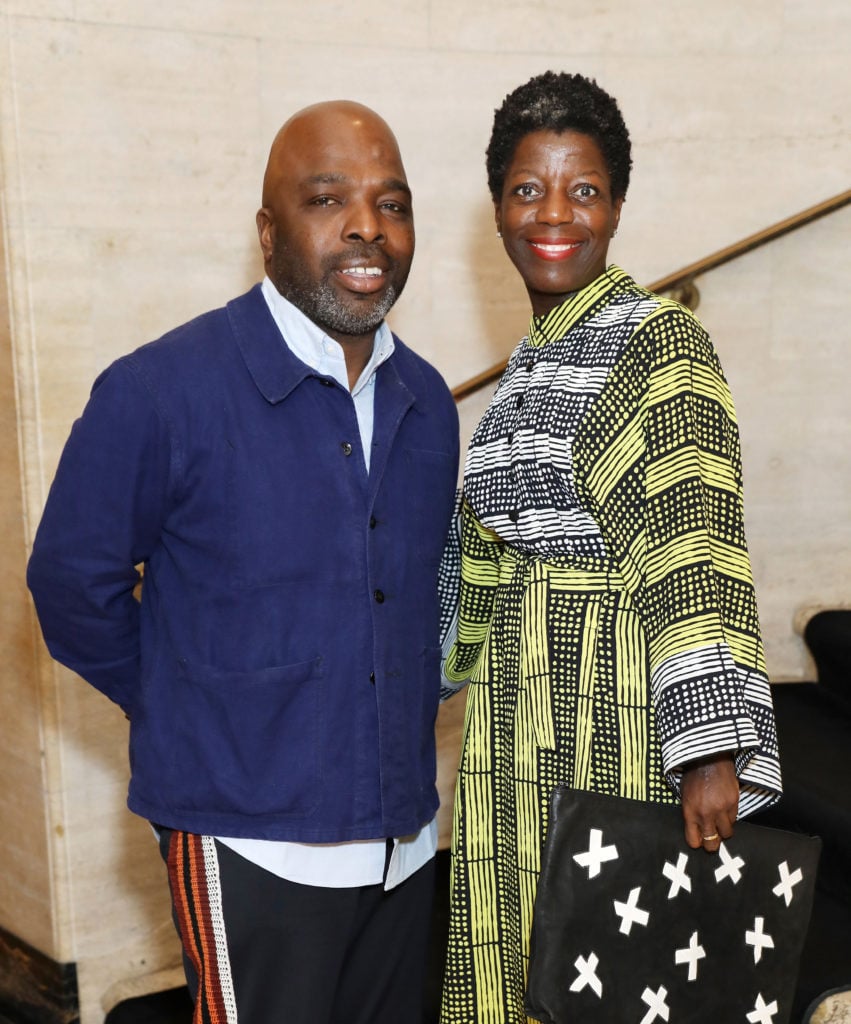
Duro Olowu and Thelma Golden. Photo by
Darren Gerrish/WireImage
You are, of course, married to a powerhouse curator. Did
Thelma Golden help you in any way to realize this
show?
It’s very interesting you ask me
that because Thelma never knows what’s going on with my shows.
[laughs] She loves my clothes so much—she always asks what they’re
about, what I’m working on. And I tell her, “You have to wait like
everyone else and go tomorrow morning to see the collection on
Vogue.com.” But I’m
lucky that she wants to enjoy the work in the same way as other
people.
Thelma and I respect each other
in part because of what we do. I have enormous respect for her
talent and her enthusiasm, and not because she champions artists of
color, but because she champions art and artists. And her specific
mandate is artists of color, because that is something that needs
doing, and I love that. I get excited by it, and I discover artists
through her.
One thing I will share that
continues to guide me is this piece of advice she gave me early in
our relationship. I was always editing my collections really early,
and we would talk about them, and I would say, “Next time, I think
I’ll cut this and this,” and she said, “No, you have to make
everything. And then edit.” And I know that that’s how she talks to
artists, too. It’s not about being extravagant, but don’t over-edit
in your head while you’re doing something. It’s
like eating the
ingredients before the meal gets made.
Art world people are often wary of fashion people who
talk about art. The notion that fashion is a form of art is also
prone to getting a lot of eye rolls. But your exhibition has been
received so positively by the art world. Why do you think that
is?
Of course being involved with
the art world and being with Thelma and meeting people through her
has helped. I also
think that I didn’t go into doing this with arrogance, and I was
never too cocky about the whole thing. I think when the viewer goes to see a show—and
I’m talking about the public, the mass public—it’s successful when
it really speaks to them in a simple, fundamental way. I think this
show does that.
Also, it’s is not about
shopping. I think the art world is really sensitive to this—that
commerce, which we all need to some extent, takes over. But not for
the public. I really think that they need to see something that was
not just worth it for the money, but brought something into their
lives or the lives of their children.
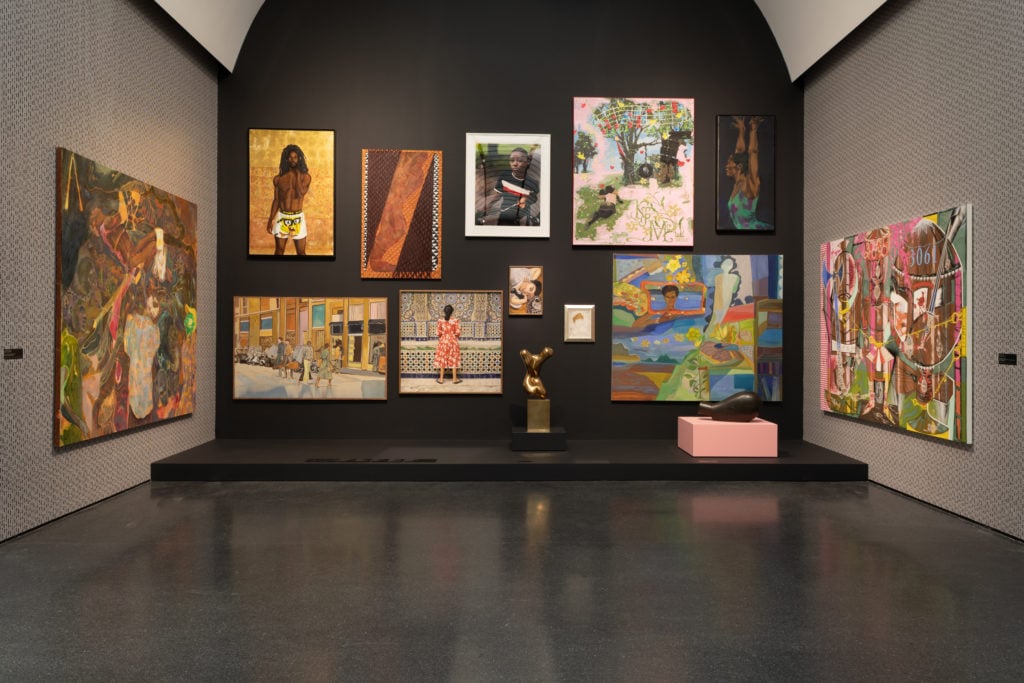
Installation view, Duro Olowu: Seeing
Chicago, MCA Chicago 2020, Photo: Nathan Keay, © MCA Chicago
The worlds of fashion and art are coming closer together in
more ways than before. What do you make of the art-fashion
collaboration trend? What’s in it for designers?
I think artists and designers
have always done it, that’s nothing new. Willi Smith, for example
collaborated with Christo, Jenny Holzer, you name it. The thing is,
it has to be done in a certain way for it to be legitimate. Most of
it is done in a “take the work and slap it on a piece of something”
way, which, you know, means nothing. Some of the big collaborations
are visually very beautiful, but what dismays me is that they’re
not made for keeps or to endure. They’re made as disposable items
and then the brand says, “Next!”
My thing is, if you’re a big
fashion company with a gazillion dollars, go to smaller museums all
over America and do projects there. Because if you have enough to
put into major artists or big art events, you have enough to give
to the people who really need it. It’s just that a lot of them
aren’t that generous.
So I think it’s about the
integrity of the finished project, and who you choose to
support—you know, it can be like taking from Peter to pay Paul. If
you’re going to sponsor art, then sponsor art in a way that it
gives to the public. But I think it’s over now anyway, all that
fashion-party-for-art stuff. The thing is, art doesn’t need
glamour. Glamour needs art.
The post ‘Art Doesn’t Need Glamour, Glamour Needs Art’:
Designer Duro Olowu on What Fashion Brands Must Do to Collaborate
Successfully With the Art World appeared first on artnet
News.
Read more https://news.artnet.com/art-world/duro-olowu-interview-seeing-chicago-1860483
Further reading


Leave a comment