
Art Schools Play an Essential Role in Supporting the Medical Industry—and That’s Why the Government Must Bail Them Out Now
Throughout the Covid-19 crisis,
the British public has been told that the government is led by
science. And that is what all of us would want. But as we consider
ways in which we are going to rebuild after the pandemic, who
better to reimagine that future than our designers and creative
entrepreneurs?
But where do the David Adjayes,
Bridget Rileys, James Dysons, and Elton Johns all start life? Who
helps train the minds of our great cultural leaders, such as Neil
MacGregor and Sir Nicholas Serota? Overwhelmingly, it is a
small group of specialist institutions—including the Royal College
of Art, the Courtauld Institute of Art, the Royal Academy of
Dramatic Art, the University of the Arts London, and the Glasgow
School of Art—that are the fountainhead of our creative
economy.
Pre Covid-19, the UK’s creative
industry generated some £112 billion for our economy, employed over
two million individuals, and was growing at a faster rate than the
financial-services sector. And it’s an industry that is peculiarly
British, given our centuries’ long excellence in literature, drama,
fine art, architecture, and—more recently—fashion and technology.
These creative industries not only employ us, they define our
cultural and social identity.
These very identity-defining
structures are at risk of vanishing under the financial pressures
of the crisis. A recent survey of
2,000 creative institutions and individuals by the Creative Industries
Federation showed that only half of them expect to survive beyond
June. While some support has
been offered to shelter this sector, too many small, specialist institutions and
conservatoires are taken for granted—and yet they are pivotal to
the future of our creative industries.
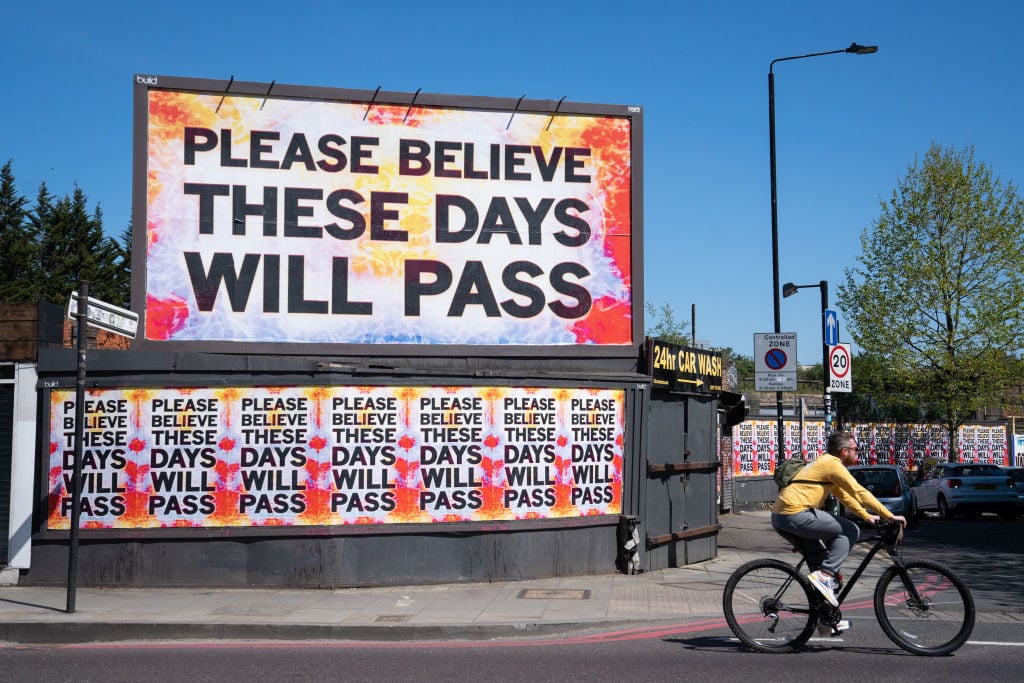
A cyclist rides past a billboard by the
artist Mark Titchner in Shoreditch, east London. Photo by Dominic
Lipinski/PA Images via Getty Images.
Protecting the Source
When Covid-19 hit the UK, we
heard first about the plight of our airlines, then our retail and
hospitality sectors, the preparedness or otherwise of our health
services, and then our universities. And our universities not only
train our nurses and doctors and power the research that will
design a new vaccine; they also build and train workers in our
vital creative economy.
It is easy to say that artistic
genius is heaven sent, and that any education is purely the gilt on
a lily. In the 1920s, the Royal College of Art noted that one of
its students appeared to have “a very poor understanding of
sculpture.” That student was Henry Moore.
Sometimes educators get it
wrong, or the education is misplaced. But overwhelmingly, our great
artists, art historians, musicians, and video-game designers point
to their place of study and express profound thanks for the
training and encouragement they received. David Hockney, who
studied at the Royal College of Art, has expressed his gratitude to
the school. And Elton John has said that without his training at
the Royal Academy of Music, he never would have been able to write
the songs that he has written.
There are practical applications to the skills learned in our
arts institutions as well. Riccardo Tisci, Burberry’s chief creative officer and a
graduate of Central Saint Martins, announced via his Instagram that
the luxury fashion brand
would transform its Yorkshire trench coat factory to manufacture
personal protective equipment (PPE) to meet the most immediate
needs of the medical community.
Dyson, the manufacturing company
set up by Royal College of Art graduate Sir James Dyson, began
developing a device in response to the government’s call to
increase the number of ventilators.
And a team from the Royal
College of Art’s Helen Hamlyn Centre for Design recently worked
with frontline staff at University College Hospital to design
bespoke signage and maps for their new Covid-19 intensive-care
complex. This has allowed new staff who are unfamiliar with the
space to easily locate important emergency equipment and clearly
understand which hospital zones require what levels of
PPE.
Artists have also led fundraising campaigns and made work that
has been a comfort in difficult times. Esteemed pop artist and Royal College of Art
graduate Sir Peter Blake partnered with the Evening Standard to design free
downloadable artwork to bring London together.
"background:#FFF; border:0; border-radius:3px; box-shadow:0 0 1px 0 rgba(0,0,0,0.5),0 1px 10px 0 rgba(0,0,0,0.15); margin: 1px; max-width:500px; min-width:326px; padding:0; width:99.375%; width:-webkit-calc(100% - 2px); width:calc(100% - 2px);">
View this post on Instagram
Nor did it take the pandemic for creative professionals to push
forward medical developments: design thinking was already
revolutionizing healthcare with innovations such as the 3D printing
of prosthetics and medical devices.
When government puts emphasis on
“the science,” it fails to see that the divisions between science
and technology, on the one hard, and arts and design, on the other,
are often facile. There
is value in the dialogue between the arts and sciences—and both
sectors are strengthened by this creative exchange.
Creativity, art, and design are
not an add-on to society. They are the expression of it, and are
deeply connected to our material world. Is Apple a design-led
company, or a tech-driven company? It is, of course,
both. Creative
entrepreneurs and designers can help both now and in the future,
supporting our immediate recovery and helping us to rediscover our
cultural and social identity.
Powering the New Future
On May 4, the government announced measures to support the
university sector as a whole. Many of these actions are welcome,
but they apply understandably to big multi-faculty institutions.
Government must understand the vital role played by Britain’s
small, specialist art and design universities, and come forward now
with assertive action to protect these golden geese.
In 1837, Lord Melbourne’s
government founded the Government School of Design, the world’s
first publicly funded design college. Why? Because the government
recognized that while Britain was the workshop of the world, our
design skills did not match those of our Prussian or French
competitors.
The threat we face today is
different and more complex. But in the rush to find a vaccine,
which of course must be the focus, let’s not forget the
complementary role of our creative industries and arts universities
that are forging the next generation of Dysons, Tiscis, and Blakes,
who will power the new future after this pandemic has
passed.
The post Art Schools Play an Essential Role in Supporting
the Medical Industry—and That’s Why the Government Must Bail Them
Out Now appeared first on artnet News.
Read more https://news.artnet.com/opinion/rca-arts-education-support-1853808
Further reading


Leave a comment