
5 Bold Predictions From Art-Industry Veteran Simon de Pury for How the Auction Business Will Change in the Post-COVID Era
The pandemic we are currently experiencing is a wake-up call to
humanity as a whole and to each of us individually. Now, as with
any wake-up call, we have the choice to act on it or to ignore
it.
What will the world look like post-coronavirus? Will we still
need art? Will it change the practice of art itself? How will it
affect museums? How will it change auctions and art fairs? What
will the consequences be for fundraising for charities and cultural
institutions? What can each of us, as participants in the art
world, try to do differently?
I have my views on what the answers to some of the above
questions might be. But here, I will focus specifically on the
future of auctions.
Auctions are still the most democratic and fair solution for
both the seller and the buyer. As a collector, you can, provided
you are the highest bidder, buy the work that you actually want.
There is none of the nonsense of dealers deciding if you are worthy
of a certain piece. It should be a basic human right that if you
pay for an artwork, you should be free to resell it when and
where you want to. As a successful auction buyer your freedom to
decide on the destiny of your purchase will not be hemmed in.
Auctions have existed forever and will continue to do so. But
they may look different in the future. Below, here are 5
predictions about how the auction industry will change.
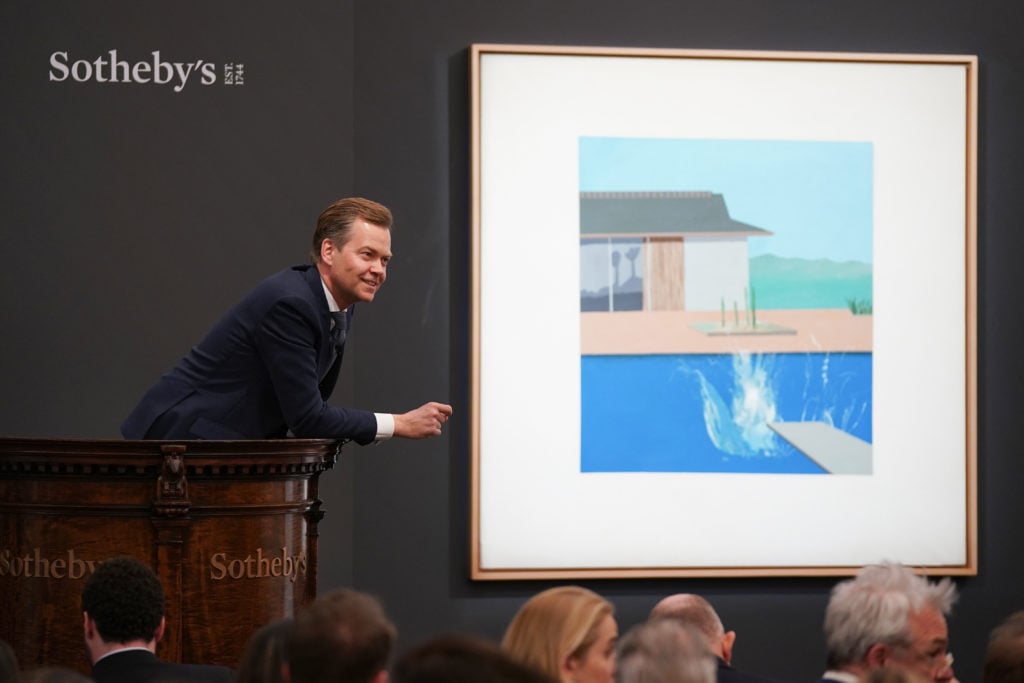
Auctioneer Oliver Barker brought the
hammer down on David Hockney’s The Splash at Sotheby’s.
(Photo by Michael Bowles/Getty Images for Sotheby’s)
1. Evening sales are here to stay—even if you
participate from home.
The main evening sales at Christie’s, Sotheby’s, and Phillips
are the bellwether of the art market. They are exciting events to
attend, and the seats in the main auction room are a highly coveted
commodity that you earn by being a regular bidder. The
majority of the people in the auction room are dealers, gallerists,
or art advisers. They, together with the personality of the
auctioneer, create the electric atmosphere.
But in recent years, most of the real action in these sales has
been generated by end buyers who bid from their homes, offices, or
swimming pools. They would do so over the telephone to a staff
member who would relay their bids to the room, or by sending bids
online directly onto a screen visible to the auctioneer.
Does the fact that, for the time being, people will think twice
before wishing to attend these evening sales in person cause a
problem? It will not make auctions any less fascinating. They are
like TV shows being watched by millions with a live audience in the
studio to create the mood. The show itself doesn’t change.
As a soccer fan, I have witnessed several Champions League games
played in front of empty stadiums—the players didn’t perform any
less well without an audience. In other words, top auctions or top
charity events will, thanks to ever improving technology, make it
possible to convey maximum excitement and atmospherics with or
without physical attendance.
2. You won’t see a lot worth more than $50 million
at auction for a while.
How much longer will owners of works valued at, say, more than
$50 million be prepared to offer them at auction—even with a
guarantee? When the art market contracted in June 1990 as a result
of Japanese buying stopping almost overnight, it took several years
for truly major works to be offered again at auction. The turnover
at Sotheby’s and Christie’s dropped by nearly 60 percent, not due
to a dip in prices, but a drop of the number of top works being
offered.
In October and November 2008, at the height of the financial
crisis, the turnover of the main auction houses also dropped
sharply. But when the Pierre Bergé – Yves Saint Laurent auction
went ahead anyway at Christie’s in March 2009, it became the most
successful single-owner collection ever, and potential vendors were
instantly filled with confidence. The market has not ceased to
strengthen since.
If a sale of that caliber were to happen again, confidence would
return to the market. But unless an owner is hard-pressed to sell a
trophy work, they will not want to test the waters for quite some
time now. They may however try to do so by private treaty sale. The
private sales departments of the main houses are essential for them
to be profitable at all, and remain one place auction houses can
continue to be very effective.

A security guard stands next to Jeff
Koons’s Rabbit from the “Masterpieces From The Collection
of S.I. Newhouse” sale at Christie’s New York. (Photo: TIMOTHY A.
CLARY/AFP/Getty Images)
3. As auction houses contract, buyer’s premiums
could come down.
However, drastic staff reductions
are now being implemented at these same businesses.
One of the reasons the duopoly of Christie’s and Sotheby’s has
been consistently strong is because of their huge infrastructures.
Having an army of specialists, marketeers, social connectors, and
client liaisons in offices all over the world comforts the
potential vendor. The feeling is that the auction house will reach
parts of the market that nobody else can reach—to paraphrase an old
Heineken advert, “it refreshes parts other beers can’t reach.”
This is the reason auction houses get away with raising their
buyer’s premiums at regular intervals. But it also means that if
you sell any artwork between $10,000 and $3 million, you pocket, at
the least, 25 percent less than what the purchaser pays. These
margins are substantial. If the main auction houses drastically
slim down their infrastructures, will vendors still accept leaving
so much money on the table for the auction houses?

Richard Prince, 3 Jokes Painted to
Death or 3 Jokes Really Painted (1987), which will be included
in Sotheby’s Contemporary Art Day Auction Online in May.
4. Auction catalogues will go extinct as online buying
and browsing becomes permanent.
The art market is the only market that has managed to resist the
technological revolution for so long. Several online auction houses
have come and gone and, until recently, the in-house competition
from auction houses’ brick-and-mortar colleagues made it impossible
for online sales to grow significantly. Thanks to the lockdown era,
the online auction world will grow more in these few months of 2020
than it has over the past ten years.
Sotheby’s has understood this, as their recent promotion of
Edouard Benveniste to CDO (chief data officer) shows. He is the
first person in the art world to be given that title. A
potential positive outcome of the current crisis is that auction
houses may cease producing the very beautiful and lavish catalogs,
printed and distributed at great cost to themselves and at far
greater cost to the environment.
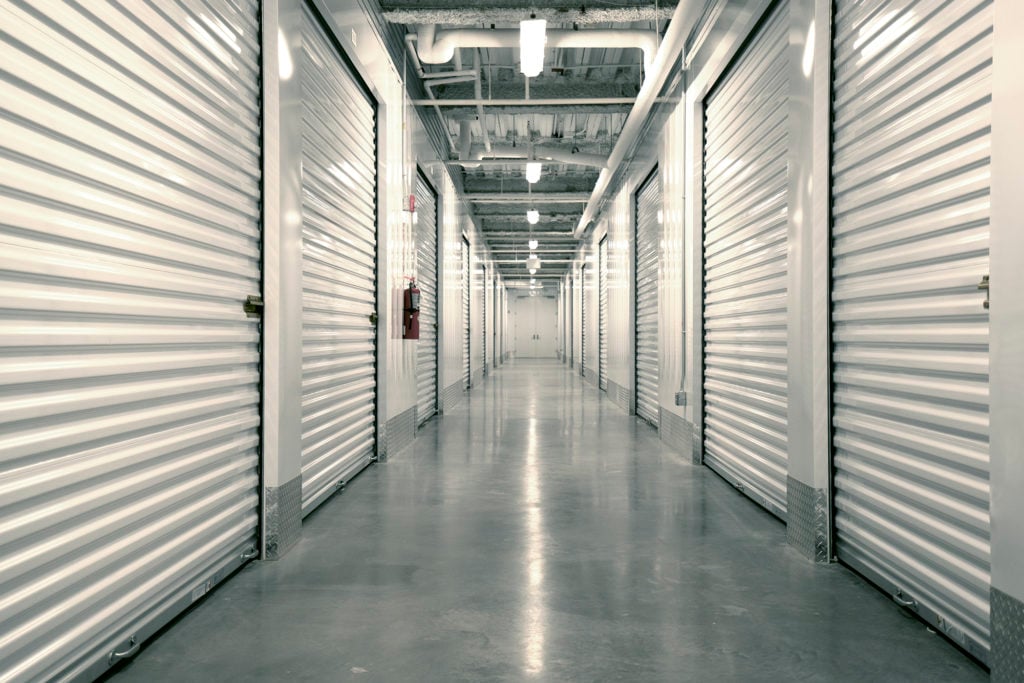
An interior hallway of the ARCIS
freeport in Harlem. Image courtesy of ARCIS ©2018.
5. Art storage companies will be among the first
cultural businesses to reopen—or commerce will stall.
The immediate problem the market faces is that art warehouses
are in lockdown themselves. I have works stored in New York,
London, and Geneva and am unable to have a single work moved from A
to B.
The art storage companies in Germany have remained open but
didn’t have much business during the shutdown. Collectors may not
be prepared to pay for a work without knowing when they can have
it. Art warehouses may be amongst the first businesses to reopen
when health guidelines begin to be loosened around the world.
A final thought
I used to say, “While we don’t need art to live, I couldn’t
imagine a life without it.” This has never felt more true. It is
extraordinary to witness people on social media reenacting famous
paintings, or memes linked to art and music. More than ever, it
is art that lifts us up and gives us hope, comfort, and strength to
make it through these challenging times.
Simon de Pury is the former chairman and chief auctioneer of
Phillips de Pury & Company and now works as a private dealer,
artistic director of Newlands House Gallery in Sussex, and a
partner in the joint venture de Pury @ Asprey.
The post 5 Bold Predictions From Art-Industry Veteran Simon
de Pury for How the Auction Business Will Change in the Post-COVID
Era appeared first on artnet News.
Read more https://news.artnet.com/opinion/simon-de-pury-auction-future-1859196
Further reading


Leave a comment