
Missing Graduation? Here Are 8 Inspiring Commencement Speeches From Carrie Mae Weems, Dana Schutz, and Other Artists Throughout History
Over the weekend, Barack Obama delivered two virtual
commencement speeches to all the graduating students who cannot
attend ceremonies in person this year.
“Build a community,” he advised. “Stand up for one another’s
rights. Leave behind all the old ways of thinking that divide
us—sexism, racial prejudice, status, greed—and set the world on a
different path.”
Art schools, too, are staging virtual commencements this year,
even some with celebrity appearances, such as John Waters at the School
of Visual Arts on May 27.
To honor this year’s graduating artists, we’ve looked back on
some of the most stirring commencement speeches at art schools
throughout history.
Below, watch, listen, and read addresses from Glenn Ligon,
Carrie Mae Weems, Dana Schutz, and more.
Dana Schutz
Cleveland Institute of Art, 2019
Glenn Ligon
The New School, 2018
Carrie Mae Weems
School of Visual Arts, 2016
John Waters
Rhode Island School of Design, 2015
Teresita Fernández
Virginia Commonwealth University, 2013
David Byrne
Columbia University, 2013
Jenny Saville
New York Academy of Art, 2011
Watch part two of Saville’s speech here.
Anne Truitt
Maryland College Institute of Art, 1991
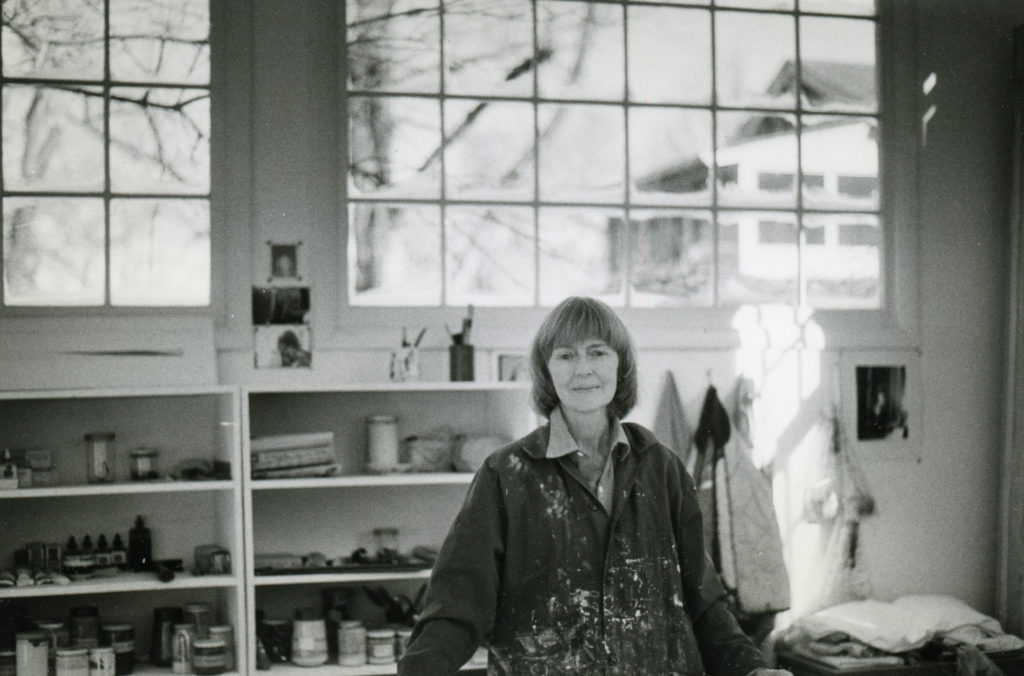
Anne Truitt, Washington DC, 1978. ©
annetruitt.org, courtesy of Matthew Marks Gallery.
Artist’s lives are adventures into territory as uncharted as
that of Daniel Boone, who, when asked whether he had ever been lost
in the wilderness, replied, “No—but I once was bewildered for two
weeks!”
You also will be bewildered now and then, for an artist’s life
is predicated on a subtle attunement to an unknown self, and none
can guess where that unknown self will lead. Creative work is a
matter of listening attentively to yourself, even if what that self
is saying seems to you—and to everyone else—utterly outlandish. It
is a fascinating way to live, because if you listen to your
particular inner voice and follow it courageously, you will learn
to trust that voice more and more—and you will surprise yourself
afresh for as long as you live.
In your adventuring explorations you will be for some years in
apprenticeship to yourself. It takes a lifetime. This is a delicate
and demanding discipline, and I beg of you that you give yourselves
time; do not expect quick results. In his Letters to a Young
Poet, the great German artist Rainer Maria Rilke wrote, “A
work of art is good if it has sprung from necessity…. Go into
yourself and test the depths in which your life takes rise: at its
source you will find what you must create. Accept it without trying
to interpret it.”
The work in art that you will do in your future may be very
different from that in which you are currently engaged. I hope that
it will be very different, for your future work in art will in its
unpredictable course reflect and refract the unpredictable course
of your lives, of what those lives will teach you if you learn from
them with open-minded passion. The artists who disappoint
themselves are those who build intellectual and psychological
fences around their expectations, who preconceive their work too
narrowly. For if you preconceive who you are, you can only create
what rises out of a self you have already defined as “correct.”
This not only discourages and limits the possibility of brand
new concepts erupting into your work, but also deprives you of the
value of learning how to be tough on yourselves, to endure, to rise
above failed aspirations—which usually turn out to have been steps
toward an unguessable goal. I urge you to preconceive as little as
possible. Accept yourselves as strangers to yourselves, and let
these strangers teach you who you are in the process of becoming as
you move from one stage in your development to the next. Have faith
in what your work is teaching you, and stand fast in that faith no
matter what storms of criticism or praise rage around you. Both can
be equally destructive.
I have found it useful to maintain the checks and balances of
what Sigmund Freud called “reality testing.” To examine carefully
what intelligent people have to say about my work, but always to
retain a distance within which to judge for myself. And I firmly
believe in addition: include every human experience that comes your
way—personal relationships of all sorts, responsibility for
children, all that sustains and deepens your heart. For the work
you make will evolve—and you yourself evolve—only to the extent
that you choose expansion rather than contraction.
Courage is the stoutest root of art.
If you maintain your independence you may find yourselves out in
left field, obsessed by concepts that bear little or no relation to
what people in general think that art is, should be, or could be. I
have observed over and over again that spontaneous, original
concepts arise equipped with all they need to become actual. They
are accompanied by new—even astonishing—ways and means.
A second salient fact about innovative concepts is that they
result in work that is magnetic. Work of authentic originality and
value automatically attracts notice. I urge you to pay no more than
intelligent attention to the work that you find around you as you
move into the arena.
A current fashion in art is always leavened by the taste of the
majority, and the taste of the majority is always conditioned by
excitements that bear only oblique relation to the powerful current
of ever-changing original conceptualizations of truth, the current
in which genuine artists move and to which they contribute. Place
yourselves squarely in this current, and learn to swim there. It is
in the company of your contemporaries that you will find challenge.
And courage, and comfort too. For individual aspiration is
quintessentially a lonely endeavor. Loneliness comes with the
territory, and you will devise ways to fortify yourselves while you
learn to live there.
Last week I spent some time at the Whitney Biennial and thought
of your good fortune in moving out into a situation so rich in
possibilities. You come to it equipped with a range of technical
and intellectual tools. You are, I am sure, well-founded there, and
it seems to me that I might serve you best by speaking personally
about what a lifetime in art has taught me about living the life of
an artist. For artists are their own stock-in-trade: they make
their work out of themselves, and this presents them with a
challenge.
In the first place, they are adventurers into territory as
uncharted as that of Daniel Boone. This fact presents them with a
special challenge: that of making their work out of the material of
their lives while they are living them. So that the art of making
art and the art of living in such a way that a lifetime distills
into their work are mutually dependent. The authenticity of their
lives guarantees the authenticity of their art. And this
authenticity rises from a bedrock of honesty to individual
experience and a high heart.
Do not compromise your ideals for yourselves. This will take
fidelity and a special kind of patience, and grit. Sheer luck comes
in somewhere in how your work fares, but to a degree luck can be
made. Place yourselves in situations rich with possibilities. If
two cars collide on an empty road, the results are limited; if they
collide on a Los Angeles Freeway at 5:30 p.m. on a workday, a great
deal happens.
A long life in art has led me to the understanding that its
rewards are secret. There is no worldly recompense commensurate to
the cost of a lifetime of work. But that cost is as nothing when
considered in the light of the exhilaration of trying to make what
is true for yourself real for other people. Artists’ lives are
essentially generous: they give themselves away. And in rendering
their aspirations available to humankind, they render a noble
service to our common life on this planet.
For you will, in a real sense, be making your own mind’s world
visible in your work. This is a privilege, and like all privileges
involves responsibility. Any action—and making art is a very
complex action—leads to incalculable, unpredictable results, and
these results are in themselves actions. All these actions
accumulate over the years and, like money in a bank, accrue
interest. If they have been honest they gain in value. Not only in
the evolution of the artist’s work, but also in the evolution of
the artist as a person—in unalienable spiritual value.
I close with a quotation from Pericles, who wrote these words in
Athens in the fifth century BC: “For the whole earth is the
sepulcher of people, and their story is not graven only on stone
over their native earth but lives on far away woven into the stuff
of other people’s lives.”
I wish you all, with all my heart, noble lives.
The post Missing Graduation? Here Are 8 Inspiring
Commencement Speeches From Carrie Mae Weems, Dana Schutz, and Other
Artists Throughout History appeared first on artnet
News.
Read more https://news.artnet.com/art-world/8-stirring-artist-commencement-speeches-1854570
Further reading


Leave a comment