
The Art of Craft: How Elsa Peretti Designed Tiffany & Co.’s Bone Cuff to Draw Attention to the Elegance of a Woman’s Wrist
There are three women whose
legacies are as entwined in the story of Tiffany & Co. as they are
in their own: Audrey Hepburn, Paloma Picasso, and Elsa Peretti. Of
all three, Peretti has easily had the strongest influence on the
design of the American jewelry house, with her sensuous,
otherworldly designs totaling close to 10 percent of Tiffany’s
annual net sales—a testament to their enduring value and to her
singular taste.
Born and raised in Rome,
Florence, and Switzerland, Peretti was a strong-willed girl
determined to forge her own path from that of her wealthy,
conservative family. She began her working life at 23 as an Italian
teacher and ski instructor, before moving to Milan to pursue a
degree in interior design and an apprenticeship with the architect
Dado Torrigiani. After just a year, she changed course again and
started modeling, first in Barcelona and then in New York City,
where she reportedly arrived for the first time with a will of
steel and a black eye from a boyfriend who didn’t want her to leave
Europe. “I was poor,” she told Vanity Fair of that time, in a 2014 interview. “But in a
good way.”
In New York, she quickly fell
into the inner circle of fashion girls, becoming one of designer
Halston’s favorite models alongside other household names of the
late ’70s scene, including Angelica Huston, Pat Cleveland, and
Karen Bjornson. Peretti was also snapped up by Andy Warhol’s Studio
54 crowd, and for a period, much of her life became, by her own
admission, debauched and defined by wild nights
out.
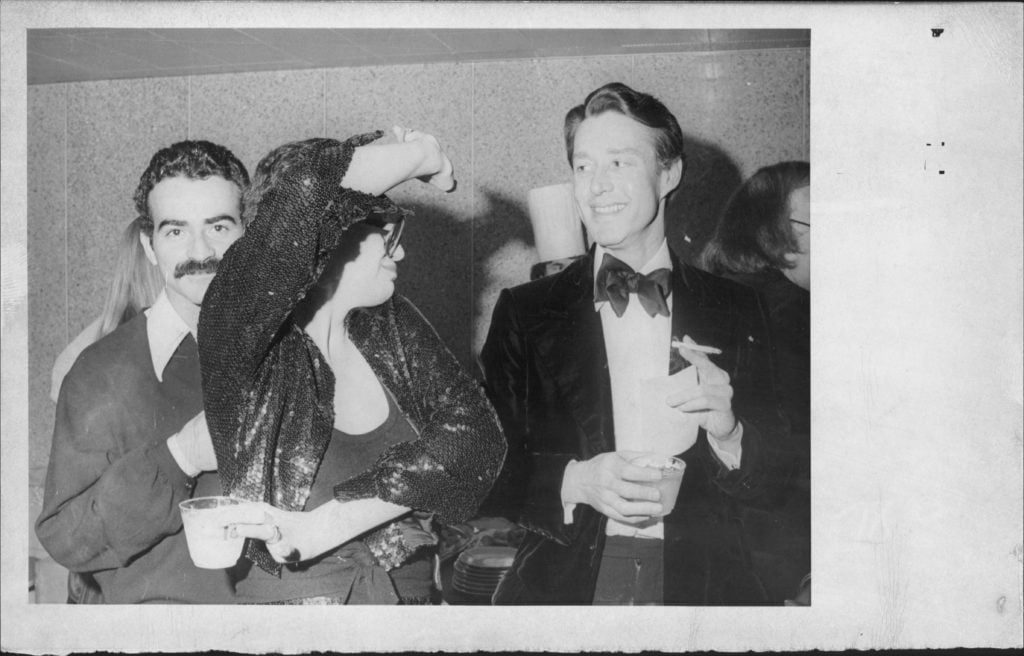
Victor Hugo, Elsa Peretti, and Halston.
March 22, 1975. Photo by Vernon Shibla/New York Post Archives /(c)
NYP Holdings, Inc. via Getty Images.
Still, no one could deny her
inimitable sense of style, and at the suggestion of Halston, she
eventually began designing sculptural silver jewelry crafted to
encase and highlight the liquid curves of the female form. As her
popularity grew among the glamazons of Gotham—Liza Minnelli was
apparently a big fan of her work—she was asked to design pieces for
Tiffany & Co. Later, in 1979, she was named their lead jewelry
designer.
While at the house, she
introduced the use of sumptuous natural materials like lacquer,
jade, and rattan, inspired by her frequent trips to Japan and
China. She continued to expand her line of sensual, organic forms,
many of which went on to become the house’s cult collections, like
her bean pendants, open-heart necklaces, mesh bracelets, and
diamond-by-the-yard strands, all of which are still produced
today.
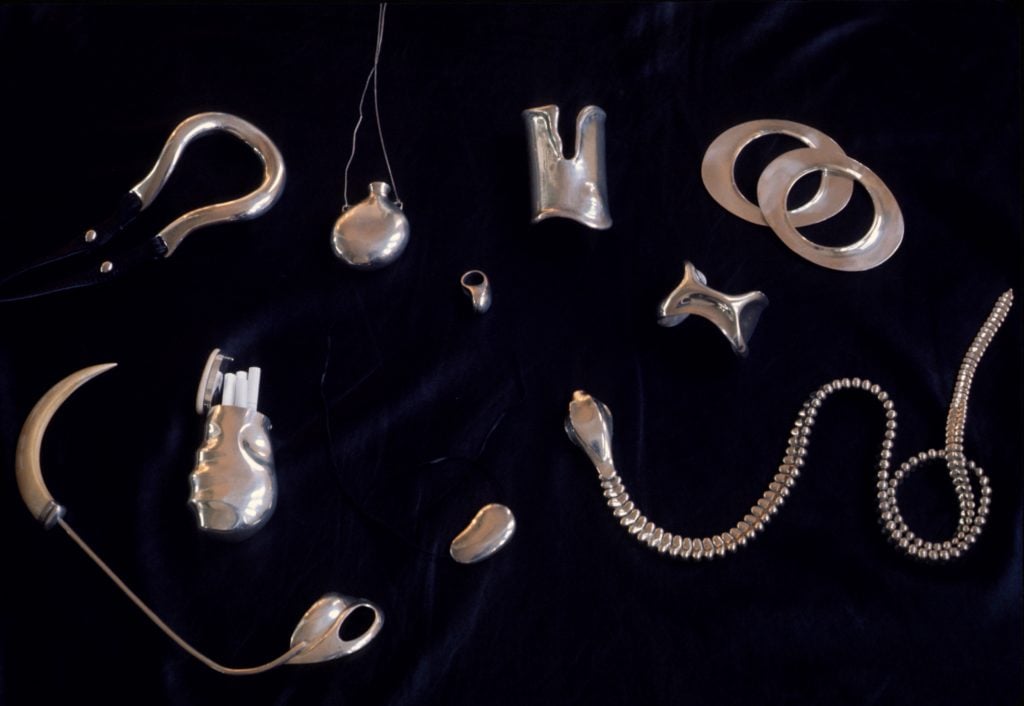
Elsa Peretti jewelry circa 1970 in New
York. Photo by Peter L Gould/Images/Getty Images.
But no design comes close to the
success of Peretti’s Bone Cuff, which she designed to wear as a
pair on the left and right wrists. A small rise on the inside of
the object was meticulously crafted to encircle the wearer’s wrist
nodules, calling attention to both her strength and grace. “It
takes so long to make a curve, and to make sure the curve is done
well,” Peretti said of her exacting design
process.
In celebration of the cuff’s
50th anniversary this year, Tiffany & Co has just released a new
line of colorways that pay homage to Peretti’s love of nature and
art that celebrates bold color.
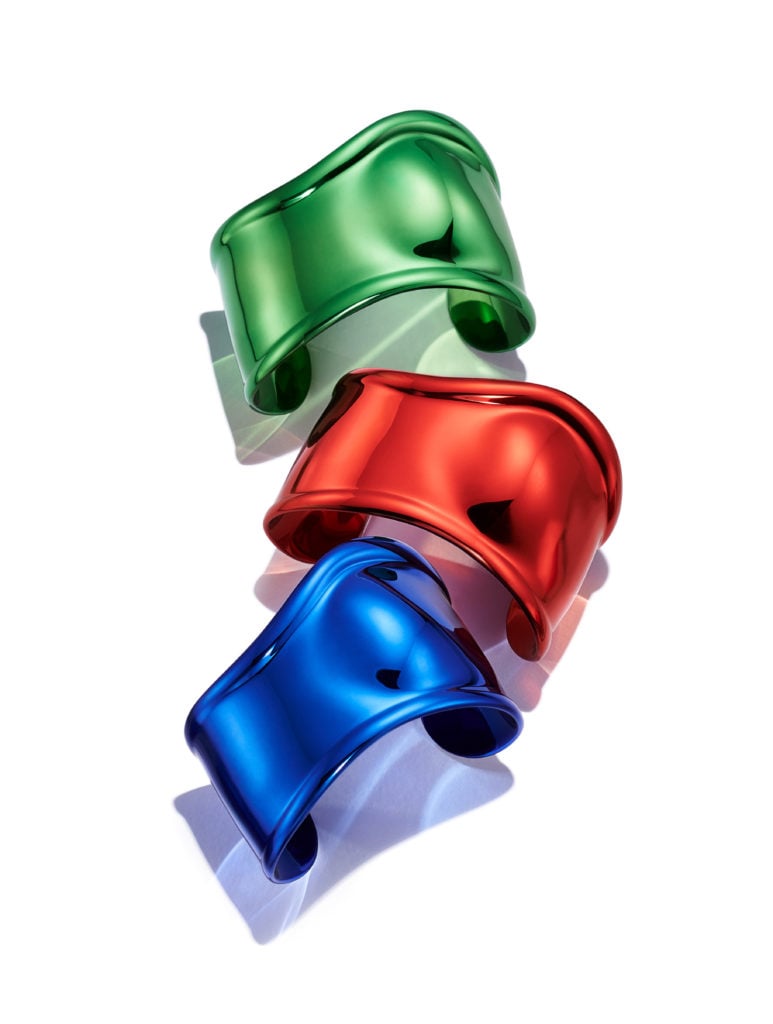
The new Elsa Peretti Bone Cuffs. Photo
courtesy Tiffany & Co.
Unbeknownst to many, the cuff
was originally inspired by Peretti’s childhood visits to Antonio
Gaudi’s Casa Mila, which features an undulating facade and
interconnected rooms that appear “webbed” together.
The cuff also nods to the work
of another Surrealist talent, Salvador Dalí, whom Peretti
befriended and modeled for in the 1960s. It also riffs on her trips
to the crypt of a 17th-century Capuchin church in Rome that she
took with her mother as a young girl. “My love for bones has
nothing macabre about it. All the rooms [of the church] were
decorated with human bones,” Peretti recalled, in a statement from
Tiffany & Co. “My mother had to send me back, time and time again,
with a stolen bone in my little purse. Things that are forbidden
remain with you forever.”
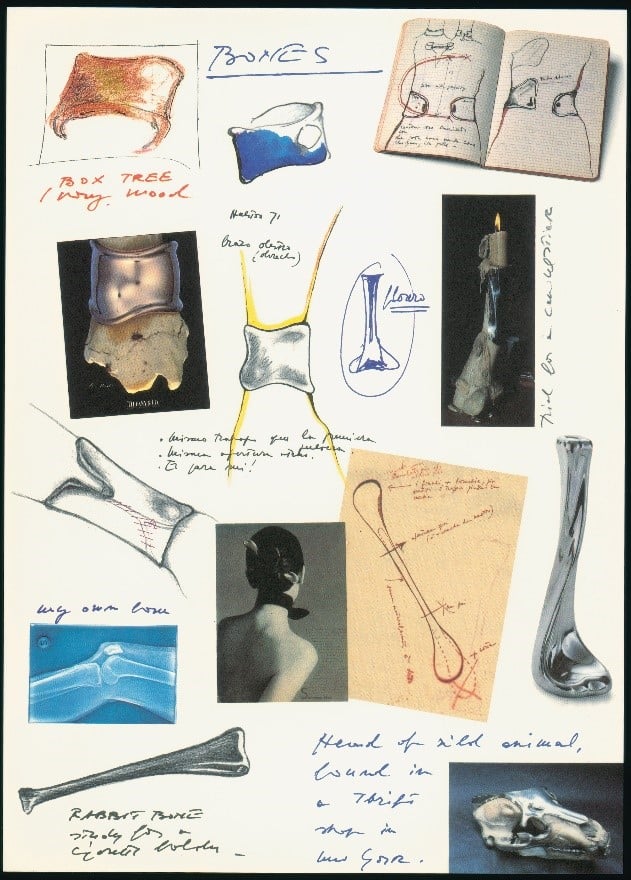
Elsa Peretti’s Bone Cuff sketches. Photo
courtesy Tiffany & Co.
The newly released bone cuffs
come in electric red, green, and blue, while a capsule collection
of limited-edition gold and silver styles also feature inlaid
carved stones in black jade, green jade, and turquoise. Together,
they recall Peretti’s love of large, colorful gemstones. Each piece
is inscribed with “special edition” on the inside.
Says Peretti—who is celebrating
her 80th birthday this year, and whose works are housed in major
museums around the world, including the Metropolitan Museum of Art
and the British Museum in London—“I have always been interested in
the Bone Cuff’s mechanics and feel. Every jewelry piece should be
as captivating and as comfortable to wear.”
The post The Art of Craft: How Elsa Peretti Designed Tiffany
& Co.’s Bone Cuff to Draw Attention to the Elegance of a Woman’s
Wrist appeared first on artnet News.
Read more https://news.artnet.com/art-world/tiffany-bone-cuff-50-years-1866951
Further reading


Leave a comment