
‘I’m Always in a Recession’: A Day in the Life of Collector-Provocateur Stefan Simchowitz, Who Feels Just Fine Doing Business During Lockdown
Days start early for the
controversial art collector and cultural entrepreneur Stefan
Simchowitz.
On a recent Wednesday at the end
of April it is even earlier than usual. He is roused at 3 a.m. when
his son crawls into bed between him and his partner, Rosi Riedl. It
is already a full house. Sandwiched together with two stubborn
rescue dogs, Benji and Sambuca, he struggles to get back to sleep.
The art collector-slash-dealer-slash-patron has a lot to think
about.
His reputation for flipping
young artists at auction has made Simchowitz—Simco to those in the
know—a thorn in the side of the art world establishment. But these
days, he says he’s not concerned with selling art. His venture
instead hinges on the production of work by young and emerging
artists, on whom the public health situation has had an outsize
impact. Many are struggling to make rent or keep their studios
running, and he is busy coordinating to keep them
afloat.
“I think it’s inappropriate to
try and sell art right now,” he says. “First of all, clients don’t pay for work on a
regular basis, which is no help to artists who need cash. And
secondly, everyone is under pressure, so it’s a very difficult
thing to call a friend who owns a restaurant and ask them to buy
art. It’s ridiculous.” Besides, he says, the people who are buying
right now are only interested in assets that are speculatively of
monetary value, which isn’t generally the case for young artists
with no established market.
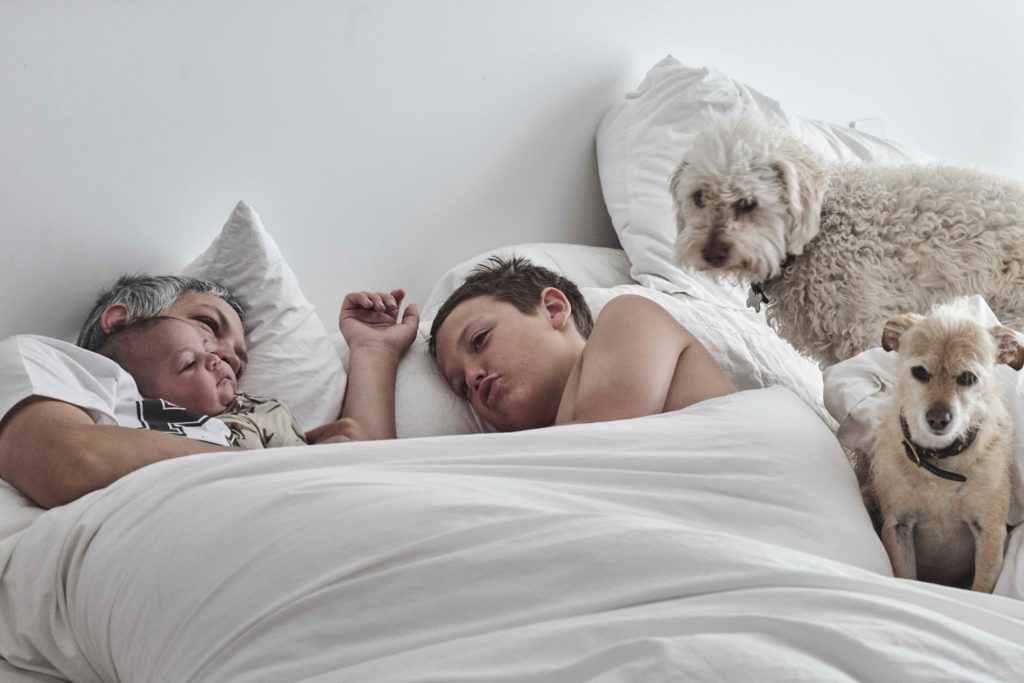
Rosi Riedel, baby Harlow, Morris, and
dogs Benji and Sambuca.
I’m tailing Simchowitz remotely, to get a fly-on-the-wall
perspective on his daily life. Surprisingly little has shifted in his
day-to-day since Los Angeles was ordered to shelter in place in
March. “Even when I was in the movie business, my office was my
home, it’s my comfort zone,” he says.
As the art world’s resident
enfant terrible, Simchowitz tends to eschew the industry’s usual
protocols. He’s not one to get invited to gallery dinners, nor does
he jetset with the fashionable set. When he would go to art fairs,
he would routinely upset gallerists by stomping around asking for
big discounts.
As for the economic impact of
the current crisis, Simchowitz is not too perturbed.
“I’m always in a recession,” he
says. “In a week I give $10,000 to artists, to buy their work and
keep them alive.”
He takes the opportunity to
sound off about the poverty of working capital for artists in the
traditional art market system. “As much criticism as I get for
sometimes selling a work at auction”—in February, he sold a
painting by the 35-year-old Ghanaian artist Amoako Boafo at auction
for more than 10 times its high estimate—“I support artists all
over the world who have no markets on a consistent basis and it
makes a huge difference,” he says.
5 a.m.: The Socratic Method
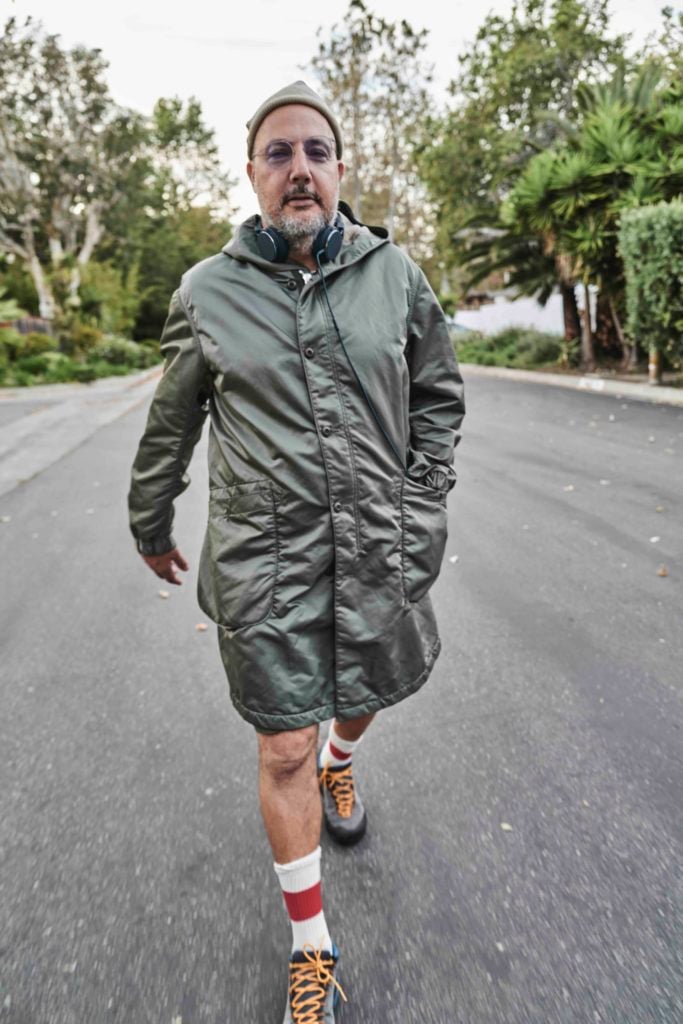
Stefan Simchowitz walking.
After a few hours of tossing and
turning, Simchowitz decides to give up on sleep. It might be 5 a.m.
in Los Angeles but there are plenty of time zones that have been up
and at ‘em for hours. He brushes his teeth—the 49-year-old never
eats breakfast—and washes down his morning vitamins (a Vitamin B12
spritz, a D3 + K2 complex, and something called Elysium, which he
tells me “supposedly makes you younger”) with a bottle of San
Pellegrino.
Then he dons one of the many
headsets that are scattered around his house and goes for a walk
around his neighborhood in Malibu West, which he calls “deep
Malibu.” Walks are an important part of the Simco ritual. Inspired
by the Greek philosopher Socrates, who was known for his
walking-and-talking approach to philosophy, he tells me earnestly
that he has averaged six miles a day over the past five years. “If
you ever have a meeting with me, I’ll tell you to wear tennis
shoes, because we’re going for a walk.”
First up, he calls one of the
artists he works with, the South Africa-based Turiya Magadlela.
While Simchowitz tends to favor artists who are prolific producers,
Magadlela is struggling to monetize her inventory as there is a lot
of unpaid for work that has been consigned to different galleries.
They discuss her career, and Simchowitz agrees to send her $1,000
to pay her landlord.
After that, he speaks to a
couple of friends. One is stuck alone in Paris, another in London.
Then, he gets on the phone with New York; there is a show by Petra
Cortright, an artist who Simco “discovered” and purchased many
works from early on, at Team Gallery that needs to be taken down,
and with limited movement during the lockdown, and 100 huge printed
sheets to be deinstalled, the logistics are challenging.
9 a.m.: Simco’s Clubhouse
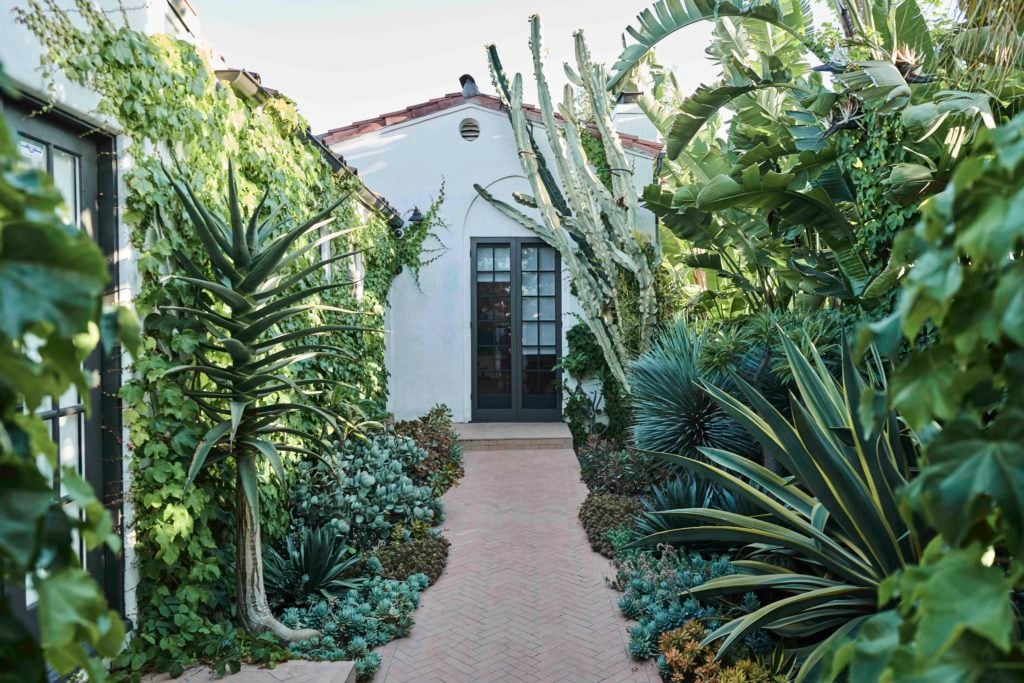
Stefan Simchowitz’s house.
Back home, after crawling back
into bed for a bit, he goes on Instagram to promote a talk he has
planned for later in the day. Simchowitz was an early adopter of
social networks as a tool for business, and he spends between two
and three hours a day on the photo-sharing app. “You’ll never hear
me say ‘I need to get off social media,’” he says.
There are other items of
business to attend to, some of which are overseen by his partner
Rosi, but there is another important “member of his tribe,” as he
puts it: his right-hand woman, Lisa Marie Pomares. The former model
and her newborn baby girl, Harlow, is quarantining with them. The
child’s father, art market darling Oscar Murillo (who is one of the
artists Simchowitz is known for buying early and cheap) is in
Colombia.
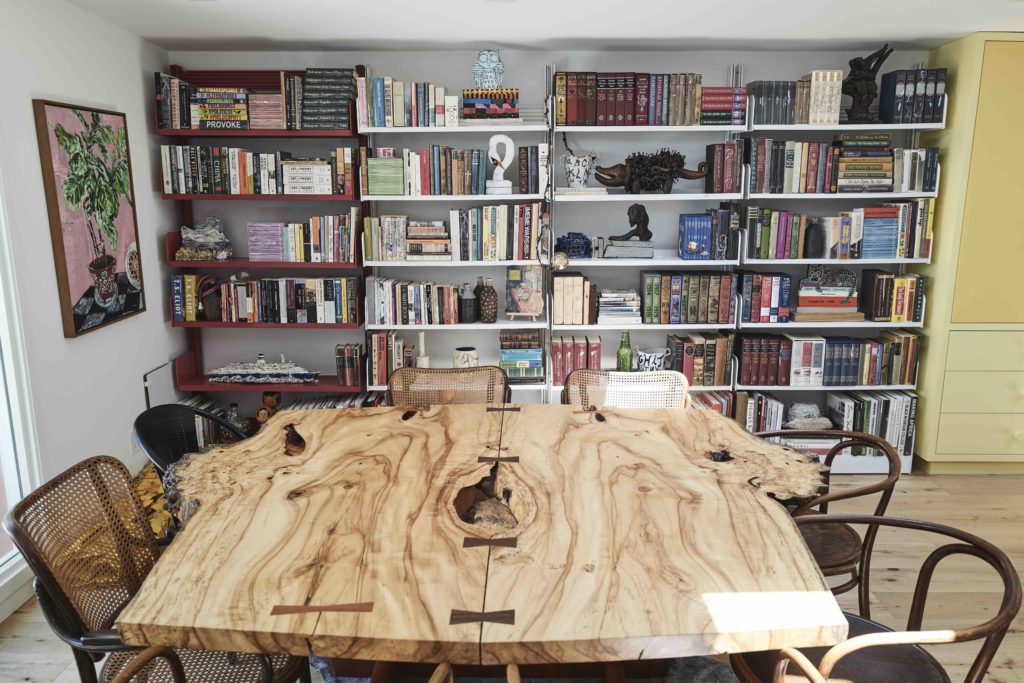
Stefan Simchowitz’s house.
The house, which Simco bought at
the end of last year, is filled with art. On one side of the living room is a
bookshelf, decorated among other things with some artwork by
Jonathan Edelhuber. A gorgeous table by the architect and furniture
designer Mira Nakashima, daughter of 20th-century American
furniture designer George Nakashima, is in the center of the room.
Tripping around a mess of empty delivery boxes is another of
Simchowitz’s adoptees, a former alleycat named
Smokey.
12 p.m.: Instagram Live
At noon, Simchowitz goes live on
Instagram with Oliver Elst, the German car designer and art
collector behind the Cuperior Collection.
In the nearly two-hour
conversation, Simchowitz spends most of the time shouting out his
artists and proselytizing to his followers about his collecting
philosophy. He has around 83,000 of them on Instagram, and there
are consistently some 200 concurrent viewers.
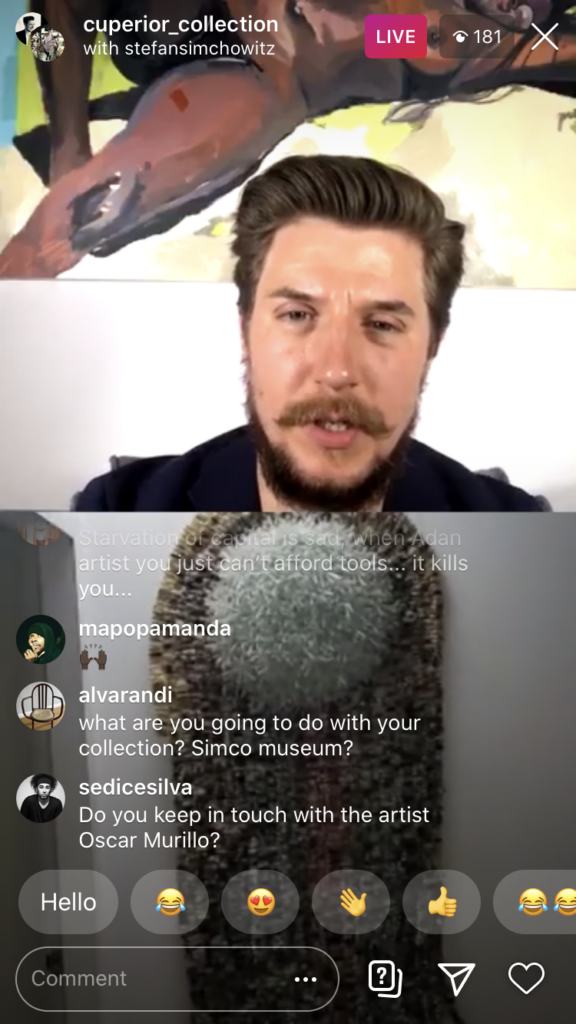
Screen shot of Stefan Simchowitz and
Oliver Elst on Instagram Live.
When asked, he reveals that he
has no plans for a “Simco Museum,” but will leave his extensive
collection to existing museums. He says he has already given $10
million of work to museums, listing off the Brooklyn Museum, MASS
MoCA, MCA Chicago, the Pérez Art Museum Miami, and the Tang Museum,
among others. And his advice to young artists? “Number one: be
good. Number two: call me.”
2 p.m.: Artists in Residence
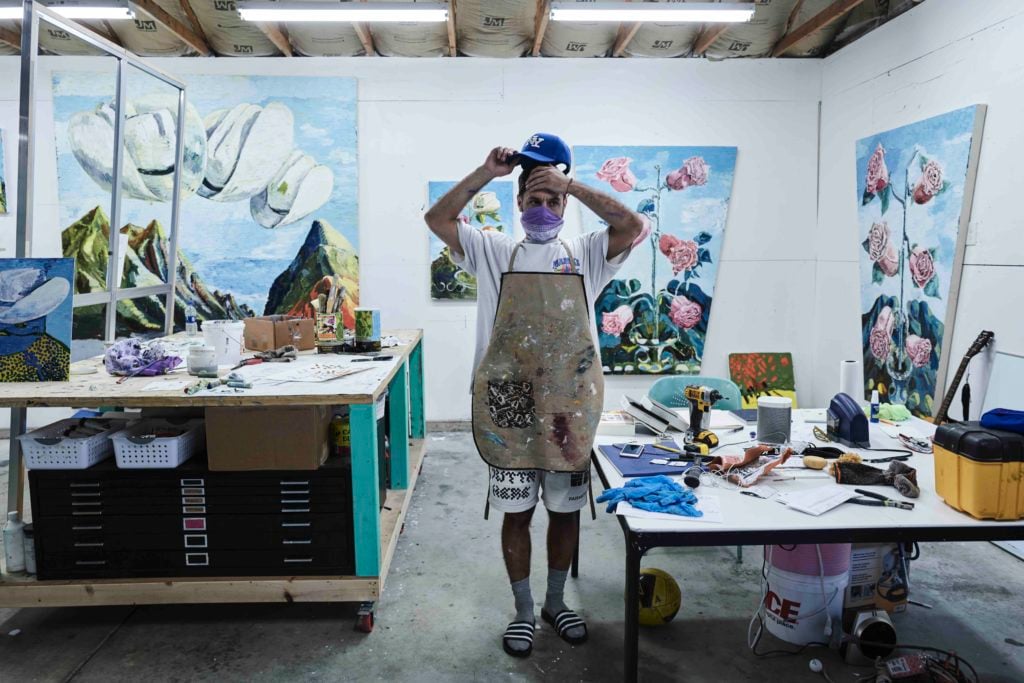
Ken Taylor in studio. Photo by Stefan
Simchowitz.
Lunch is a vegetable burrito
with guacamole from Lily’s, and a cold brew from the
fashionable LA coffeehouse, Blue Bottle.
Then,
Simchowitz drives out
to visit his own residency program in Pasadena, where the artist
Ken Taylor is on an extended residency, and Jesse Edwards is doing
a ceramic residency (the residency has three kilns on site, as well
as a giant hand loom).
4 p.m.: Studio Visits
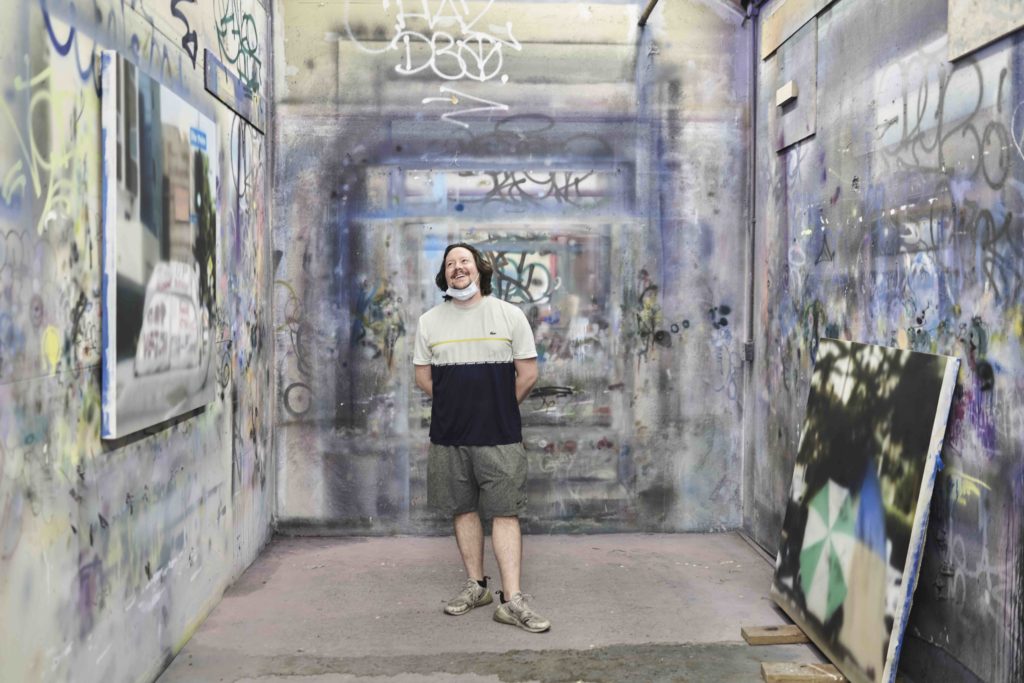
Sayrle Gomez. Photo by Stefan
Simchowitz.
After leaving Pasadena,
Simchowitz swings by the studio of Marc Horowitz. Then, he pays
another studio visit to Sayre Gomez—a California artist who shows
with François Ghebaly—and takes a portrait of the artist wearing a
mask.
“I have a big passion for
photography, on every level,” Simchowitz says. The hobby surprises
some people because he doesn’t fit into most people’s “moral idea”
of what a good photographer should look like, he
says.
Inspired by artists like Deana
Lawson and Wolfgang Tillmans, he makes time to take photographs
every day. “Even if my life is quiet and banal, it is my
experience,” he says. “The job of every photographer is to
photograph your world.” David Kordansky has apparently offered
Simchowitz a show next year.
7 p.m.: Learning Curve
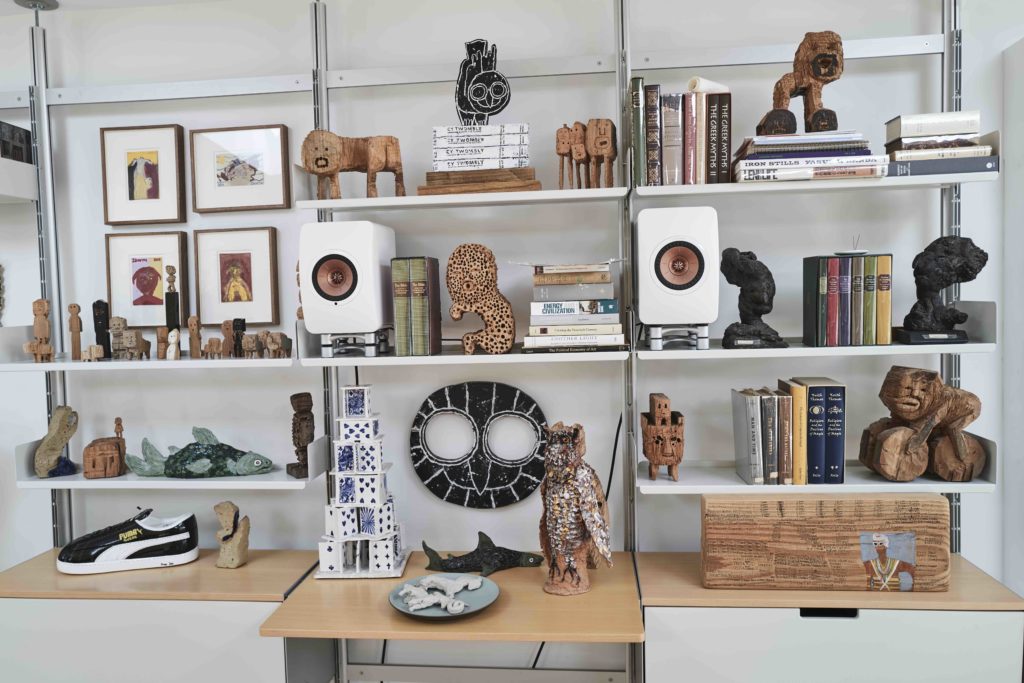
Stefan Simchowitz’s bookshelf.
The evening is fairly
quiet. Simchowitz eats
nothing for dinner, except a bag of Rusty’s salt-and-pepper chips,
which he deems the “best in the world.”
He didn’t go out to fancy
dinners or parties even in the “before time,” so you won’t catch
him on the art world’s favorite online hangout, Houseparty. The
only special occasions are Friday nights, when he will have Shabbat
with his family (lately they’ve been doing it over
Zoom).
Instead, he spends his evening
reading books. He is taking a course on the ancient Chinese
philosopher Confucius, and is studying the Analects,
Confucius’s daily
teachings, which were recorded by his students. Simchowitz also dips into a series of essays
about the political economy of art edited by the art historian
Julie Codell.
By the time he goes to sleep, he
has a lot to think about.
The post ‘I’m Always in a Recession’: A Day in the Life of
Collector-Provocateur Stefan Simchowitz, Who Feels Just Fine Doing
Business During Lockdown appeared first on artnet
News.
Read more https://news.artnet.com/art-world/stefan-simchowitz-day-in-the-life-1867260
Further reading


Leave a comment