
A High-Tech Investigation Has Finally Figured Out the Brilliant Trick Renaissance Architects Used to Make Their Domed Churches
The domed churches of Italy have
long stood as an emblem of the Renaissance, inspiring many a
pilgrimage for engineers, architects, and anyone who loves
beautiful things. But for generations, the science behind these
domes baffled experts.
At least, until now. A team of
researchers from Princeton University and the University of Bergamo
in Italy have used computer analysis to prove the underlying
engineering techniques that made the construction of
self-supporting masonry domes—especially that of the famous duomo
of the Cathedral of Santa Maria del Fiore in Florence—possible
without the use of supporting structures.
Cupolas like the duomo were
erected using a “complex cross-herringbone spiraling pattern,”
wherein staggered bricks extended diagonally, forming diamond
shapes as they crossed one another. The design, called a double
loxodrome, distributes the weight of the interior domed structure
down through its base, allowing builders to work brick by brick,
from the bottom from the top—and to do so without closing off the
whole building.
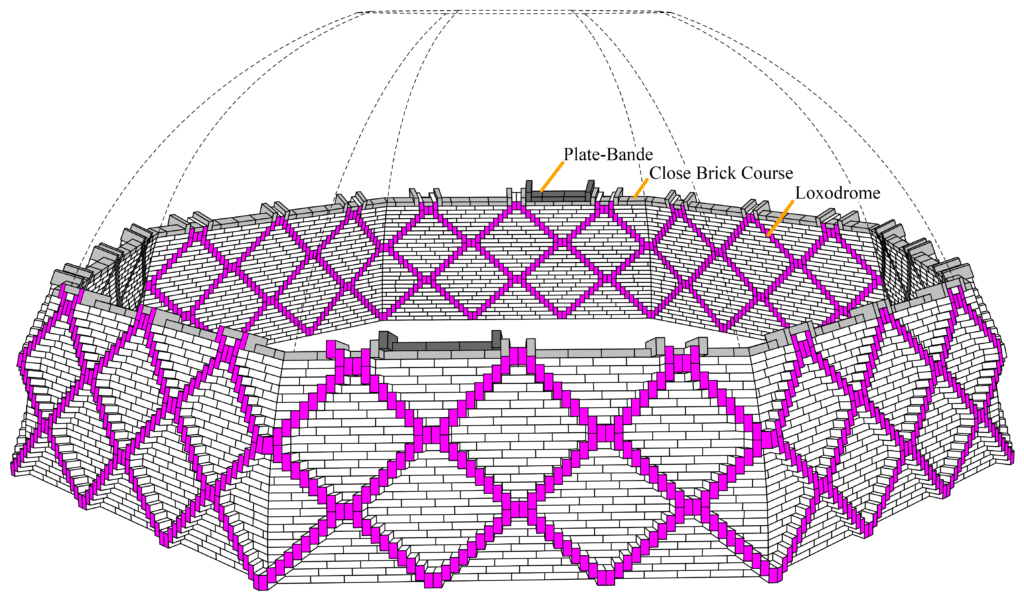
A diagram showing the “complex
cross-herringbone spiralling pattern” of the double loxodrome.
Courtesy of the researchers.
The study, led by Sigrid
Adriaenssens, professor of civil and environmental engineering at
Princeton; Attilio Pizzigoni, professor of engineering and applied
sciences at the the University of Bergamo; and Vittorio Paris, a
graduate student at the Italian school, was published in the July
2020 issue of academic journal Engineering
Structures, out
now.
“With these studies, we aim to
approach moments in history when the sole form of technology
available to man was the abstract rationality of geometry,”
Pizzigoni told Princeton
Engineering. “What
we as designers, architects, and builders can learn from the past
is the knowledge of a structural equilibrium of form based on the
geometry of materials and of their reciprocal measurements in
three-dimensional space.”
The double helix model was
designed by architect Antonio da Sangallo, who was born in Florence
1484. It is believed to be based on the single helix structures
developed a century earlier by Filippo Brunelleschi, who was
responsible for the Santa Maria del Fiore—which is still the
largest brick dome in the world.
The design, says Pizzigoni, is a
capstone of Renaissance thinking that blends the
“stability, beauty, and
utility…between engineering, construction, and
architecture.”
“Nothing is more moving,” he
goes on, “than reading the lightness of the heavens in stone, in an
absolute and simple form such as that of the Florentine
cupola.”
The post A High-Tech Investigation Has Finally Figured Out
the Brilliant Trick Renaissance Architects Used to Make Their Domed
Churches appeared first on artnet News.
Read more https://news.artnet.com/art-world/researchers-domed-churches-renaissance-possible-1867764
Further reading


Leave a comment