
The Gray Market: Why Selling the Mona Lisa Would Be a Ridiculous Way to Try to Dig France Out of Massive Debt (and Other Insights)
Every Monday morning, Artnet
News brings you The Gray Market. The column decodes important stories from the
previous week—and offers unparalleled insight into the inner
workings of the art industry in the process.
This week, crashing a thought
experiment…
LOUVRE IT OR LEAVE IT
On Tuesday, the Independent relayed a provocative proposal by
entrepreneur Stéphane
Distinguin: that the French
government could help eliminate its colossal (and still building)
debt from the global crisis by selling the Mona Lisa. And after
careful consideration, I’m here to tell you that it is a
hilariously bad idea—just
not for the reasons you might think.
For context, Distinguin laid out
his argument in a lengthy op-ed
in French-language magazine
Usbek & Rica in early May. The gist is that it’s good
business in times of financial crisis to sell any assets that are
both easily transferable and able to bring back outsized value in
comparison to what would be lost in the trade. The Mona Lisa, which
continues to draw millions of visitors to the Louvre every year by
virtue of its status as the world’s most famous painting, fits the
description.
Distinguin admits that the price
must be “insane” for this plot to be worth pursuing, but his
efforts as a recreational art economist have left him convinced
that the Mona Lisa would indeed incite the necessary market frenzy.
In fact, he’s even landed on an asking price that he believes
perfectly straddles the line between hysteria and
achievability: €50
billion ($54.5 billion).
Yes, that’s “billion” with a
“b.” And if you think it’s absurd to suggest Leonardo’s best-known
painting would go for two orders of magnitude more than his $450.3
million Salvator
Mundi, Distinguin has an
answer for you: ”I was told
that my estimate was very overvalued, even far-fetched, but each
time without real arguments.”
In short, he’s standing firm on
this hill.
Now, before I launch into what I
would consider my “real argument” for why he is wildly, comically
off target, I just want to call out two important points: first,
I’m sure some of the finer points in his op-ed are being lost in
Google Translation; and second, he states that his idea is an
intentional “provocation” intended to advance a larger, legitimate
conversation.
I respect this
approach,
so let’s use the same
one as we run up that hill of his, shall we?
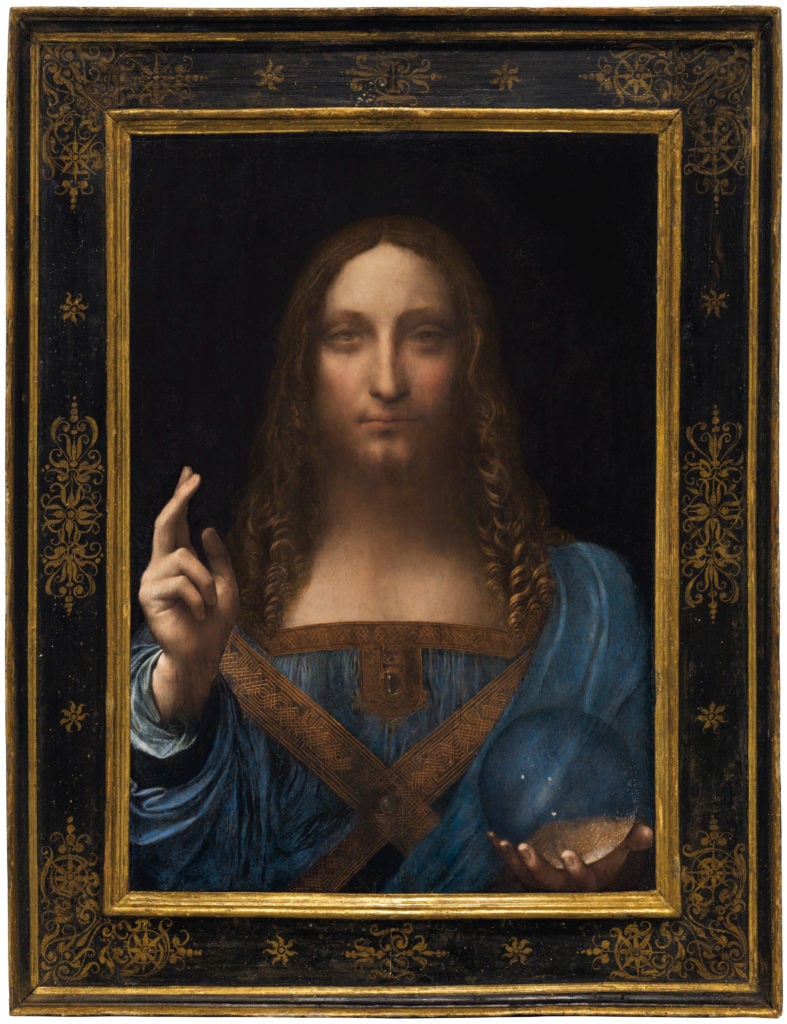
Leondaro da Vinci, Salvator
Mundi, ca. 1500. Courtesy of Christie’s Images Ltd.
STRANGER IN A STRANGE LAND
Distinguin rests his
€50 billion valuation for the Mona Lisa on three
pillars. The first is a cursory price comparison
to Salvator
Mundi (in which he also
unhesitatingly co-signs my colleague Kenny Schachter’s
conclusion about its location). The translation reads:
“Salvator
Mundi, which was much
less certain, was bought for $450 million to end up on the yacht of
a Saudi prince. We can expect more than 100 times more for the most
famous painting in the world, with the significant premium of the
first.”
His second point is that Italian
officials allegedly
assigned an insurance value of at
least €1 billion ($1.1 billion) to Leonardo’s
celebrated sketch Vitruvian Man when Venice’s Gallerie dell’Accademia loaned the work to
the Louvre for its
blockbuster Leonardo retrospective last year. The only place I can
find any reference to this valuation comes from the local Italian
media, who, to put it diplomatically, have earned an international
reputation for being cavalier with facts. But for the sake of this
exercise, I’ll accept the valuation and keep moving.
His third point is that the Mona
Lisa’s gargantuan value to French tourism should be factored into
any consideration of its price. He estimates that at least two
million tourists travel to Paris strictly to see the painting every
year, and that each tourist spends approximately
€1,500 ($1,635) during their stay. Therefore,
the Mona Lisa is worth at least €3 billion ($3.3 billion) to the French economy
annually. In that context, €50 billion would be a steal to buyers,
as it would equate to slightly less than 17 years’ worth of its de
facto earning power.
This, dear reader, is the
argument that Distinguin found critics unable to pierce as of May
6, 2020. Whether that says more about him or who he’s been
listening to is a question I’ve been pondering for
days.
Okay, let’s hit these three
points in reverse order. Distinguin’s invocation of tourism value
is creative outsider thinking. The only problem is that it’s
completely irrelevant to the way real dealers, appraisers, and
collectors actually determine the market value of
artworks.
After 15 years in the business,
I have never once heard of a museum calling in an economist to
calculate a painting’s share of annual gate revenue, let alone
metropolitan tourism value, before deciding on a fair target price
for its deaccessioning. It’s not necessarily a bad idea; it just
has no connection to reality, like when the average teenager
declares from the depths of their first awful hangover that they’re
never going to drink again.
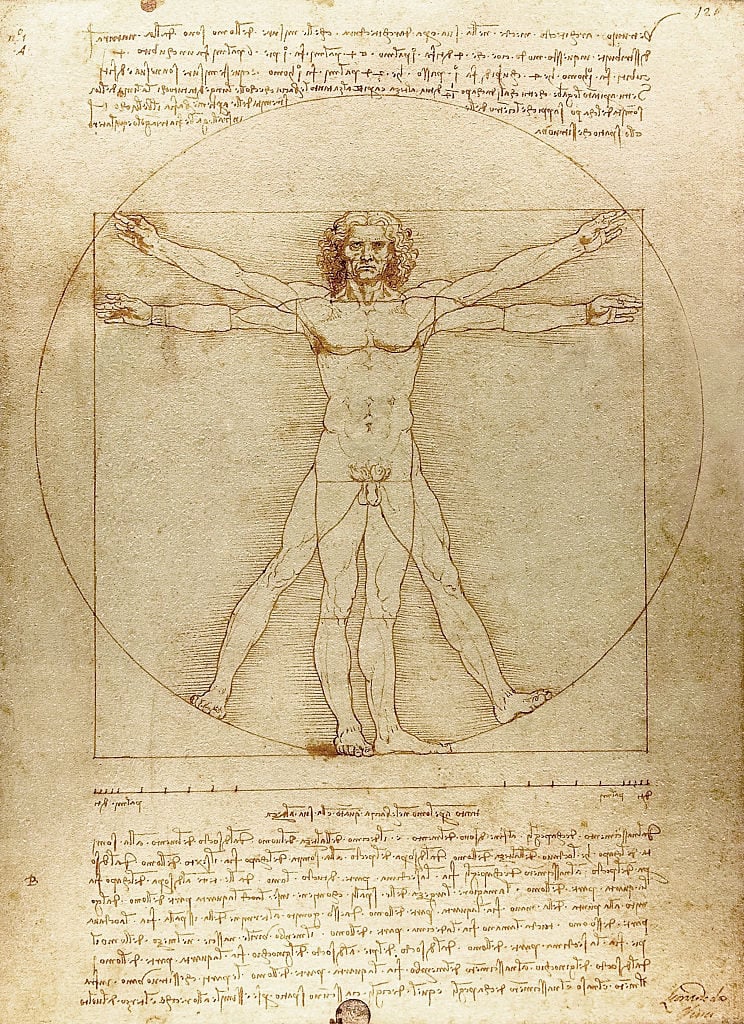
Leonardo da Vinci’s Vitruvian Man
(Canon of Proportions) (c. 1490) at Gallerie dell’Accademia in
Venice. Photo: VCG Wilson/Corbis via Getty Images.
What do museums do instead? Call
in fine-art appraisers, usually from auction houses hoping to
secure the consignment. And in addition to assessing the work’s
physical condition, the appraisers largely base their valuations on
direct sales comps.
This leads us to the
supposed €1
billion insurance valuation for Vitruvian Man. Similar to the tourism value conversation,
this point is one that no doubt seems intriguing to art-market
outsiders… and instantly proves to art professionals that
Distinguin has very little understanding of how the industry
actually works.
The key is this: insurance value
and market value are related but not interchangeable. A full accounting of why would be its own
post (which, incidentally, I wrote here).
But as a rule, insurance valuations tend to be anchored
artificially high. The reason? If the work is damaged, the
insurance value becomes the number from which the insurance
carrier’s own appraiser must calculate a “percentage loss in value”
to determine an appropriate payout to the
policyholder.
Since that appraiser is
incentivized to minimize the loss to the carrier (their client),
i.e. to determine the lowest possible percentage loss, it’s smart
business for the policyholder to secure the highest initial
insurance valuation they can. (For example, 20 percent of $1,000
means way more cash than 20 percent of $100.) Sure, the
policyholder will have to pay a higher premium in the interim, but
it could more than make up the difference if they need to file a
claim later on. So even if Vitruvian Man did have a €1
billion insurance value—again, a questionable data point to begin
with—that doesn’t mean we
should consider it likely to fetch anything close to that value if
it were to actually come to market.
That leaves us with Distinguin’s
comp to the Salvator
Mundi. In principle,
it’s his best argument for getting the Mona Lisa to
€50 billion. If only he’d done a little
auction-history homework before thundering in with the most
bombastic profit projections this side of a Ponzi
scheme….

Jussi Pylkkanen, global president of
Christie’s, takes bids Pablo Picasso’s Les femmes d’Alger
(Version O) at Christie’s on May 11, 2015 in New York City.
Courtesy of Andrew Burton/Getty Images.
HISTORY LESSONS
Is the Mona Lisa worth more
than Salvator
Mundi on the open
market? Absolutely.
Is it worth
significantly
more? Yeah, I think
so.
But “more than 100 times more”?
(111.1 times more, to be exact.) That’s where I have to say, “Pump
the brakes, mon
ami.”
Here’s the problem: Saying
“Salvator
Mundi, which was much
less certain, was bought for $450 million”—therefore “we can expect more than 100 times
more for the most famous painting in the world” is very similar to
saying, “Hicham El
Guerrouj, who only had the
benefit of late-1990s training methods in Morocco, set the world
record by running a mile in three minutes and 43
seconds—therefore we can expect more than 100 times
more speed for the best middle-distance runner in a more advanced
future, making it
reasonable to assume the next
record for the mile will be 2.01 seconds.”
Now, you can of course try to
downplay that comparison by saying that the art market is not bound
by the same limits as human physiology. Obviously, that’s true. But
my point is that sudden 111-fold increases within the same category
almost never happen. It’s not as if
the most expensive painting ever auctioned before
Salvator Mundi
sold for $4.05 million!
Art-market history proves as
much. My feature for the Fall 2019 Artnet
Intelligence Report included an inflation-adjusted comparison of
all seven works that held the title for priciest painting sold at
auction in the preceding 30 years. The full list shows just how
preposterous it would be to assume that even the most famous
painting in the world could sell for €50
billion anytime in the near future, even if the world weren’t
staring down the worst economic carnage since the Great
Depression.
In 2019 dollars, the
premium-inclusive price of Salvator Mundi (which was sold in November 2017) was $470.6
million. Once you make the same adjustment for the previous
record-holder, Pablo Picasso’s Les femmes d’Alger (Version ‘O’)
(sold in May 2015), its price comes in at
$193.8 million. On an even playing field, then,
Salvator Mundi
was less than 2.5 times pricier
than its closest competitor in three decades.
Just as crucial, that 2.5X
increase was itself a huge—and
hugely unlikely—step
up. This becomes apparent from the other five paintings that
previously held the “most expensive” title. Adjusted to 2019
dollars, their prices range from $125.1 million to $161.7
million.
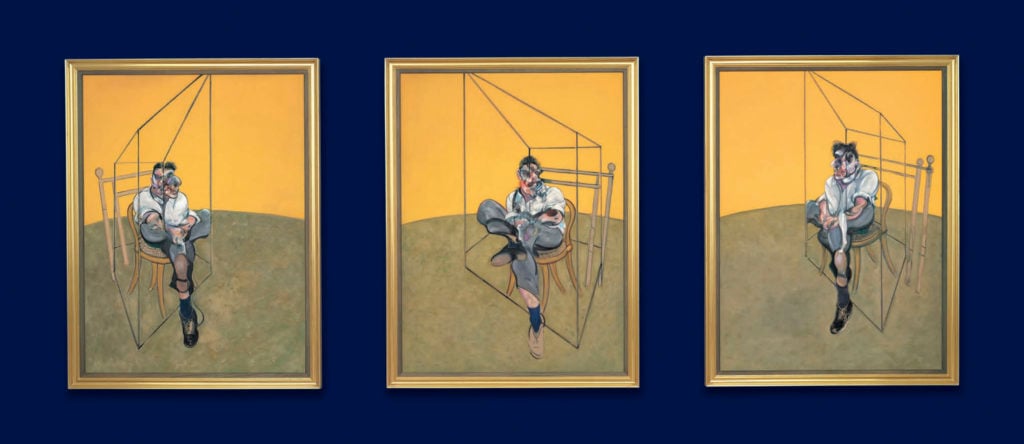
Francis Bacon, Three Studies of
Lucian Freud (in 3 parts) (1969). Photo courtesy Christie’s
Images Ltd.
Proportionally speaking, then,
the largest leap between two works on the list prior to
Salvator Mundi
was between Francis Bacon’s
Three Studies of Lucian
Freud (sold in November
2013) and Les femmes
d’Alger (Version ‘O’), sold a year and a half
later. How many more times pricier was the latter than
the former? Less than 1.25X.
So what was the smallest
difference in sales price between two works on the list? It turns
out that the record price actually once decreased when you convert the two sales to real dollars.
Although Picasso’s Nude,
Green Leaves and Bust sold in the auction room for $2.3 million more
than the artist’s Garçon
à la Pipe did
six years
earlier, adjusting for
inflation shows the true price of Nude, Green Leaves and Bust
was $16.2 million lower than its
predecessor—a drop of 11
percent.
So from 1989 to 2019, every new
record-holder for most expensive painting at auction sold for a
price between 0.89 times and 2.5 times more than the previous
record-holder. Reminder: Distinguin is suggesting that, less than
three years after the Salvator Mundi shattered the previous price apex by the
largest margin in 30 years, the Mona Lisa would sell for
111 times
more.
Could it still happen, though? I
mean, it wouldn’t violate the laws of nature. But the next time a
tornado hits my hometown, it could also reduce the house I grew up
in to a pile of wreckage that, viewed from just the right angle,
looks uncannily like a supersized version of Michelangelo’s
David. That doesn’t mean the local tourism board
should structure their plans around it!
In seriousness, having read the
rest of his op-ed, I honestly think Distinguin’s heart is in the
right place, and there is
some wisdom in his proposal to sell the Mona Lisa. It at least
recognizes that, whether in the cultural sphere or the political
one, the path to a better world demands real people make actual
sacrifices. The sooner we all make peace with that inconvenient
truth, the better off we’ll be.
Let’s just try to do it with
some grounding in factual reality, because as the internet kids
say, this ain’t it. Otherwise, we’ll only make matters worse than
they already are in this historical catastrophe—and Mona Lisa’s
famous smile will read like the mockery we deserve.
[The
Independent |
Usbek and
Rica]
That’s all for this week. ‘Til
next time, remember: genius is often criticized in its own time,
but that doesn’t mean that every idea criticized in its own time is
genius.
The post The Gray Market: Why Selling the Mona Lisa Would Be a
Ridiculous Way to Try to Dig France Out of Massive Debt (and Other
Insights) appeared first on artnet News.
Read more https://news.artnet.com/opinion/mona-lisa-sale-1869297
Further reading


Leave a comment