
Why Does Red Represent Power? A New Book Reveals How Natural History Drives the Cultural Evolution of Color
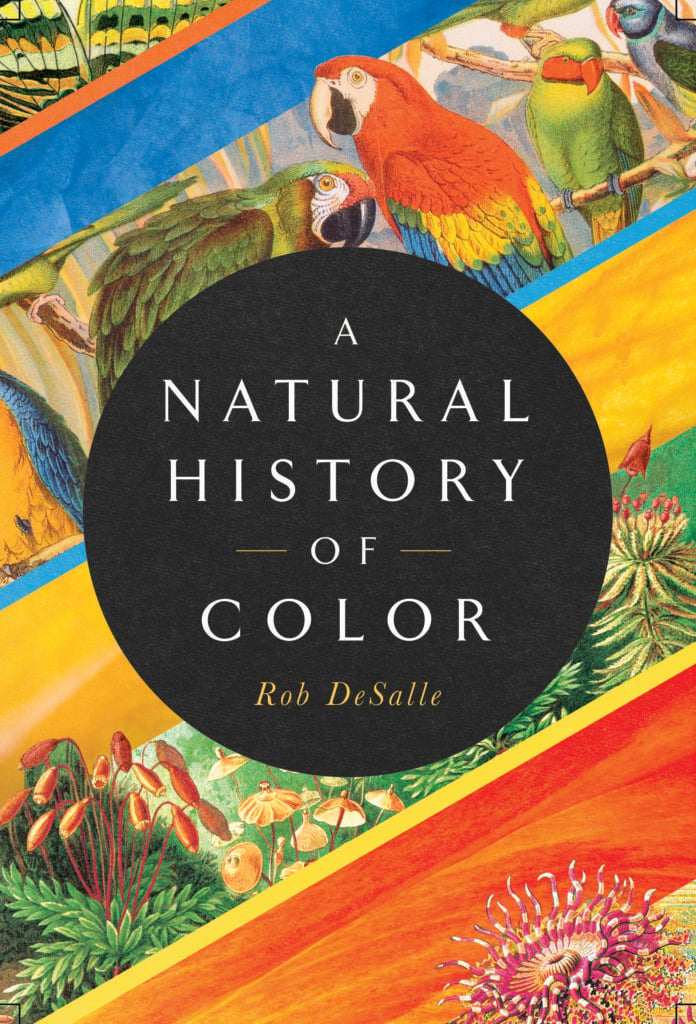
American Museum of Natural History curator Rob DeSalle’s new
book A Natural History of Color explores how cultural
meanings get attached to colors, and how they evolve over time. In
this excerpt, he examines the lifecycles of red, pink, and
blue.
The use of red in clothing often means power, or “look at me—I
stand out.” Look no further than the 2016 presidential race in the
United States, where one candidate is famous for wearing an overly
long red tie and the other a red power suit. The stylist Bill Blass
once said, “When in doubt wear red,” probably because if you aren’t
interested in making a specific statement with color, the best
thing to do is make a power statement. Since red can also mean
“look at me,” it is one of those colors that has a dual meaning in
Western cultures. Often it is considered garish or less than
honorable. Just think red-light district, or Sting’s lyrics from
“Roxanne”: “You don’t have to put on your red light.” And while
there were some pretty tacky tuxedos in the 1960s and 1970s, the
color red was so tacky that very few males wore red ones to the
prom. Today the staid color black is the norm for tuxedos. Tacky or
dishonorable uses of red directly contrast with its use as a symbol
of power. Red conveys emotions too, like passion and romance,
anger,
dangerous feelings and volatility.
Colors are often used to establish group membership and form
bonds. While there are many examples in American sports, the color
red is used throughout the globe for sports teams as a way to make
group (be it team or fan) divisions easily recognizable. But it’s
not just sports where the color red and other colors are used to
engender group identity. In the United States, political parties
are identified by red and blue—so much so that a state is
designated as a red state or a blue state depending on whether the
state leans toward conservativism (red) or liberalism (blue). In
Australia, it is reversed, as the Liberal Party (which leans more
to the conservative right) is represented by blue; the Labor Party
(which is liberal leaning) is represented by red; and of course,
the Green Party is represented by green. In most European countries
the left-leaning parties are represented by red. While these color
preferences for political parties are rather new, using color to
identify political philosophies is older. The red flags of the
People’s Republic of China and the now dissolved USSR are good
examples of red representing political movements in these
countries. The red in the flag for the USSR goes back to the French
Revolution, where a red flag, or Red
Banner, was oppositional to the upper class and represented
protest. Later the Paris Commune of 1871 adopted a red flag. The
use of red in both earlier movements were adopted by the USSR as it
was being formed as the color of the national flag. The red in the
Chinese flag has a much deeper history though. Confucianism used
red as a symbol of luck, happiness, and joy, and this meshed nicely
with the Marxist leanings of the Cultural Revolution in China. It
is almost as if the red in the Chinese flag was preadapted to
represent Maoist thinking. Red pops up in Mao Tse-tung’s Little Red
Book, in the de facto anthem of the Chinese republic (“The East Is
Red”) and the famous chime of the Chinese people that Mao is “the
red sun in our hearts.” Other non-Communist cultures developed an
aversion to red. Not wanting to be associated with Marxist, Maoist,
or Communist thinking, they chose yellow as the go-to color for
protest.
Red is also used ceremonially, including in weddings and
religious rites. In India brides wear red saris, which represent
fertility and prosperity for the Hindu women who are marrying. Red
also has the traditional meaning of love in Hindu cultures, hence
the use of red in a wedding rite. Many Asian cultures have adopted
red as a sign of auspiciousness, and red in the Hindu wedding rite
appears not only in the bride’s dress but also in other objects
used in the rite representing good luck and providence. Contrast
this with the now popular use of white dresses for the bride in
Western wedding rites. In 1840 Queen Victoria wed Prince Albert in
a white dress, and this started a trend in the West of white as a
wedding dress color. White in this context also meant wealth
because of the tradition of wearing the dress only once. Prior to
the tradition, brides wore their favorite dress at weddings, but if
they could marry in white and then store the dress, this was a sign
of wealth. Red also was developed as a very important color in the
Catholic religion, as it represented the blood of Christ. Red was
also the color of the cardinal’s robe and signified the willingness
of these religious leaders to shed their blood for Christ.
Red was a difficult color to create before modern times because
there was no readily available red dye for clothing. While red
ochre could easily be created from specific kinds of earth, it was
a dull red and not a very good dye for clothes. As the New World
was colonized, dyes that fit the bill for various colors were
discovered and brought back to Europe. In 1523 the Spanish
explorers returned with a brilliant red dye called cochineal, which
quickly became valuable and rare in Europe. It comes from insects
(Dactylopius coccus) that live on cacti in Central and South
America and was discovered by the Native Americans from these
regions over two thousand years ago. People from these regions
cultivate the insects, dry them, and crush them to produce the
brilliant red dye. They kept the process a secret as well as they
could, so the dye became rare and coveted by Europeans. The rarity
of these red dyes allowed only those of high status to use them. It
is not surprising that Europeans developed a penchant for the color
red via cochineal. Among the Inca, red conveyed a high status, as
only the king was allowed to wear red clothing dyed using
cochineal. The Aztec rulers also recognized the sign of high status
from the color red in general, and cochineal specifically, and they
would demand tribute in the form of cochineal.
Even if we go a little off red to pink, the cultural
ramifications are still significant. In the 1700s, three
portraits—The Blue Boy, Pinkie, and The Pink
Boy—foreshadowed the use of pink and blue to indicate
masculinity or femininity. Blue Boy, painted in1770 by
Thomas Gainsborough, depicts a young man decked out in blue pants,
jacket, socks, and shoes. He maintains a very masculine stance,
with one hand on his hip holding a blue cape. In his dangling hand
he holds a dark blue hat. His hair is a bit tussled, and his gaze
is very boyish, as anyone with a tweenish son can attest.
Pinkie was painted in 1794 by Thomas Lawrence. It shows a
young girl in an ankle-length pink dress, with a dark pink sash
across her waist. The dress is flowing in the wind. She wears a
pink bonnet with the ribbons also flowing in the wind.
Pinkie has one hand behind her back and the other crossing
her body just below her neck in a quite graceful pose. Her face is
blushed pink throughout, and while Blue Boy has some pink
in his cheeks, the contrast between the two faces is striking.
Twelve years after Blue Boy, Gainsborough painted Pink
Boy. This boy strikes a masculine pose similar to that struck
by Blue Boy. Pink Boy holds his hat in his left
hand, his right hand free, his face blushed as pink as the suit he
is wearing. Fast-forward to the early 1900s, and it would not be
unusual to dress a male baby in pink or blue in the USA and Europe.
But as the 20th century progressed, pink became the color for girls
and blue the color for boys as a result of targeted marketing of
wholesalers. This artistic pink and blue dichotomy is what we would
call a weak or neutral CSV [cultural survival vehicle, or what
gets learned and passed on]. Preference for blue as masculine
and pink as feminine wavers back and forth even across generations.
As we implied earlier, parents were confused in the early 1900s as
to whether pink was a good color for their male offspring. In the
1960s and 1970s, pink was entrenched as a feminine color.
Words get created all the time, and in 1989 Susan G. Cole
created a perfect term—“pinkification”—in her book Pornography
and the Sex Crisis. This term literally means “the act or
process of being made pink or being saturated with pink.” Cole’s
book is about sexual suppression and the subordination of women by
men. Cole used “pinkification” as a reminder that the color pink
and its implication of femininity and its spread in cultures was
problematic and contributed to subordination. Cole was probably
very familiar with Barbie dolls and their pinkification. Pink is a
dominant color in Barbie’s wardrobe, while her male counterpart,
Ken, rarely has pink in his. Even astronaut Barbie (released in
1985) gets in on the act, with a white space uniform and pink
helmet, pink moon boots, and pink bands marking the uniform around
her waist, thighs, and ankles. Her oxygen tank is even pink. In a
more recent example, JeongMee Yoon, a Korean artist and
photographer, created the 21st-century Pinkie and Blue
Boy with her art installation The Pink and Blue
Project. She placed young children in their bedrooms with
typical kid items, but for the male children the items were mostly
blue and for females the items were mostly pink. The photographs
are stunning and demonstrate Yoon’s initial observation and
stimulus for the project, which was that the phenomenon is tied to
marketing, which specifically targets girls with pink and boys
with blue. Currently the Pussyhat Project is popular. This movement
recently found prominence in several Women’s Marches across the
globe. It was started as a symbol of unification; women at these
marches wear pink wool caps topped with little pussycat ears. It is
quite impressive to see these marches, where a significant
proportion of women in the march don these hats to produce a sea of
pink. As we write this book, the Pussyhat Project is under fire for
using the color pink for a wide variety of reasons, including, but
not limited to, the assertion that while pink represents
femininity, it does not represent all women. Oh, and in 2019, pink
is now the “new black,” as it is used widely in suits, shirts, and
ties for men. This fallout demonstrates further the fragility of
color involved in CSVs.
Remember that we are discussing mostly Western cultures here.
There are many parallel stories around the globe. For example, as
marketing gets more and more global, the preference for pink as
feminine and blue as masculine tugs back and forth at each other.
We focus mostly on red (and its diluted cousin, pink) in this
chapter to demonstrate the lability of color preferences in the
history of some cultures. How do people use any of the other
primary colors that humans perceive? A cultural history of color,
instead of a natural history of one, would certainly make for a
tremendous follow-up to this book.
Excerpted from A Natural
History of Color by Rob DeSalle. Pegasus Books Ltd. Copyright ©
2020 Rob DeSalle and Hans Bachor. First Pegasus Books edition July
2020.
The post Why Does Red Represent Power? A New Book Reveals
How Natural History Drives the Cultural Evolution of Color
appeared first on artnet News.
Read more https://news.artnet.com/art-world/rob-desalle-natural-history-of-color-1869513
Further reading


Leave a comment