
How Christo and Jeanne-Claude Brought 6 of Their Most Remarkable Projects to Life, From ‘The Gates’ to ‘Valley Curtain’
Husband-and-wife artist duo Christo and
Jeanne-Claude created some of art history’s most memorable
and monumental installations, yet they often took pains to make the
distinction between scale and complexity.
“In fact, they are very humble projects, very simple projects,
but they need to be put together in an incredibly clever way,”
Christo once told Artnet News.
To mark Christo’s death—on May
31 at age 84—we’ve revisited six of the couple’s most beloved works
of art, and the hurdles they had to surmount to bring them to
life.
The Gates, New
York
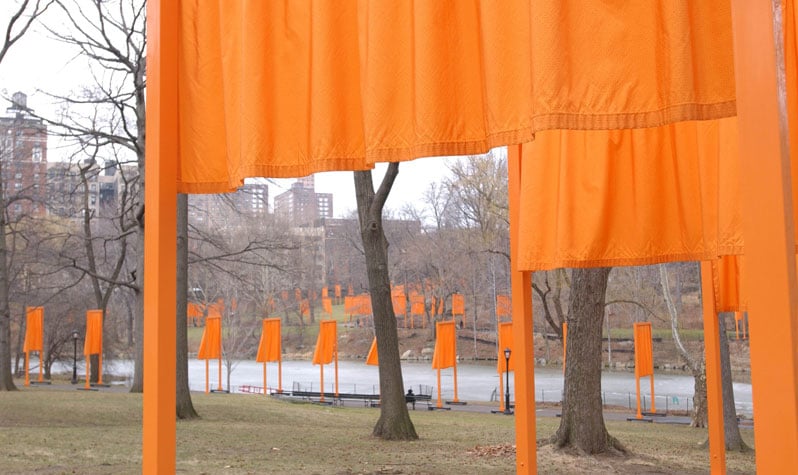
Christo and Jeanne-Claude, The
Gates (2005), Central Park. Photo by Spencer Tucker, courtesy
of NYC Parks.
Where: Central Park
When: February 12–28, 2005
What: A team of 600 workers installed
7,503 gates across 23 miles of pathways in Central Park. From each
gate, spaced out at 12-foot intervals, hung a sheet of
saffron-colored fabric, seven feet above the ground and free to
blow in the wind, creating a golden ribbon of light streaking
across the park in the dead of winter.
How long it took to realize: 26 years
Biggest challenge: The
Gates was ultimately a triumph, drawing four million
visitors to Central Park. But back in the late 1970s, when the duo
first conceived of the work, New York City was blighted by crime
and the park was in a state of neglect. The Parks Department
initially turned down the artists’ permit applications, due in part
due to opposition from neighborhood organizations and conservation
groups such as the Audubon Society, which feared the potential
environmental impact of The Gates.
Most ingenious tactic: Undeterred by
setbacks, Christo and Jeanne-Claude opted to wait until they found
a powerful ally—Mayor Michael Bloomberg—who supported the project. Christo didn’t
even bother to read the Parks Department’s 107-page rejection
report in 1981, assuring the New York Times
that “I am in good health, the park is still there, and I will do
that project.”
Running Fence, Marin
and Sonoma Counties, California
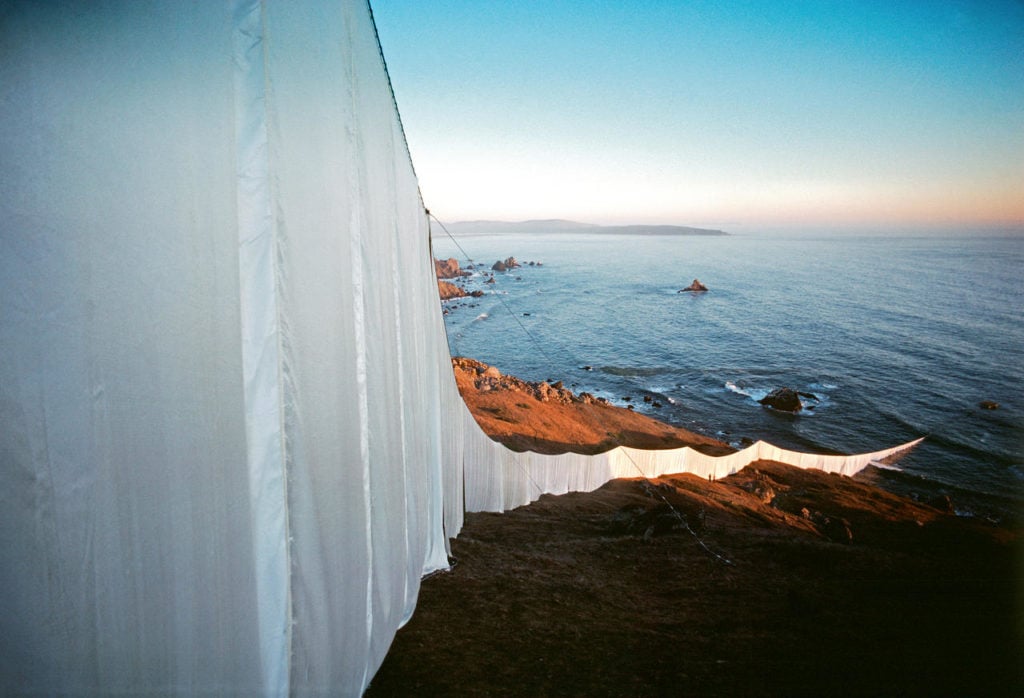
Christo and Jeanne-Claude, Running
Fence, Sonoma and Marin Counties, California, (1972–76). Photo
by Wolfgang Volz ©1976 Christo.
Where: Along the coast of the Pacific
Ocean and Freeway 101
When: September 10–24, 1976
What: The artists hung an 18-foot-tall
rippling curtain of white nylon fabric—more than 2 million square
feet in total—along a steel cable strung between 2,050 steel poles,
stretching 24.5 miles along the California coast in the North
Bay.
How long it took to realize: Three and a
half years
Biggest challenge: Christo and
Jeanne-Claude navigated 18 public hearings and three superior court
sessions in California to get approval for the piece. They also
sat down individually
with 59 ranchers who owned the land along the project’s route to
convince them to take part. They got everyone from art students to
Hell’s Angels motorcyclists to help with the five-month
installation.
Most ingenious tactic: When the California
Coastal Zone Conservation Commission denied the last permit for the
project, for the section that would run into the ocean at
Bodega Bay, Christo and Jeanne-Claude didn’t flinch—they just
installed it anyway.
Valley Curtain,
Rifle, Colorado
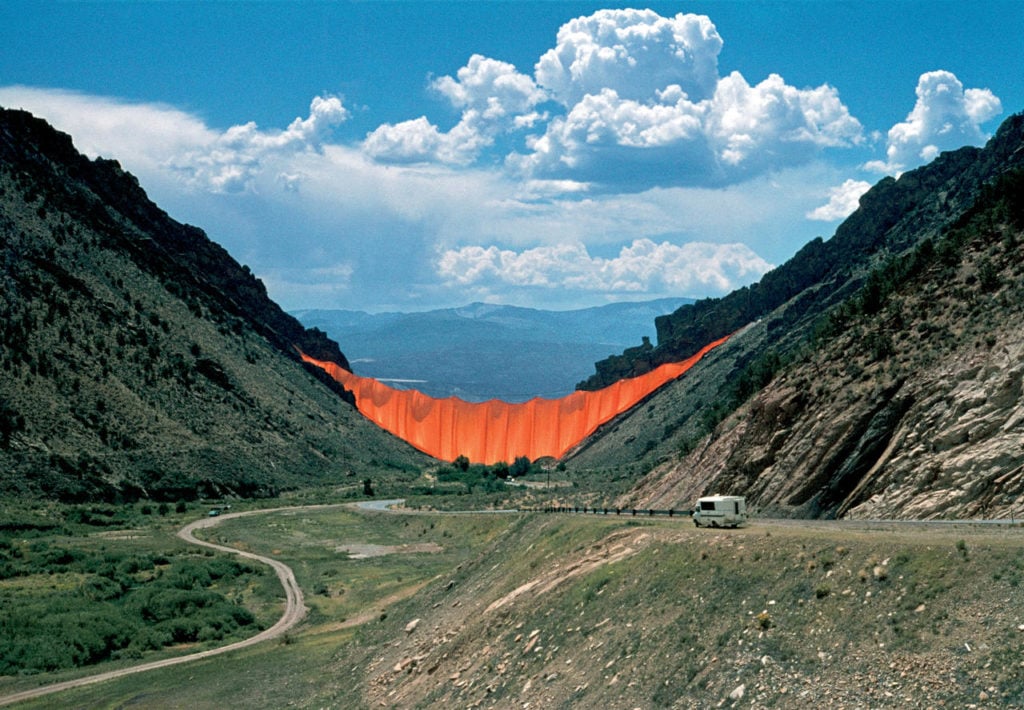
Christo and Jeanne-Claude Valley
Curtain (1970–72), Rifle, Colorado. Photo by Wolfgang Volz,
©1972 Christo.
Where: Between Grand Junction and Glenwood
Springs in the Grand Hogback Mountain Range
When: August 10–11, 1972
What: Christo and Jeanne-Claude erected a
250,000-square-foot orange curtain of nylon polyamide fabric across
the 1,250-foot-wide Rifle Gap, 300 feet tall at its biggest
point.
How long it took: Over two years
Biggest challenge: Officials from the
Colorado Division of Highways were on board with Valley
Curtain from the start, but it still took two tries to bring
this work to life. An attempt to install the piece on October 9,
1971, failed when workers dropped the massive curtain as a gust of
wind tore through the valley. The rocks shredded the fabric and
delayed the project until the following summer. As a team of 35
construction workers and 64 art students and other helpers worked
to unfurl the second curtain, a release chain jammed, endangering
the piece yet again as ropes whipped in the wind until the crew
secured the billowing fabric and anchored the work. Only 28 hours
later, winds reached 60 miles an hour, bringing the short-lived
installation to an end.
Most ingenious tactic: To keep the curtain
in place, Christo and Jeanne-Claude installed 864-ton concrete
foundations on either side of the gap, and four 61-ton cables
running across the valley. The curtain was transported inside
a rubber cocoon, and further protected by a second cocoon
inserted inside the fabric.
Surrounded
Islands, Miami
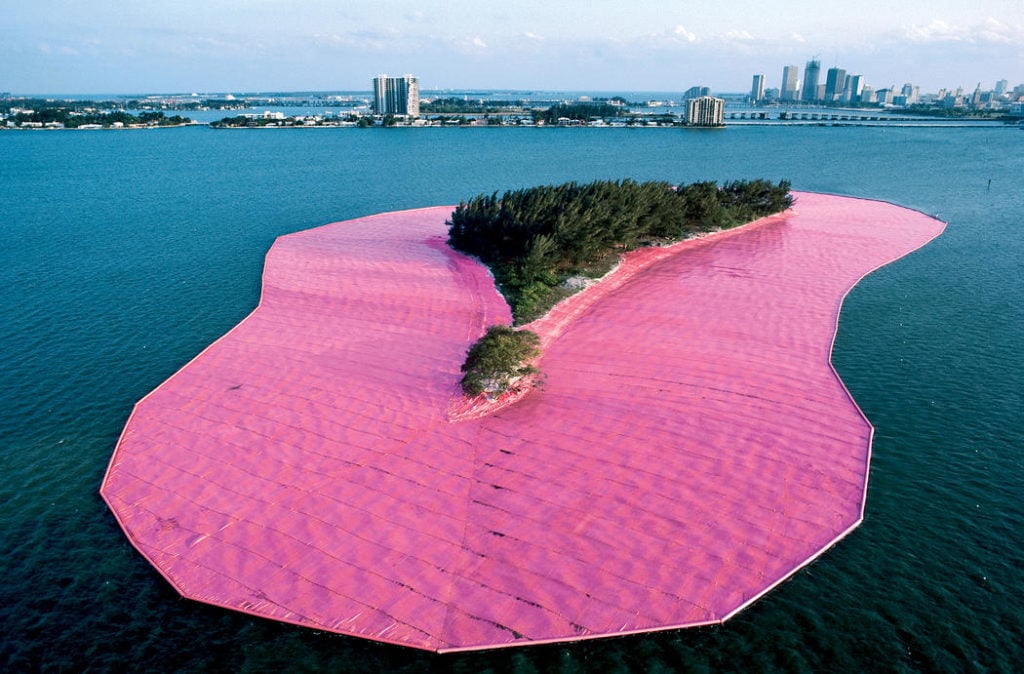
Christo and Jeanne-Claude,
Surrounded Islands (1980–83), Biscayne Bay, Miami. Photo
by Wolfgang Volz ©1983 Christo.
Where: Biscayne Bay, Miami
When: May 7–18, 1983
What: Christo and Jeanne-Claude used 6.5
million square feet of floating pink woven polypropylene fabric to
cover the surface of the water around 11 islands on Biscayne Bay.
The effect was akin to giant pink lily pads.
How long it took: Two and a half years
Biggest challenge: Before Christo and
Jeanne-Claude took an interest, the islands were mainly being used
as garbage dumps. The pair had to remove some 40 tons of rubbish
ahead of installation, including refrigerator doors and mattresses.
Realizing the complicated project required a team that included a
marine engineer, a marine biologist, an ornithologist, and a
mammals expert, as well as a building contractor and lawyers. It
also necessitated a permit with the US Army Corps of Engineers and
led to a lawsuit from wildlife paramedic Jack Kassewitz, Jr.
Most ingenious tactic: Each of the tiny islands
required its own design, the fabric cut to match the contours of
the land. Workers sewed a flotation strip into each seam, and
constructed the fabric accordion style to facilitate the unfurling
during installation. A team of 120 monitors were on site in
inflatable boats day and night, making sure the piece remained
seaworthy and that no animals got caught in the fabric.
Wrapped
Reichstag, Berlin
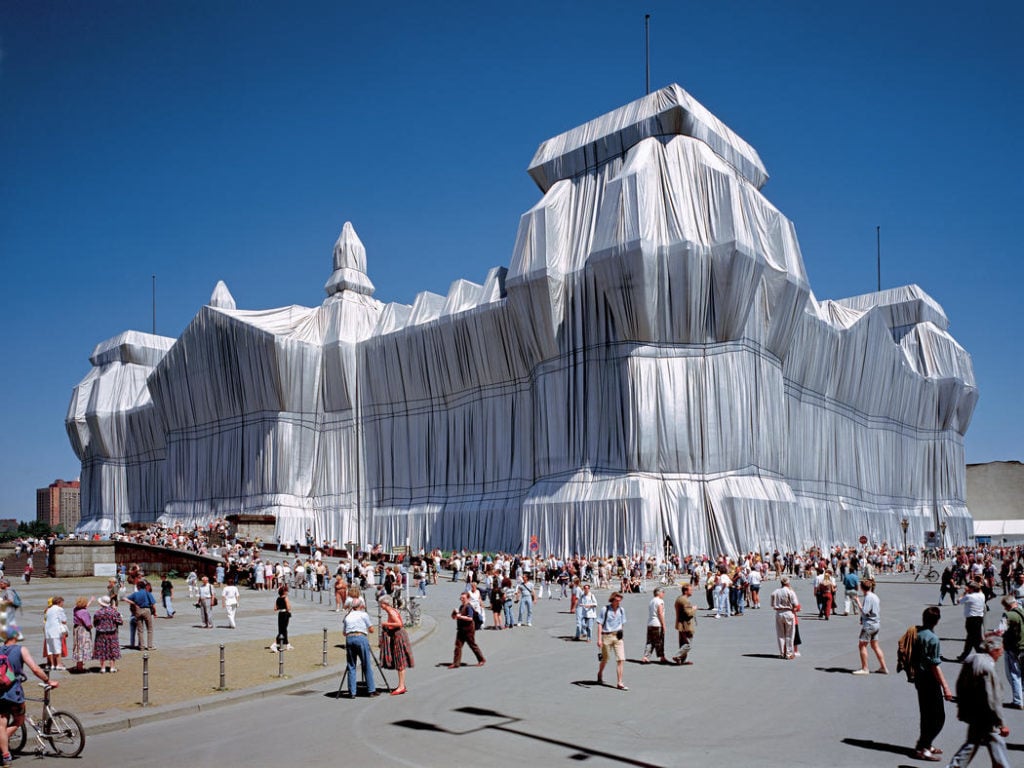
Christo and Jeanne-Claude, Wrapped
Reichstag (1971–95), Berlin. Photo by Wolfgang Volz ©1995
Christo.
Where: The Reichstag, the German
parliament building in Berlin
When: June 24–July 6, 1995
What: More than a million square feet of
silvery polypropylene fabric were draped over a 220-ton steel
structure built around the Reichstag, which was burned by an
arsonist in 1933 and fell into disuse after World War II.
How long it took to realize: 24 years
Biggest challenge: Michael Cullen, a
Berlin historian, first suggested the Reichstag as a possible
project site for Christo and Jeanne-Claude back in 1971, but the
idea went nowhere until German reunification and the fall of the
Berlin Wall. Ahead of renovations in preparation for parliament’s
return to the building, the artists seized the opportunity to
realize the project. But it still wasn’t smooth sailing. Costs for
the work ballooned from $6 million to more than $10 million,
according to the New York
Times.
Most ingenious tactic: To fit the
then-101-year-old building’s unique shape, the artists had to craft
70 tailor-made panels to cover the façades, the towers and the
roof. They also hired 90 specially trained rock climbers as part of
the team who installed the work.
The Floating
Piers, Lake Iseo, Italy
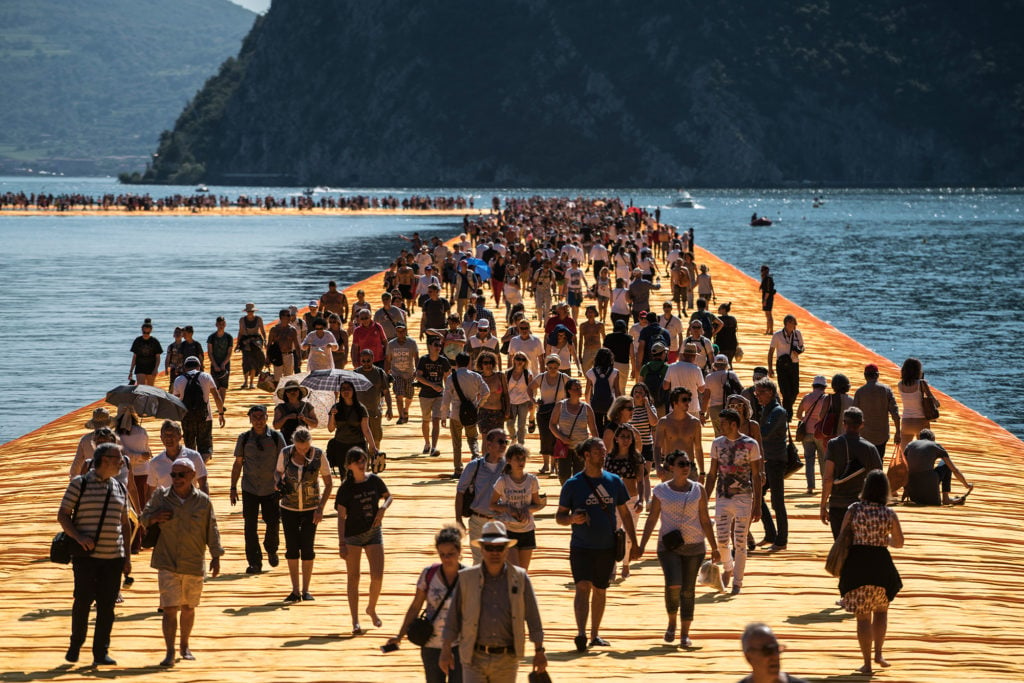
Christo and Jeanne-Claude, The
Floating Piers, Lake Iseo, Italy, (2014–16). Photo by Wolfgang
Volz ©2016 Christo.
Where: Monte Isola and San Paolo, two islands
in Lake Iseo, and the mainland town of Sulzano
When: June 18–July 3, 2016
What: For his first major project since
the death of Jeanne-Claude in 2009, Christo constructed two miles of floating
piers covered in bright yellow fabric.
How long it took to realize: Two years
Biggest challenge: Christo and Jeanne-Claude
originally tried staging the work, conceived in 1970,
in Argentina and Japan, but it was Italy that gave the green
light. The biggest problem came after the project opened to the
public, when tourists flocked to the small town by the hundreds of
thousands. Government officials were forced to shut the work down
overnight and limit access to Sulzano, stranding 3,000 would-be
visitors at the nearest train station and triggering complaints from an Italian
consumer group.
Most ingenious tactic: How do you mimic
the sensation of walking on water?
Christo installed no fewer than 200,000 buoyant polyethylene cubes
floating just above sea level, transferring the fluidity of the
water into the fabric and the body. “This project is unbelievably
sexy,” he told Artnet News at the
time.
The post How Christo and Jeanne-Claude Brought 6 of Their
Most Remarkable Projects to Life, From ‘The Gates’ to ‘Valley
Curtain’ appeared first on artnet News.
Read more https://news.artnet.com/art-world/revisiting-christo-jeanne-claudes-projects-1875495
Further reading


Leave a comment