
What Trump’s Church Photo Op Says About the Widespread Repression of Journalists and Photographers
It’s worth drawing a bright line between two stories.
In an incident that may go
down as one of the most grotesque of a grotesque presidency, Donald
Trump on Monday night used police and the National Guard to clear
the way for a personal photo op. Crowds of protesters were
violently cleared from Lafayette Square in Washington, DC, with
smoke grenades and pepper balls so that Trump could travel to
nearby St. John’s Episcopal Church, the so-called “Church of
Presidents,” which had been damaged by a basement fire during
protests over the weekend.
There, Trump posed for photos with a Bible. Even without knowing
how these images bracket out the surrounding scenes of repression,
the resulting images have an off quality.
Watch the actual footage of the incident, if you haven’t. The
whole thing that justified such an expenditure of force lasts a
little more than two minutes. Trump doesn’t even open the Bible he
clasps so awkwardly.
He speaks briefly and distractedly, clearly focused on the still
image that this will become. He poses in front of the
boarded-up church, first by himself, then with military leaders.
Sirens are blaring nearby in the actual footage, indexing the
off-camera chaos that the picture is meant to suggest he has under
control.
Nothing about it makes sense as an event. It only makes sense
from the point of view of politics reduced completely to
decontextualized media events, to the raw assertion of an image of
authority.
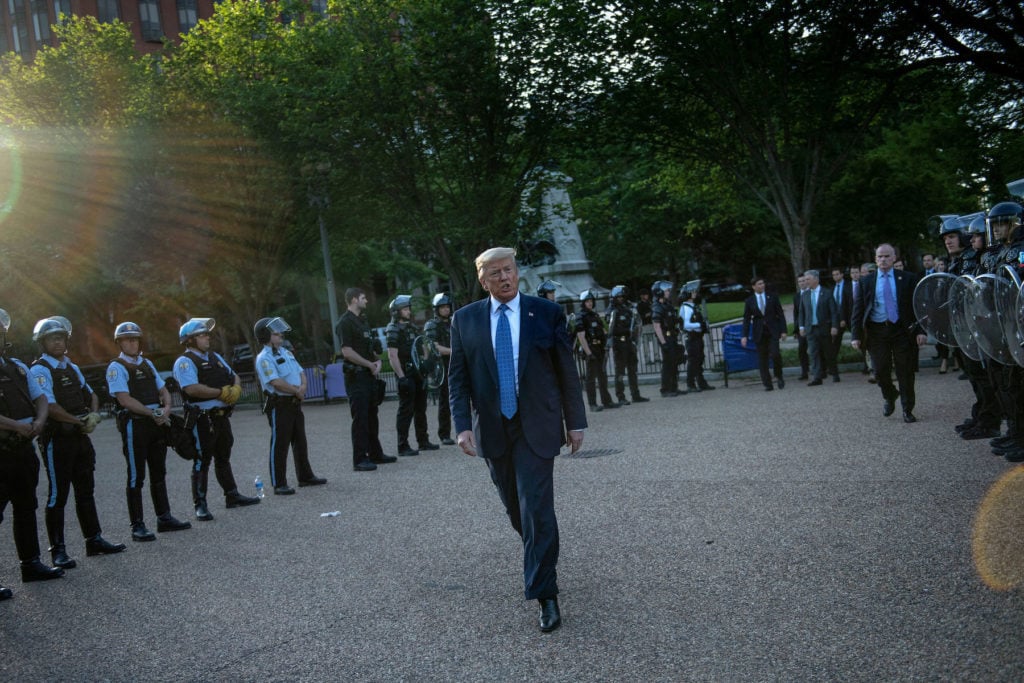
US President Donald Trump leaves the
White House on foot to go to St John’s Episcopal church across
Lafayette Park in Washington, DC on June 1, 2020. Photo by Brendan
Smialowski/AFP via Getty Images.
In the New York Times’s long, thorough
accounting of what led up to the disturbing photo op, you see a
cameraman covering the demonstration in the square just before it
is cleared. You see a black-clad storm trooper surge forward, slam
the cameraman with his riot shield bearing the word “POLICE,” then
aggressively smash his camera down so that it can no longer film
the incident. The police shove the reporter and his companion out
of their position covering the action from a fence. Another officer
beats them with a club across the back as they retreat. (According
to reports, the
cameraman worked for CNN, though I don’t know his name.)
The act of suppressing the protests so that the president could
get to St. John’s has its parallel in the way that the photographer
covering the protests is repressed so that the other photographers
covering the president can generate the image that he wants.
That bridges to the second story I want to link this incident
to: the systematic police
attacks on journalists and photographers since the beginning of the
nationwide round of protests.
As of June 3, the US Press Freedom
Tracker listed more than 233 “press freedom incidents”:
OUR LATEST DATA:
*233+ total press freedom incidents*41+ arrests/detainments
153 assaults (125 by police, 27 by others)
39 equipment/newsroom damageAssault category breakdown:
53 physical attacks (33 by police)
35 tear gassings
21 pepper sprayings
55 rubber bullet/projectiles— U.S. Press Freedom Tracker (@uspresstracker) June 3, 2020
These numbers do not convey the human stories behind these
incidents, which have by now become a predictable feature of the
unfolding crisis.
One of the most horrible is the case of Linda Tirado, a photographer and author
of Hand to
Mouth: Living in Bootstrap America. Tirado is based
in Tennessee, but went to Minneapolis to cover the protests for
George Floyd. She explains what happened to her in a vivid and disturbing
essay for NBC news:
I was only on location in Minneapolis for two days. Thursday
night I got into town around 8 p.m. and went out to take photos. I
saw structure fires and smashed windows but the people I ran into
were mostly just scared and angry and grieving, the property damage
more a symptom than a cause. Friday night was the first night of
curfew, and I started hearing that police were tear-gassing
protesters before curfew had started, without issuing dispersal
warnings.I put on my goggles and respirator and ran into the gas. I was
lining up a photo when I felt my face explode. My goggles came off
and my face was suddenly burning and leaking liquid, the gas mixing
with the blood. I threw up my arms and started screaming “Press,
I’m press,” although I’m not sure if anyone could hear me with my
breathing apparatus and the general chaos around me. Protesters
took my hands and guided me to their medics, who put a bandage on
my lacerated eye and drove me to the hospital.
Tirado underwent emergency surgery. She permanently lost use of
her wounded eye.
She says she couldn’t tell if those who fired on her could hear
her identify herself as press. But read enough of these accounts
from state after state and it becomes clear that photographer after
photographer does identify themselves, only to be
targeted.
This is true of Adam Gray, chief photographer with the
British press agency SWNS, arrested while documenting cops rushing
in on crowds in Union Square on the weekend.
“I photographed the pandemonium that ensued of them pushing and
grabbing protesters before one big cop came at me and pushed me to
the ground with his truncheon to my chest,” Gray told Yahoo News UK. “I
smashed into the floor with my three cameras as three or four cops
then got on top of me, restraining me and putting me in handcuffs
as I shouted repeatedly that I was press.”
The same pattern holds with Tom Aviles, a photographer
with CBS Minnesota station WCCO-TV. He was hit by a rubber
bullet and arrested while covering the intensifying
protests Saturday night. Joan Gilbertson, the producer with
him, says that a patrolman told
her, “You’ve been warned, or the same thing will happen to
you.”
“I’m not fighting”: Tom Aviles, an
award-winning photographer with CBS Minnesota, was arrested and
struck by a rubber bullet while covering protests in Minneapolis
https://t.co/sLIXA8qLaq pic.twitter.com/OU4LsYwSZq— CBS News (@CBSNews) May 31, 2020
On Monday night in New Jersey, Asbury Park
Press reporter Gustavo Martínez Contreras was livestreaming as police threw two
teenagers to the ground. He was actually retreating when an officer
shouted “fuck him, he’s the problem” and tackled Martinez
Contreras to the ground.
He was wearing his official press badge.
The incident was so egregious that it has provoked an official
apology from the state attorney general and will be the subject of
an inquiry. “Once you see the video,” the head of the Asbury Park Press
said, “the only conclusion you can come to is that another
officer didn’t want anyone to film the arrest and took Gustavo down
without asking questions.”
I was arrested during the protest against
police brutality in Asbury Park earlier tonight. I was just
released from the Belmar PD headquarters with a summons for failing
to obey an order to disperse.— Gustavo Martinez (@newsguz) June 2, 2020
In context, this repeated pattern of attacks on
photographers is part of the dynamic of this new
wave of protests.
Professional reporters, heroic as they are, are
not the first to face
the violent repressive force of the law. The line between
journalist and ordinary citizen has become more and more blurred in
the social media age. Every confrontation will now have numerous
participants livestreaming and disseminating images of the
unfolding events as they happen.
It was ordinary neighborhood residents in black communities,
documenting acts of police violence with their smartphones, who
transformed the wider public perception of the issue in the last
decade. For some, like Ramsey Orta, the man who documented the
killing of Eric Garner in Staten Island, their acts of witnessing
have resulted in being systematically terrorized
and harassed.
A classical formulation in political theory states that in
democratic societies, the powers-that-be rule by the combination of
force and consent. It is the “consent” part that distinguishes them
from openly authoritarian societies—leaders wield not just brute,
repressive power but are able to win over enough of the public to
their narrative to maintain stability. This is what Antonio Gramsci
called “hegemony.”
In a deeply unequal and racist society, winning consent involves
image-management, being able to shape the narrative—to tell the
stories those in power want to tell and sideline the ones that are
inconvenient.
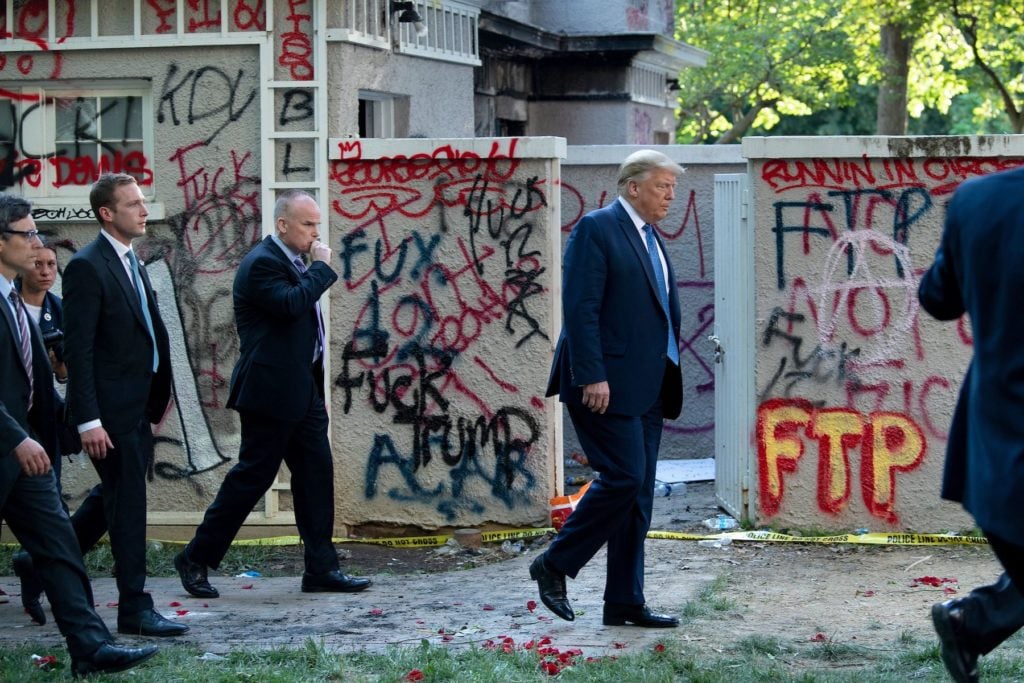
US President Donald Trump walks back to
the White House escorted by the Secret Service after appearing
outside of St John’s Episcopal church across Lafayette Park in
Washington, DC on June 1, 2020. Photo by Brendan Smialowski / AFP
via Getty Images.
I wouldn’t say that the state’s powers of image management are
completely undone. While the vast majority of the public supports
the insurgent wave of protests against racist police
violence right now, the polls also show
that a majority is concerned about violent protest. This is
definitely the pivot on which a hegemonic narrative of the need of
a return to stability, while changing as little as possible, is
going to turn.
While President Trump seems to be in a downward PR spiral,
he can still count on a very loyal
audience ensconced in a filter bubble amenable to his
interpretation of reality.
But the sheer emptiness of the St. James photo op shows that the
effort to win a public relations battle outside of that base is
minimal—maybe because it is actually not possible at this
moment.
That’s what I see when I see the stories of the professional
photographers and journalists being brutalized by the police. This
is not just overreach or excess. This seems to be a symptom of the
fact that the state’s ability to enforce its version of reality is
eaten away. That has led to the explosive spread of radical
protest. The flip side of this is that it leaves the state with
less and less incentive to play nice with those documenting events.
All that’s left is raw force.
The post What Trump’s Church Photo Op Says About the
Widespread Repression of Journalists and Photographers appeared
first on artnet News.
Read more https://news.artnet.com/opinion/trump-photo-op-attacks-journalists-photographers-1878630
Further reading


Leave a comment