
Ruangrupa, the Collective in Charge of the Next Documenta, Reflect on What It Means to Curate in Times of Crisis
ruangrupa is a Jakarta-based collective established in 2000.
Its nine members were selected last year as the curator of the 15th
edition of documenta in Kassel, which is set to take place in 2022.
Here, the collective discusses what it’s like to organize a major
contemporary art exhibition at a time of unprecedented
change.
As ruangrupa looks towards
documenta 15 in 2022, we are rethinking structures for the
production of contemporary art while, just like the rest of the
world, we shift our practices online. When COVID-19 broke out in
Indonesia, we tried to help combat the systemic breakdown by
turning some of our spaces into emergency kitchens and making masks
and hazmat suits. Now that the supply chain can cope on a mass
scale, we are further thinking of what we can do next for the
ecosystem around us.
Patriarchy, capitalism, and
colonialism have never seemed so problematic as under the current
challenging times. The inequality those bigotries bring are
becoming very visible—we hope
that business as usual will not continue after this. Before
COVID-19, ruangrupa was already concerned about issues that have
now just become more visible. We have long been questioning with
our practice the usual working modes within the economy and
institutions and hierarchical structures as well as aspects of the
global and the local.
In these times, our core concept
for documenta 15, the Indonesian term of lumbung, rings louder than ever.
lumbung, which is directly translatable to “rice
barn,” refers to a collective pot or accumulation system where
crops produced by a community are stored as a future shared common
resource. It is about generosity and empathy. The need for
lumbung in this current time of upheaval is paramount,
and it is clear right now that we cannot afford the time to
prepare. We need to act as soon as possible.
In ruangrupa, we rarely have
hierarchy. All decisions are made by consensus, so thinking
together both in physical spaces and online is a process-based
effort. It has long been our focus to diminish hierarchy in our
structure, considering it an inheritance of patriarchy, something
that is not so different here in Indonesia as it is in the Western
world. This has also become increasingly urgent in this current
crisis. We all need to become more inclusive to the different types
of lives we lead and caring for one another and an awareness of
mental health are both very important, and so, productivity and
efficiency cannot be the only metrics with which we measure
success.
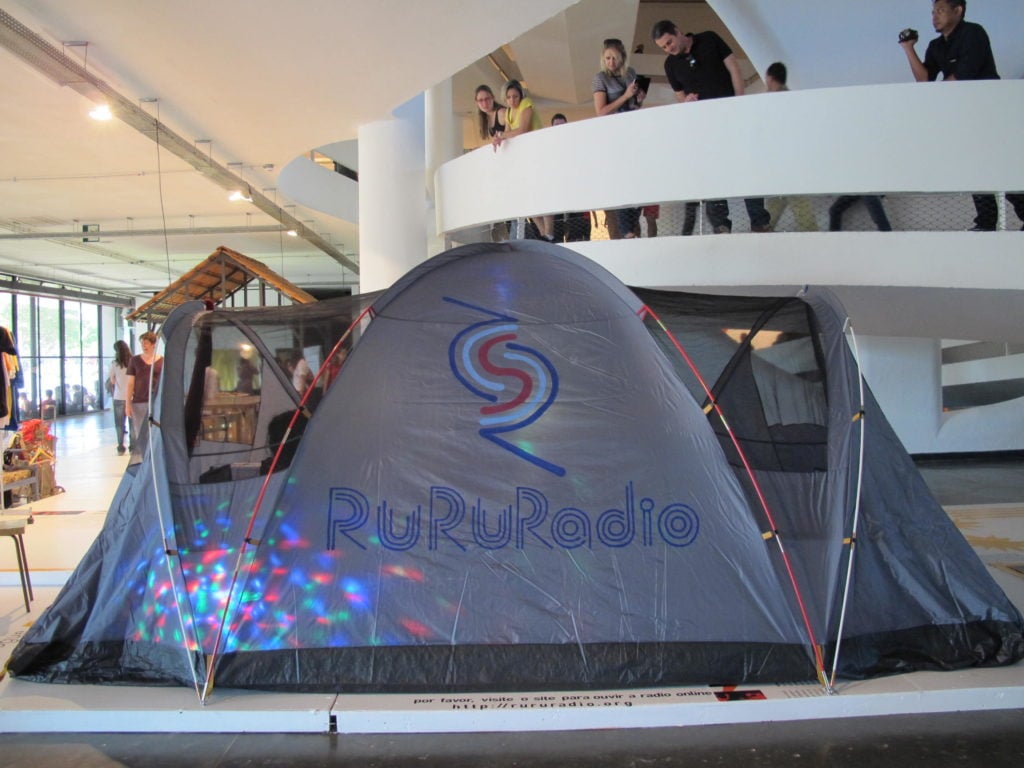
ruangrupa’s work at the São Paulo Art
Biennial in 2014. Photo: ruangrupa.
In the lead up to 2022, we had
been planning on holding assemblies every two months in different
places around the world beginning last year, but now we have had to
stretch that concept into a flatter understanding of time and
space. We have had to change our entire understanding of assembly.
Instead of these physical gatherings, like many people around the
world, we gather on Zoom, congregating three to five days a week
with around 15 or 20 of our collaborators for around four hours a
day including workshops in smaller groups.
Like a lot of art collectives in
Indonesia, it’s part of our practice to transform domestic spaces.
We rent houses and transfer from house to house after turning them
into a space that is more public. Consequently, we understand the
term “public” differently than public institutions. We just open up
spaces without calling them an “exhibition space” or “residency
space,” or boxing it in with such terms. Activities happen there.
It is not metaphoric; it is a space that we think can truly
function.
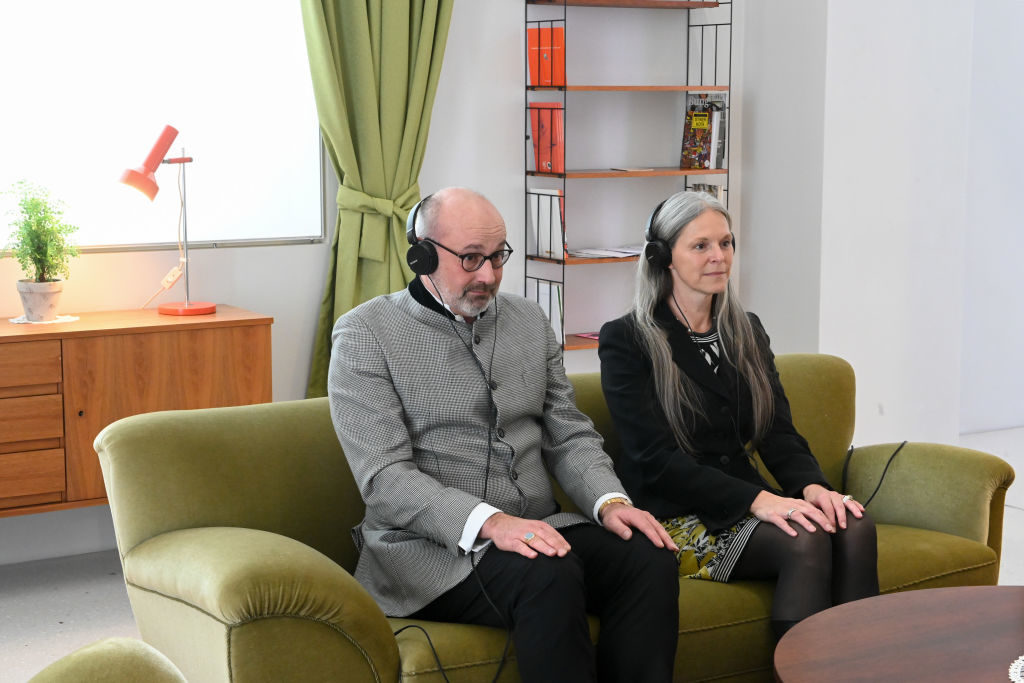
Martin Eberle, director of the
Museumslandschaft Hessen Kassel, and Sabine Schormann, director
general of the documenta, sit with headphones on furniture
exhibited by the new documenta director Ruangrupa in the permanent
exhibition “about: documenta” in the Neue Galerie. Photo: Uwe
Zucchi/picture alliance via Getty Images.
We are in the process of opening
that type of space in Kassel because, again, that is how we work,
in preparation of documenta 15 but also in general. Making a space
to ground ourselves in a local context is something we always
strive for, but one of our biggest challenges is now to adapt
gatherings, which is very embodied in our practice, to the present
situation. In any case, we are establishing ruruHaus in Kassel, a
house that will function like those we open in Indonesia. It is not
our intention to only innovate, but to support and co-exist with
what is already existing in Kassel. However, the pandemic will in
part determine when exactly ruruHaus as a real
space.
This current situation makes us
need to rethink our concept to some extent, but it is not a
deadlock and there are many ways to handle it. We are not afraid.
It is good to have to think about transforming processes, which
will include for us the production of spaces. Maybe we do not need
so many spaces right now. Maybe we can shift this power into a
better place. COVID-19 has changed a lot of our minds about
production as knowledge-sharing and, in this way, it opens up more
possibilities. What COVID-19
has made us realize is that we are all global. At the same time, it
shows just how important the local is.
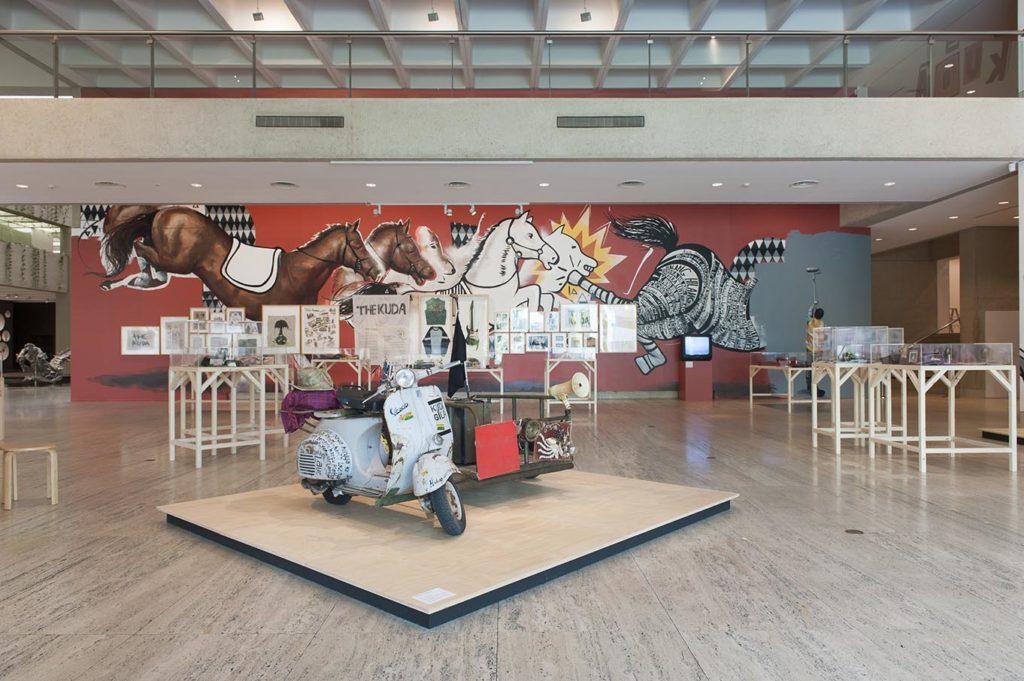
Installation view
of ruangrupa. The 7th Asia Pacific Triennial of Contemporary Art
(APT7). Photo courtesy ruangrupa.
We hope that as a result of this
crisis, the misunderstanding that there is only one way to approach
things will be gone. In the art world, we hope that there will be a
lot more openness to other practices. The shift towards knowledge-
or information-based practices and away from object-making is
something we have practiced, but it has never been so clearly
necessary to so many. For documenta fifteen, we will focus on art
practices that depend on accumulations of value in time, knowledge,
and dissemination. How can we invest in those types of practices?
What does investment mean? How can an exhibition be? How these
current shifts in working will meet these factors of
exhibition-making and become translated into documenta 15 is what
we are most concerned about now.
ruangrupa exists as living proof
that work in the arts field can be done. Looseness and informality
have always been a part of how we work. If you try to put our
members into an office environment, you
will quickly realize that it
is our kryptonite. We are not going to function. More and more
people join us in this mixing of the professional and domestic as
life and work now enters the home during lockdown, but this is
something we have long been interrogating in both its positive and
negative aspects. And while it is not all romantic, we are enjoying
the shift we are experiencing right now. Whether it is going to
address certain problems that the world is facing, that we really
do not know. Our way is not all that matters to us; the practice of
seeing different ways of thinking and creating is of equal
importance. We hope that we can learn from each other.
As told to Kate Brown
The post Ruangrupa, the Collective in Charge of the Next
Documenta, Reflect on What It Means to Curate in Times of
Crisis appeared first on artnet News.
Further reading


Leave a comment