
Your Brain May Not Be Able to Distinguish a Digital Reproduction of an Artwork From the Real Thing, a New Study Suggests
There may be little difference between the way our brains
perceive works of art in person versus through digital
reproductions, a new study from Cuseum, a Boston-based start-up that helps
museums improve visitor experience with technology, suggests.
Given that many of the country’s museums still remain on
lockdown, forcing art lovers to settle for JPGs and video tours
instead of the real thing, that may be a comforting thought. But is
there really no difference between the way our brain perceives an
image of a painting and the actual work itself?
The study is small—only nine subjects—but an analysis of the
electroencephalograms, or EEG tests, suggests “that the human brain
doesn’t differentiate between digitally reproduced artworks and
their originals,” Brendan Ciecko, Cuseum’s founder and CEO,
told Artnet News in an email.
Cuseum conducted the study, titled
“Neurological Perceptions of
Art through Augmented & Virtual Reality,” over the course
of ten months, and released their findings in May. Pawan
Sinha, a professor of vision and computational neuroscience at
Massachusetts Institute of Technology, was the study advisor.
Cuseum hopes the study’s findings might challenge long-held
assumptions about how we experience art—particularly Walter
Benjamin’s 1935 essay “The Work of Art in the Age of
Mechanical Reproduction,” and its assertion that “even the most
perfect reproduction of a work of art is lacking in one element:
its presence in time and space, its unique existence at the place
where it happens to be.”
Researchers conducted the tests at the Museum of Fine Art Boston in order to
best replicate a typical art-viewing experience. Participants
were outfitted with Muse2 headsets, which feature two EEG
electrodes. None of the subjects were art experts, or had close
family members with art backgrounds. They also had limited previous
exposure to augmented and virtual reality experiences.
Each participant was tested five times, under the same
conditions in the museum galleries. They encountered a real
painting, a 2-D image on an iPad of the same work, and the work in
augmented reality, seen through their smartphone and an Oculus
virtual reality headset. The paintings in the study all featured
thick brushstrokes, and were either abstract canvases or
Impressionist landscape or portrait paintings.
Cuseum, it should be noted, has a stake in the results. Its
business aims to create digital tools that help make art and
culture more accessible. It recently launched a new “Museum From
Home” feature on its apps, which will harness the power of
augmented reality to let users place museum masterpieces on their
own walls.
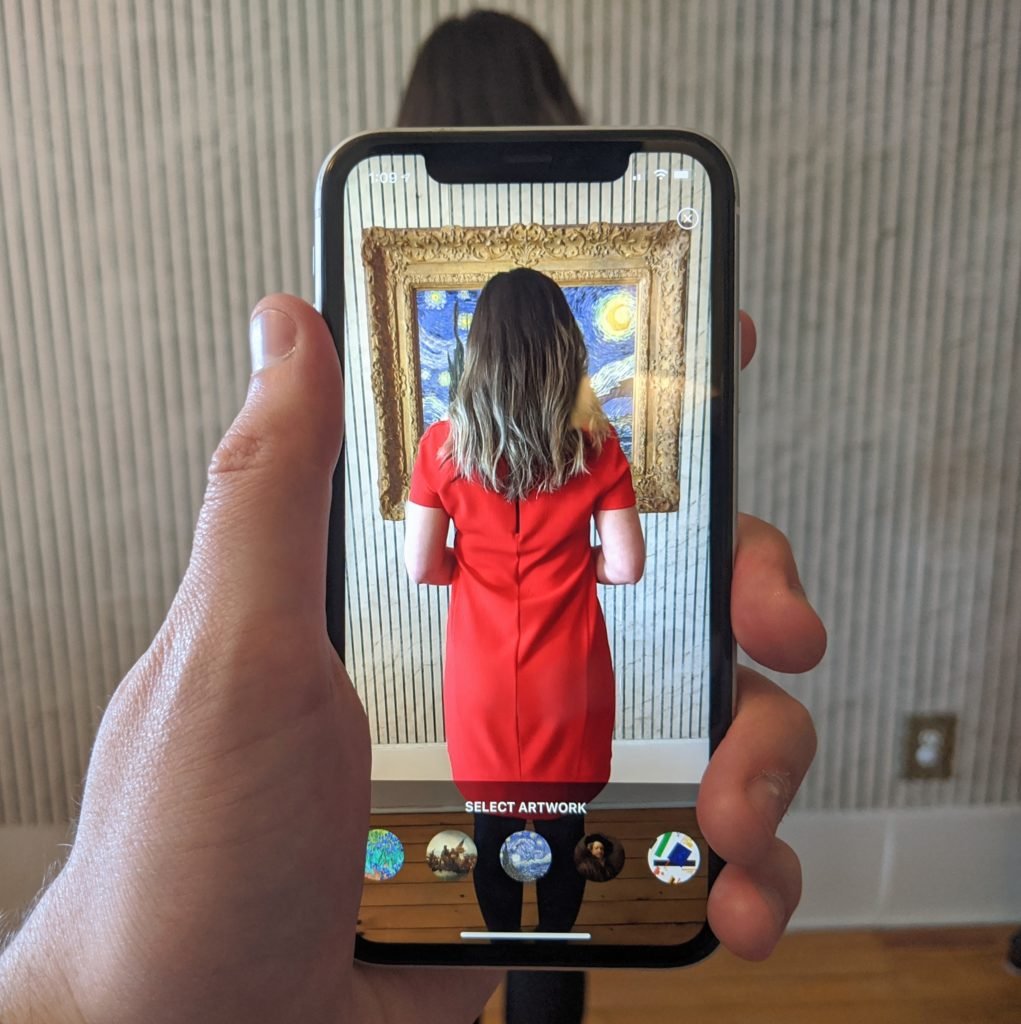
Cuseum’s new “Museum From Home” will
enable museums to let viewers place masterpieces like Vincent van
Gogh’s Starry Night on their walls at home. Photo courtesy
of Cuseum.
The study found that participants’ brain activity was even more
pronounced when they viewed the works in augmented and virtual
reality than in real, physical space.
The study compared brain activity in the alpha and gamma
bands, and found the differences in readings were not statistically
significant. That suggests that the aesthetic experience wasn’t
denigrated by being filtered through AR and VR, but was in fact
essentially just as immersive and neurologically
stimulating as encountering art in real life.
But even though the Muse2 headset found that the brain signals
triggered when viewing digital reproductions could not be
distinguished from those evoked by real art objects, that doesn’t
mean we can seamlessly replace trips to museums and galleries with
digital art.
“The results are interesting, but should be considered
preliminary,” Sinha told Artnet News in an email. It could be that
the Muse2 headset just might not be sensitive enough to detect the
difference between the brain signals in the different
conditions.
“Muse2 gives one a very limited glimpse into the richness of
brain activity,” Sinha said. “With just a handful of EEG sensors,
one cannot hope to capture nuances of the activity of tens of
billions of neurons in the brain.”
But even if the exact same neurons are physically firing in the
exact same way in both conditions, what does it really mean if our
brains can’t objectively tell the difference between the two?
That question, said Sinha, “is one that philosophers have
discussed and debated. For most neuroscientists, the answer, in
principle, is ‘no.’ If two conditions
evoke exactly the same neural activity right down
to all of the neurons (which also
incorporates effects of past experiences/memory), then our
experiences will be indistinguishable across them.”
The post Your Brain May Not Be Able to Distinguish a Digital
Reproduction of an Artwork From the Real Thing, a New Study
Suggests appeared first on artnet News.
Read more https://news.artnet.com/art-world/brain-digital-art-reproduction-study-1873623
Further reading


Leave a comment