
4 Key Elements That Are Very Different About the Newly Rebooted MoMA, Plus Where to Find Your Favorite Masterpieces Now
The Museum of Modern Art is back, and it’s bigger than ever.
MoMA, which was closed to visitors for months as builders and
architects executed a $400 million renovation and expansion, has
much to offer in its updated home, including a completely
reconceptualized installation of the museum’s famed permanent
collection, a third of which will be reconfigured every six
months. The museum will finally reopen to the public on
October 21.
In advance of that signal date, artnet News took an early tour
of the august institution to see what it had to offer. With
the fleeting nature of time battling the lasting power of great
art, here are our snap takeaways from our first visit to the
reimagined MoMA.
1. When It Comes to the
Rehang, “Radical” Is a Relative Term
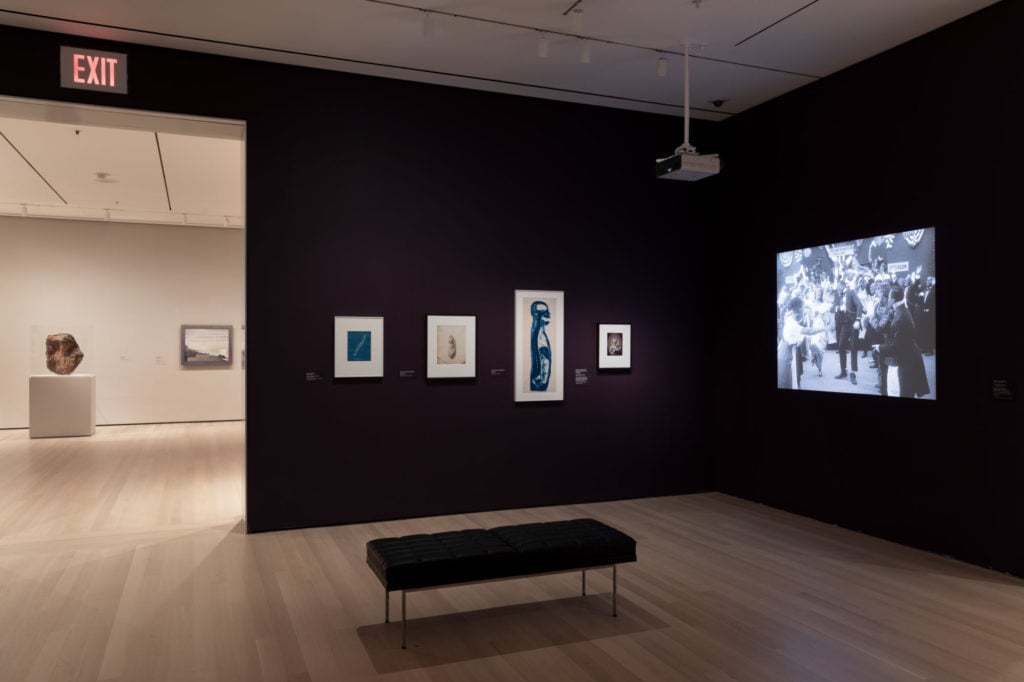
Installation view of the “19th Century
Innovators” and “Early Photography and Film” galleries at MoMA. ©
2019 The Museum of Modern Art. Photo: Jonathan Muzikar.
Much of the spotlight on MoMA’s next phase has (rightly) focused
on the curators’ efforts to break down the collection’s old
divisions. To that end, the museum has downplayed the narratives of
narrowly defined artistic movements (such as Cubism or Abstract
Expressionism) in favor of more inclusive themes (such as
“Responding to War” or “City as Stage”).
This shift allows for juxtapositions of works in different media
and from different periods, and includes liberal samplings of films
alongside works of early Modernism. For instance, there is a
position in the galleries from which viewers can see Lime
Kiln Club Field Day (1913), a rediscovered American
feature film starring an all-black cast, and—through the entryway
to the next room—Picasso’s Les Demoiselles
d’Avignon on the far wall.
But these curatorial mash-ups will probably feel dramatically
less jarring to the average visitor than to most anyone in the art
establishment. If you’re not already intimately familiar with the
canon—as much of MoMA’s tourist-heavy audience is not—you can’t be
scandalized by its disruption. And admirable as the rehang is from
a canon-reshaping perspective, it now feels like an ultra-refined
version of the media-saturated, era-independent free-for-all that
is everyday life in 2019.
In a sense, the reinstallation of MoMA adapts the template of
the social-media feed to the needs of art history. That game plan
may seem radical to art lifers, but it will likely seem like
business as usual to the uninitiated. And for the sake of art’s
traction in the broader culture, that’s a good thing.
—Tim Schneider
2. Regular Visitors Won’t
Have a Hard Time Finding Their Favorites
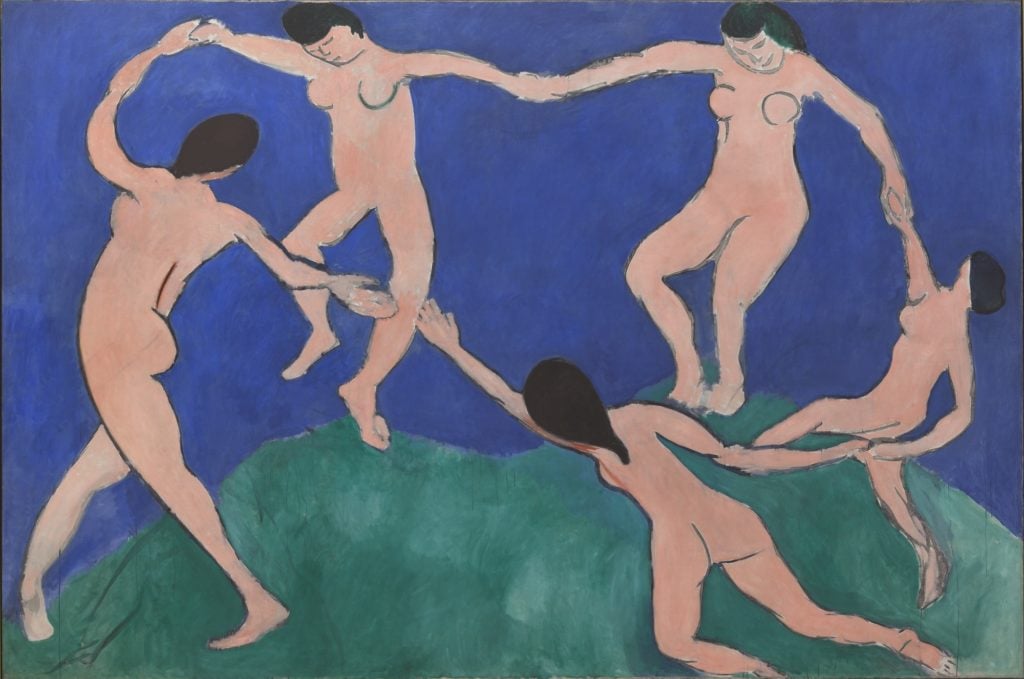
Henri Matisse, The Dance
(1910).
Oh no! You’re at the new MoMA and your favorite Matisse is not
where it used to be. What to do?
At least twice during an early preview of the new galleries,
MoMA’s chief curator of painting and sculpture, Ann Temkin, was
asked how lifelong New Yorkers and other MoMA denizens would know
where to find their favorite artworks.
Noting that such information is available freely on the museum’s
website, Temkin pointed out: “I’m not sure if everything that we’re
doing now could have been done prior to the digital era. Having
those resources as a counterpoint enables more flexibility.
Everybody has this wealth of information that you didn’t have 20
years ago.”
And for any art lovers who remain skeptical of the rehang,
Temkin had this piece of advice: “If you’re coming in and you know
you want Warhol, you’re pretty safe to go to the mid-century floor,
which has always been the fourth floor. Or if you want van Gogh,
come to the fifth floor, which has always been the early part of
the collection.”
—Eileen Kinsella
3. MoMA’s Old Formalist
Approach Has Been Cast Aside
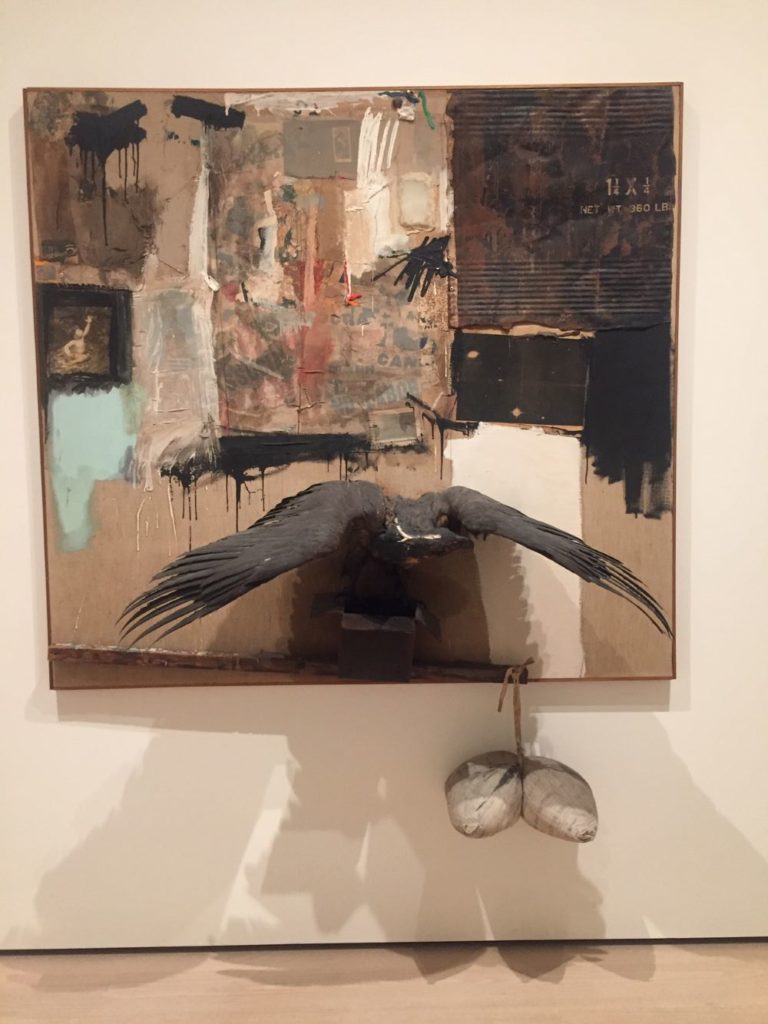
Robert Rauschenberg, Canyon
(1959). at MoMA. Photo by Eileen Kinsella
For long periods of its history, MoMA has told the story
of art qua art, presenting its permanent collection
as a lesson in the power of formalism. Social and political
concerns, which undoubtedly affect how artists work, have often
been left out of the story.
But the new MoMA doesn’t shy away from those issues. One key
work in the museum’s collection, Robert
Rauschenberg’s Canyon (1959), was made
after Hungarian-born American artist Sari Dienes
supplied Rauschenberg with the stuffed bald eagle that
famously adorns the artwork. Acquired by his legendary dealer,
Ileanna Sonnabend, Canyon made its way to
numerous international shows and retrospectives over the
years—that is, until 1981, when US Fish and Wildlife agents spotted
the bird carcass and notified Sonnabend that the object ran
afoul of the 1940 Bald and Golden Eagle Protection Act. In
order to retain possession, Sonnabend had to prove that the bird
was killed and stuffed prior to 1940.
Rauschenberg came to the rescue. In a notarized statement, he
recounted that in the 1950s, Dienes lifted the bird out of the
trash after it had been thrown out following the death of a
neighbor, who happened to have served in the US Calvary alongside
Teddy Roosevelt. Satisfied with the explanation, the US government
let Sonnabend keep the work, but under the strict condition that it
could not be resold.
The story offers a succinct illustration of a fact we know to be
true today: that are and politics are never far from one
another.
—Eileen Kinsella
4. Sadly, You Get What You
Pay for (Or Don’t Pay For)
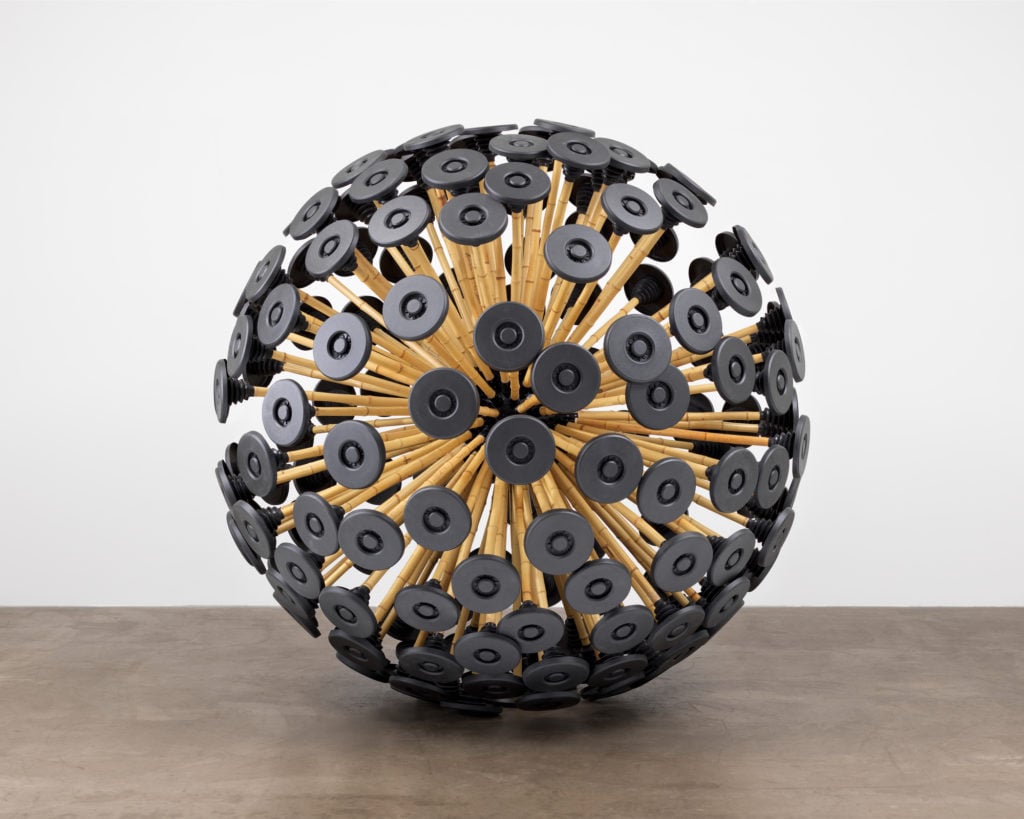
Massoud Hassani, Mine Kafon
wind-powered deminer (2011). Photo courtesy of the Museum of
Modern Art, New York, gift of the Contemporary Arts Council of the
Museum of Modern Art.
One of the new MoMA’s chief selling points is its first-floor
galleries, which will be free and open to members of the public not
willing to shell out $25 for general admission.
In the north gallery, a show of works by Michael Armitage
(through January 20, 2020) presents eight colorful paintings
on lubugo, an alternate kind of canvas made
from East African fig-tree bark. The show is presented in
conjunction with the Studio Museum in Harlem (currently closed for
an expansion of its own), and offers a wonderful showcase of the
new direction MoMA has taken to elevate non-Western art, which has
historically not been its focus.
Less immediately impactful is a design show titled “Energy”
(through January 26, 2020). The centerpiece is Massoud
Hassani’s Mine Kafon wind-powered deminer (2011), an
ingenious device designed to detonate hidden land minds (it looks
at first glance like a giant ball of plungers). It’s a brilliant
piece of humanitarianism, but let’s be honest: this is not why most
people come to MoMA.
So why not throw the public a bone and toss a Picasso into those
free galleries? Maybe the museum doesn’t want to give away Vincent
van Gogh’s Starry Night for free, but it would
be nice if they offered something especially representative of the
museum’s holdings.
—Sarah Cascone
5. What’s Old Is New,
What’s New Is Old

Florine Stettheimer, Family Portrait
II, 1933. Gift of Miss Ettie Stettheimer. Photo by Nate
Freeman.
There’s no doubt about it: a room devoted to Florine Stettheimer
in all her splendor would be a highlight of any modern art museum,
even the country’s grandest. What a pleasure, then, that MoMA
decided to bring out a few of the Jazz Age saloniste’s greatest
hits, including the painting Stettheimer referred to as her
masterpiece. That would be Family Portrait II (1933), a
glowing Manhattan scene of the artist and her sisters in a sky-high
canopy amid the era’s great metropolis, with its Art Deco
monuments—the Chrysler Building, the skyscraper at Rockefeller
Center, Radio City Music Hall—assembled behind in a Surrealistic
blur.
And the museum upped the ante, complimenting Stettheimer’s
genius with top-notch works by like-minded contemporaries and
spiritual descendants. Alongside her painting are Frances Stark’s
Chorus Line (2008), with three dancers echoing the ballet
sketches of Stettheimer, and Jutta Koether’s Bitches Brew
(2010), acquired for the museum through the Pat Hearn and Colin de
Land Acquisition Fund
As for work from Stettheimer’s time, MoMA chose Fresh
Window (1920), an installation by Rrose Sélavy, the female
alter ego of Marcel Duchamp. Both of them—artist and fictional
counterpart—were painted by Stettheimer for a 1923 stunner of a
portrait. The room is a gem, a highlight even in this redesigned
and expanded temple of the new.
—Nate Freeman
The post 4 Key Elements That Are Very Different About the
Newly Rebooted MoMA, Plus Where to Find Your Favorite Masterpieces
Now appeared first on artnet News.
Read more https://news.artnet.com/exhibitions/moma-expansion-takeaways-1675810
Further reading


Leave a comment